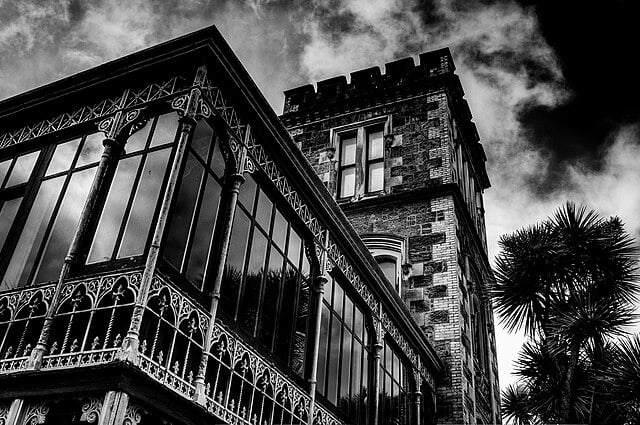
Larnach Castle: Key Points
-
Larnach Castle, built in the 1870s on New Zealand’s Otago Peninsula, is the country’s only castle and is renowned for reported paranormal activity.
-
The castle’s tragic history includes the death of William Larnach’s first wife, family scandals, financial ruin, and William’s suicide in Parliament in 1898.
-
Visitors and staff report apparitions of Eliza Larnach, unexplained sounds, cold spots, moving objects, and sightings of William’s ghost.
-
Skeptics attribute reports to psychological factors like suggestion, environmental conditions like old building sounds, and the brain perceiving patterns in random stimuli.
-
Theories range from residual hauntings caused by intense emotions to environmental factors like electromagnetic fields inducing feelings of unease.
-
Whether the phenomena represent actual paranormal activity or psychological factors remains a matter of ongoing debate and personal belief.

Introduction
Larnach Castle, which is located on the Otago Peninsula near Dunedin, New Zealand, is the only castle in the country. It has long been the subject of ghost stories and other strange events. William Larnach, a rich banker and politician, built this Gothic Revival mansion in the 1870s. It is now known for its lovely architecture, sad history, and odd events. The castle’s dark past, which includes financial ruin, suicide, and family tragedy, has made it a popular place for ghost stories that still fascinate visitors and researchers.
Description
It took more than ten years and well over two hundred skilled craftsmen from all over the world to build the castle itself. William Larnach spent a lot of money building this grand home for his first wife, Eliza. He brought in materials like marble from Italy, slate from Wales, and glass from Venice. The building has forty-three rooms on different floors, and the carvings, stained glass windows, and ornate plasterwork show how wealthy and ambitious the first owner was. Large gardens, meticulously planned and planted, surround the castle. They offer stunning views of the harbor and peninsula beyond (Petchey, 2018). Even though the castle was very grand, it would be the scene of several personal tragedies that many people think had a lasting impact on the property.
The building of Larnach Castle took place at a time when European settlers were trying harder to make their mark and establish their identity in New Zealand. This was after the Treaty of Waitangi made many changes in 1840. This agreement was a key moment in New Zealand’s history because it made it easier for Europeans to settle there by clearly defining the relationship between Māori and British settlers (King et al., 2020). Larnach was a key political figure in early colonial New Zealand, where politics were very unstable. He had to navigate the complicated relationships with Māori communities and other colonial actors. As settlers tried to make their culture known, buildings like Larnach Castle became symbols of both personal ambition and larger colonial stories (Lester & Dussart, 2008).
The history of Larnach Castle is full of sadness and unfortunate luck that started when William Larnach was alive and seemed to follow the property for generations. Eliza Larnach died in 1880, and William got married two more times. His third wife was said to have had an affair with his oldest son, which caused a family scandal that broke his heart. Larnach’s business failures made his financial problems worse, and in 1898, he killed himself in a committee room at Parliament in Wellington, leaving behind a lot of debt. The castle changed hands many times and fell into disrepair. It was a mental asylum and a religious retreat at different times before the Barker family bought it and started fixing it up in 1967. A personal tragedy, financial ruin, and the building’s later use as an asylum have all contributed to the reported hauntings, according to paranormal enthusiasts.
Haunted Castle
Over the years, many people who have been to Larnach Castle have reported strange things happening there. There are records of sightings and encounters from different parts of the property. Visitors say they have seen Eliza Larnach, William’s first wife, wandering through the castle’s hallways and rooms, especially in the areas that used to be her private chambers. This is the most common apparition reported. Guests have reported experiencing sudden cold spots, unexplained touches, and the rustling of period clothing when no one else was present. People have said that the ballroom is another busy place, where they can hear music and laughter echoing through the space, as if a big party from the Victorian era is still going on. Staff members have reported experiencing uncontrollable movements, unexpected door openings and closings, and a sense of being watched while working alone in certain areas of the castle (Gilberd & Davy, 2011).
Other things that have been reported include seeing a man who is thought to be William Larnach himself. He is often described as looking sad and walking through the castle as if he is looking for something he lost. People who have seen this figure near the tower room and in the hallways late at night say that it disappears when they get close. Some who were there said they heard kids laughing and running on the upper floors, even though no kids were there. The old servants’ quarters in the castle have been especially busy, with reports of shadowy figures moving in the corners of people’s eyes and the sounds of everyday life, like dishes clattering and footsteps on the stairs. People who like to take pictures of the castle have sometimes seen what they call orbs, mists, and shadows that can’t be explained in their pictures, especially in areas that are linked to the family’s private rooms and the tower.

Theories
People who don’t believe in the paranormal activity at Larnach Castle present other reasons for the reported events that are based on psychological and environmental factors instead of supernatural ones. A lot of the time, people who visit the castle already know its sad history and may be ready to see normal things as paranormal. The castle’s age causes creaky floors, drafty hallways, and settling foundations, which can sound and feel like ghosts. Some people see faces or figures in shadows, reflections, or architectural details because of pareidolia, which is the brain’s tendency to see familiar patterns in random stimuli. Knowing the sad history of the Larnach family can make people more anxious and more likely to misinterpret sensory information. Critics also say that many reports are based on personal experiences and don’t have the controlled conditions needed for scientific verification, so they can’t be trusted as proof of real paranormal activity.
There are many theories about why paranormal reports keep coming in at Larnach Castle. These range from psychological to pseudoscientific ones. Some paranormal researchers think that the strong feelings connected to the tragedies that happened there, like William Larnach’s suicide and the family scandals, may have caused what they call residual hauntings or psychic imprints that play back like recordings. Some people think that the castle’s stone walls and its location on a peninsula surrounded by water might somehow make electromagnetic fields stronger or keep them around longer, which people who are sensitive to them might be able to feel. Environmental psychologists have noticed that the combination of low-frequency sounds, electromagnetic fields from old wiring, and poor air circulation in some parts of the castle can make sensitive visitors feel uncomfortable and even see things that aren’t there. Cultural factors are also important. The Victorian Gothic style of the castle fits perfectly with what people expect a haunted place to look and feel like, which may strengthen beliefs in paranormal activity through a cycle of expectation and experience.
The role of housekeepers at Larnach Castle shows how class and social status worked at the time, and it has also affected the stories about ghosts. Recent historical research has shown that many house museums, like Larnach Castle, tend to romanticize the lives of domestic workers, leaving out the often harsh realities and working conditions they had to confront. As Trapeznik (2022) points out, these places make people feel nostalgic and proud of their country, but they also require people to think critically about the stories that surround the lives of the people who ran such large estates. Learning about the roles and treatment of domestic workers provides us a better idea of what life was like in 19th-century New Zealand.
Impact
Since it was restored in the late 1960s, Larnach Castle has had a big effect on the culture and economy of the Otago region and New Zealand as a whole. The castle is now one of Dunedin’s top tourist attractions. Every year, thousands of people from all over the world come to see its unique mix of history, architecture, and paranormal interest. This steady flow of tourists has brought a lot of money into the local economy through hotel bookings, restaurant visits, and other spending that helps businesses and jobs in the area.
The castle has an impact on more than just tourism; it also affects New Zealand’s cultural identity and efforts to preserve its heritage. Larnach is the only castle in New Zealand, so it has a special place in the minds of Kiwis. It is also a physical link to the country’s colonial past and Victorian-era architecture. The Barker family’s extensive restoration work has set a standard for historic preservation in New Zealand. It shows how private ownership can keep and show off heritage buildings. The castle also serves as a place to learn about life in the 1800s, social hierarchies, craftsmanship, and the darker sides of colonial wealth and personal tragedy (Randell-Moon, 2020).
The spooky reputation of Larnach Castle has sparked more conversations about supernatural events in New Zealand and helped the country’s growing ghost tourism industry. The castle has been on TV shows, documentaries, and paranormal investigation teams from all over the world. This attention has made New Zealand a place for those interested in the unexplained. The castle offers special ghost tours and paranormal investigation nights that combine history, entertainment, and the supernatural in ways that appeal to a wide range of people. These events have led to similar ones at other historic sites in New Zealand, showing that the castle is a leader in experiential tourism.
Larnach Castle is a key part of New Zealand’s colonial history, preserved for people to learn about it and its ghost stories. Today, it is not only a place for tourists to visit but also a place to contemplate New Zealand’s colonial past and what it means for identity and memory. As a heritage site, the castle makes it easier to talk about the effects of colonialism and the stories that have shaped New Zealand’s political and social landscape (Kennedy et al., 2022). Visiting historical places like Larnach Castle can help us understand how different groups lived during the colonial period. For example, the voices and histories of indigenous Māori people have often been lost in the stories of colonial elites (Bickler & Best, 2024).
Conclusion
Even nonbelievers in the supernatural find Larnach Castle one of New Zealand’s most fascinating historical sites. The combination of real historical tragedy, beautiful buildings, and decades of reports of supernatural events has made it a haunted place in the minds of the public. People still argue about whether the strange things that happen at the castle are real paranormal activity or just the result of psychology, the environment, and the power of suggestion. There’s no doubt that Larnach Castle’s story, which includes both its real history and its ghostly legends, still fascinates visitors and serves as a powerful reminder of how tragedy and mystery can mix in the places we live.
References
Gilberd, J., & Davy, J. (2011). Spooked: exploring the paranormal in New Zealand. Penguin Random House New Zealand Limited.
King, C. L., Buckley, H. R., Petchey, P., Kinaston, R., Millard, A. R., Zech, J., … & Gröcke, D. R. (2020). A multi‐isotope, multi‐tissue study of colonial origins and diet in new zealand. American Journal of Physical Anthropology, 172(4), 605-620. https://doi.org/10.1002/ajpa.24077
Lester, A. and Dussart, F. (2008). Trajectories of protection: protectorates of aborigines in early 19th century australia and aotearoa new zealand. New Zealand Geographer, 64(3), 205-220. https://doi.org/10.1111/j.1745-7939.2008.00146.x
Petchey, P. G. (2018). Larnach’s Farmstead, Otago Peninsula, Dunedin. Archaeological Report on Woolshed Building.’Southern Archaeology Ltd., for Hereweka Harbour Cone Trust.
Randell-Moon, H. (2020). Coloniality, tourism and city-branding as an apparatus of forgetting in Dunedin, Aotearoa New Zealand. In Colonialism, Tourism and Place (pp. 163-179). Edward Elgar Publishing.
Trapeznik, A. (2022). Dismissing the staff: domestic servants and a historic house in dunedin, new zealand. The Journal of New Zealand Studies, (NS34). https://doi.org/10.26686/jnzs.ins34.7668
Leave a Reply