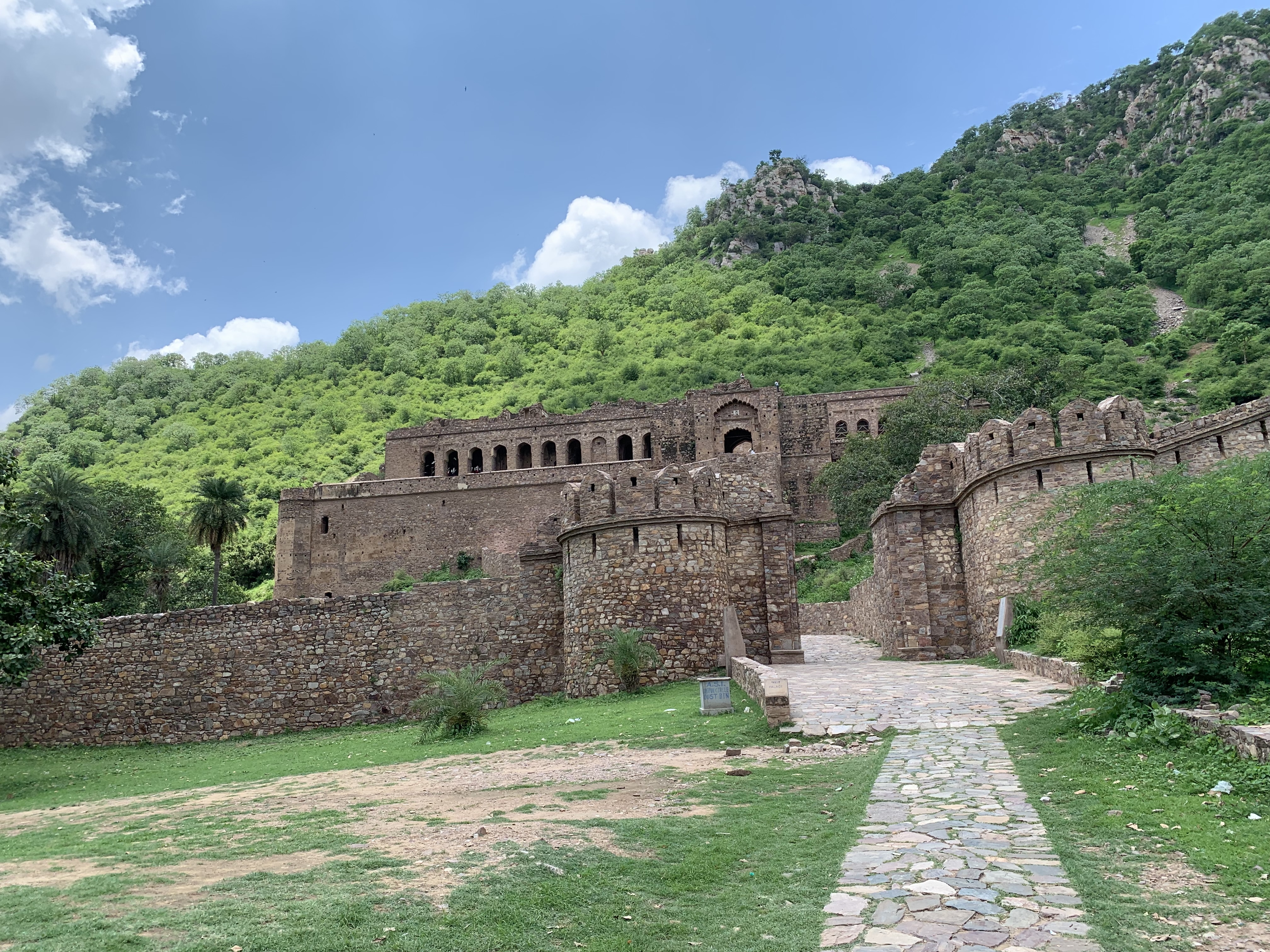
The Archaeological Survey of India officially acknowledges the Bhangarh Fort in Rajasthan, India, as India’s most haunted spot, making it one of the most infamous purported haunted sites in Asia. Local authorities have put up conspicuous warning signs cautioning people against entering the property after dark because of the strong beliefs surrounding its supernatural events, which forbid admission between sunset and daybreak.

History and Tales
During Bhagwant Das’s reign in the 17th century, he built Bhangarh Fort for his younger son Madho Singh in Rajasthan’s Alwar district. The fort is a wonder of design, with several gates, elaborately carved temples, and opulent structures all constructed in the dominant Nagara architectural style. The once-thriving township stretched across a valley encircled by the Aravalli Range, including bazaars, temples, and residential areas (Srivastava, 2024).
Historical documents reveal the abrupt abandonment of the fort and the surrounding community in 1783, for reasons still unknown. This enigmatic exodus has inspired numerous myths and supernatural stories. The most well-known of these is the curse of Guru Balu Nath, a revered figure who reportedly approved the fort’s construction on the condition that no building’s shadow should fall on his retreat. He cursed the fort when this requirement was broken, which ultimately caused it to collapse and be abandoned.
An evil magician who fell in love with Princess Ratnavati, the stunning princess of the fort, is the subject of another well-known fable. The story goes that the sorcerer tried to make the princess fall in love with him by using a cosmetic item to cast a spell. But when Ratnavati figured out his scheme, he tossed away the charmed object, which transformed into a boulder and smashed the magician. Before his death, he cursed the fort and its occupants, leading to its destruction and the deaths of all its inhabitants, including the princess (Stern, 2011).
Both residents and visitors have reported numerous ghostly events at Bhangarh Fort. People report hearing strange noises, such as dancing and music, emanating from the ruins at night. Others say they have sensed unseen presences or felt strange touches, while others say they have heard cries and screams. Paranormal investigators have recorded unusual temperature variations and electromagnetic readings on the fort grounds. The locals adamantly oppose the construction of roofed homes in the area because they think that any building with a roof will inexplicably collapse (Sinha, 2014).

Theories
From supernatural beliefs to scientific reasons, a number of theories try to explain the claimed paranormal activities at Bhangarh Fort. The two well-known curses are the main focus of supernatural ideas. The dying curse of the tantric practitioner, according to adherents of mystical traditions, generated a vortex of negative energy that imprisoned spirits inside the fort’s walls. According to some paranormal researchers, the fort’s terrible deaths left emotional energy imprints that resulted in lingering hauntings. According to local spiritual leaders, supernatural beings are still expressing their ire because the fort’s building violated sacred rituals.
Others propose that djinns, mythical creatures from Islamic mythology, inhabit the fort. This hypothesis gained popularity due to the fort’s location in a historically influenced area by Islamic mysticism. According to certain believers, the region’s ancient tantric rituals established enduring portals between the spirit realm and our planet.
Scientific explanations provide more realistic views. Geologists speculate that minute earth movements may cause the strange sounds and vibrations tourists have noticed, given the fort’s location in a seismic zone. The region’s distinct geography and wind patterns may produce acoustic anomalies, which would account for the enigmatic voices and music that many report hearing (Kaur, G., et al, 2021).
According to environmental scientists, visitors may experience “cold spots” and unexpected breezes because of the fort’s stone masonry and the surrounding terrain, which can produce considerable temperature and air pressure differences. The high mineral richness of the nearby rocks may have an impact on electromagnetic fields, which could account for visitor experiences and equipment failures.
The renown of the fort, according to psychologists, produces a strong anticipation effect that leads tourists to see natural phenomena as supernatural. People may sense anxiety due to the fort’s imposing architecture and remote location, which could result in enhanced sensory experiences they mistake for paranormal activity.
Impact
The fort’s reputation as a haunted place has impacted local businesses in diverse ways. Due to the substantial increase in tourism, neighboring towns now have more modest hotels, gift stores, and guided tour companies. Local sellers hawk religious objects, protective amulets, and goods associated with the fort’s mystical reputation. To accommodate travelers, a number of eateries and tea shops have arisen (Gupta, 2011).
However, the ban on visits at night restricts possible business hours, and some entrepreneurs say they have trouble keeping employees because of paranormal anxieties. Since many businesses choose to operate from a “safe” distance, property values in the nearby area are still relatively low. Since several hotel chains and travel agencies steer clear of associations with purportedly haunted sites, the fort’s notoriety has also discouraged any conventional tourism initiatives.
Many books, films, and television programs have drawn inspiration from the fort’s notoriety. Due to its enigmatic background, it has gained popularity as a paranormal tourism site, attracting tourists from all over the world. Multiple Bollywood horror films have drawn inspiration from this location, and a number of spooky investigative shows have highlighted it. The fort is nevertheless a significant historical landmark that exemplifies the architectural genius of medieval Rajasthan, despite its unsettling reputation.
Conclusion
Bhangarh Fort is a singular fusion of mystical legend and historical relevance. The fort’s enigmatic abandonment and the enduring ghostly traditions throughout centuries have solidified its place in India’s cultural consciousness, despite the skeptics’ rejection of the paranormal claims. The fort is a monument to India’s rich historical legacy and the timeless influence of folklore in forming cultural narratives, regardless of one’s belief in the paranormal. Its enduring capacity to enthrall tourists and arouse their imagination shows how historic buildings may unite historical truth with ethereal mystery to leave a lasting legacy.
References
Gupta, D. R. (2011). Paper 11: Special Interest Tourism Module 25: Dark Tourism (Doctoral dissertation, Panjab University, Chandigarh).
Kaur, G., et al (2021). The Alwar quartzite built architectural heritage of North India: A case for global heritage stone resource designation. Geoheritage, 13, 1-17.
Sinha, C. (2014). Haunted India. Chandan Kumar Sinha.
Srivastava, N. (2024). Uncovering Psychological Shadows: Delving Into the Soul of Dark Tourism in India Through Narrative Inquiry. In Dark Tourism: Theory, Interpretation and Attraction (pp. 311-333). Emerald Publishing Limited.
Stern, S. L. (2011). Cursed Grounds. Bearport Publishing.


Leave a Reply