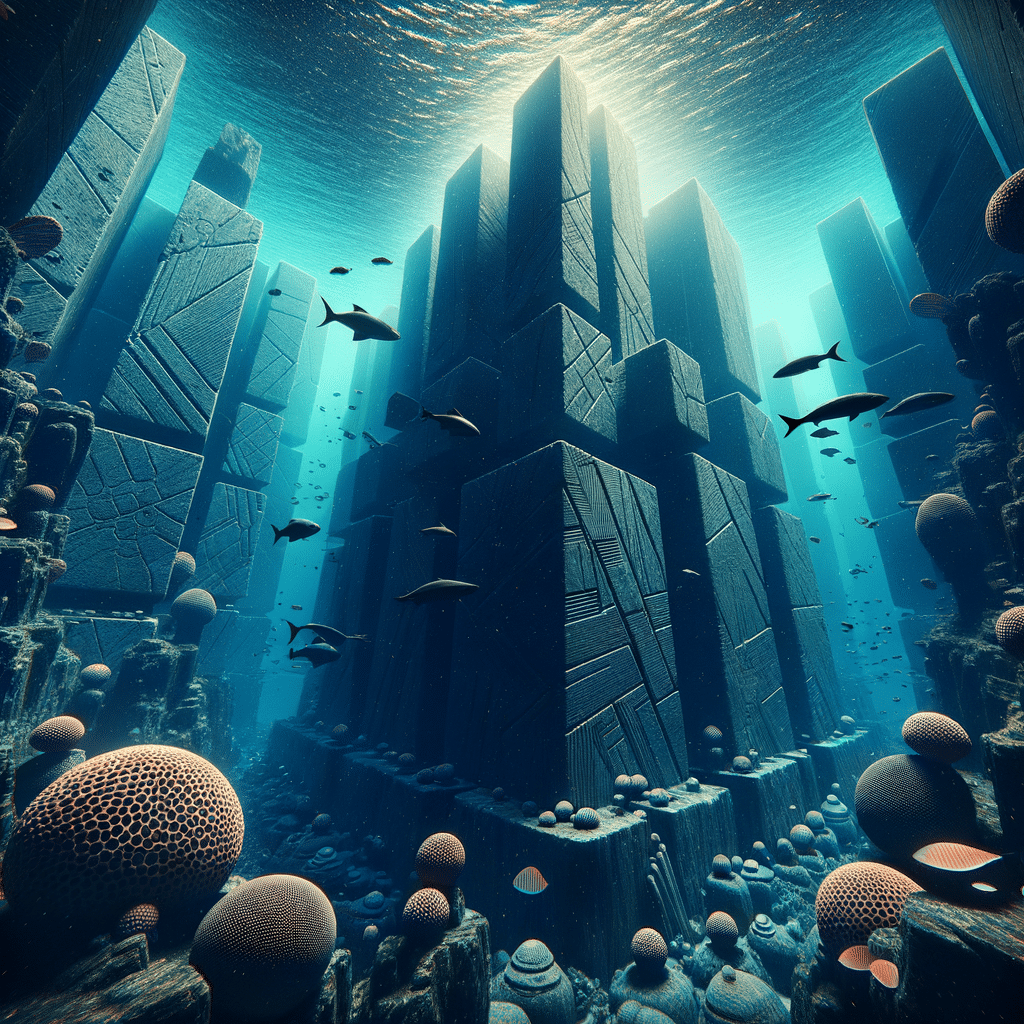
The Yonaguni Monument, a large, submerged rock formation off the shore of Yonaguni Island in Japan, has captivated scholars and paranormal enthusiasts since its discovery in 1987. Although geologists typically view it as a natural creation, a number of different theories—from lost civilizations to extraterrestrial involvement—have been proposed to try and explain its origins. Paranormal or not, it is a real historical mystery.
Huge stone constructions, 5–25 meters below the ocean’s surface, make up the monument. The most noticeable aspect of it is a rectangular platform that is about 150 meters long and 40 meters broad. It has sharp corners, straight edges, and what look like steps, terraces, and columns. In addition, the formation consists of drainage ditches, walls, roads, and pyramid-like structures.
While looking for new dive sites, local diving teacher Kihachiro Aratake first came across the memorial. Researchers have since taken a keen interest in the creation, chief among them Professor Masaaki Kimura of the University of the Ryukyus, who has been doing in-depth research on the location since 1992. Kimura asserts that humans constructed the monument approximately 10,000 years ago, during a period when the region was above sea level due to lower water levels during the previous ice age (Kokubu & Kaneko, 1962).

Paranormal Theories
The Yonaguni Monument is associated with Atlantis by certain theorists, who speculate that it may be a relic of the mythical lost civilization that Plato describes. These hypotheses suggest that the expansion of Atlantean society throughout the Pacific left behind megalithic constructions like Yonaguni. Supporters cite the monument’s present underwater location and apparent architectural elements as proof of this relationship (Joseph, 2008).
Some paranormal researchers link the monument to Lemuria, a fictional lost continent in the Pacific Ocean. These ideas suggest that the advanced Lemurian civilization constructed the Yonaguni Monument prior to the submersion of their land by the sea. Proponents of this theory frequently compare the monument’s purported architectural style to other historic Pacific buildings.
Atlantis theorists frequently cite similarities between the Yonaguni Monument and other submerged structures throughout the world as evidence that they are part of a global network of Atlantean outposts. They argue that Plato’s depiction of a civilization near the Mediterranean does not accurately represent Atlantis, but rather a sophisticated maritime culture with colonies across the Pacific. The geometric accuracy of Yonaguni’s characteristics, according to some supporters, is consistent with architectural concepts purportedly employed in other purported Atlantean sites in Bimini, Malta, and off the coast of India. These theories frequently cite the monument’s current underwater location as evidence of the same catastrophic flooding that destroyed Atlantis some 11,600 years ago (Chouinard, 2012).
The writings of Helena Blavatsky and James Churchward, as well as occult traditions from the late 19th century, are major sources of the Lemurian connection. Lemuria theorists assert that a sophisticated Pacific society, based on a now-sunken peninsula between Asia and North America, constructed the monument. Generally speaking, they refer to Lemuria as the “motherland of Asian civilizations” and assert that the Yonaguni Monument is among their most important architectural remnants. Some supporters assert that the monument’s design resembles that of ancient Tamil architecture, which they say retains aspects of Lemurian construction methods (Joseph, 2006).
The monument’s orientation and purported astronomical alignments have drawn special attention. According to some scholars, its characteristics match important astronomical occurrences, indicating that it functioned as an observatory for astronomy for priests from both Atlantea and Lemuria. These ideas often incorporate aspects of sacred geometry, suggesting that the monument’s measurements reflect the sophisticated mathematical knowledge of these extinct civilizations.
These hypotheses do, however, encounter many obstacles. The location has never yielded the discovery of tools, inscriptions, ceramics, and technological remnants, all hallmarks of a highly developed civilization. Both Atlantis and Lemuria’s suggested dates run counter to what we currently know about the evolution of human technology and geological history. Scientists dropped the entire Lemuria theory, which started as a scientific notion to explain animal distribution patterns in the nineteenth century, when plate tectonics offered more compelling explanations. Likewise, the majority of academics consider Plato’s Atlantis to be a philosophical metaphor rather than a historical reality.
Furthermore, natural rock formations all around the world contain the purported architectural elements that connect Yonaguni to these lost lands. Pareidolia, the human propensity to perceive patterns and give meaning to natural formations, probably contributes significantly to the interpretation of the site’s features. Although these hypotheses offer intriguing alternate explanations of the monument, they are based less on geological concepts and archeological evidence and more on conjecture and pattern-matching.
Theories of extraterrestrial interference suggest that either ancient aliens directly constructed the monument or ancient humans used highly developed technology. Some theorists cite the accuracy of the seemingly geometric shapes and the challenge of building underwater as proof of extraterrestrial activity. Others propose that aliens used the monument as an underwater base.

Natural Explanations
The Yonaguni Monument is a natural feature, according to the majority of geologists and archaeologists. They clarify that the sedimentary makeup and tectonic activity of the area cause the sandstone to spontaneously fracture at right angles and in straight lines. Natural forces have patterned rock geometrically in other parts of the world, creating similar formations. Skeptics assert that they have never discovered any tools, artifacts, or other archaeological proof of human construction at the site.
The Yonaguni Monument’s geometric patterns and straight lines are the result of several geological processes cooperating. The main mechanism lies in the joint structures of the sandstone formation. The elevation and cooling of the granite mass releases a force that causes these joints, which are naturally occurring fissures, to form perpendicular to one another. These joint sets’ orthogonal (right-angled) structure naturally produces designs that may seem square or rectangular (Toki, et al 2022).
Horizontal sheets of material deposited over time make up the sedimentary rock. Geologists refer to these layers as bedding planes, which are naturally occurring planes of weakness in the rock, mirroring the original depositional surface. These bedding planes, which frequently show up as “steps” or “terraces” in the rock formation, can produce surfaces that seem flat and artificial when exposed by erosion or other processes.
Diaclases, or systematic cracks that occur without any displacement of the rock on either side, are another important component. Because of the local stress patterns, these diaclases usually occur at 90-degree angles near Yonaguni. This improves the formation’s geometric look by producing an additional set of straight lines that intersect with the bedding planes and joint systems.
Wave erosion significantly shapes these landforms. Waves preferentially erode along the pre-existing weaknesses formed by joints, bedding planes, and diaclases as they constantly strike the rock. In fact, by producing sharper edges and more distinct shapes along these inherent regions of weakness, this selective erosion improves the formation’s geometric look.
Mechanical weathering, especially sheeting, further influences the formation’s peculiar look. Rock layers peel off parallel to the surface, a process known as sheeting, producing flat surfaces and sharp edges. The geometric patterns in the granite are further highlighted by this procedure, which works especially well along the current joint systems. Together, these processes over thousands of years can produce formations that, in spite of their natural origins, seem surprisingly manufactured.
Conclusion
The Yonaguni Monument continues to be an intriguing topic of research and conjecture regardless of its actual origins. Although paranormal beliefs about its creation provide amusing alternatives to traditional answers, they often rely more on conjecture than on factual data. The monument is a reminder that people often look for remarkable explanations for strange occurrences and that nature can produce things that seem manmade. The Yonaguni Monument serves as a reminder of the continuous discussion between alternative theories and scientific inquiry in our pursuit of understanding amazing natural phenomena.
References
Chouinard, P. (2012). Forgotten Worlds: From Atlantis to the X-woman of Siberia and the Hobbits of Flores. Simon and Schuster.
Joseph, F. (2006). The lost civilization of Lemuria: the rise and fall of the world’s oldest culture. Simon and Schuster.
Joseph, F. (2008). Atlantis and Other Lost Worlds. Arcturus Publishing.
Kokubu, N., & Kaneko, E. (1962). Ryukyu Survey 1960.
Toki, T., Kataoka, H., Takada, R., Nakaya, S., Oshima, S., & Ijiri, A. (2022). Spring discharge mechanism along the southeast coast of Yonaguni Island in the southern Ryukyu forearc. Journal of Hydrology: Regional Studies, 40, 101051.



Leave a Reply