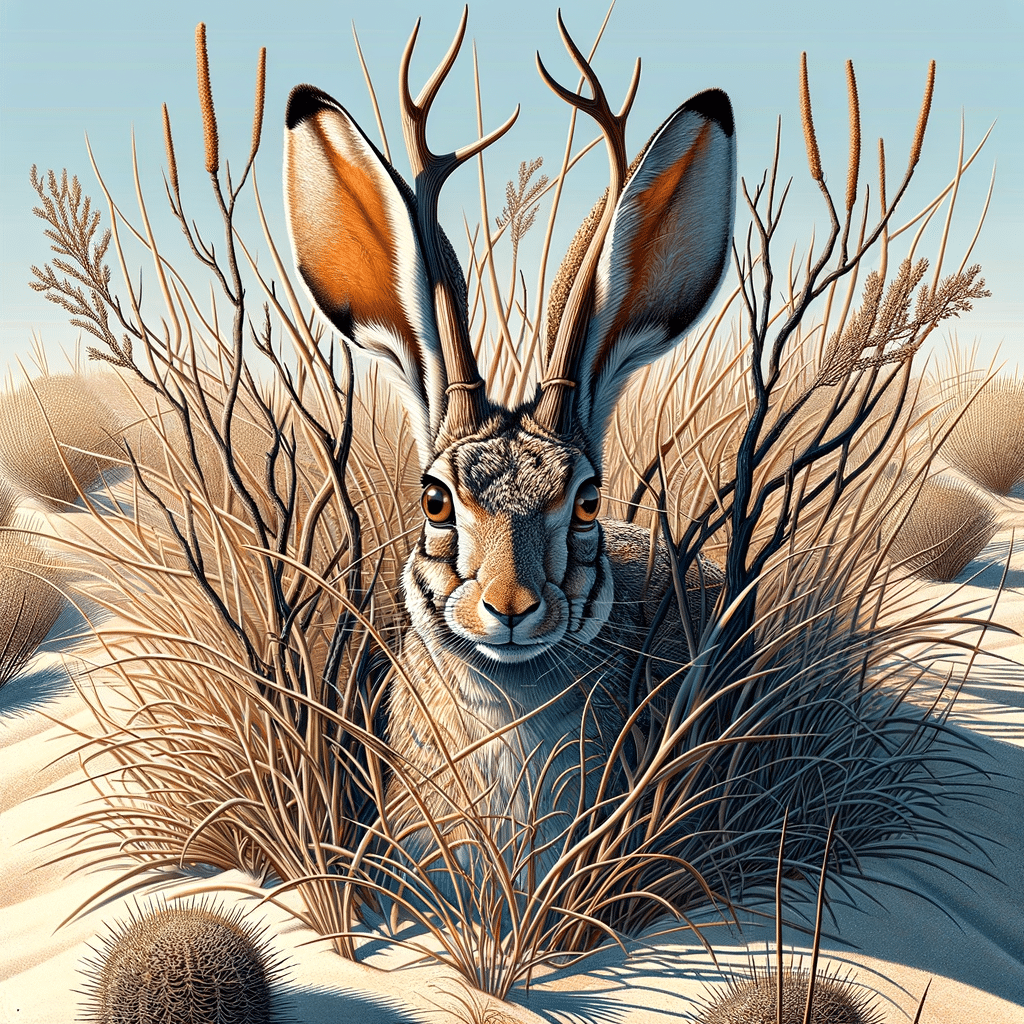
One of the most cherished and enduring instances of Western tall tales is the jackalope, a legendary animal in American folklore. For almost a century, this fabled hybrid—rumored to be a cross between an antelope and a jackrabbit—has captivated American imaginations and come to represent inventiveness and comedy on the frontier. It is an interesting cryptid species that everyone knows is fake.

Description
People commonly refer to the jackrabbit with the striking horns or antlers of a pronghorn antelope as a jackalope. While some varieties exhibit goat-like horns, people typically depict these antlers as branching and pointy, akin to those of a deer. Other than that, the animal has the features of a big hare, including long ears, strong hind legs, and a cottontail. Although coloration might vary in various creative renderings, the majority of depictions feature the animal with brown or grey fur (Siporin, 2000).
Folklore claims that, despite their diminutive size, jackalopes are quite violent and use their horns to protect themselves and ward off attackers. They frequently join in around campfires from a safe distance and are reputed to be excellent mimics, able to replicate human voices and cowboy songs. Only specific nights of the year allow for their capture, and thunderstorms are known to increase their activity. According to certain legends, they can run extremely fast and even attack those who approach too closely with their horns (Crimmel, 2023).

Rogue Taxidermy
Douglas Herrick and his brother Ralph, taxidermists from Douglas, Wyoming, created the first mounted jackalope specimen in 1932 and are largely responsible for the present jackalope tale. In order to create what would become a famous image of a Western American legend, they mounted deer antlers onto a jackrabbit carcass. But the idea of horned rabbits has a longer history; it first appeared in Persian literature and European medieval manuscripts centuries ago.
In cryptid folklore, taxidermy has been an intriguing medium for artistic expression as well as a means of giving fantastical creatures a physical form. Known as gaff taxidermy or rogue taxidermy, the process of fabricating composite animals has had a big impact on how people envision and spread cryptid myths. People have done it for a variety of reasons (Niittynen, 2015).
Although the jackalope is a part of a larger history, it is arguably the most popular and successful example of cryptid taxidermy. Mounted specimens of impossible species were common in curiosity museums and touring displays during the 19th and early 20th centuries. A prime example of how taxidermy contributed to the establishment of persistent cryptid imagery in popular culture is P.T. Barnum’s Feejee Mermaid, which was built from the upper body of a monkey and the tail of a fish (Levi, 1977).
Fake specimens have a long history in European customs, especially in German-speaking areas. Intricate arrangements of rabbit bodies with scales, fangs, bird wings, or other animal characteristics are on display at Bavarian museums. Similar customs exist in Sweden with the Skvader, which combines the body of a hare with the wings of a wood grouse, and in various regions of Germany with the Rasselbock.
There were several uses for these mounted specimens. They improved storytelling, drew tourists, and showcased the technical prowess of taxidermists. Even when spectators realized they were looking at man-made objects, the fact that these “specimens” were physically present in reputable places like museums and bars gave the stories some legitimacy. Although it frequently takes a more creative and self-consciously surreal approach, modern rogue taxidermy carries on this history. In order to explore issues of mythology, nature, and human imagination, contemporary artists build hybrid creatures rather than to deceive. These works stretch the limits of the genre into new creative realms while acknowledging their homage to historical faux taxidermy.
Cultural Impact
Particularly in Wyoming, where the city of Douglas has adopted the jackalope as a local symbol and tourist attraction, it swiftly established itself as a mainstay of American Western culture. In the 1930s and 1940s, postcards with jackalopes on them started to circulate and quickly gained popularity as vacation mementos. Bars and restaurants throughout the Western United States frequently display mounted jackalope heads and occasionally offer jackalope hunting licenses for sale as novelty items. Often, these licenses restrict hunters to hunting the animal only in unlikely situations, like midnight on June 31st.
Among cryptids, the jackalope distinguishes itself with its overt humor and deliberate fabrication, differentiating it from other mythical animals that their devotees often take more seriously. From its inception, people welcomed the jackalope as a friendly hoax and amusing tall story, unlike monsters such as Bigfoot or the Loch Ness Monster, which have attracted devoted researchers and purported eyewitness statements asserting their genuine existence. The jackalope bears more resemblance to Paul Bunyan and his blue ox than it does to mysterious creatures, as its creators, the Herrick brothers, never attempted to make it appear real.
The closest analogy might be the Wolpertinger of Bavarian legend, a hybridized rabbit creature typically depicted with wings, fangs, and other animal traits. Like the jackalope, taxidermy customs gave rise to the Wolpertinger, which now stands as a curiosity in museums and bars, rather than an actual enigmatic animal. People rarely believe it to be an authentic specimen.
Cryptozoological circles view other hybrid cryptids like the Mothman (moth/human/bird traits) or the Jersey Devil (goat/horse/bat features) more seriously and often associate them with sinister, menacing mythologies. By contrast, the jackalope consistently exhibits a humorous nature, with its worst claimed behaviors being the rare aggressive defense of its territory or mimicking human voices. The jackalope is about fun and tourism.
While adjusting to new media, the jackalope has retained its cultural relevance in the current era. It functions as a mascot and a representation of American frontier mythology in video games, TV series, and commercials. Additionally, the monster has served as the inspiration for a variety of goods and commodities, ranging from craft beer labels to t-shirts. Scientists suggest that actual rabbits with the Shope papilloma virus, which causes horn-like growths on rabbit faces and heads, may have partially influenced the myth of the jackalope (Hume, 2022).
Conclusion
The jackalope, which embodies the spirit of tall stories that defined Western expansion, is now a symbol of American frontier fun and inventiveness. What started out as a whimsical creation by a taxidermist has developed into a timeless work of American folklore that reminds us of the lightheartedness of Western storytelling traditions while also delighting and inspiring new generations. The jackalope, which connects ancient frontier culture with contemporary popular entertainment, is still a cherished representation of American folk art and fantasy.
References
Crimmel, H. (2023). On the Trail of the Jackalope: How a Legend Captured the World’s Imagination and Helped Us Cure Cancer by Michael P. Branch. Western American Literature, 58(1), 89-91.
Hume, S. (2022). Could nature turn a hare into a jackalope?. Journal of Interdisciplinary Science Topics, 9.
Levi, S. C. (1977). PT Barnum and the feejee mermaid. Western Folklore, 36(2), 149-154.
Niittynen, M. (2015). Animal magic: Sculpting queer encounters through rogue taxidermy art. In Gender Forum: An Internet Journal for Gender Studies (Vol. 55, pp. 14-38).
Siporin, S. (2000). Tall Tales and Sales. Worldviews and the American West: The Life of the Place Itself. Ed. Polly Stewart, Steve Siporin, CW Sullivan III, and Suzi Jones. Logan: Utah State UP, 87-104.

Leave a Reply