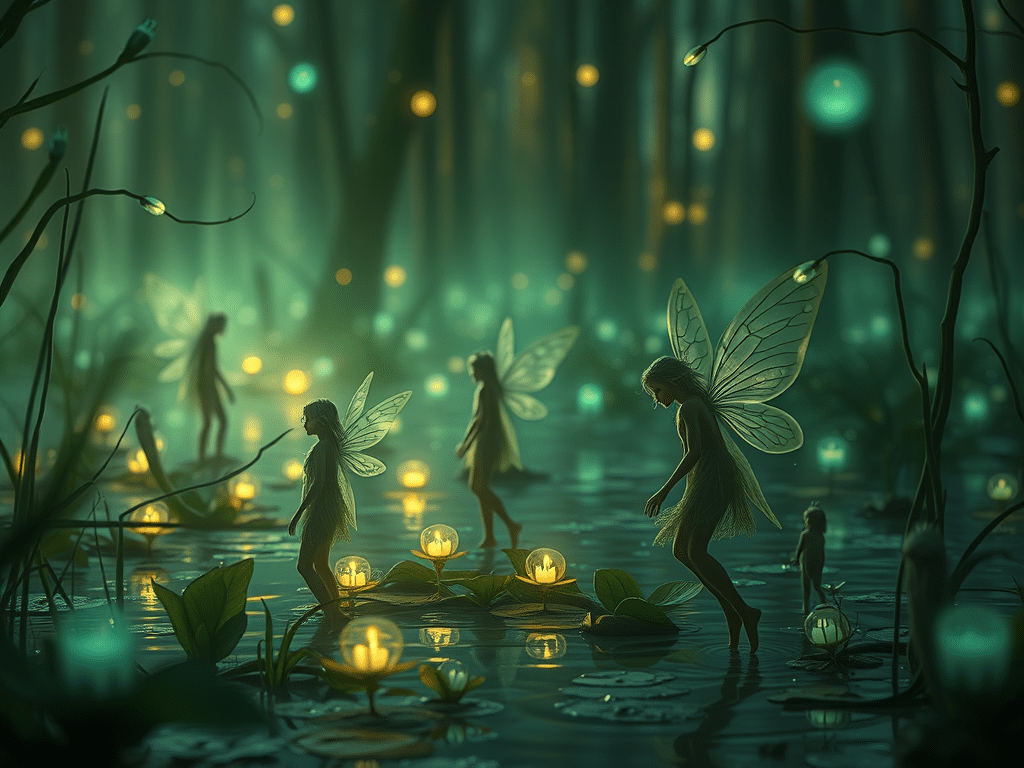
Faeries and Swamps: Key Points
-
Faeries are supernatural beings from global folklore that range in size and disposition, possessing powers over nature and serving as intermediaries between human and natural worlds.
-
Swamps are paranormal hotspots due to their liminal nature between water and land, creating conditions that blur reality’s boundaries and serve as gateways between different planes.
-
Swamp faeries are more ancient and dangerous than other faeries, with witnesses reporting luminous beings, spectral figures, and ethereal music in wetlands.
-
Theories include swamp gases inducing visions, faeries as nature spirits embodying ecosystems, or interdimensional entities manifesting where electromagnetic anomalies occur.
-
Faerie-swamp beliefs shaped human wetland interaction through protective rituals and perceptions of danger, potentially protecting fragile ecosystems from human interference.
-
This connection reflects human tendencies to assign supernatural meaning to mysterious spaces, encoding ecological wisdom about respecting complex environments.

Introduction
The intersection of faerie folklore and the mystical qualities of swamps represents a fascinating, but often overlooked, area of paranormal study. People have linked these changing wetland areas to supernatural events throughout history. The existence of faerie beings is a prevalent motif across various cultures and regions. This research examines the nature of faeries, the supernatural characteristics linked to marshes, the relationship between these entities and their wetland environments, the prevailing interpretations of their connection, and the broader cultural and psychological impacts of these beliefs on human societies.
Overview
Faeries, sometimes spelled fairies or fae, are supernatural beings found in the folklore of many different cultures. These elements are especially prominent in the Celtic, Germanic, and Slavic traditions. These beings are usually described as having human-like forms, but they also show characteristics that are not of this world. These abilities include invisibility, the power to control natural forces, and the ability to exist in a separate but connected realm. Faeries show a wide range of sizes, from tiny, winged beings the size of insects to large creatures, some of which are bigger than humans. Their personalities range widely, encompassing everything from benevolent guardians of the environment to mischievous pranksters and even malevolent entities. Worldwide, stories about fairies often connect them to wild, untamed places. These entities also act as intermediaries, connecting people with the natural world.
Fairies, often depicted as supernatural beings with magical powers, are strongly connected to nature, particularly in wetlands and forests. Folklore often portrays swamps as magical places where fairies dance and celebrate, which leads to the creation of “fairy rings” made of mushrooms. This phenomenon is explained in various cultural stories, which helps to strengthen their mythical importance (Aoshima et al., 2024; Fidanza et al., 2016). The idea that fairies create these rings comes from how often they appear in stories. These stories often see them as signs of fairy activity, which suggests both protective and mischievous behaviors in their world (Dugan, 2008; Gagnon, 2017).
From a paranormal perspective, swamps and marshes have unique characteristics that distinguish them from other natural environments, making them particularly susceptible to supernatural events. Wetlands, which constantly change between wet and dry conditions, physically represent a state of liminality. Paranormal investigators believe this ability makes them natural conduits to different realities. Swamps, with their dark waters, dense plant life, unusual sounds, and the strange lights from swamp gas, create an atmosphere that challenges the usual understanding of reality. People who have spent time in these areas often report feeling disoriented, changes in their sense of time, and experiences with things that seem impossible to explain. This suggests that swamps might be places where the boundary between different realities is thin.
Swamps and bogs, which are important ecosystems, are often characterized by waterlogged conditions, supporting diverse biological communities. The sedge sprite (Nehalennia irene) and similar species thrive in these wetland environments, highlighting the ecological importance of marshy habitats for supporting unique life forms (Iserbyt et al., 2011). This ability to adapt highlights how certain insect species find ecological niches in different swamp ecosystems. These species then become part of local folklore, often portrayed as creatures from mystical realms.
The connection between faeries and wetlands seems to be both ecological and metaphysical. These otherworldly entities are inexplicably attracted to wetlands, and their reasons for this go deeper than mere liking. Swamp faeries are often portrayed with different characteristics than their forest- or meadow-dwelling relatives. These beings are often described as more ancient, more dangerous, and more closely connected to the basic forces of decay and renewal. For ages, tales have circulated of luminous forms hovering over marshes, spectral figures emerging from the mist, and eerie music wafting from lonely wetlands—all attributed to the faeries’ handiwork. Whispers suggest these entities guard the secrets of the marshlands. These entities can mislead travelers with will-o’-the-wisps or ghostly lights, but they can also protect those who respect the swamp.

Theories
Various explanations have been proposed to clarify the consistent link between fairies and wetland areas, as seen in different cultures and historical periods. One hypothesis suggests that swamps, which are ecosystems rich in decaying organic matter and produce methane and other gases, create natural conditions that could induce altered states of consciousness in people who enter these environments. As a result, these circumstances could lead to visionary experiences, which people might interpret as encounters with fairies. Another idea suggests that fairies represent a type of elemental consciousness or nature spirit, closely connected to specific ecosystems. From this perspective, swamp fairies symbolize the transformative and boundary-crossing characteristics of wetlands. Some paranormal investigators suggest that these entities might come from other dimensions. They might find it easier to appear in places where there are natural electromagnetic anomalies. Swamps, with their unique mineral composition and water movement, might naturally create the conditions needed for this.
Fairy tales often explore the themes of transformation and the experience of being taken away. People who enter fairy territory might face negative consequences, such as livestock getting sick or things going missing. This phenomenon reinforces the limits set by these otherworldly beings (Gagnon, 2017). Folklore often highlights the importance of respecting the natural world and its supernatural inhabitants, a theme frequently found in stories from wetland areas.
The will-o’-the-wisp has been a common subject in folklore stories since at least the thirteenth century. For ages, these lights have been associated with the supernatural. Tales have depicted them as ghosts or beings from another realm, enticing unsuspecting travelers to stray from their paths. The term “wandering flame” historically describes these phenomena, which often reflect societal worries and the fear associated with nighttime forays into wetlands (Miner et al., 2024; Gearey, 2022). Similarly, geographers and sociologists have studied the cultural importance of figures like Tiddy Mun, a folkloric character linked to guiding, or misguiding, people in difficult-to-navigate areas (Gearey, 2022).
From a scientific perspective, the appearance of will-o’-the-wisps is usually explained by the combustion of gases released from decaying organic matter in areas with little oxygen. These substances include gases like methane and phosphine, which can ignite spontaneously under certain conditions, creating flickering lights that resemble flames (Dugan, 2008; Edwards, 2014). Weiss and his team (1982) conducted a study. Research indicates that the concentrated gathering of microbubbles in marshy areas could create effects similar to microlightning. This study might provide a physical explanation for the mysterious lights often seen in wetlands (Xia et al., 2025). Moreover, research has shown that the combination of gas emissions and their temporary ignition creates the typical behavior of will-o’-the-wisp lights. These lights often disappear when approached and then reappear in different places (McLean, 2011). Academic studies and stories have described these behaviors, integrating scientific explanations with cultural viewpoints (McLean, 2011; Edwards, 2014). Far from being mere warnings, these lights weave together local narratives, ethical lessons, and a sense of belonging. In literature, will-o’-the-wisps have been portrayed in various ways, sometimes as mischievous beings that lead people into danger, and at other times as symbols of transformation and connections to other worlds (Dugan, 2008; McLean, 2011).
Wetlands are important for will-o’-the-wisps because they provide the right conditions for this phenomenon, and they also support a wide variety of species and ecological processes. Living organisms, through the breakdown of organic matter, produce gases that sustain wetland ecosystems (Durogbade et al., 2024; Palmer et al., 2010). The creation of this gas is essential for the nutrient cycles in these environments. Therefore, its production supports diverse biological communities, which can then influence local folklore (Weiss et al., 1982; Palmer et al., 2010). Moreover, the geological and biological processes occurring in wetland environments demonstrate the changing interactions that define these ecosystems. The rate at which organic matter breaks down is affected by changes in water levels, which then influences the release of gases. This, in turn, can alter the visibility of will-o’-the-wisps. Therefore, this connection links ecological research with local stories about these mysterious lights (Hagen, 2006).
Impact
Throughout history, the cultural and psychological effects of fairy tales and swamp stories have profoundly influenced how human societies interact with wetland environments. Different cultures developed detailed methods for safely navigating swampy areas. These included rituals meant to either appease or avoid the faerie inhabitants, which shows how supernatural beliefs influenced practical survival strategies. The portrayal of swamps as faerie-haunted places contributed to their reputation as dangerous, unstable environments, which led to avoidance or extreme caution. This view might have unintentionally protected these fragile ecosystems by discouraging human intrusion. Faerie-haunted swamps, with their unique blend of romance and mystery, continue to captivate people. This influence is felt in environmental conservation efforts, in the world of art, and even in the burgeoning realm of paranormal tourism. These mysterious places draw people who seek to connect with both the natural world and the supernatural.
Globally, swamps have become important in cultural stories, which then shape local folklore that highlights the ecological importance of these environments. In Baltic folklore, stories often show a strong connection between people and the spirit world, frequently using transformation themes in places like swamps (Brūzgienė, 2023). Stories about creatures like fairies, said to live in and protect these areas, highlight the swamp’s role as a place where the natural and supernatural meet. Moreover, cultural portrayals of wetlands often mirror broader societal values and beliefs. In Eglė, the Queen of Serpents, the relationship between change and the environment connects human experiences with the supernatural, highlighting the swamp’s role as a place of both transformation and understanding (Brūzgienė, 2023). Similarly, literature from the Victorian era onward often links fairies with pastoral and idealized settings, creating romanticized images that combine ecological beauty with whimsical fantasy (Kimber, 2007).
Conclusion
The enduring connection between fairies and marshes highlights a basic human tendency to impart supernatural meaning to mysterious natural places. The issue also highlights how we see these border areas as a reflection of our complex relationship with the boundary between what we know and what we don’t. Faerie beings, whether considered real supernatural entities, psychological projections, or symbolic representations of natural forces beyond our full understanding, continue to capture human imagination and influence how we interact with wild places. This situation highlights the connection between ancient spiritual beliefs and ecological understanding. The seemingly irrational fear and reverence associated with faeries dwelling in wetlands could have functioned as a mechanism for safeguarding practical knowledge about the stewardship of environments that remain, even in the present day, some of the most obscure and poorly understood ecosystems worldwide.
References
Aoshima, H., Mizuno, R., Iwatsu, Y., Onishi, S., Hyodo, S., Ibuki, R., … & Saitoh, Y. (2024). Inhibitory effect of 2-aza-8-oxohypoxanthine on tyrosinase activity and melanin production. Cosmetics, 11(2), 43. https://doi.org/10.3390/cosmetics11020043
Brūzgienė, R. (2023). Folk tale “eglė, the queen of serpents” [eglė žalčių karalienė] on the soviet stage as a representation of lithuanian culture. Contemporary Issues of Literary Studies – International Symposium Proceedings, 16, 249-258. https://doi.org/10.62119/cils.16.2023.7553
Dugan, F. M. (2008). Fungi, folkways and fairy tales: mushrooms & mildews in stories, remedies & rituals, from oberon to the internet. North American Fungi, 23-72. https://doi.org/10.2509/naf2008.003.0074
Durogbade, S. A., Korode, T. B., & Akpeji, B. H. (2024). Production of biogas from plantain peels, using cow dung as substrate. British Journal of Multidisciplinary and Advanced Studies, 5(2), 40-53. https://doi.org/10.37745/bjmas.2022.0471
Edwards, H. G. M. (2014). will-o’-the-wisp : an ancient mystery with extremophile origins?. Philosophical Transactions of the Royal Society A: Mathematical, Physical and Engineering Sciences, 372(2030), 20140206. https://doi.org/10.1098/rsta.2014.0206
Fidanza, M. A., Settle, D., & Wetzel, H. C. (2016). An index for evaluating fairy ring symptoms in turfgrass. HortScience, 51(9), 1194-1196. https://doi.org/10.21273/hortsci10915-16
Gagnon, J. P. (2017, January 1). Celtic Nightshade. International Textile and Apparel Association Annual Conference Proceedings, 74(1). https://www.iastatedigitalpress.com/itaa/article/id/1712/
Gearey, M. (2022). English wetland immersions. Transfers, 12(2), 60-78. https://doi.org/10.3167/trans.2022.120207
Hagen, J. W. (2006). For black caucus. Monographs of the Society for Research in Child Development, 71(1), 224-226. https://doi.org/10.1111/j.1540-5834.2006.00408.x
Iserbyt, A., Bots, J., Dongen, S. V., Ting, J. J., Gossum, H. V., & Sherratt, T. N. (2011). Frequency-dependent variation in mimetic fidelity in an intraspecific mimicry system. Proceedings of the Royal Society B: Biological Sciences, 278(1721), 3116-3122. https://doi.org/10.1098/rspb.2011.0126
Kimber, M. W. (2007). Victorian fairies and felix mendelssohn’sa midsummer night’s dreamin england. Nineteenth-Century Music Review, 4(1), 53-79. https://doi.org/10.1017/s1479409800000069
McLean, S. (2011). Black goo: forceful encounters with matter in europe’s muddy margins. Cultural Anthropology, 26(4), 589-619. https://doi.org/10.1111/j.1548-1360.2011.01113.x
Miner, K., Wong, E., Gay, B., & Miller, C. (2024). Will ‘o the Wisps: non-traditional data to inform modern science [Preprint]. Research Square. https://doi.org/10.21203/rs.3.rs-4077431/v1
Palmer, K., Drake, H. L., & Horn, M. A. (2010). Association of novel and highly diverse acid-tolerant denitrifiers with n 2 o fluxes of an acidic fen. Applied and Environmental Microbiology, 76(4), 1125-1134. https://doi.org/10.1128/aem.02256-09
Weiss, A. J., Tate, R. L., III, & Colombo, P. (1982). Assessment of microbial processes on gas production at radioactive low-level waste-disposal sites (BNL 51557). Brookhaven National Laboratory. https://www.osti.gov/servlets/purl/5292836-xcd5VU/
Xia, Y., Meng, Y., Shi, J., & Zare, R. N. (2025). Unveiling ignis fatuus: microlightning between microbubbles. Proceedings of the National Academy of Sciences, 122(41). https://doi.org/10.1073/pnas.2521255122

Leave a Reply