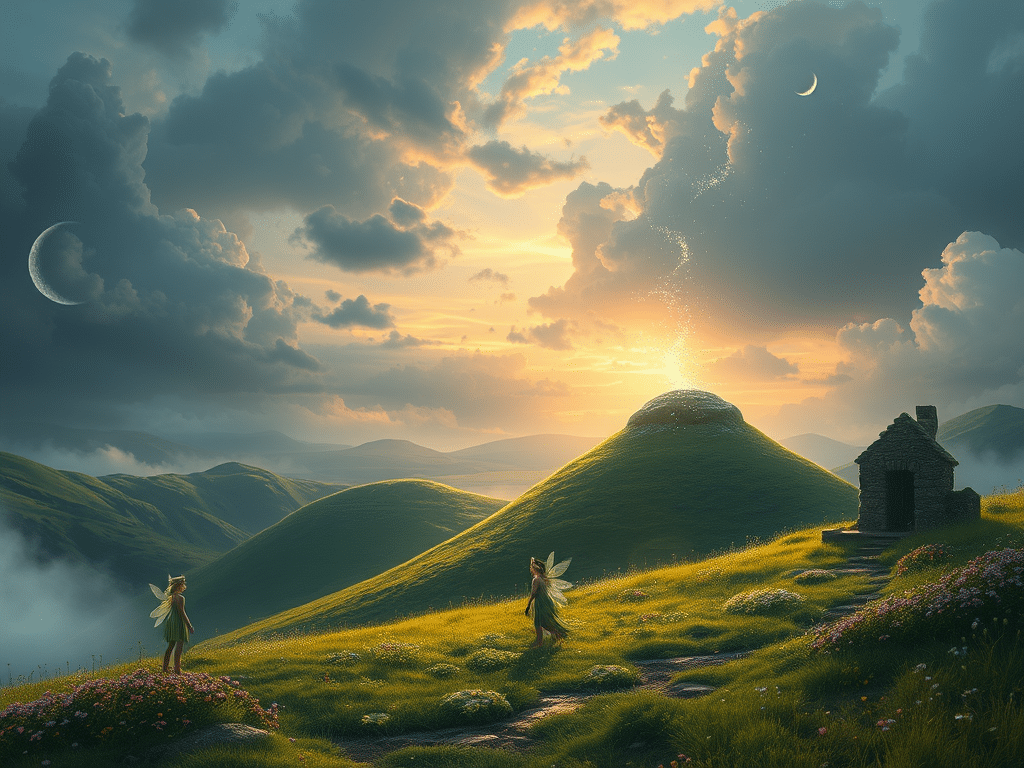
Fairies of Scotland: Key Points
-
Scottish fairies are powerful, often human-sized supernatural beings inhabiting a parallel realm accessible through mounds and hills, known by Gaelic names like daoine sith and aos sí.
-
Scottish fairy lore includes diverse beings like the Seelie and Unseelie Courts, brownies, kelpies, selkies, and changelings, each with distinct characteristics ranging from helpful to malevolent.
-
Fairy beliefs were integrated into daily life through elaborate customs, protective taboos, and offerings, especially during dangerous times like Samhain and Beltane.
-
Theories pointing out fairy beliefs include folk memories of earlier inhabitants, psychological explanations for misfortune, and anthropological views of fairies as personifications of natural forces.
-
Fairy traditions profoundly influenced Scottish architecture, agriculture, literature, and identity, from building placement to works by Burns, Scott, and Barrie.
-
While literal belief has declined, fairy lore remains culturally significant as heritage and artistic inspiration, continuing to resonate in contemporary Scottish culture and identity.

Introduction
Fairies have a deeply rooted place in Scottish culture and imagination, appearing in folklore, literature, and oral traditions for centuries. These otherworldly beings are embedded in stories passed down through families and communities across the Highlands, Lowlands, and islands, forming a shared cultural memory. Scottish fairy lore is notably complex, reflecting the country’s diverse geography, its Gaelic foundations, and the blending of Celtic, Norse, and later Christian influences that have shaped Scottish identity over time.
Scottish folklore typically portrays fairies as supernatural beings who inhabit a parallel realm that occasionally intersects with the human world at specific locations or times. Unlike the delicate, miniature fairies of Victorian children’s literature, Scottish fairies are often described as human-sized or larger and endowed with considerable power. They are morally ambiguous figures, capable of both kindness and cruelty, and are believed to dwell in fairy mounds (sìthean), burial cairns, glens, and hills regarded as gateways to their hidden world.
Language itself reflects the caution and respect with which fairies were treated. In Gaelic tradition, they are known by names such as daoine sìth (people of peace), aos sí (people of the mounds), and sluagh (the host), terms that deliberately avoid direct confrontation or offense. These naming practices illustrate how fairy belief functioned not simply as storytelling, but as a system of cultural etiquette rooted in fear, reverence, and coexistence with unseen powers.
Fairy Belief as a Worldview
Scottish fairy belief has long been understood as a coherent worldview rather than a loose collection of fanciful tales. Historical accounts emphasize that fairies were believed to be real, active beings who existed within the same moral and physical universe as humans, particularly in rural and early modern Scotland (Henderson & Cowan, 2001). Far from being imaginary, fairies were thought to inhabit hills, mounds, and other liminal spaces, shaping how people understood their surroundings and structured their daily behavior (MacRitchie, 1908).
This worldview allowed fairy belief to serve as an explanatory system for misfortune, illness, and unexplained events. When crops failed, children fell ill, or time seemed to behave strangely, fairy interference offered a culturally meaningful explanation. Such beliefs reinforced communal norms and encouraged caution, respect for certain places, and adherence to ritualized behavior intended to maintain harmony between human and fairy realms.
A defining feature of this worldview was the uncertainty surrounding the boundaries of the fairy realm. Fairies were regarded as one category among many supernatural beings, alongside angels, demons, and ghosts, with identities that often overlapped or remained indistinct (Goodare, 2014). This ambiguity reflects a flexible popular mentality in which supernatural categories were not rigidly defined, allowing fairy belief to coexist with Christian theology while remaining grounded in local tradition and lived experience.

Types of Fairies and Social Meaning
Scottish folklore distinguishes between different kinds of fairies based on their behavior and moral character. A common division is made between the Seelie Court, often viewed as generally benevolent, and the Unseelie Court, regarded as dangerous or malevolent, though both were capable of rewarding or punishing humans (Nozedar, 2012). These distinctions reinforced social expectations by encouraging respectful conduct and careful interaction with the natural and supernatural worlds.
Folktales frequently depict fairies as either helpers or abductors, highlighting their unpredictability and the importance of protective rituals (Kotake, 2014). Communities developed a range of customs to guard against fairy mischief, such as carrying iron, wearing clothes inside out, or avoiding certain locations at twilight or on liminal dates like Samhain and Beltane. Seasonal festivals were believed to weaken the barrier between worlds, making these times especially dangerous and necessitating offerings of milk, bread, or cream to placate the fair folk.
Scottish fairy lore is populated by a rich array of beings, each reflecting particular fears and values. Brownies appear as domestic spirits who assist with household tasks, while the bean-nighe foretells death by washing bloody garments at streams. Water spirits such as kelpies, each-uisge, and selkies embody the dangers of lochs and seas, while changeling beliefs offered troubling explanations for childhood illness or disability. These figures illustrate how fairy lore addressed everyday concerns, reinforcing social boundaries and offering symbolic meaning to human suffering and difference (Eberly, 1988).
Fairy Lore, Culture, and Continuity
Fairy belief profoundly influenced Scottish cultural life, shaping architecture, agriculture, and artistic expression. Traditional building practices avoided fairy paths, included protective symbols, and sometimes featured designated spaces for offerings. Agricultural customs such as leaving a “fairy’s share” of the harvest demonstrate how belief in fairies was woven into practical land use and seasonal labor.
Literary and artistic traditions played a crucial role in preserving and reshaping fairy belief. Ballads and legends provided emotionally resonant depictions of fairy encounters, embedding supernatural themes within narratives that reflected local landscapes and communal values (Henderson & Cowan, 2001). Later writers, including Robert Burns, Sir Walter Scott, and James Hogg, drew heavily on fairy lore, while authors such as George MacDonald and J. M. Barrie reworked these traditions for new audiences, often blending Scottish folklore with emerging forms of fantasy literature (Briggs, 2002).
In contemporary Scotland, fairy lore continues to hold cultural significance despite the decline of literal belief. Tourism, academic study, and modern literature all draw upon fairy traditions as expressions of heritage and identity. Recent research in cultural linguistics demonstrates that fairy belief persists in everyday language, with phrases such as “fairy hill” and “fairy ring” reflecting enduring ideas about danger, protection, and place (Borschke & Wolf, 2024). Together, these traditions reveal the lasting power of Scottish fairy lore to adapt, endure, and connect past worldviews with present cultural concerns.
References
Borschke, A., & Wolf, H. G. (2024). Cultural model of FAIRY in Scottish English. In Cultural Linguistics and (Re)conceptualized Tradition (pp. 405–427). Springer.
Briggs, K. M. (2002). The fairies in tradition and literature. Psychology Press.
Davies, O. (2008). A comparative perspective on Scottish cunning-folk and charmers. In Witchcraft and belief in early modern Scotland (pp. 185–205). Palgrave Macmillan.
Eberly, S. S. (1988). Fairies and the folklore of disability: Changelings, hybrids and the solitary fairy. Folklore, 99(1), 58–77.
Goodare, J. (2014). Boundaries of the fairy realm in Scotland. In Airy nothings: Imagining the otherworld of faerie from the Middle Ages to the Age of Reason (pp. 139–169). Brill.
Henderson, L., & Cowan, E. J. (2001). Scottish fairy belief: A history. Dundurn.
Kotake, M. H. (2014). Introduction to the folklore of Scotland.
MacRitchie, D. (1908). Stories of the mound-dwellers. The Celtic Review, 316–331.
Nozedar, A. (2012). Fairies. Casemate Publishers.

Leave a Reply