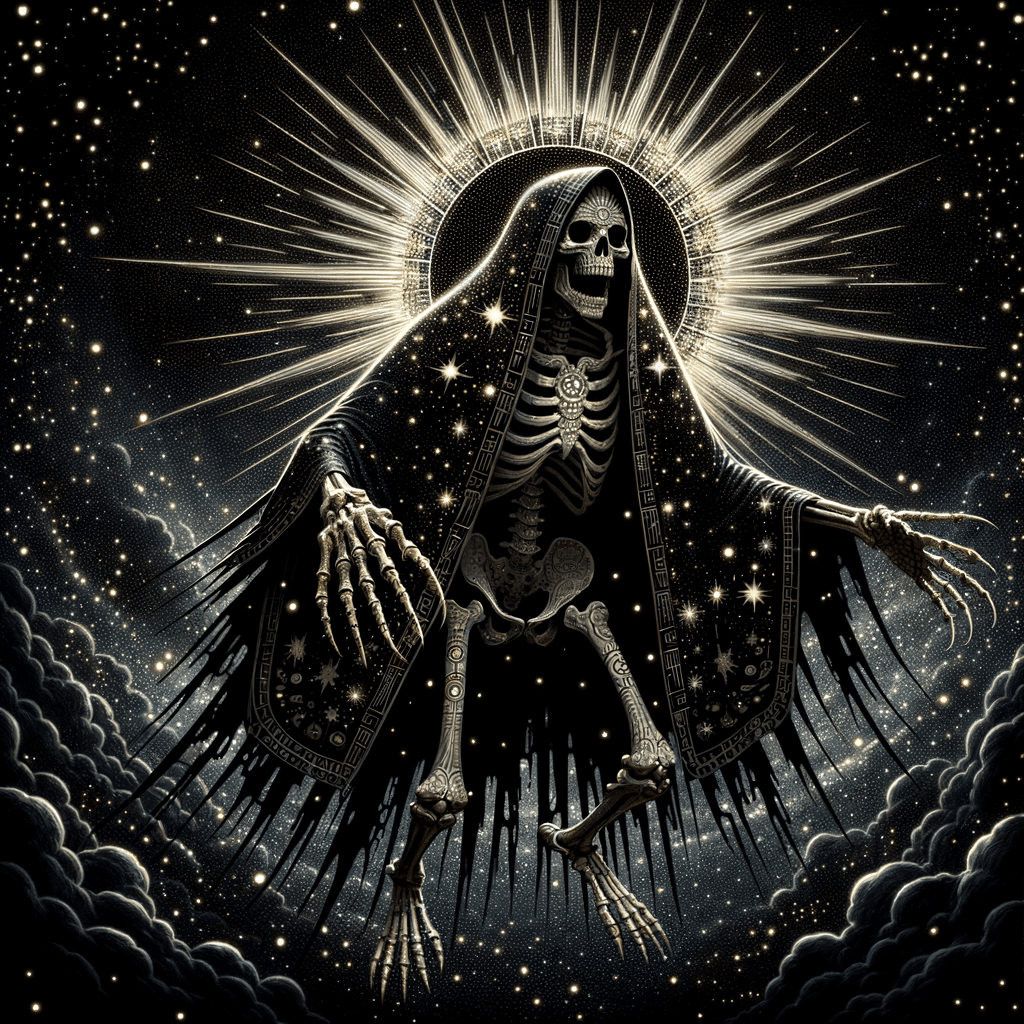
Fearsome celestial beings from Aztec mythology, the Tzitzimimeh (singular: Tzitzimitl) represented both creative and destructive powers in the universe. It was thought that these female skeletal warriors lived in the higher reaches of the skies and threatened to descend on Earth to devour humanity during solar eclipses and other cosmic vulnerable times. Their connection to vampirism and other similar myths shows a common theme in folklore worldwide.

Description
Skeletal faces adorned with pointed, sharp teeth portrayed the Tzitzimimeh as frightful female characters. They usually depicted their hair as wild and disheveled and adorned their bodies with skulls, bones, and claws. They appeared in several depictions, their serpentine skirts adorned with bells and other ceremonial decorations. Their affinity with stars, often encircled by starlight or adorned with celestial insignia on their bodies, was their most distinguishing characteristic.
In Aztec mythology, these celestial demons had intricate behavioral patterns. During solar eclipses, people believed they attacked the sun to prevent its return, threatening to plunge the world into endless darkness. However, they also guarded women giving birth and maintained connections with the spirits of Cihuateteo, women who died during childbirth. Aztec civilization revered and feared them due to their dual nature (Schwartz, 2018).
Evolution
Around 900–1200 AD, during the early Post-Classic era of Mesoamerican history, the Tzitzimimeh was the subject of mythology. Their beginnings entwine with older starry deities from earlier Mesoamerican societies, especially Teotihuacan. These creatures were part of the Aztecs’ intricate cosmology, and they were crucial to the story of the Five Suns, the creation myth that explained the world’s various ages.
During solar eclipses, when Aztec priests would offer human sacrifices to nourish the sun and fortify it against these celestial enemies, Tzitzimimeh rituals were especially significant. Pregnant mothers would take extra care during eclipses, believing that the Tzitzimimeh could turn their unborn offspring into monsters. To help drive these celestial beings away, regular folk would shout, and warriors would create noise with their weapons.
The Tzitzimimeh tale has changed dramatically throughout time. Spanish conquistadors and Catholic missionaries frequently confused these gods with European ideas of demons and witches after their arrival. They have become somewhat sterilized in contemporary Mexican mythology, frequently showing up in tales that are more cautionary than the nuanced celestial entities they formerly stood for. Rather than being exclusively evil beings, modern interpretations occasionally depict them as symbols of cosmic balance or female empowerment (Bassett, 2018).

Vampirism
The relationship between vampires and the Tzitzimimeh offers an intriguing examination of post-colonial synthesis of ideas and parallel mythical development. Despite not being vampires in the conventional European sense, the Tzitzimimeh have a number of important traits in common with vampire legend. The most evident similarity between them is that they both drink blood. People said that the Tzitzimimeh would descend during eclipses to devour people, particularly their blood and hearts. Although the Tzitzimimeh’s feeding was more cosmic in origin and purpose than for personal sustenance, this reflects the basic vampire trait of sucking human blood.
They have intriguing connections to vampire lore through their affinity with darkness and celestial happenings. While sunlight destroys European vampires, the Tzitzimimeh aggressively seek to destroy the sun, symbolizing a more potent and primordial affinity with darkness. During certain astronomical events, these entities are at their most potent: vampires at night and Tzitzimimeh during eclipses.
When Spanish colonists encountered Aztec beliefs, they often interpreted native gods through a European perspective, leading to confusion between the Tzitzimimeh and vampire-like entities. Their association with women who died during childbirth further confounded this synthesis, as both the Tzitzimimeh and European vampires were associated with transitional states between life and death. Although the Tzitzimimeh’s skeletal look differs from European vampires’ pale but otherwise human-like appearance, both share physical traits linked to death. Both kinds of creatures stand for an immortality or undeath that is contrary to the laws of nature (Leeming, (2022).
Modern interpretations, particularly in fantasy literature and culture, occasionally combine aspects of vampire mythology and Tzitzimimeh to create fresh hybrid interpretations that incorporate elements of both traditions. However, this is not traditional folklore but rather a contemporary creative synthesis. The fundamental difference is still that the Tzitzimimeh were always celestial beings, reflecting cosmic forces rather than changed mortals, whereas vampires are usually shown as former people who have become undead creatures. Their legendary position and significance fundamentally differed, as their motivation to drink blood stemmed from a greater cosmic purpose, not personal survival.
Various mythologies around the world feature heavenly creatures and destructive female goddesses that bear similarities to the Tzitzimimeh, but they also possess unique traits specific to their respective cultural contexts. An example is a set of strong female celestial beings is the Valkyries, according to Norse mythology. Similar to the Tzitzimimeh, they are associated with death and the fate of warriors. But while the Tzitzimimeh pose a menace to civilization, Valkyries act as selectors of the fallen, leading deserving fighters to Valhalla. Both groups portray Valkyries as formidable female characters, despite their typical portrayal as lovely maidens rather than skeletal warriors (Donahue, 1941).
The Tzitzimimeh is similar to Lamia and Empusa in Greek mythology in that they are both dangerous to youngsters and expectant mothers. The Tzitzimimeh, believed to threaten unborn children during eclipses, were also known to prey on children and young men. But unlike the celestial Tzitzimimeh, Greek monsters were typically terrestrial beings.
The destructive nature and intimidating look of the Tzitzimimeh are very similar to those of the Hindu goddess Kali. Both wear lethal trinkets and are associated with skeletal images. In Hindu cosmology, Kali’s role as a destroyer clearly aims to destroy evil and ego, while the destructive nature of the Tzitzimimeh is more closely associated with natural order and celestial occurrences.
Similar to the Tzitzimimeh, the Jiutian Xuannü (Nine Heavens Mysterious Lady) is associated with the stars and the celestial world in Chinese mythology. However, people regard Jiutian Xuannü as a teacher and protector, while they mostly view the Tzitzimimeh as frightening creatures. This illustrates how similar cosmic entities can have wildly disparate cultural purposes. Although they are not heavenly entities, the Japanese Onryō are associated with vengeful female spirits and childbirth death, just like the Tzitzimimeh. In contrast to the Tzitzimimeh’s cosmic role, Onryō are individual ghosts seeking personal retribution; however, both types of beings are feared for their destructive power (Paciorek, 2018).
Among these legendary characters, the Tzitzimimeh are special because of their connection to solar eclipses and their dual function as guardians and destroyers of birth. Although female destructive deities or heavenly beings are present in other mythology, few of them combine these characteristics with such a clear link to astronomical occurrences and the human reproduction cycle. Various civilizations have created comparable yet unique supernatural beings to represent society’s values and anxieties as well as to explain natural phenomena. The Tzitzimimeh provides a particularly intricate illustration of Mesoamerican societies’ understanding of the connection between cosmic order, human reproduction, and astronomical events.
Conclusion
Despite the loss of the Tzitzimimeh’s original religious significance, its legacy continues to influence contemporary Mexican art and culture. The reinterpretation of pre-Columbian conceptions of supernatural powers and celestial events in light of societal systems and human experience is evident in these stellar devils. Their transformation from intricate celestial creatures to legendary figures demonstrates how cultural narratives may change over time, and their continued existence in Mexican cultural memory attests to the persistent influence of Aztec cosmology.
References
Bassett, M. H. (2018). Animals and Aztec religion: Keepers and cultivators of nature. Religion Compass, 12(5-6), e12264.
Donahue, C. (1941). The Valkyries and the Irish war-goddesses. PMLA, 56(1), 1-12.
Leeming, B. (2022). “Big-old long lips, big-old jar nose”: Ancient Mesoamerican monsters and clowns and the transformation of Christianity in early colonial Mexico. Ancient Mesoamerica, 33(2), 403-416.
Paciorek, A. (2018). Phantasms of the Floating World: Tales of Ghostly Japan. Folk Horror Revival: Field Studies, 198-204.
Schwartz, D. A. (2018). Aztec pregnancy: archaeological and cultural foundations for motherhood and childbearing in ancient mesoamerica. Maternal Death and Pregnancy-Related Morbidity Among Indigenous Women of Mexico and Central America: An Anthropological, Epidemiological, and Biomedical Approach, 11-33.



Leave a Reply