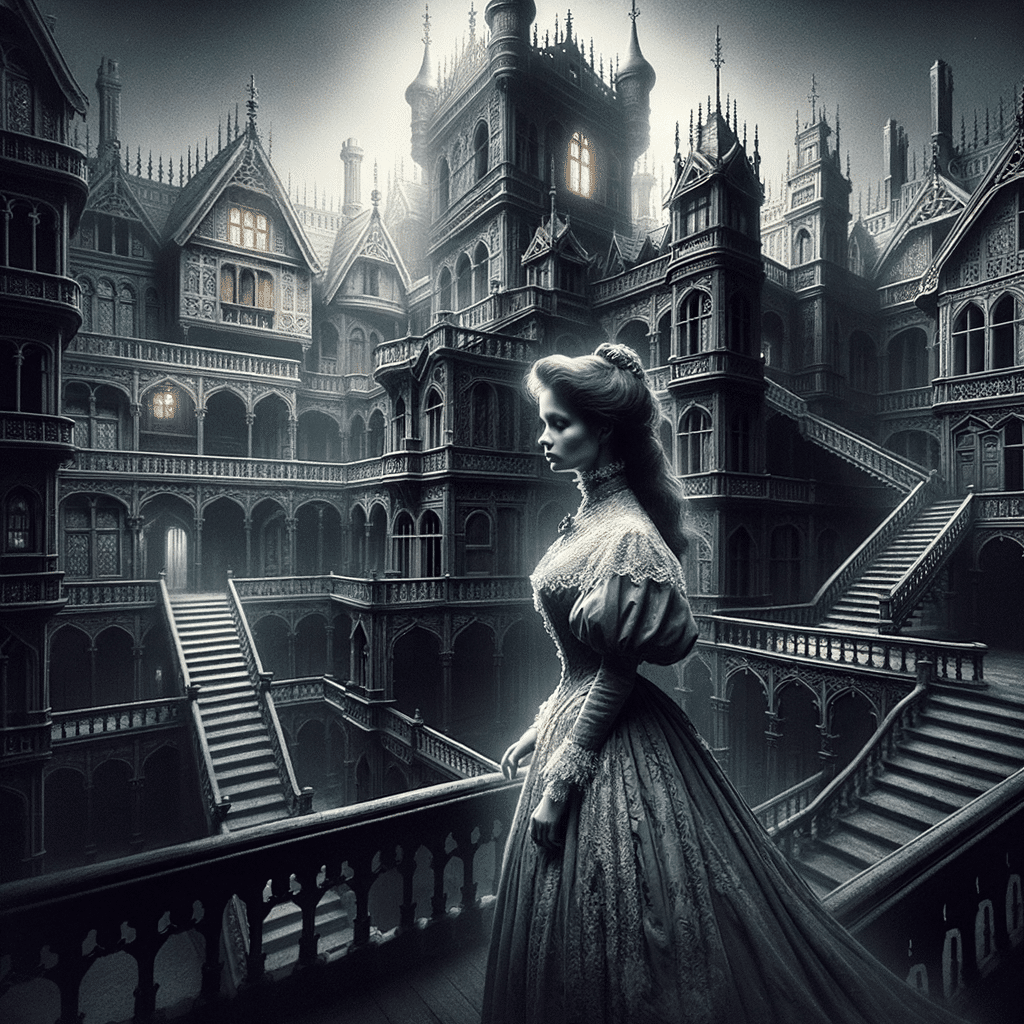
One of America’s most mysterious and purportedly haunted buildings is the Winchester Mystery House, whose strange design and meandering hallways bear witness to one woman’s sorrow, superstition, and possibly insanity. This expansive 24,000-square-foot Victorian estate in San Jose, California, has 160 rooms, 40 beds, 47 fireplaces, and a host of architectural curiosities, such as doors that open into walls, windows constructed into floors, and staircases that lead to nothing. People still see ghosts at the house.

Description
Born Sarah Lockwood Pardee in 1839, Sarah Winchester wed William Wirt Winchester, the heir apparent to the Winchester Repeating Arms Company’s wealth. Tragic events marred their lives together when William passed away from TB in 1881 and their young daughter Annie died of malaria in 1866. Despite the devastating losses, Sarah remained extremely wealthy, inheriting $20 million and nearly 50% of the Winchester firm, providing her with a daily income of $1,000 in 1881 currency (Lueck, 2021).
Sarah sought the advice of a Boston psychic, who allegedly informed her that the ghosts of people killed by Winchester rifles cursed her. In order to placate these restless spirits, the psychic supposedly suggested that she relocate west and continue constructing a house. Sarah bought an unfinished farmhouse in San Jose in 1884 and started a construction effort that would last for 38 years, day and night, until her death in 1922.
The building of the house went against accepted architectural theory. Workers hurriedly built rooms, creating a maze-like structure with odd characteristics such as stairs with uneven risers, a séance room with one entrance and three exits, and a door to nowhere that opens to a two-story plunge. While some argue that these oddities were merely a reflection of Sarah’s lack of architectural experience and her superstitious conviction that ongoing construction would prolong her life, others believe they were intentional to confuse bad spirits (Meyer & Werth, 2016).
Paranormal Activity
Since Sarah’s passing, there have been ongoing reports of paranormal activity at the Winchester Mystery House. Both personnel and visitors have recorded cold spots, enigmatic footsteps, and inexplicable pounding noises. Some people say they have seen Sarah Winchester’s ghost walking around the hallways of the house while wearing a black outfit. Although there isn’t an organ in the ballroom anymore, some people claim to have heard organ music coming from it. Many guests have complained of feeling watched while touring the mansion, and maintenance staff have reported tools inexplicably going missing and then resurfacing in other places (Edwards, 2020).
The Winchester Mystery House’s architectural decisions offer an intriguing examination of superstition, symbolism, and psychological expression. The mansion frequently uses the number 13, featuring thirteen windows in each room, thirteen panels on the ceiling, thirteen steps on the staircase, and even thirteen coat hooks on some of the walls. Sarah Winchester’s fixation on the usually unlucky number may reflect her fascination with the supernatural or her attempt to control and change its negative connotations.
When viewed from above, the mansion’s web-like floor layout, which resembles a spider’s web, produces a sense of confusion that may have several uses. From a supernatural perspective, this arrangement might have been intentional to confuse evil spirits. Psychologically speaking, it can symbolize Sarah’s own disorganized thoughts or her wish to give her emotional maze a tangible form. In addition to showcasing exquisite creativity, the widespread usage of stained glass, especially windows with spider web patterns and the number 13, may also act as spiritual barriers. Many of these windows, oriented to produce specific light patterns on solstices and equinoxes, may have had astronomical or religious significance in their placement.
The renowned door, which leads to a two-story drop, is just one of many doors and staircases in the home that lead nowhere. These could represent the sudden endings in Sarah’s life, especially the deaths of her husband and daughter. On the other hand, they could symbolize spiritual passageways that are only available to the dead, a tangible representation of the line separating the living from the dead.
The mansion may have been an attempt to ascend to higher spiritual planes because of its vertical growth to seven floors (it was only four stories before the 1906 earthquake). The recurring destruction and reconstruction of different areas may symbolize the cycle of death and rebirth, suggesting Sarah’s potential belief in spiritual resurrection. The Séance Room has especially intriguing architectural symbolism with its one entrance and three exits. The several exits could stand for the different ways spirits might take or even escape routes for Sarah herself, while the one entry might signify the only way into the spirit world. The room’s purposeful placement in the center of the house indicates how important it is to the overall design scheme.
The house’s Victorian architecture with Oriental influences reflects Sarah’s sophisticated taste and possibly her interest in Eastern mysticism. The elaborate hand-carved panels and supports, as well as the significant use of expensive timbers, especially redwood and oak, may be an attempt to merge natural materials thought to have spiritual qualities. At first look, these architectural decisions may seem arbitrary or outlandish, but they actually reflect a complex interaction between psychological expression, spiritual beliefs, and personal symbols. Whether deliberate or not, the Winchester Mystery House is a physical representation of one woman’s sorrow, terror, and possibly her desire for spiritual atonement.

Skepticism
Skeptical researchers and investigators have questioned the widely accepted narrative behind the Winchester Mystery House’s construction and offered a number of logical explanations for the purportedly supernatural events there. No modern documentation appears to support the founding tale of Sarah Winchester contacting a Boston medium. The earliest mention of this story, decades after her death, suggests a possible later addition to enhance the house’s enigmatic appeal. Historical evidence challenges the notion that Sarah was an illogical, superstitious recluse, revealing her to be a shrewd businesswoman who prudently managed her finances (Stollznow, 2013).
Spiritual beliefs provide useful explanations for many of the architectural peculiarities. Many of the doors to nowhere and abrupt stairs may just be the remains of restoration efforts or abandoned renovation projects, as the mansion sustained major damage in the 1906 earthquake. Sarah’s desire to retain local workers during economic downturns may account for the ongoing construction, exhibiting social consciousness as opposed to supernatural fixation.
There are usually simple reasons for reported paranormal occurrences. One reason for cold areas is the intricate and ineffective ventilation system in the house. Large, ancient wooden constructions sometimes react to temperature fluctuations and sinking foundations with mysterious footfall and pounding noises. The scale and asymmetrical design of the home produce peculiar acoustic effects that can give the impression that everyday noises are enigmatic or dislocated. In any large business, particularly one with many rooms and storage facilities, vanishing tools are a typical occurrence, as reported by maintenance personnel. Tourists often experience a feeling of surveillance due to the psychological impact of being in an unfamiliar, architecturally distinctive setting and the power of suggestion.
The house’s growth as a tourist destination has coincided with the emergence or evolution of many paranormal claims. The emphasis on supernatural components serves clear economic interests, potentially leading staff members and guests to view everyday events through a paranormal lens. Over the years, the property’s marketing has changed significantly to highlight its reputation as a haunted house, especially as ghost tourism has become more and more popular. Expert skeptics point out that no solid proof of paranormal activity has ever been found, even after innumerable examinations with contemporary technology. Without the need for supernatural explanations, the house’s historical history offers an intriguing study in architecture, wealth, and American cultural history.
Conclusion
The Winchester Mystery House has greatly impacted popular culture, serving as the inspiration for countless novels, documentaries, and motion pictures. In 2018, the story of the mansion received new attention because of the horror movie Winchester, which starred Helen Mirren as Sarah Winchester. The home has been on numerous paranormal investigation programs, such as Ghost Adventures and Ghost Hunters. It is an important monument in both architectural and supernatural history because of its distinctive architecture and eerie mythology, which have also served as inspiration for video games, books, and architectural studies (King, 2022).
As a California Historical Landmark today, the Winchester Mystery House welcomes hundreds of thousands of tourists each year. Others claim that the house’s strange characteristics and reported paranormal events point to something more supernatural at work, while doubters contend that Sarah Winchester was just an eccentric widow with boundless wealth and no architectural experience. Regardless of one’s belief in ghosts, the Winchester Mystery House continues to enthrall tourists and paranormal fans more than a century after its first construction, serving as a compelling example of the strength of grief, remorse, and the human need to make meaning of tragedy.
References
Edwards, E. D. (2020). Morbid curiosity, popular media, and thanatourism. Australian Journal of Parapsychology, 20(2), 113-138.
King, H. (2022). Sarah Winchester: Silicon Valley Developer. JCMS: Journal of Cinema and Media Studies, 61(4), 188-193.
Lueck, A. J. (2021). Haunting women’s public memory: Ethos, space, and gender in the Winchester Mystery House. Rhetoric Review, 40(2), 107-122.
Meyer, D., & Werth, L. (2016). School Reform: America’s Winchester Mystery House. International Journal of Education Policy and Leadership, 11(4), n4.
Stollznow, K. (2013). Bad language: a maze of myths: The Winchester Mystery House. Skeptic (Altadena, CA), 18(4), 6-8.

Leave a Reply