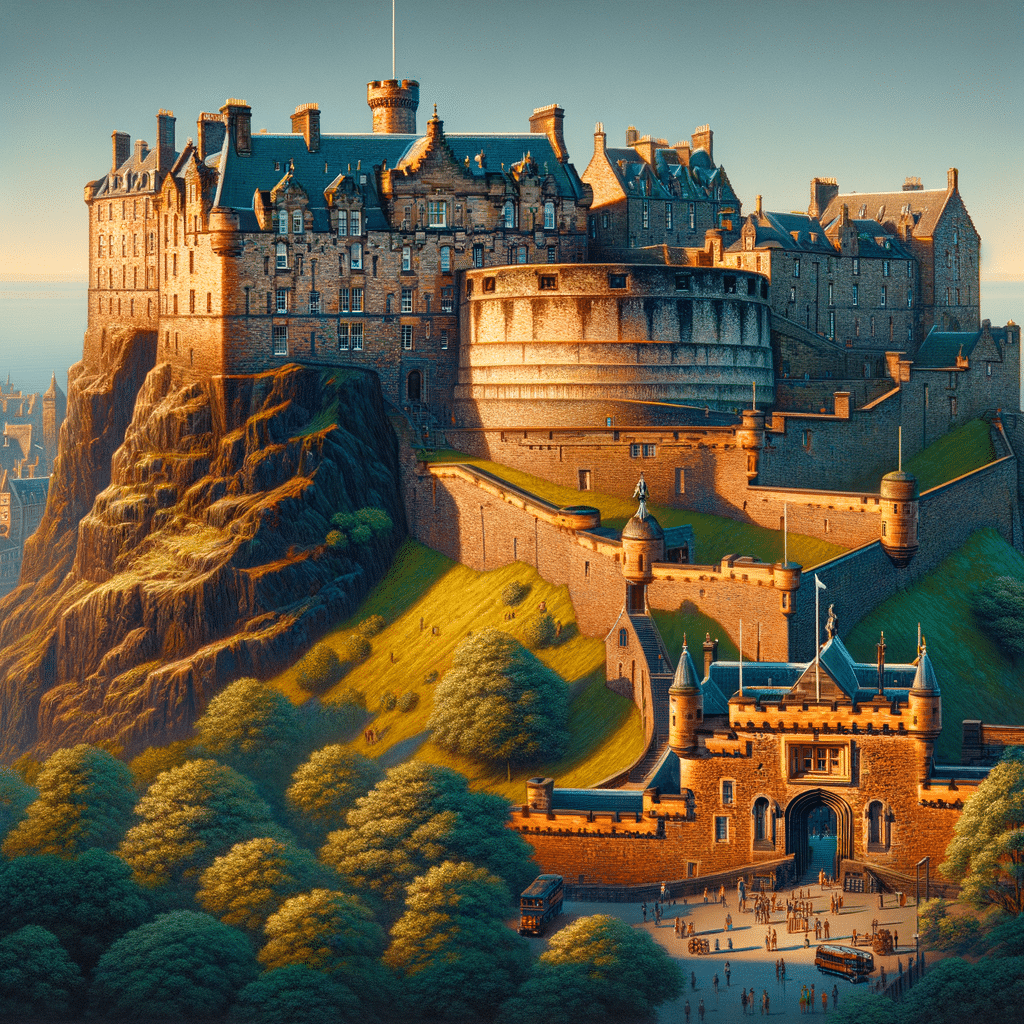
For ages, people have experienced paranormal activity at Edinburgh Castle, which is located impressively atop an extinct volcano overlooking Scotland’s capital city. The fortress is one of Scotland’s most supposedly haunted places because of its sordid past of battle, incarceration, torture, and execution, which has caused many people to believe it is home to restless souls.

Paranormal History
With its enormous stone walls towering from 350 million years of volcanic rock, this majestic castle dominates Edinburgh’s skyline. The castle complex consists of a number of structures from many historical eras, including old chapels, Victorian military structures, and medieval great halls. The Great Hall, with its characteristic hammerbeam roof, the royal palace that houses the Scottish Crown Jewels, and St. Margaret’s Chapel, Edinburgh’s oldest surviving building from the 12th century, are among its most notable buildings.
The castle has been used as a military fortress, a jail of war, and a royal home for more than a millennium. The castle was occupied by Scottish kings and queens until 1633, when Charles I became the final monarch to occupy it. The citadel saw multiple sieges over the course of its history, with English and Scottish armies taking control alternately. Prisoners from the American Revolutionary War and the Napoleonic Wars were housed in the castle dungeons. Many people perished there as a result of torture, execution, or unfavorable circumstances (Weirter, 1913).
At Edinburgh Castle, there have been several reports of ghostly experiences. The most well-known ghost is the Phantom Piper, who is said to show up when the castle is in peril. According to legend, a piper who was sent to investigate the tunnels beneath the castle vanished forever, leaving only the sound of his pipes resonating through the passageways. Other alleged apparitions include the spirit of Lady Janet Douglas of Glamis, who was executed at the stake for witchcraft in 1537, and a headless drummer boy who was first sighted prior to Oliver Cromwell’s 1650 siege of the castle (Halliday, 2013).
Unaccounted-for phenomena have been recorded by both workers and visitors around the castle. These include shadow figures in the military museums, enigmatic footfall in deserted hallways, abrupt temperature decreases in the dungeons, and the sound of drums when no one is playing. In the less-traveled parts of the castle, some people have reported seeing ghostly warriors, while others have reported feeling invisible presences or having strange emotional reactions in particular places.

Paranormal Explanations
Researchers studying the paranormal provide a number of explanations for the observed activities. According to one hypothesis, powerful emotional experiences—especially sad ones—can create energetic imprints that play back like recordings. According to a different hypothesis, the castle’s position atop volcanic rock may intensify natural electromagnetic fields, which some people think might affect perception and foster paranormal occurrences. Another explanation given for possible spiritual attachments is the castle’s lengthy history of death and sorrow.
Many theories have been developed by the paranormal research community to explain the claimed unexplained events at Edinburgh Castle and other similar sites. These theories include more modern scientific theories as well as more conventional spiritual beliefs. According to the Stone Tape Theory, which was put forth in the 1970s, structures or things have the ability to collect and replay energy from traumatic or emotional events in a manner akin to how a tape captures sound. This hypothesis suggests that the centuries of conflict, executions, and suffering may have left energy etched into the walls of Edinburgh Castle. In order to explain why several witnesses claim to have seen the same apparitions or experienced comparable events in particular places, proponents contend that specific meteorological conditions or psychological states may cause these “recordings” to play again.
Building on this idea, the Residual Energy Theory suggests that strong emotions and human consciousness leave energy traces in the surroundings. According to this notion, emotional and psychological energy from past events is still present in Edinburgh Castle’s dungeons, execution sites, and battlegrounds. According to some researchers, these energy remnants can be detected by sensitive people, who may then experience them as bodily sensations, emotional reactions, or apparitions.
According to interdimensional ideas, what we seem to be paranormal activity may actually be glimpses of other dimensions or other periods. According to these hypotheses, Edinburgh Castle may be one of the “thin spots” where the boundaries between dimensions become permeable. These interdimensional windows may be influenced by elements like electromagnetic fields, geological features, or astronomical alignments, which would account for why paranormal activity frequently appears to rise during particular situations or periods (Imbrogno, 2013).
According to the Consciousness Theory, paranormal occurrences arise from interactions between the residual consciousness of the deceased and the collective awareness of living people. According to this notion, consciousness can stay connected to meaningful places even after death. It’s possible that Edinburgh Castle’s extensive human history has produced a sophisticated web of conscious energies that modern tourists occasionally perceive or engage with.
According to the Quantum Theory of Ghosts, quantum physics concepts may be able to explain paranormal occurrences. According to this idea, consciousness could be a quantum field that persists after death, which could account for residual hauntings—where things seem to repeat without any interaction—as well as intelligent hauntings, where ghosts appear to communicate with the living. Edinburgh Castle’s distinct geology and electromagnetic characteristics may produce circumstances that increase the perceptibility of these quantum consciousness fields (Jones, 2006).
According to time slip theories, what we see as ghosts may actually be traces of the past that have permeated the present. According to these views, time isn’t always linear and can overlap in some situations. Because of Edinburgh Castle’s rich history and distinctive geological features, there may be instances in which the past and present momentarily blend together, giving modern witnesses the opportunity to see or experience historical events or figures.
Natural Explanations
Skeptics, however, provide logical justifications for these occurrences. They draw attention to the peculiar acoustic phenomena produced by the castle’s old construction, which can be mistaken for supernatural due to its thick walls and cramped passageways. Natural temperature fluctuations may result from the building’s thermal characteristics, and visitors may be more likely to perceive everyday events as ghostly due to its eerie past and atmospheric location. Furthermore, some claimed experiences may be explained by the power of persuasion and the human propensity to look for patterns in seemingly random events.
The connection between electromagnetic fields (EMF) and paranormal activity reports offers an intriguing point of convergence between parapsychology and science. For a long time, researchers have examined how electromagnetic fields could account for some reports of paranormal activity, especially in places like Edinburgh Castle where paranormal encounters have been reported consistently.
Strong electromagnetic fields can interact with the brain, especially the temporal lobe, to produce noticeable changes on human perception. This area of the brain can induce experiences that are strikingly comparable to documented paranormal encounters when exposed to specific electromagnetic frequencies. Hallucinations, a sense of being watched, and an invisible presence are some examples of these effects. Variable magnetic fields have even been shown by some researchers to cause micro-seizures that provide strange sensory sensations. Furthermore, visitors to purportedly haunted places frequently report experiencing physical symptoms including headaches, nausea, dizziness, and disorientation as a result of extended exposure to specific EMF frequencies.
The construction and geographical position of Edinburgh Castle offer multiple natural sources of electromagnetic waves. Magnetic materials found in the volcanic rock the castle is built on have the ability to produce localized magnetic fields. Temperature changes in the castle’s enormous stone walls can create piezoelectric effects, which produce tiny electrical charges, while underground water movement through this rock can induce electromagnetic fluctuations. Areas of exceptional electromagnetic activity could be produced by the combination of these natural occurrences (Zotova & Ushanova, 2020).
Interesting connections between tales of paranormal activity and electromagnetic phenomena have been found by scientific research. Higher-than-normal electromagnetic field measurements have been recorded by researchers in regions where reports of paranormal activity are common. Additionally, a correlation between claimed ghostly experiences and geological fault lines has been observed. Furthermore, research has demonstrated connections between clusters of inexplicable occurrences recorded by witnesses and variations in local magnetic fields.
These results imply that although there may be physiological explanations for many paranormal experiences, the connection between electromagnetic fields and human perception is intricate and poorly understood. Strong or unique electromagnetic fields may be the cause of the frequent accounts of paranormal activity at some places, such as Edinburgh Castle.
Conclusion
The paranormal activity associated with Edinburgh Castle continues to captivate both tourists and scholars. Skeptics contend that natural causes and human psychology can explain these experiences, while believers cite centuries of consistent reporting and eyewitness testimonies as proof of authentic supernatural happenings. Whatever one’s point of view, the castle’s combination of dramatic history, opulent architecture, and enigmatic happenings guarantees its status as an intriguing location for paranormal enthusiasts.
References
Halliday, R. (2013). Edinburgh After Dark: Vampires, Ghosts and Witches of the Old Town. Black & White Publishing.
Imbrogno, P. J. (2013). Interdimensional universe: The new science of UFOs, paranormal phenomena and otherdimensional beings. Llewellyn Worldwide.
Jones, M. D. (2006). PSIence: How New Discoveries in Quantum Physics and New Science May Explain the Mysteries of Paranormal Phenomenom. Red Wheel/Weiser.
Weirter, L. (1913). The Story of Edinburgh Castle. GG Harrap, & Company.
Zotova, T. V., & Ushanova, N. P. (2020). The Interaction of Infrasound and Architectural Monuments on Examples of Ancient Castles. Components of Scientific and Technological Progress, (3), 16-22.

Leave a Reply