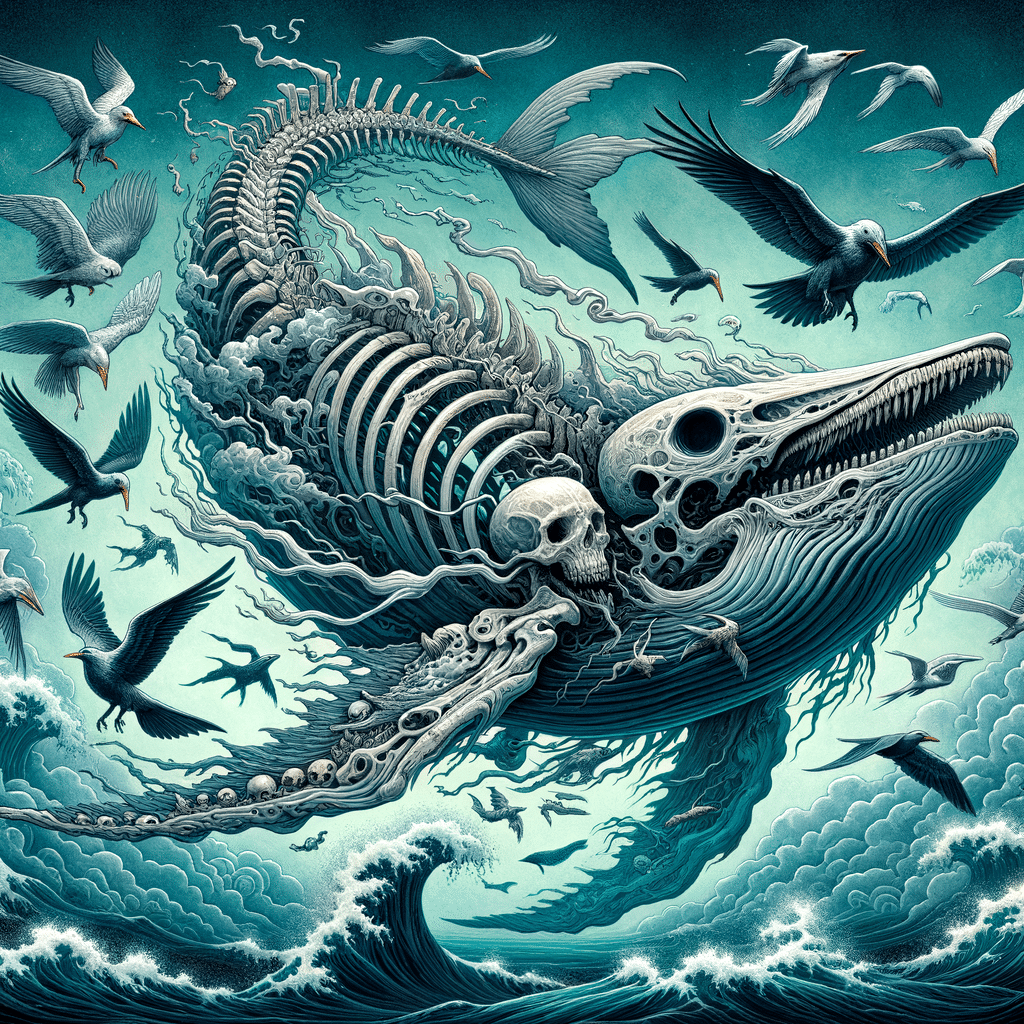
Among the most eerie and unusual yokai (supernatural beings) in Japanese maritime mythology is the Bake-kujira, also known as the ghost whale in Japanese folklore. This skeletal whale apparition, believed to emerge from the foggy waters off the coast of Shimane Prefecture, especially around Matsue, has enthralled Japanese coastal towns for decades. The folklore of the paranormal and legendary beings is still relevant today.

Description
The Bake-kujira’s physical characteristics are remarkable and recognizable. According to conventional wisdom, it resembles a huge whale skeleton that is entirely fleshless but nonetheless moves through the water as though it were alive. It is frequently followed by odd, spectral fish and birds that swim in its wake, and its bones are said to shine an unsettling white, even in the dark. According to other stories, these accompanying animals are likewise skeletons, giving the waves a gruesome procession (Bane, 2016).
Just as enigmatic as its appearance is the behavior of this extraordinary whale. Despite its massive size, witnesses say the Bake-kujira travels through the water quietly, producing no ripples or disruption. According to folklore, its appearance portends coming misfortune, especially disastrous harvests or fishing mishaps. There are stories of entire fishing communities going into poverty after a Bake-kujira sighting, and fishermen who come across the ghost whale frequently say that their nets remain empty for days after the encounter (Howerton, 2021).
Bake-kujira has traits in common with a number of other Japanese yokai, especially those related to transformation and water. Though they manifest as human ghosts rather than animal spirits, the Funayurei, the spirits of individuals who perished at sea, also haunt and bring disaster to maritime travelers. Similar to Bake-kujira, they are known to prey on fishermen and have the potential to ruin fishing trips.
Another intriguing analogy is the female spirit of the water, Isohime. Isohime, while not as malevolent as the Bake-kujira, shares a connection with the interactions between humans and aquatic life. But instead of seeking revenge, she usually defends marine life.
The Japanese mermaid-like creature known as the Ningyo is more directly analogous. When it comes to fishing and coastal villages in particular, Ningyo and Bake-kujira are both signs of impending tragedy. However, every encounter with Bake-kujira only results in bad luck, despite the belief that consuming Ningyo’s meat grants immortality.
Despite using different techniques, Bake-kujira and the Ikuchi, an oil-secreting sea yokai, both deal with marine disasters. The presence of Bake-kujira brings about universal misfortune, but the Ikuchi attack ships directly by smearing them with oil. It takes a more straightforward approach.

Regional Variations
Different coastal regions of Japan are the main source of regional variances in Bake-kujira portrayals. The most comprehensive stories originate from the Sea of Japan coast, specifically Shimane Prefecture. Reports frequently highlight the creature’s iconic skeletal appearance and its ethereal fish and bird entourage (Roberts, 2010).
Some stories describe the Bake-kujira in southern regions—especially around Kyushu—as more horrific than a mere skeleton due to the remnants of decaying flesh still attached to its bones. These versions occasionally mention a foul smell that goes along with its appearance. Accounts from northern coastal regions, particularly Hokkaido, combine features of floating ice formations with Bake-kujira. Perhaps inspired by the natural occurrence of moonlight reflecting off ice, these accounts occasionally mention how the monster seems to gleam or shimmer in winter moonlight.
According to certain legends, the Bake-kujira are smaller but more common in the Inland Sea regions, and they occasionally appear in groups rather than alone. These narratives frequently have a closer connection to certain fishing villages and their past. The folklore changes as appropriate for the local storytellers.
Modern Views
Bake-kujira folklore’s development closely reflects Japan’s complicated whale and whaling relationship. During the Edo period (1603–1867), when whaling was a vital industry in coastal Japan, the mythology most likely first appeared. The ghost whale may have arisen as a form of guilt or as a paranormal explanation for the diminishing whale populations because whales were hunted to almost extinction in some places. People say that the Bake-kujira symbolizes the vengeful spirits of whales killed by hunters, mirroring the Buddhist concept of reincarnation and the consequences of taking life.
A variety of mediums have revitalized the Bake-kujira in contemporary popular culture. Numerous anime and manga series have featured it, frequently portraying it as a strong and enigmatic sea spirit. The ghost whale has appeared as both an opponent and an ally in video games, especially those that are based on Japanese legend. Contemporary artists have also adopted the Bake-kujira, frequently using it to link the mythical animal to contemporary environmental issues, particularly those related to ocean conservation and the effects of commercial whaling (Mandals, 2016).
The Bake-kujira has gained popularity among environmental activists and educators as a potent emblem of environmental awareness and ocean conservation. This spectral whale effectively symbolizes the effects of overfishing and marine pollution. Japanese conservation organizations have used the Bake-kujira picture in public awareness campaigns to compare the loss in whale populations today to the skeletal whale of mythology. Environmental deterioration reinterprets the legend’s prophecy of bad luck following Bake-kujira sightings as a forecast of ecological catastrophe.
Teachers use the Bake-kujira story in their environmental education lessons, especially in coastal communities in Japan. Teachers use the legend to teach children about the history of whaling, marine ecosystems, and the value of sustainable fishing methods. By relating the ghost whale’s story to a cultural legacy, it helps young learners understand and remember difficult environmental themes.
Several environmental artists have created installations using Bake-kujira, a product made from plastic waste and ocean debris, to convey a powerful message about marine pollution. These pieces, which blend traditional storytelling with modern environmental messaging, frequently tour public areas and schools. Interactive websites and mobile applications, which use this iconic animal to teach about marine conservation, have also included the Bake-kujira in their educational digital media. While addressing contemporary environmental issues, these contemporary interpretations preserve the original folklore’s warning element.
Conclusion
As a potent reminder of humanity’s complicated relationship with the ocean and its people, the timeless legend of the Bake-kujira is still relevant in modern-day Japan and beyond. Whether perceived as a warning about environmental stewardship, a supernatural expression of guilt, or simply an intriguing piece of maritime mythology, the ghost whale remains an intriguing figure that unites Japan’s traditional spiritual beliefs with contemporary environmental concern. As long as people remain captivated by the secrets of the water, the Bake-kujira is likely to continue captivating people’s attention and stimulating fresh interpretations of this age-old myth.
References
Bane, T. (2016). Encyclopedia of spirits and ghosts in world mythology . McFarland.
Howerton, A. (2021). Toward a Poetics of Allyship: Rajiv Mohabir’s Radical, Animal Coolitude. MELUS , 46 (1), 1-23.
Mandals, SVPK (2016). The relevance of the Japanese myth of creation and the Tale of Jiraiya in the anime manga series Naruto (Doctoral dissertation, University of Mumbai).
Roberts, J. (2010). Japanese mythology A to Z (2nd ed.). Chelsea House Publishers.
Wikipedia contributors. (2024, September 11). Bake-kujira. In Wikipedia, The Free Encyclopedia. Retrieved 21:39, January 7, 2025, from https://en.wikipedia.org/w/index.php?title=Bake-kujira&oldid=1245186923



Leave a Reply