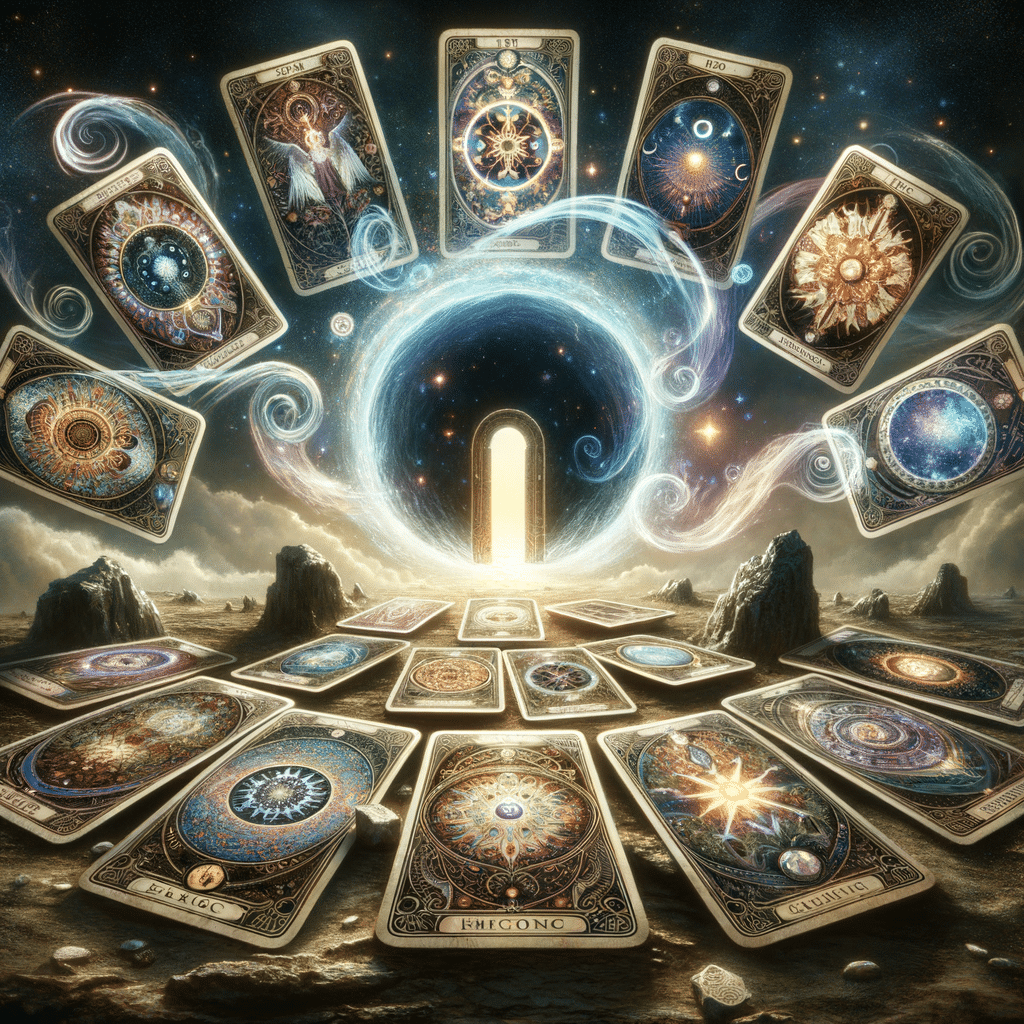
Throughout human history, we have created tools and artifacts that enable us to transcend the mundane routine. Rich in symbolism and powerful images, tarot cards have long been guides between the physical world and worlds beyond traditional view. This link between tarot and the idea of portals exposes much about humanity’s continuous search for secret knowledge and other worlds. These embellished cards and their use as metaphysical doors provide an interesting window into how we build meaning from symbols and how these symbols might change our sense of reality.

Overview
At their most basic, tarot cards are a deck of 78 illustrated cards split into the Major and Minor Arcana, each carrying symbolic imagery loaded with several levels of meaning. While the Minor Arcana has four suits—cups, pentacles, swords, and wands—each containing ten numbered cards and four court cards—the Major Arcana consists of 22 trump cards portraying archetypal individuals and cosmic forces, including The Fool, Death, and The World. Beyond their physical appearance, tarot cards are repositories of collective information locked in visual language, a complex system of esoteric knowledge gathered from many philosophical, religious, and mystical traditions. Through symbols that communicate directly to the subconscious, their images connect with the most recessive areas of human awareness and build a link between the logical mind and intuitive knowledge (Hofer, 2009).
In both literal and symbolic terms, portals are gates or thresholds permitting passage between two worlds, therefore connecting them. In architecture, they are physical gateways that signal changes between areas, usually ornamented to indicate their significance as limits separating the profane from the holy. Mythologically, portals seem across civilizations as magical doors, fairy rings, or cave entrances that carry visitors to foreign regions, therefore acting as liminal areas where the usual norms of reality might be suspended. Metaphysically, portals provide means for consciousness to move between several levels of awareness or realms of life, offering doors through which we could catch realities usually concealed from our view. The idea of portals reflects mankind’s ongoing conviction that there are worlds outside our daily life accessible by particular ways or situations (Hume, 2020).
Tarot cards and portals are connected in their capacity as interfaces between the known and the unknown. Laying tarot cards in a spread, a reader creates a threshold experience whereby hidden insights could show themselves between conscious awareness and more profound currents of knowledge. Every card serves as a doorway or gateway through which elements of the unconscious, communal knowledge, or spiritual dimensions could be seen and understood. Reading tarot is like crossing a perceptual boundary—that of a portal—where normal awareness extends to incorporate symbolic and intuitive modalities of knowing. Tarot’s liminal character makes it especially useful for psychological integration and spiritual inquiry since it lets people access aspects of themselves or reality usually hidden under the surface of daily awareness (Jodorowsky & Costa, 2009).

Impact
Over millennia of cultural transmission and evolution, the mythology around tarot and gateways has changed rather significantly. Originally used as playing cards for games in 15th-century Europe, tarot first seemed to have no magical meaning but later absorbed components from Hermetic philosophy, Kabbalah, alchemy, and other esoteric traditions to become tools for divination and spiritual direction. This development reflects how formerly basic architectural needs—doors and thresholds—became imbued with supernatural significance as borders between worlds. Every age has reinterpreted these ideas depending on its dominant perspective: Renaissance mystics saw tarot as containing divine wisdom, Enlightenment thinkers tried to systematize its symbolism, and modern psychologists reinterpreted it through the prism of archetypes and the collective unconscious. These changing readings show how people constantly develop and reinterpret legends to express their relationship with mystery and the transcendent.
Tarot and portals have psychological power because they activate the liminal imagination—our ability to conceive of and negotiate thresholds between many realms of existence. Like walking between rooms, when we interact with tarot, we enter a transitory condition where several possible meanings coexist simultaneously. This liminality permits psychological change as stiff lines separating conscious from unconscious material become momentarily flexible. Tarot cards’ symbols, which use visual analogies to transmit difficult psychological realities across logical defenses, operate much like dream images. In his theory of “active imagination,” Carl Jung identified this trait whereby symbolic interaction opens a portal to greater self-awareness. From this perspective, tarot reading becomes a ritual of threshold-crossing in which the cards act as actual representations of psychic doors (Huson, 2004).
Modern interpretations of tarot as gateways now also incorporate quantum and neurological viewpoints. Some theories suggest that symbolic systems such as tarot might assist in the reorganizing of neural pathways, hence establishing fresh connections in the brain that provide access to hitherto unreachable knowledge or cognitive processes. Others propose that consciousness itself operates via quantum events, and tarot is a tool for guiding the collapse of probability waves into specific insights or realizations. Whether using a theoretical framework or not, practitioners still find tarot as a gateway between ordinary and non-ordinary awareness where knowledge apparently lacking through traditional channels becomes available. Whether we choose to explain it or not, this recurring experience throughout civilizations and times points to tarot’s function as a portal connecting to basic elements of the human mind and perspective (Daniels, 2024).
Conclusion
Tarot cards represent humanity’s ongoing development of symbolic thresholds across which we could reach latent spheres of existence. Physical artifacts bearing ideal images act as physical gates between conscious and unconscious worlds, known and unknown territory of human experience. Their success resides in their capability to stimulate the mind’s natural capacity for symbolic thinking and liminal awareness, not in supernatural powers. Tarot as a portal is still significant as we keep changing our knowledge of consciousness and reality since it points to the continuous human intuition that there are doors to increased awareness buried inside our cultural productions. Between the query of the card reader and the visuals that show, a portal opens—not to some far-off world but rather to deeper levels of our own multifarious life.
References
Daniels, K. N. (2024). Stars, Cards, and Stones: Exploring Cosmic Connections between Astrology, Tarot, and Runestones. Schiffer+ ORM.
Hofer, G. M. (2009). Tarot cards: An investigation of their benefit as a tool for self reflection (Doctoral dissertation).
Hume, L. (2020). Portals: Opening doorways to other realities through the senses. Routledge.
Huson, P. (2004). Mystical origins of the tarot: from ancient roots to modern usage. Inner Traditions/Bear & Co.
Jodorowsky, A., & Costa, M. (2009). The way of tarot: The spiritual teacher in the cards. Simon and Schuster.


Leave a Reply