Brown Lady Ghosts: Key Points
-
Brown lady ghosts are female apparitions wearing earth-toned period clothing from the eighteenth and nineteenth centuries, appearing solid with pale faces contrasting their dark attire.
-
These spirits typically walk purposefully through spaces while seeming unaware of observers, often replaying moments from their lives rather than attempting to communicate with the living.
-
The most famous example is the Brown Lady of Raynham Hall, allegedly photographed in 1936, with folklore connecting these ghosts to stories of betrayal and untimely death.
-
Explanations range from paranormal theories about residual consciousness to skeptical perspectives involving optical illusions, environmental factors, and psychological phenomena like pareidolia.
-
Brown lady ghost stories have influenced literature and tourism while shaping paranormal investigation methodologies through photography and environmental analysis.
-
These apparitions serve as cultural metaphors for historical injustices against women and the persistence of trauma, ensuring their continued presence in the collective imagination.

Introduction
The occurrence of brown lady ghosts constitutes a particularly captivating and enduring subset of spectral experiences, as evidenced by historical records and cross-cultural accounts. These specific apparitions, identifiable by their distinctive brown or earth-toned attire, have intrigued ghost hunters, folklorists, and skeptics for centuries. In contrast to the conventional white-sheeted specter often depicted in popular culture, brown lady ghosts embody a more complex and historically situated manifestation, frequently linked to particular locales, tragic narratives, and social circumstances. Consequently, the examination of these apparitions provides valuable perspectives not only on paranormal beliefs but also on the cultural anxieties, historical recollections, and narrative traditions of the communities in which they are reported.
Brown Lady Ghost Description
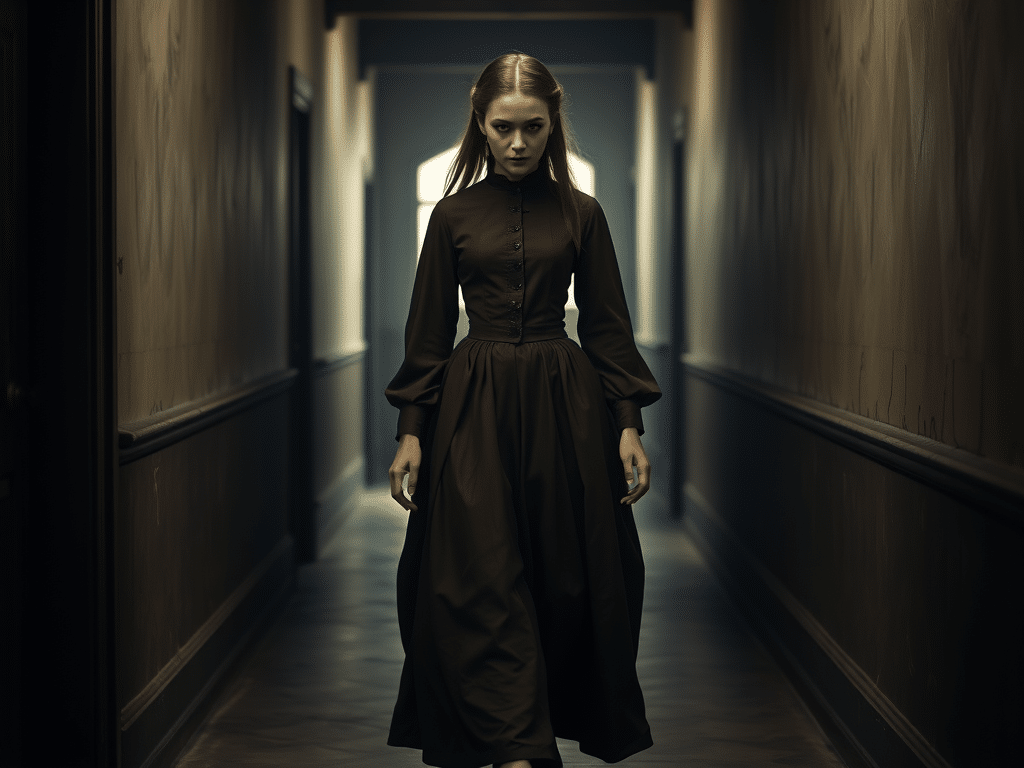
Brown lady ghosts are generally characterized as female apparitions attired in period clothing, the colors of which typically span from deep chocolate to lighter tan tones. The brown hue of their attire frequently mirrors the sartorial trends of earlier periods, especially the eighteenth and nineteenth centuries, when brown textiles were prevalent among women of all social strata. Observers often describe these entities as possessing a solid, three-dimensional quality, rather than a translucent one, although they may either gradually diminish or abruptly disappear upon closer inspection. The garments typically feature long dresses or gowns with expansive skirts, high collars, and sometimes shawls or capes, all presented in a range of earth tones that characterize these spirits (Thomas, 2007).
The physical characteristics of brown lady ghosts extend beyond their clothing to include their overall comportment and presentation. Numerous witnesses recount these apparitions as having pale or glowing faces that sharply contrast with their dark clothing, thereby generating a disconcerting visual impression that amplifies their ethereal quality. Their hair is frequently depicted as dark, styled in accordance with the fashions of their respective eras, and arranged in buns or braids or concealed beneath caps or bonnets. Some narratives describe eyes that glow or appear hollow, whereas others portray the apparitions as possessing strikingly realistic features, rendering them indistinguishable from the living until they vanish or traverse solid matter (Innes, 2023).
The behavioral characteristics of brown lady ghosts typically exhibit several recurring themes that differentiate them from other spectral entities. These spirits are often described as moving deliberately through corridors, staircases, or gardens, frequently appearing oblivious to or unconcerned by the presence of witnesses. Numerous brown lady ghosts seem to be reenacting particular moments from their lives, such as descending a staircase, standing at a window, or traversing rooms along routes that may no longer correspond to the building’s present configuration. Unlike more aggressive or malevolent spirits in folklore, brown lady ghosts are generally portrayed as sad, mournful, or merely present, going about ethereal business without attempting to communicate with or frighten the living, though their appearance inevitably causes alarm.
In folklore traditions from around the world, brown lady ghosts occupy a significant place in the taxonomy of supernatural beings. The most famous example is undoubtedly the Brown Lady of Raynham Hall in Norfolk, England, believed to be the ghost of Lady Dorothy Walpole, whose apparition was allegedly photographed in 1936 in one of the most celebrated ghost photographs ever taken. European folklore contains numerous accounts of brown-clad female spirits haunting manor houses, castles, and estates, often connected to stories of betrayal, forbidden love, or untimely death. These tales frequently serve as cautionary narratives about the treatment of women, the consequences of family disputes, or the dangers of breaking social conventions, with the brown lady’s eternal wandering representing unfinished business or unresolved injustice.

Theories
Several theories have been advanced to account for sightings of the brown lady ghost, encompassing supernatural, psychological, and environmental perspectives. Proponents of the paranormal posit that these apparitions are manifestations of the lingering energy or awareness of the deceased, especially those who perished in distressing or emotionally significant situations. The frequent appearance of brown attire in these encounters could be attributed to the historical prevalence of brown fabrics, thereby statistically increasing the likelihood that numerous deceased women would have worn such colors during their lifetimes. Conversely, skeptics offer alternative explanations, including optical illusions stemming from lighting conditions, shadows, and the human brain’s propensity for pareidolia, the tendency to discern meaningful patterns within random stimuli. Furthermore, environmental factors, such as low-frequency sound waves, which can induce feelings of discomfort and even visual hallucinations, have also been proposed as potential explanations for certain sightings.
Ghosts function as metaphorical vehicles for collective traumas, especially those stemming from colonial legacies and experiences of marginalization. The “brown lady” ghost, for instance, can represent the enduring impact of racial injustices and the associated cultural memories. Johnson (2020) explores how ghostly entities, such as the “Lady Mother” spirits in Thailand, embody the persistent consequences of both individual and societal trauma, thereby serving as a reminder of unresolved historical conflicts. This spectral presence frequently serves as a prompt for societal acknowledgment and confrontation with the past.
Furthermore, psychological theories provide an additional perspective on the phenomenon of the brown lady ghost. The human propensity for suggestion, especially within environments steeped in ghostly lore, can prompt individuals to perceive ambiguous visual cues as evidence of the supernatural. Memory distortion and the social reinforcement of ghostly accounts can create self-sustaining cycles in which expectations shape experiences, thus reinforcing beliefs and narratives. Certain scholars have posited that sightings of the brown lady could embody a form of collective or cultural memory, wherein communities unconsciously preserve and reenact historical narratives through paranormal occurrences. The persistent nature of these sightings at particular locales may be linked to the psychological and emotional significance of spaces associated with pivotal historical events, especially those involving female suffering or injustice.
Impact
The cultural influence of brown lady ghost stories transcends mere entertainment or superstition.
These accounts have significantly shaped literary traditions, spanning from Gothic novels to modern horror, thereby establishing a framework for the examination of memory, culpability, and the impact of historical trauma. Numerous tourism sectors have leveraged the allure of brown lady legends; consequently, locations associated with these spectral figures have evolved into prominent tourist destinations, stimulating economic growth and contributing to the conservation of historical landmarks. Furthermore, these narratives fulfill educational functions, illuminating historical figures and occurrences that might otherwise be overlooked, especially the experiences of women whose lives were circumscribed by societal norms and power disparities. Ghost stories, therefore, occasionally provide a means for marginalized historical voices to achieve posthumous acknowledgment and cultural visibility.
In both literary and folkloric contexts, the “lady ghost” motif has been extensively repurposed to represent not only the supernatural but also to investigate historical identities and societal discourses. The lady motif’s adaptation, for example, demonstrates regional and contextual variation, thereby facilitating community engagement with historical narratives. Boye’s research underscores the “Rådhusspøkelset’s” role in shaping Arendal, Norway’s historical identity, effectively transforming the ghost from a European archetype into a localized symbol of nostalgia and heritage (Bjerkås & Fjalsett, 2024). These reinterpretations, consequently, prompt a critical reevaluation of historical accounts that frequently overlook women’s contributions.
Moreover, Glasbeek’s research indicates that employing a “ghost methodology” in the examination of surveillance and community violence allows academics to confront the less apparent, yet significantly influential, aspects of societal issues (Glasbeek, 2022). The pervasive lack of sufficient representations and the quest for acknowledgment echo scenarios featuring “brown lady” ghosts, as these figures exemplify stories that demand visibility in the face of erasure. This perspective emphasizes the psychological value of history, viewing it as tangible remnants necessitating careful consideration and examination. Moreover, O’Donnell’s feminist literary critiques explore the intersection of gender and race within ghost narratives, underscoring the influence of these spectral figures in current dialogues concerning domesticity and gendered violence (O’Donnell, 2020). These reinterpretations enrich the horror genre, portraying ghosts as intricate entities that subvert patriarchal frameworks.
Brown lady apparitions have significantly influenced the evolution of paranormal investigation as a scholarly discipline. The renowned Raynham Hall photograph, notwithstanding persistent disputes regarding its veracity, played a pivotal role in establishing photography as an instrument for ghost hunting, thereby shaping the methodologies employed in paranormal research for many years (Baldwin, 2024). These instances have engendered discourse concerning the nature of evidence, the dependability of eyewitness accounts, and the interplay between belief systems and empirical inquiry. Contemporary paranormal investigators frequently utilize brown lady sightings as illustrative examples for formulating investigation protocols, evaluating equipment, and scrutinizing environmental variables that could either contribute to or elucidate apparitional encounters, irrespective of their individual stance on the subject matter.
Conclusion
The persistent allure of brown lady ghosts underscores fundamental human anxieties concerning mortality, the nature of memory, and the pursuit of justice. These spectral figures frequently represent women who endured hardship during their lifetimes, whether through betrayal, mistreatment, or societal limitations; consequently, their spectral endurance serves as a symbol of unresolved historical injustices and the transmission of trauma through time. The specific visual element of brown attire anchors these narratives in historical veracity, thereby enhancing their authenticity and connection to real individuals and occurrences, in contrast to more generalized ghost stories. Given that societies will continue to confront issues related to the past’s influence on the present, the essence of consciousness and existence beyond death, and the appropriate recognition of historical wrongs, brown lady ghosts will probably persist in both physical locations and cultural imagination, functioning as conduits between the living and the domains of memory, legend, and potential.
References
Baldwin, P. J. (Ed.). (2024). Ghost Stories: Architecture and the Intangible. John Wiley & Sons.
Bjerkås, T., & Fjalsett, G. K. B. (Eds.). (2024). Sted og identitet – minne, markeringer og historiebruk i lokalsamfunn på Agder [Place and identity – memory, markers and use of history in local communities in Agder]. Cappelen Damm Forskning. https://doi.org/10.23865/cdf.230
Glasbeek, A. (2022). The Haunting of Surveillance Studies: Seeing, Knowing, and Ghostly Apparitions. Surveillance & Society, 20(4), 364-371. https://doi.org/10.24908/ss.v20i4.15981
Innes, B. (2023). Ghost Sightings. Amber Books Ltd.
Johnson, A. (2020). Accidents and Agency: Death and Occult Economies in Thailand. Made in China Journal, 5(2), 138-143. https://doi.org/10.22459/mic.05.02.2020.15
O’Donnell, E. (2020). Hauntings of Bodies, Selves, and Houses. Digital Literature Review, 7. https://doi.org/10.33043/dlr.7.0.13-23
Thomas, J. B. (2007). Gender and Ghosts. Haunting Experiences: Ghosts in Contemporary Folklore, 81-110.

Leave a Reply