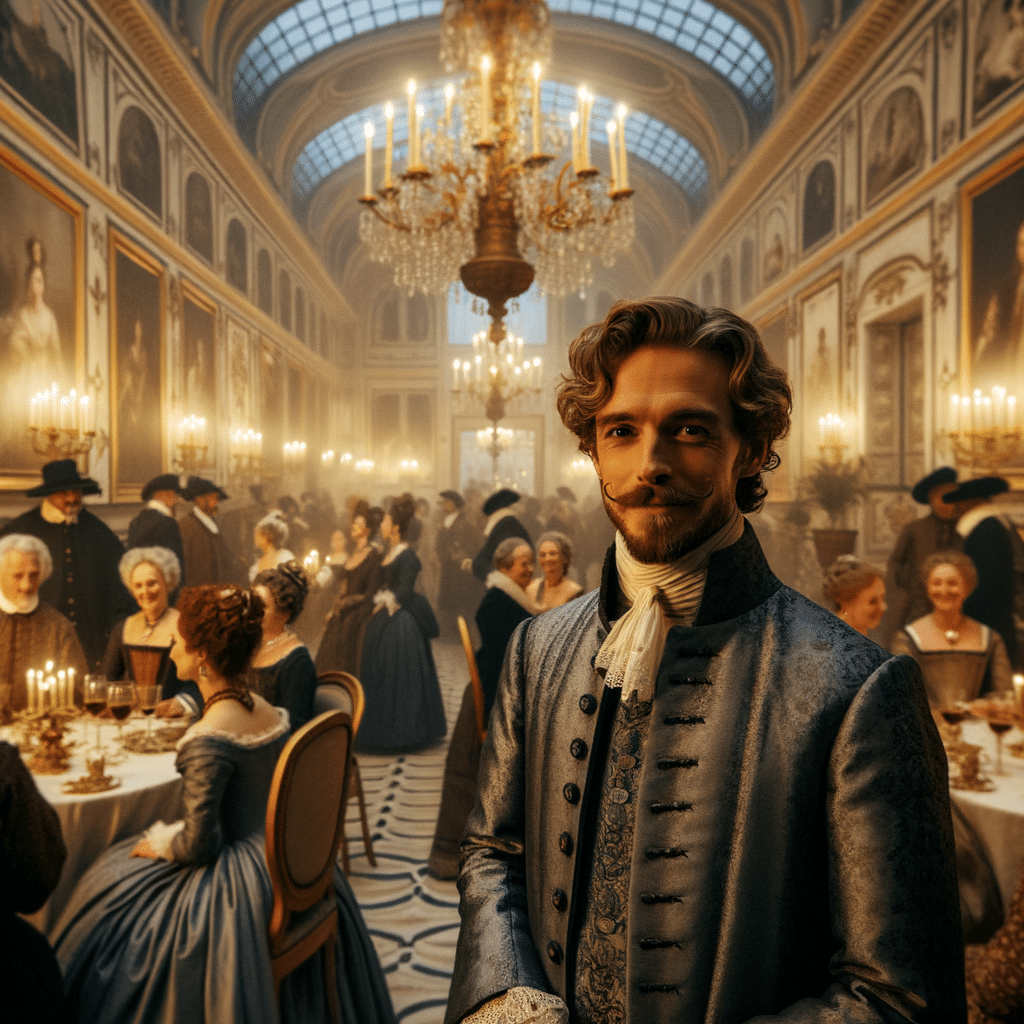
Some people have emerged throughout history whose lives became so interwoven with folklore that distinguishing fact from fiction becomes almost impossible. Perhaps one of the most enigmatic of these people, the Count of Saint Germain enthralled 18th-century European society with his apparent powers, cryptic past, and whirl of tales of supernatural ability that followed. Modern stories describe a sophisticated gentleman of uncertain age who spoke many languages fluently, alluded to events spanning millennia, and demonstrated extraordinary knowledge across many disciplines. The stories of his claimed magical abilities have endured for almost three hundred years, transforming from aristocratic gossip into spiritual doctrine and posing the question: was the Count of Saint Germain really only an extraordinary person whose talents encouraged supernatural rumors, or did he indeed possess abilities beyond ordinary human capacity?

Overview
The historical record offers just sporadic flashes of Saint Germain’s life prior to his arrival in European high society about 1740. Though he presented himself as a nobleman of means and cultivation, no verified birthplace or date existed. His first known appearance was in London in 1743; he was momentarily imprisoned as a Jacobite spy but released when no proof could be turned against him. Later, he became a regular feature in Parisian society during the 1750s and 1760s, where his musical compositions, artistic prowess, and broad knowledge of science and history delighted the elite (Chrissochoidis, 2024). Later, he traveled much over Europe, accompanied Louis XV on delicate missions, and finally resided at the court of Prince Charles of Hesse-Kassel in Germany. Official records state that he passed away in February 1784; but, many who hold beliefs contest even this fundamental truth (Bernard, 1993).
Saint Germain’s powers span the quite amazing but realistic to the completely fanciful range. Commentators of his language skills often noted that he spoke German, English, Italian, Portuguese, Spanish, French, Greek, Latin, Sanskrit, Arabic, and Chinese without any obvious accent. Witnesses said he could quickly create beautiful tunes and play the violin like a virtuoso, therefore highlighting his musical ability. Most remarkably, he showed a profound awareness of historical events spanning millennia, usually speaking about them with the familiarity of a firsthand observer. Rumors of alchemical talent sprang from his seeming riches and amazing collection of jewels; some claimed he could turn base metals into gold and produce perfect precious stones. Most remarkable were his claims about his age and appearance — despite decades of social activity, witnesses remarked he never seemed to age and kept the look of a man around 45–50 years old.
The supernatural assertions about Saint Germain included other psychic and magical powers in addition to alchemical ability and lifespan. Countess von Georgy famously claimed to have met him fifty years before their 1760s meeting when she was a young lady, but he seemed exactly the same when asked about this; he apparently responded with a smile, “I am ancient.” Some witnesses claimed his elixirs and medicines could heal diseases and restore vitality, therefore conferring healing powers to him. Others said he could read sealed letters without opening them or bilocate—that is, show himself at several sites simultaneously. His friends claimed he seemed to require little food or sleep and lived mostly on a unique tea he made. Most importantly, he was reported to have clairvoyant powers; some stories claimed he foresaw the French Revolution and other major historical events years before they happened with accuracy (Fanthorpe, 1998).

Powers?
Examining these assertions closely finds more ordinary reasons for many of Saint Germain’s claimed supernatural abilities. Though outstanding, his language skills fit the education expected of European nobility in that age, especially for someone engaged in foreign diplomacy. Though not extraordinary among the well-educated aristocracy of the time, his musical and creative skills were forceful. Good genes, thorough grooming, cosmetics (which men of prestige used during that period), and the possibility that he may have originally inflated his age, therefore giving the illusion of not aging over time, could help to explain the seeming agelessness. His riches and jewelry collection could have come via smart patronage or investments instead of magical transformation. Most crucially, given his access to Europe’s major libraries, his thorough historical knowledge could have come via much reading rather than direct experience.
The ambiguities and discrepancies in modern narratives further undermine some of the more remarkable assertions. Several witnesses gave contradicting accounts of his look, implying he was less identifiable or consistent than myth suggests. Although amazing to viewers, his alchemical demonstrations usually took place under controlled circumstances, allowing for sleight of hand or substitution. Usually emerging after the expected events had already happened, reports of his prophetic ability begged doubt regarding their veracity. Saint Germain also had an obvious incentive to develop an air of mystery and supernatural skill as a diplomat engaged in delicate political affairs, as such a reputation would increase his influence in diplomatic circles and aristocratic salons, respectively. At least partially, his mystery might have been a manufactured persona rather than a mirror of actual supernatural ability.
The development of the Saint Germain story after his claimed death reveals much about how historical individuals become legendary. Several frauds claiming his identity in the years immediately following his alleged death in 1784 used his notoriety for their benefit. As occult movements grew in popularity during the middle of the 19th century, Helena Blavatsky, co-founder of the Theosophical Society, included Saint Germain into her spiritual cosmology as one of the Ascended Masters, enlightened people who direct human spiritual growth. The result was a dramatic change in his legend from historical curiosity to spiritual personage. Blavatsky asserted to have received messages from him and other masters, therefore setting a standard for expected correspondence with Saint Germain that still exists in many spiritual communities today. The first significant development of the Saint Germain mythology outside his life is this change from historical person to spiritual entity.
Modern Views
Through several esoteric and New Age movements, the Saint Germain myth evolved even more throughout the 20th century. Claiming to have seen Saint Germain physically on Mount Shasta in California, Guy Ballard’s “I AM” activity in the 1930s positioned Saint Germain as their principal spiritual authority. Saint Germain was not only immortal but also apparently lived as other important historical people, including Christopher Columbus, Francis Bacon, and even the prophet Samuel, in one cycle. Later on, the Church Universal and Triumphant built on these assertions, presenting Saint Germain as the Chohan of the Seventh Ray charged with guiding humanity into a new age of spiritual illumination (Prophet & Prophet, 2004). These movements turned what had been aristocratic stories into comprehensive spiritual doctrines with rituals, prayers, and spiritual practices based on calling on Saint Germain’s direction and protection. This transformation demonstrates the ability to adapt historical figures to align with contemporary spiritual needs.
The Saint Germain mythology has been increasingly included into more general new age spirituality recently, where he is regularly cited as an ascended master able to be channeled or invoked. Modern spiritual books credit him with mastery of the violet flame of transmutation, which ostensibly helps practitioners clear negative energy and karma. His alleged alchemical powers have been seen symbolically as signifying personal metamorphosis instead of exact manipulation of physical materials. Modern concerns include environmental damage, spiritual enlightenment, and world transformation, which are allegedly messages from him addressed by contemporary channelers. Spiritual markets abound with books, seminars, and online courses connecting to Saint Germain’s wisdom, proving his legendary outstanding flexibility. Every successive version shows how mythic figures change to remain culturally relevant, reflecting the spiritual concerns of their time (Seligmann, 2018).
Analyzing the Saint Germain phenomenon from a sociological perspective reveals various elements that have helped him to be always appealing. His arrival fell during a period of change in European intellectual history when Romantic sensibilities embracing mystery and transcendence replaced Enlightenment logic. His persona wonderfully captured this conflict: a scientific intellect caught in magical appeal. He is the perfect vehicle for expressing our shared need to transcend death and access ancient wisdom since people are always fascinated with immortality. Furthermore, the intentional vagueness about his birthplace lets several groups claim him as their own, which makes his legend especially flexible between civilizations and ages. His mythology has proven especially strong by combining parts of history, spirituality, and psychology in ways that relate to basic human desires for transcendence, knowledge, and connection to something higher than ourselves.
Independent of supernatural assertions, the historical record offers enough evidence to prove Saint Germain as a real historical person of importance. Periodically, between France and Britain, in particular, diplomatic letters from the era reveal his participation in delicate political conversations. Recent performances of his compositions demonstrate his genuine talent. Modern stories from reliable sources such as Casanova and the Marquise de Pompadour validate his existence in European society and his remarkable, if not superhuman, talents. From these historical shards, one gets the image of a smart, educated, and charismatic person who skillfully negotiated the convoluted political and social terrain of 18th-century Europe. Some historians believe he might have been the illegitimate son of Francis II Rákóczi, Prince of Transylvania, or maybe a Sephardic Jew from Spain or Portugal who changed his name to allow him to travel about Europe. Whatever his actual background, the factual details of his life are wonderful in themselves even in the absence of supernatural embellishment.
Conclusion
One of the most fascinating riddles in history, the Count of Saint Germain is a person whose real achievements have been progressively covered by spiritual relevance and supernatural qualities. Although historical records point to him as a gifted musician, linguist, and diplomat whose enigmatic behavior and extraordinary talent attracted respect among his contemporaries, there is no reliable evidence of really supernatural powers. Rather, what we observe in the development of his myth reflects mankind’s ongoing obsession with surpassing conventional constraints—of knowledge, of death, of human potential. Every generation has adapted his narrative to suit its distinct spiritual and intellectual requirements, transforming a charming 18th-century courtier into a conduit for mankind’s deepest aspirations and most profound mysteries. Whether considered a historical figure or a mythic construct, Saint Germain’s greatest accomplishment could be his posthumous capacity to inspire wonder and spiritual searching across centuries, so illustrating how the most powerful stories develop at the junction of recorded history and our universal search for meaning outside the physical world.
Reference
Bernard, R. (1993). The Great Secret Count St. Germain. Health Research Books.
Chrissochoidis, I. (2024). The music of the Count of St. Germain: An edition [PDF]. Retrieved February 8, 2024, from https://ichriss.ccarh.org/Germain.pdf.
Fanthorpe, P. (1998). The World’s Most Mysterious People (Vol. 3). Dundurn.
Prophet, M. L., & Prophet, E. C. (2004). Saint Germain: Master Alchemist-Spiritual Teachings from an Ascended Master. Summit University Press.
Seligmann, K. (2018). The Mirror of Magic: A History of Magic in the Western World. Simon and Schuster.



Leave a Reply