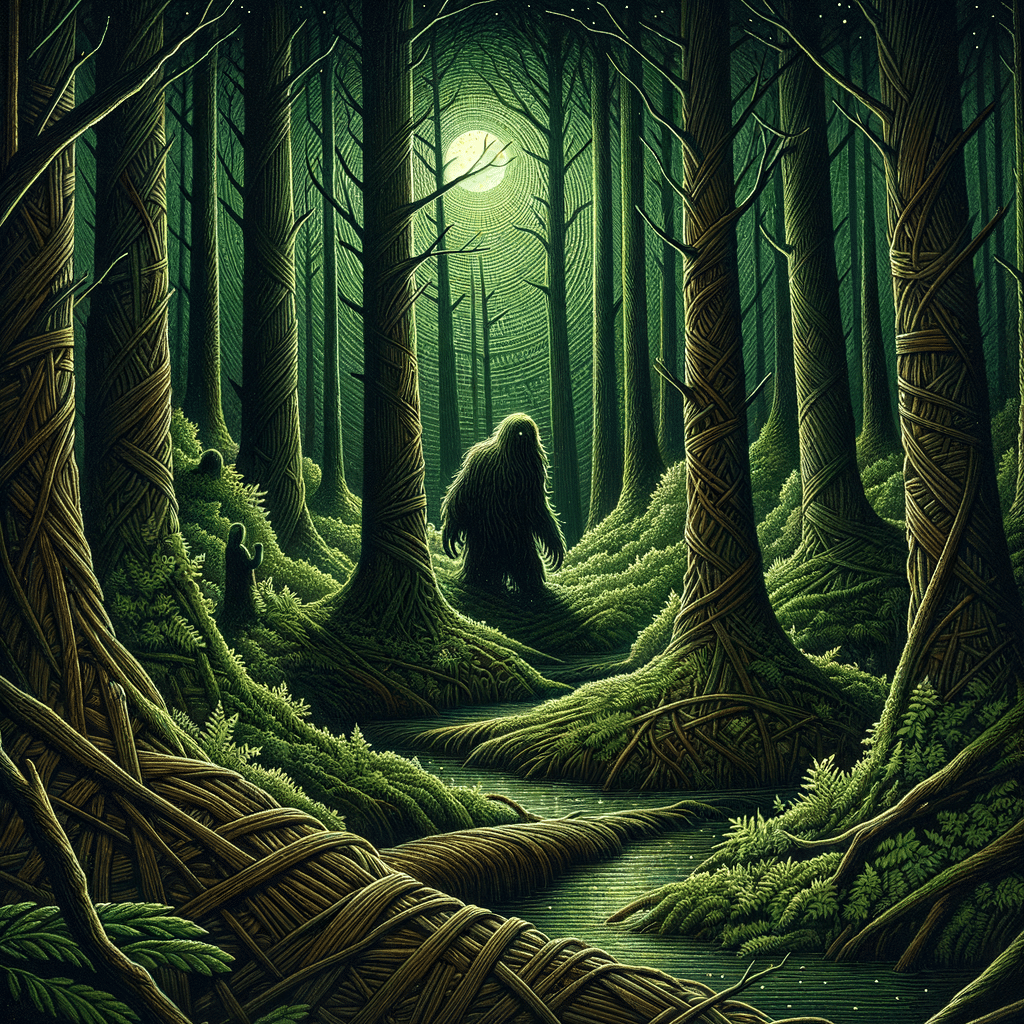
The deep, mist-covered woodlands of Appalachia have long been inhabited by mysterious tales handed down through generations of mountain people. Among these ageless tales is the Wood Booger, a creature said to lurk in the far hollows and slopes of ancient mountains. Though similar to other cryptids like Bigfoot or Sasquatch, the Wood Booger has its own distinct regional identity that reflects the cultural history of Appalachia. A complex interplay of indigenous beliefs, European folklore, and the isolation experienced by early settlers who carved out lives in one of America’s most challenging wilderness locations created these narratives.

Overview
Usually characterized physically, the Wood Booger is a large, bipedal monster between six and eight feet tall with a robust, muscular physique appropriate for the rugged mountain environs. The Wood Booger’s thick, matted hair, ranging from dark brown to reddish or even black, often provides natural cover within the shadows of dense woodland foliage. Occasionally its appearance is described as a disturbing combination of human and ape-like characteristics with deep-set eyes that gleam unnaturally in the dark, a prominent brow ridge, and an exceptionally wide mouth capable of generating bone-chilling screams that echo over mountain valleys. Often with unusual characteristics like missing toes or unusual arch patterns, the monster leaves distinctive imprints significantly larger than human feet (Simmons & Blackwell-West, 2023).
The behavioral characteristics attributed to wood boogers reveal a creature that usually shuns human contact and deftly navigates the challenging Appalachian environment. Though their size suggests otherwise, they roam woodlands with surprising stealth and have acute awareness that allows them to spot human presence from a long distance. Local tales frequently highlight the Wood Boogers’ love of tree knocking, which is striking trees with stones or wood to communicate across valleys, and their habit of watching human settlements from concealed vantage points before vanishing totally. Some stories suggest they either live in simple shelters constructed from forest materials or use natural cave systems abundant across the region, moving yearly to follow food supplies and flee harsh winter weather.
Reflecting both geographical isolation and the specific cultural backgrounds of storytellers, regional tales regarding Wood Boogers vary widely across different communities. Often in eastern Kentucky, stories have animals working as convenient protectors of local knowledge, purposely scaring trespassers away from hidden moonshine stills or coveted hunting locations. While Virginia mountain villages frequently refer to them as more benevolent forest guardians who might even protect lost children, Tennessee folklore portrays them as more aggressive animals capable of raiding farmsteads for food during harsh winters. Consistent throughout these various stories is the Wood Booger’s role as a mirror of the wild, untamed nature of Appalachia itself—a reminder of humanity’s fragile link with the natural world surrounding early mountain villages (Ocker, 2022).

Evolution of Wood Booger Folklore
Anecdotes suggest he encountered these entities during his exhaustive late 18th-century Appalachian wilderness journey run across many early Wood Booger legends, which emphasize the renowned frontiersman Daniel Boone. Always unflappable, Boone is supposed by folklore to have encountered hair-covered giants in the Cumberland Gap in 1769, an event that seemingly left him quite upset. These tales became particularly well-liked in eastern Kentucky, where Boone spent much time and where storytellers claimed he learned the habit of leaving small food presents to soothe the entities when passing through their territories. Though historical records provide no definitive evidence that Boone himself believed in or encountered such beings, his connection to the Wood Booger legend relates to the ongoing cultural relevance of the frontier hero in Appalachian folklore as one who valued and revered the mysteries of the forest (Lindahl, 2022).
The story of the Wood Booger myth adapts to accommodate changing cultural needs, reflecting more general shifts in Appalachian society over time. Early settlement stories depicted the animals largely as dangerous wilderness threats, reflecting pioneers’ genuine worries about the unexplored forest and its potential dangers. As towns were established and familiar with their environs during the 19th century, Wood Booger legends frequently morphed into moral stories warning children against venturing too far into the woods or staying out after dark. The mid-20th century saw the mythology include elements of environmental concern as many legends portrayed Wood Boogers as beings pushed farther into seclusion by mining, logging, and development. Modern interpretations can view them as reflections of Appalachia’s disappearing wilderness and the particular cultural legacy of the region being lost to uniformity.
Tales of Wood Booger have fascinating connections to the faerie traditions introduced to Appalachia by Scottish and Irish immigration in the 18th and 19th centuries. Both stories include humanoid beings living in liminal wilderness regions beyond human settlements, have complex but distant ties to humans, and expect certain rituals or presents to ensure harmonious coexistence. Suggesting cultural fusion as Old World beliefs adapted to New World environments, the practice of delivering modest gifts for Wood Boogers closely matches Celtic traditions of offering milk or bread to satisfy the fae (Henderson & Cowan,2001). There are even linguistic connections; some scholars have likened Appalachian descriptions of “boogers” to the Irish Gaelic term bodach (which means old man or spirit) or the Scottish bogle (which means naughty spirit), demonstrating how language and folklore evolved together in the cultural melting pot of early Appalachia.
Modern Impact
The relationship between Wood Boogers and the more well-known Bigfoot or Sasquatch is a fascinating study in how regional cryptid traditions mix with more widespread national mythology. Though Wood Boogers emerged from various cultural backgrounds and had different evolutionary paths in American legend, they show obvious superficial similarities with Bigfoot—both being large, hairy, bipedal humanoids who reject human engagement. Long before the Patterson-Gimlin film propelled Sasquatch into public American consciousness in 1967, Wood Booger customs developed organically in isolated Appalachian towns far away from the national Bigfoot craze (Daegling & Schmitt, 1999). Wood Booger, a distinctive name, reflects this regional autonomy by retaining historic Scots-Irish language influences rather than adopting the more well-known terminology that would later dominate cryptid discussion.
Appalachian towns underwent a complex cultural negotiation as their local Wood Booger traditions suddenly connected to a bigger event when national interest in Bigfoot rose throughout the 1970s. Some mountain villages deliberately maintained the distinction, emphasizing certain aspects of their Wood Booger mythology that distinguish their animals from the Sasquatch of the Pacific Northwest—such as their lower average height, more aggressive demeanor, or specific cultural customs like gift giving. Some individuals fast absorbed elements of the national Bigfoot narrative into their local culture, often retroactively interpreting decades of Wood Booger sightings as evidence that “Bigfoot has always been here in these mountains.” This tension between regional uniqueness and participation in a national cryptid community still largely dominates discussions about wood boogers in modern Appalachia.
Studying both traditions, scholars discover significant behavioral differences suggesting particular mythical evolution instead of only various names for the same animal. While Wood Booger customs more frequently include elements of intentional interaction—whether by intimidation, curiosity, or trade—Pacific Northwest Bigfoot tales typically portray quiet, secretive creatures generally uninterested in humans. Often depicted as having quasi-supernatural abilities absent in other Bigfoot tales, Wood Boogers feature powers such as invisibility, weather control, or the ability to alter human perception. Perhaps most tellingly, Wood Booger practices exhibit deeper integration with more broad supernatural belief systems, keeping linkages to witch stories, ghost stories, and fairy legends reflecting Appalachia’s distinct cultural past. Conversely, Bigfoot has primarily developed inside a pseudo-scientific framework attempting to categorize the animal as an unknown primate rather than a supernatural being.
Remaining as a distinctive part of Appalachian cultural identity, the Wood Booger myth connects contemporary mountain communities to their past and changes to fit current concerns. Annual festivities of the creature attract tourists to economically suffering communities where local storytellers relay generations-old tales with more contemporary claimed sightings. Occasionally, environmental organizations use the wood booger as a de facto symbol for wilderness preservation efforts, arguing that protecting its habitat maintains important ecosystems. Though scientific consensus classifies wood boogers as folklore rather than biological reality, their cultural significance surpasses worries of literal existence, therefore reflecting the mystery, tenacity, and unique legacy of Appalachian people who have maintained their traditions despite outside influence and centuries of change (Coberly, 2017).
Conclusion
Signifying far more than a simple monster story or regional oddity, the Wood Booger is a strong symbol of Appalachia’s distinctive cultural environment. Especially in a location where nature has historically controlled the terms of life and prosperity, these narratives expose the intricate interaction between humans and the natural environment. As modern development alters even the most remote Appalachian villages, Wood Booger traditions provide a cultural touchstone linking present mountain people to their predecessors’ feelings of both horror and respect toward the forest. Whether believers take the stories literally or folklorists view them as cultural metaphors, the continued discussion of Wood Boogers in the area reveals how tightly mythology and identity are intertwined in places where the land itself changes people’s lives from one generation to the next.
References
Coberly, E. T. (2017). Woodbooger Tourism.
Daegling, D. J., & Schmitt, D. O. (1999). Bigfoot’s screen test. Skeptical Inquirer, 23, 20-25.
Henderson, L., & Cowan, E. J. (2001). Scottish fairy belief: A history. Dundurn.
Lindahl, C. (2022). Daniel Boone, Yahoos, and Yeahohs. North American Monsters: A Contemporary Legend Casebook, 248.
Ocker, J. W. (2022). The United States of Cryptids: A Tour of American Myths and Monsters. Quirk Books.
Simmons, S. S., & Blackwell-West, M. (2023). Legends & Lore of Southwest Virginia. Arcadia Publishing.




Leave a Reply