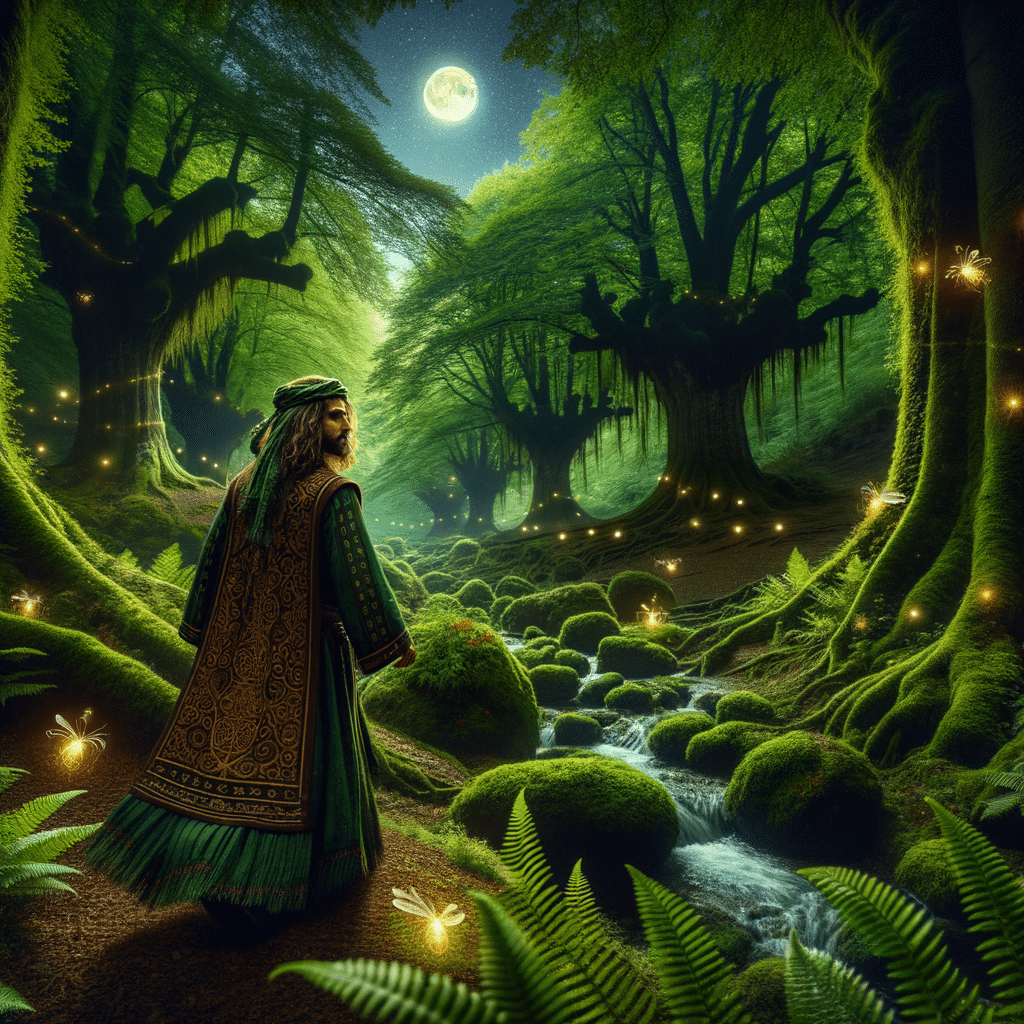
One of the most mysterious religious groups in history, the ancient druids’ activities and beliefs are cloaked in obscurity partially because of their oral tradition and the scant written records concerning them. Mediating between people and the supernatural powers permeating the natural world, these educated Celtic societal characters acted as priests, judges, healers, and knowledge keepers. Their spiritual link to nature showed most clearly in their respect for sacred groves—natural sanctuaries where the veil between worlds was thought to lessen. This essay investigates the historical knowledge of druids, their close association with sacred natural areas, and the supernatural events connected with their ritual locations, as well as how our view of druids has changed over time.

Overview
Emerging as a separate social class within Celtic Iron Age Europe, especially in Gaul, Britain, and Ireland, the druids had major political and spiritual power. Julius Caesar, Pliny the Elder, and Tacitus, among other classical authors, portrayed them as philosophers and ceremonial experts who studied natural events, astronomy, and divine secrets for up to twenty years before finishing their study (Hutton, 2009). Memorizing great amounts of poetry, genealogy, and religious knowledge that governed Celtic culture, they served as stewards of oral tradition, advisors to monarchs, and arbiters of justice. Unlike many modern religious institutions, the druids let both men and women join their ranks; female druids were occasionally called druidesses or ban-drui in Irish traditions, implying a relative egalitarianism unusual for the ancient world.
Profound respect for nature as a manifestation of divine presence was central to druidic practice. The druids saw some areas as naturally sacred—where the line between the ordinary and the spiritual became thin. Chief among these were the sacred groves, natural woodland sanctuaries where druids congregated to perform rituals, make offerings, and interact with supernatural powers. Classical sources depict these nemeton (holy sanctuaries) as hubs for religious activities, court cases, and seasonal celebrations honoring the Celtic calendar. While Roman sources highlight oak woods in particular as areas of immense importance, the Greek geographer Strabo described a sacred grove of the Carnutes in Gaul where druids from all across the area would gather to pass verdicts (Ross, 2012).
In druidic lore, the oak tree represented strength, knowledge, and the axis linking earthly and divine spheres, hence holding great respect. Pliny the Elder claims druids held a mistletoe-gathering ritual in which a white-robed priest scaled an oak tree and cut mistletoe with a golden sickle, capturing it in a white cloth before it touched the ground. Believed to guarantee fertility and guard against disease, this ceremony was held beneath a sixth-day moon. Beyond oaks, some springs, wells, mountains, and strange rock formations were also included in the holy landscape of druidic practice, therefore forming a network of natural temples all across the Celtic realm where people could directly encounter divine presence without the need for man-made buildings.
Many ancient stories of these sacred forests feature descriptions of unusual events that challenged reason. Tacitus claimed the groves on Anglesey (Mona), a last stronghold of the druids against Roman conquest, were “haunted by supernatural terrors” where “the altars flowed with human blood.” Medieval manuscript preserved folklore tells of strange lights among ancient trees, disembodied voices singing in lost languages, and unexpected atmospheric shifts happening during ritual observance. Some stories said that sacred groves were areas where time itself flowed differently; a day spent inside the grove could correspond to weeks or only minutes in the outside world, implying these locations were partly outside usual temporal limits.
Stories of protective mechanisms safeguarding these sacred areas from trespassers are especially tenacious. Reportedly, Roman troops felt inexplicable dread as they neared particular groves; others said supernatural powers pushed them away or caused disorientation that sent them off course. Celtic mythology kept tales of trespassers being hit by unexpected sickness, having nightmares for years following, or perhaps vanishing completely if they harmed trees or upset ritual locations within the groves. These stories either reinforced the supposed power connected to these natural sanctuaries or reflected actual paranormal events, psychosomatic reactions to cultural taboos, or propaganda meant to save sacred areas.

Shifting Views Through Time
Under Roman domination, the repression of druidic customs pushed many rites underground; when Christianity spread across former Celtic regions, sacred information was kept in ever more covert ways. Christian authors by the early medieval era frequently depicted druids as evil sorcerers practicing dark magic in distant woods, mixing their respect of nature with demonic worship. This recharacterization both dismissed indigenous religious traditions and accounted for aberrant events connected to historic sacred sites. Notwithstanding this demonization, aspects of druidic respect for hallowed natural areas survived in folk rituals; holy wells, extraordinary trees, and particular groves kept their spiritual relevance even as their original religious setting faded from memory.
Though this attention sometimes mirrored modern concerns rather than historical accuracy, the Renaissance and Enlightenment eras saw a revival of interest in druids as historical persons rather than supernatural dangers. Romantic nationalists in the 18th and 19th centuries reinterpreted druids as proto-scientists who grasped natural laws and noble philosopher-priests. Despite little proof linking the prehistoric monument to historical druids, groups like the Ancient Order of Druids, founded in 1781, were generating new ceremonies at locations like Stonehenge. Neo-druidic movements claiming spiritual descent from the ancient order emerged during this time. These reinterpretations downplayed features deemed barbarous by modern standards and highlighted those of druidic heritage that fit Enlightenment ideals (Pokorny, 1908).
Modern archaeological studies have revealed more complicated knowledge of sacred trees as rich ritual hubs (Fitzpatrick, 2007). Excavations in places like Navan Fort in Ireland and Flag Fen in England uncover evidence of ritualized placements of precious items, animal sacrifices, and occasionally human bones, implying these sites fulfilled several ceremonial purposes throughout centuries. Environmental study has shown that some sacred groves were intentionally managed landscapes rather than pristine wilderness, with proof of purposeful planting, removal, and maintenance to produce particular atmospheric conditions for ritual use. These results imply that while preserving the look of natural nature, druids deliberately formed their sacred areas, hence producing settings that intensified sensory experiences and maybe helped to cause the strange events noted at these locations.
Modern scientific points of view provide possible justifications for several of the paranormal events connected with old sacred woods. While infrasound generated by wind blowing through thick stands of trees can create sensations of anxiety and paranoia, certain fungal spores prevalent in old-growth woods can trigger hallucinogenic effects when breathed. Sometimes geological features under sacred sites produce electromagnetic anomalies that can alter human perception and even cause temporal lobe experiences akin to spiritual visions. While they offer background for knowing why certain sites could regularly produce strange perceptual effects throughout generations of visitors, these natural justifications do not automatically deny the spiritual relevance of such events.
The contemporary renaissance of interest in druids and sacred groves mirrors more general environmental issues and spiritual searches in an ever urbanized society. From neo-druidic groups to environmental campaigners to spiritual searchers, everyone has banded together to defend historic woodlands; certain extraordinary trees and groves enjoy legal protection depending on their cultural relevance. Modern druids mix rebuilt historical customs with current environmental consciousness and hold ceremonies in ancient sacred sites all throughout Europe. People are talking about cultural appropriation, historical accuracy, and the right balance between modern spiritual practice and academic knowledge of the past because of this renaissance. This shows how druidic traditions are changing as living cultural expressions instead of just strange historical facts (Orr, 2014).
Conclusion
Ultimately, the link between druids and sacred groves is one of the most lasting spiritual links throughout history between people and the natural environment. Druids have maintained strong emblems of nature-based spirituality and indigenous knowledge traditions from their beginnings in Celtic Europe through times of suppression, romanticization, and resurrection. The supernatural happenings in these holy places show how these carefully chosen natural sanctuaries deeply affect people’s minds. The atmosphere, cultural expectations, and maybe even real supernatural encounters all came together to create strong spiritual surroundings. The ancient druidic respect for sacred groves provides both a historical viewpoint and possible motivation for rethinking how people could once again acknowledge particular areas as deserving of special protection and respect as modern society battles environmental concerns and seeks more sustainable connections with the natural world.
References
Fitzpatrick, A. P. (2007). Druids: towards an archaeology. Communities and Connections: Essays in Honour of Barry Cunliffe, Oxford University Press, Oxford, 287-315.
Hutton, R. (2009). Blood & mistletoe: The history of the Druids in Britain. Yale University Press.
Orr, E. R. (2014). Spirits of the Sacred Grove. John Hunt Publishing.
Pokorny, J. (1908). The Origin of Druidism. The Celtic Review, 1-20.
Ross, A. (2012). Ritual and the Druids. In The Celtic World (pp. 423-444). Routledge.




Leave a Reply