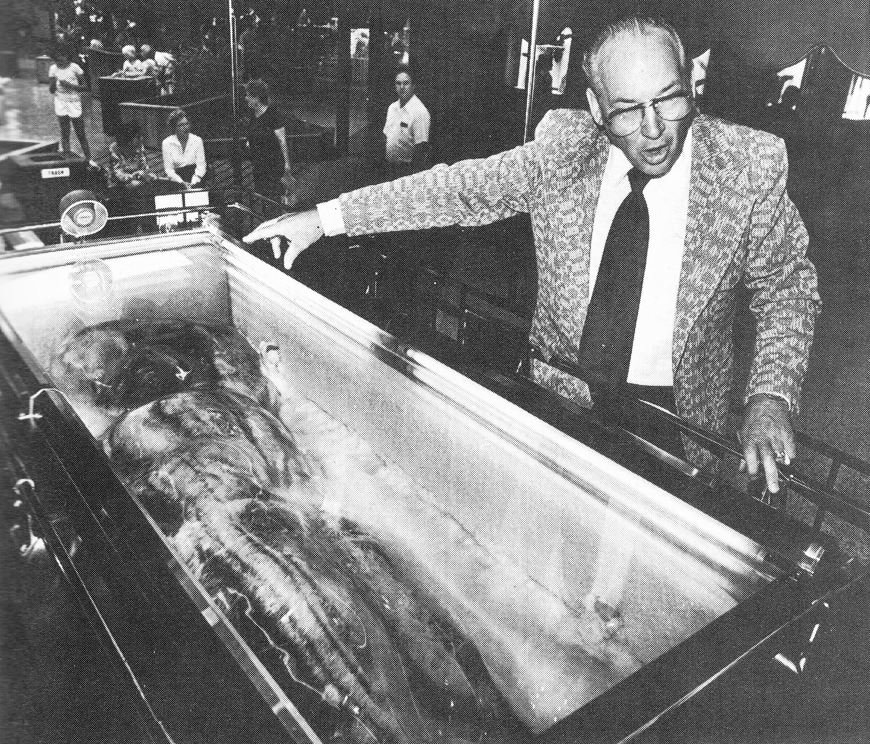
A strange sight that crossed the boundaries between scientific research, carnival entertainment, and mythmaking, the Minnesota Iceman ranks among the most fascinating cryptozoological oddities of the twentieth century. In the late 1960s, this intriguing frozen specimen—purportedly a humanoid species preserved in ice—captured the fascination of both the general public and serious scientists alike. The story of the Minnesota Iceman not only offers a captivating look into America’s mid-century carnival culture but also sheds light on how cryptid stories change with time, molded by shifting societal views and scientific knowledge. Examining this odd case reveals a striking crossroads of legend, theatrics, and the human need to believe in the exceptional.

Overview
The exhibition history of the Minnesota Iceman started in the late 1960s when carnival promoter Frank Hansen began showing the frozen specimen at state fairs, shopping malls, and carnival circuits all throughout the American Midwest. Housed in a custom-built refrigerated glass coffin, the hairy humanoid figure rapidly became a sensation, bringing curious onlookers who paid to see what Hansen variously said was a Neanderthal, missing link, or undiscovered primate killed in Southeast Asia during the Vietnam War. After noted cryptozoologists Bernard Heuvelmans and Ivan T. Sanderson investigated the creature and released their results, its notoriety skyrocketed as they proposed it was a real unknown primate they called Homo pongoides. Hansen, though, said he had swapped a model for the real specimen when formal scientific inquiry was sought, sparking a debate that only served to increase the allure of the display. Hansen switched between assertions of authenticity and admissions of artifice depending on his audience during the Iceman’s touring years, with promised revelation followed by calculated ambiguity continuing throughout. This approach allowed the frozen figure to keep its appeal as a carnival attraction until interest started to decline in the mid-1970s.
Those who looked at the Minnesota Iceman during its display peak meticulously recorded its physical appearance. Housed in a chilled glass casket, the specimen showed as a hairy, humanoid creature around six feet tall with a strong, muscular frame. Witnesses said dark brown to black hair covered most of its body, with significantly less hair on the face, hands, and soles of the feet. The creature’s face had a flat nose, noticeable brow ridge, and deeply recessed eyes that made it look somewhere between human and ape. Many viewers found the creature’s obvious state most unsettling; it appeared to have bullet wounds to the head and eye, one arm apparently shattered and contorted in an odd posture, implying a violent death (Gerhard, 2016).
Given that the item was always shown in its frozen, dead condition, the behavior ascribed to the Minnesota Iceman was mostly conjectural. Still, advocates and certain academics who thought it genuine devised hypotheses on how such a creature may have existed. Often, Frank Hansen would say it was a Neanderthal or missing link surviving in faraway wilderness. Some cryptozoologists hypothesized that the animal was a relict population of prehistoric hominids adapted to frigid conditions, which could potentially account for reported Bigfoot sightings all over North America. These behavioral theories often reflected the animal’s alleged strength, wilderness survival skills, and reclusive personality—qualities conveniently impossible to confirm but appealing to people interested in the notion of undiscovered primates.
From scientific explanations to whimsical imagination, the Minnesota Iceman’s beginnings and genuineness sparked several rival theories. Decades later, the simplest explanation emerged: a Hollywood prop manufacturer produced the specimen as a complex model. But in its prime, more strange ideas flourished. Initially thinking the specimen was a real unknown primate, some academics, including respected zoologists Bernard Heuvelmans and Ivan T. Sanderson, released their results in professional publications. Other hypotheses proposed it was a human deformity displayed as part of circus freak shows or maybe a human or ape that had been altered to seem more enigmatic. Hansen himself pushed conflicting narratives, sometimes asserting the species had been discovered by fishermen in Siberian waters, other times implying it originated from Vietnam during the conflict (Regal, 2011).

Impact
Over time, the growth of the Minnesota Iceman story reflects shifting American attitudes regarding carnival culture and cryptozoology. First shown in the late 1960s, the specimen surfaced amid a cultural era suitable for such enigmas—public interest in Bigfoot was rising following the renowned Patterson-Gimlin video, while scientific knowledge of primate evolution was still evolving. Initially attracting significant scientific interest and media attention, the Iceman underwent preliminary investigations under Hansen’s supervision. But Hansen suddenly said he had swapped the real specimen for a model when required for formal scientific research, creating a scenario that could not be verified, which became a hallmark of many cryptid stories. The Iceman faded from public notice during the 1970s as skepticism grew and carnival culture declined; he was occasionally brought back to life as a curiosity in cryptozoological groups.
The involvement of the scientific community with the Minnesota Iceman is a revealing event in cryptozoological history. Initially, the scientific community persuaded Heuvelmans and Sanderson to publish their study in a scholarly journal, identifying the specimen as Homo pongoides (ape-like man). Most conventional scientists, however, were doubtful, especially after Hansen denied comprehensive scientific investigation or carbon dating. The Smithsonian Institution expressed interest in examining the item, but their inquiries met with rejection. Despite the immediate rejection of this idea, the FBI briefly considered investigating the Iceman on the suspicion that it might be a murder victim. Common in cryptozoology instances, this pattern—first scientific interest followed by disappointed research and final rejection—highlights the ongoing difficulty of the science in closing the gap between folklore and scientific approaches (Coleman, 2007).
The Minnesota Iceman’s cultural relevance went beyond concerns of authenticity. As a touring carnival attraction, it reflected America’s long history of sideshow displays that offered the unusual and exotic to rural and small-town audiences. The specimen appeared during a transitional time when interest in scientific enigmas was rising and conventional carnival displays were fading. Hansen’s show drew on both customs, telling spectators to look at the enigmatic image and at the same time asserting scientific relevance. However, despite growing doubts, this dual attraction—to both scientific inquiry and the excitement of the macabre—helped the Iceman maintain its appeal. The story also benefited from ideal timing, coming at a cultural time when Bigfoot, the Yeti, and other cryptid primates had caught public interest, thereby offering a ready-made background for viewers to read the frozen specimen (Rivkin, 2014).
Reflecting modern views on cryptozoology, the Minnesota Iceman has seen sporadic revivals recently. The Museum of the Weird in Austin, Texas, bought the original specimen—or what was said to be the original—in 2013, where it remains on display. Though many still feel attracted to the prospect, albeit far away, that it signifies something really mysterious, modern audiences approach the Iceman with a more sophisticated knowledge of visual effects and model-making. Dedicated to cryptozoology, online groups still argue over the Iceman’s relevance; some accept it as a recognized hoax while others say Hansen’s conflicting comments could have been meant to hide a real find, drawing unwanted notice from authorities (Dregni, 2006).
Conclusion
A frozen portrait of our changing connection with the unknown, the Minnesota Iceman now presents a fascinating crossroads of American legend, scientific research, and entertainment culture. From its carnival beginnings to its contemporary museum residence, the specimen shows how cryptid legends survive by evolving to fit various cultural settings while preserving fundamental aspects of enigma. Whether one sees the Iceman as a sophisticated prank, a real scientific aberration, or something in between, he nevertheless raises questions about what could still be undiscovered in the distant areas of the earth. The lasting attraction of the Minnesota Iceman in an era of satellite mapping and DNA sequencing serves as a reminder that people are still attracted to enigmas that defy simple interpretation, hence maintaining room in our contemporary society for marvel, conjecture, and the alluring prospect of the unknown.
References
Coleman, L. (2007). Mysterious America: The Ultimate Guide to the Nation’s Weirdest Wonders, Strangest Spots, and Creepiest Creatures. Simon and Schuster.
Dregni, E. (2006). Weird Minnesota: Your Travel Guide to Minnesota’s Local Legends and Best Kept Secrets (Vol. 1). Sterling Publishing Company, Inc.
Gerhard, K. (2016). A Menagerie of Mysterious Beasts: Encounters with Cryptid Creatures. Llewellyn Worldwide.
Regal, B. (2011). Bigfoot, the Anti-Krantz, and the Iceman. In Searching for Sasquatch: Crackpots, Eggheads, and Cryptozoology (pp. 55-79). New York: Palgrave Macmillan US.
Rivkin, J. (2014). Searching for Bigfoot. The Rosen Publishing Group, Inc.



Leave a Reply