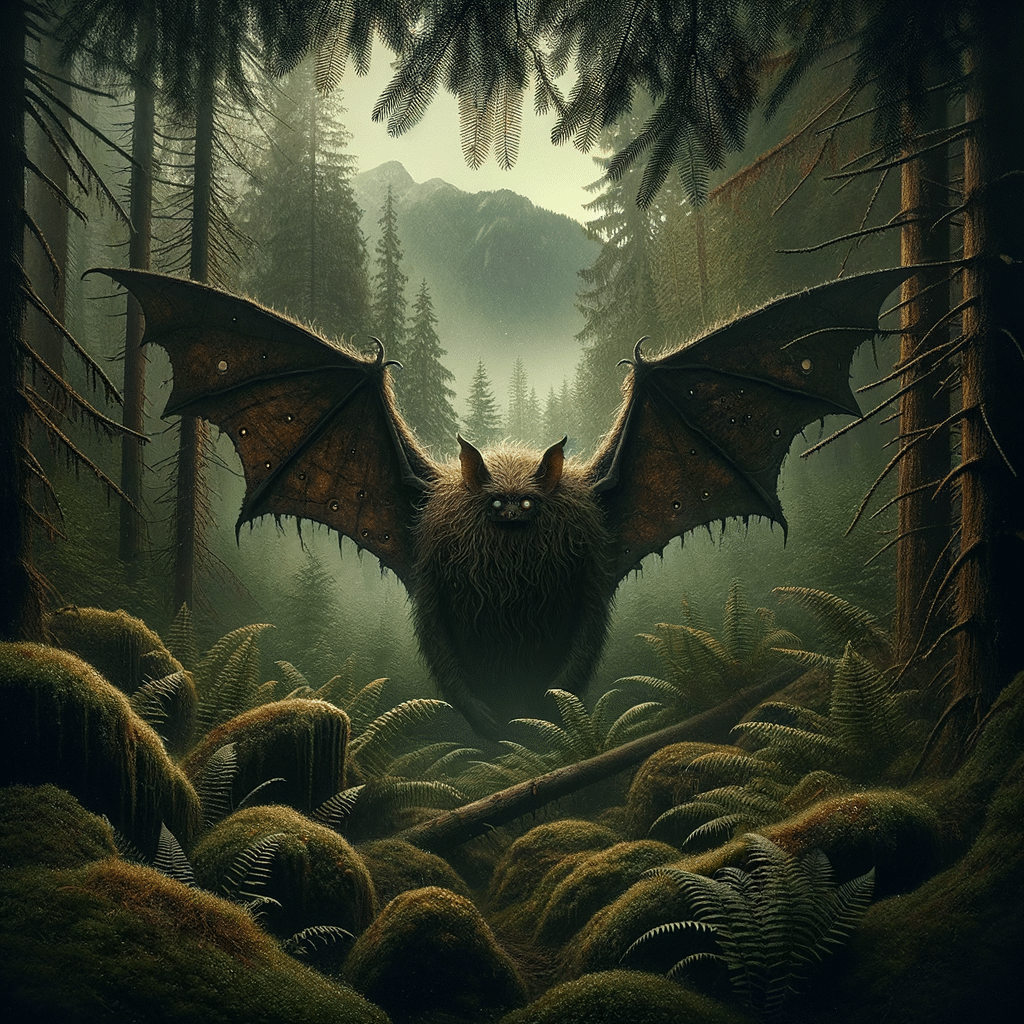
The Pacific Northwest of the United States has long been linked to enigmatic beings hiding in its vast woods and mountain ranges. Among these mysterious entities is the Batsquatch, a fairly recent addition to American cryptozoological folklore that mixes aspects of several legendary traditions. This winged humanoid creature shows how modern concerns and cultural influences produce new legends, therefore reflecting the ongoing evolution of folklore in modern times. The Batsquatch is proof of mankind’s persistent interest in the unknown beings that could populate the environment outside our daily experience.

Description
Folklore has the Batsquatch as a strong creature about 9 feet tall with a muscular, ape-like body covered in bluish-purple hair. Its most unique qualities are huge leathery wings resembling those of a bat, reaching up to 30 feet when fully extended, allowing this enormous monster to fly despite its massive weight. Usually, the creature is depicted as having sharp, bright yellow or red eyes that cut across the blackness of the forest night, a wolf-like or bat-like face with noticeable teeth, and strong clawed hands and feet. Some stories describe a clear sulfurous smell that goes with Batsquatch sightings, hence enhancing the sensory experience of contact with this enigmatic entity (Newton, 2009).
The behavioral habits ascribed to the Batsquatch show its status as a predatory creature of the night. Witnesses say it is mostly nocturnal, preferring to hunt and move under the cover of darkness when its outstanding night vision provides it an edge. Generally avoiding human interaction, the species is known to be territorial and secretive, occasionally forced to investigate human activity encroaching on its territory. Some legends say the Batsquatch can magically turn off cars and electrical devices, hence stranding campers and hikers in its domain. Though its looks are terrifying, stories usually don’t include direct assaults on people; rather, they depict the animal as a frightening presence that would rather scare away trespassers than interact with them directly (Thadani, 2023).
Relative to other cryptids like Bigfoot or the Loch Ness Monster, the Batsquatch legend’s history is rather new. Most folklorists point to the late 20th century as its beginning; the first notable sighting was claimed at Mount St. Helens, Washington, in the early 1980s following the volcanic explosion in 1980. Some theorists link this period to the environmental disturbance brought on by the eruption, therefore implying the creature was either displaced from deep forest habitats or was produced or woken by the geological catastrophe. The most well-known incident took place in 1994 when a teenager called Brian Canfield reported his pickup stalling on a remote road near Buckley, Washington, before seeing a massive bat-like monster fall from the sky and watch him before flying away.

Modern Sightings
Local newspapers in Pierce County, Washington, reported this Canfield encounter in 1994, bringing the Batsquatch to public attention for the first time. Local people were fascinated by the teen’s thorough depiction of a nine-foot-tall purple creature with bat-like characteristics, which finally drew notice from cryptozoologists. Regional paranormal investigators gradually defined the Batsquatch as a separate creature in the cryptozoological vocabulary and started gathering and releasing reports of similar occurrences. Disseminating these tales beyond their local beginnings, small-circulation paranormal newsletters and early internet forums helped the legend to take root in larger cryptid-hunting organizations all over the 1990s (Ocker, 2022).
Reported modern Batsquatch sightings show significant clusters of events near Mount Rainier and Mount St. Helens. With their images revealing an unclear black form against the twilight sky, numerous Cascades hikers in 2009 said they had seen a big winged figure gliding between summits at sunset. A particularly thorough 2011 story told of a forest ranger meeting a towering, fur-covered monster with wings folded against its back sipping from a brook close to Mount Adams; upon seeing the observer, the creature reportedly vanished into the canopy by unfurling huge wings. More recently, in 2018, a group of campers in Olympic National Park claimed their electrical devices failed at the same time before they saw a big, winged shadow flying overhead, momentarily obscuring the stars. These contemporary sightings often incorporate elements absent from earlier accounts, such as electromagnetic interference and unusual weather patterns preceding encounters.
Popular Culture
Social media’s rise has significantly changed how Batsquatch sightings propagate and develop in public awareness. Sites such as dedicated cryptid forums, YouTube, and Reddit now store firsthand stories, research, and discussions about the creature’s existence. While YouTube channels focused on unexplained events often generate material investigating claimed proof and sightings, the r/cryptids and r/humanoidencounters subreddits include several Batsquatch discussion threads. This democratization of information sharing has both increased the legend’s spread and hampered attempts to separate real encounters from artistic invention. Post-2010 narratives, according to some studies, include more complex story components and details that fit common cryptid cliches, implying the impact of current material on fresh reports (Godfrey, 2014).
When many cable television shows included segments on the monster, the Batsquatch got maybe its most notable mainstream exposure in the early 2000s. Typically showing staged reenactments of the Canfield encounter alongside interviews with local witnesses and cryptozoology experts, shows like MonsterQuest, Mysterious Encounters, and In Search Of brought the legend to national audiences. Often placing the Batsquatch next to more well-known cryptids like Bigfoot and the Mothman, these works effectively raised its standing in the hierarchy of American cryptozoological creatures. Since then, the monster has been included in several regional folklore collections, paranormal guidebooks, and cryptid encyclopedias, so confirming its position in the contemporary mythology of the Pacific Northwest (Kitmacher, 2024).
In a particularly interesting turn for the story, Rogue Brewing Company published a Batsquatch Hazy IPA in 2019 with the animal front and center on its label. This commercial use of the Batsquatch brought the fable to a whole new audience who might otherwise never have come across cryptozoological folklore. The marketing materials of the product jokingly alluded to the creature’s link to Mount St. Helens and its enigmatic character, demonstrating how regional cryptids can become cultural touchstones and commercial tools. This commercialization shows an interesting development for a legend that started with remote rural sightings, so showing how folklore adapts to and permeates many facets of modern society.
Conclusion
Ultimately, combining ancient cryptid features with modern concerns and narrative techniques, the Batsquatch is a captivating illustration of modern folklore creation and progression. Although lacking the historical substance of older legends, it makes up for it with a lively, evolving mythology that still fascinates new generations. Whether one sees the Batsquatch as a real biological enigma, a psychological projection of wilderness anxieties, or just a delightful campfire story, it serves to remind us of humanity’s constant need to fill the unknown with amazing beings. Legends like the Batsquatch will keep evolving, reflecting our evolving interaction with the natural environment and the ongoing attraction of the unknown as long as there are still uncharted areas of our planet and unresolved issues about what could live inside them.
References
Godfrey, L. S. (2014). American Monsters: A History of Monster Lore, Legends, and Sightings in America. Penguin.
Kitmacher, I. W. (2024). Pacific Northwest Legends & Lore. Arcadia Publishing.
Newton, M. (2009). Hidden animals: A field guide to batsquatch, chupacabra, and other elusive creatures. Bloomsbury Publishing USA.
Ocker, J. W. (2022). The United States of Cryptids: A Tour of American Myths and Monsters. Quirk Books.
Thadani, R. (2023). The Jersey Devil: Examining a Phenomenon Obscured by Myth. Journal of Scientific Exploration, 37(3).




Leave a Reply