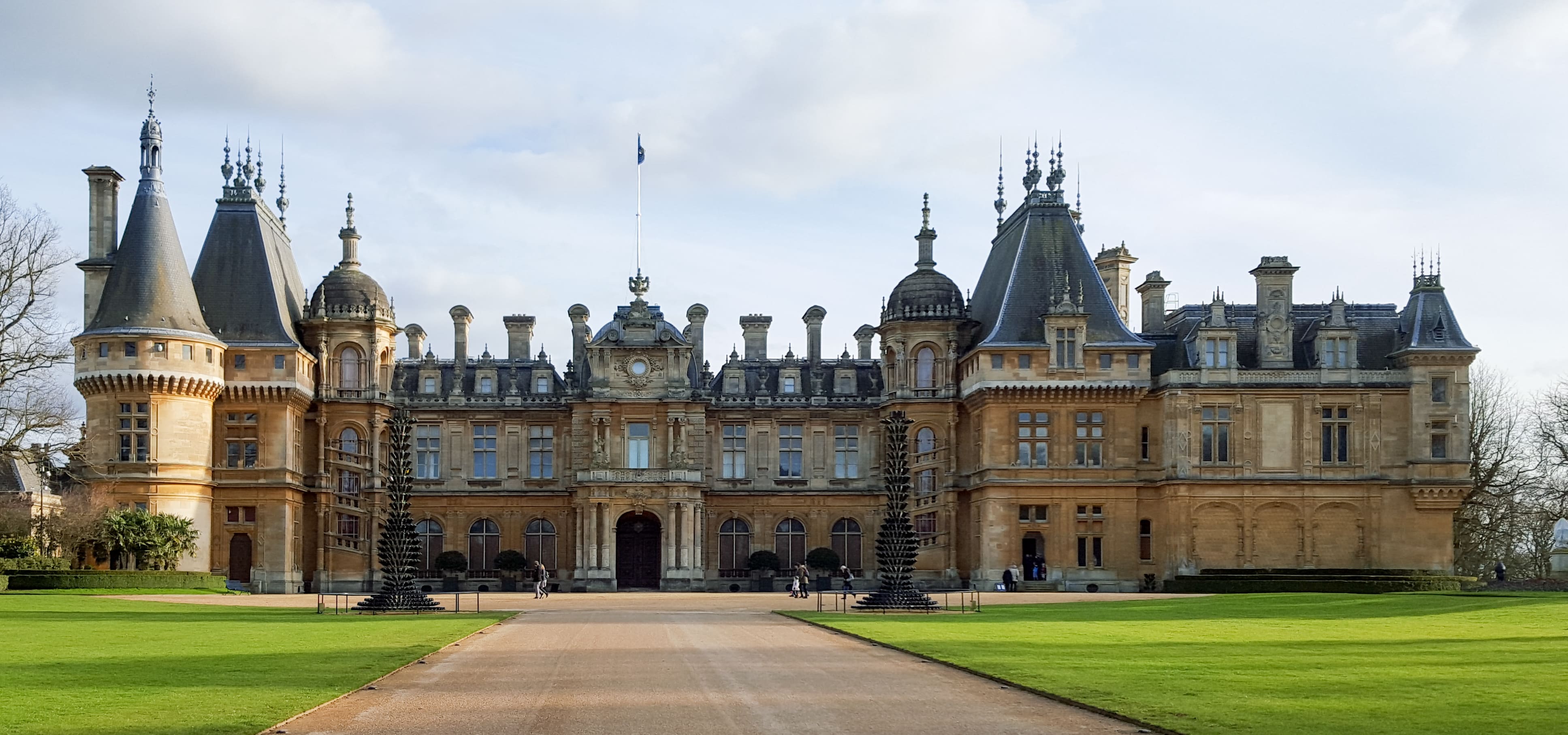
Nestled amid the undulating Buckinghamshire countryside, the Neo-Renaissance marvel Waddesdon Manor ranks among England’s most stunning country estates. Constructed for Baron Ferdinand de Rothschild between 1874 and 1889, this architectural wonder has gained fame not just for its rich interiors and remarkable art collections but also for rumors of supernatural activity that have lasted all through its history. While many guests come to appreciate the French château-inspired design of the estate and carefully tended gardens, others are drawn by stories of enigmatic apparitions, unexplainable noises, and odd feelings that appear to challenge reason. Passed down through generations of staff and guests, these ghostly stories have become a fascinating, albeit debatable, feature of Waddesdon’s rich historical tapestry.

Description
With its turrets, towers, and exquisite masonry mirroring the Renaissance châteaux of France’s Loire Valley, Waddesdon Manor casts a striking profile against the English sky. The estate includes not only the stunning main house but also large formal gardens, woodlands, an aviary, and several facilities formerly supporting the activities of the manor. Inside, guests find rooms decorated with rare paintings, including pieces by Gainsborough and Reynolds, as well as beautiful French furniture, Sèvres china, and decorative items gathered by generations of the Rothschild family. Visitors are transported to a world of nineteenth-century aristocratic splendor by the Manor’s opulent interiors, with gilded ceilings, sumptuous tapestries, and detailed woodwork, where no cost was spared in building places meant to wow and amuse the elite of British society (Rothschild, 2017).
Waddesdon’s history starts with Baron Ferdinand de Rothschild, a member of the renowned banking dynasty, who bought the estate in 1874 to build a weekend getaway where he could host visitors and show his expanding art collection. Incorporating modern conveniences strange for the time, including central heating, electricity, and plumbing, the baron commissioned French architect Gabriel-Hippolyte Destailleur to construct a mansion inspired by the châteaux of the Loire Valley. Construction called for leveling the summit of a hill and used hundreds of workers over fifteen years before completion. The estate went to Ferdinand’s sister Alice after his death in 1898 and finally to James de Rothschild, who left Waddesdon to the National Trust in 1957, therefore guaranteeing its conservation for the next generations. Over its lifetime, the manor has welcomed politicians, kings, and intellectuals from all around British society, each contributing to the rich history that pervades its walls (Hall, 2007).

Paranormal Activity
Beginning in the late Victorian century, reports of paranormal activity at Waddesdon Manor have persisted to this day, producing an unsettling backdrop to the estate’s formal grandeur. Particularly in the Bachelor’s Wing and the Morning Room, where the ghost of a lady in gray is claimed to appear on misty mornings, staff members have often reported feeling watched while alone in the house. Especially close to the grand staircase, where footsteps have been heard ascending and descending when no one is present, visitors have reported unexpected cold areas that defy explanation even on scorching summer days. While some say they can hear soft music coming from the vacant Music Room, others say they can smell cigar smoke in the Smoking Room despite the rigorous no-smoking regulation in place all across the property (Greeves, 2021).
The most common paranormal story revolves around the spirit of Baron Ferdinand himself, who is purportedly still supervising his cherished work from the afterlife. While some claim to have seen a distinguished man in Victorian dress inspecting art or moving items before disappearing when approached, night security officers have recorded unexplained lights moving around rooms long after they have closed. Visitor-taken photos often catch invisible orbs or hazy figures not visible to the naked eye when the images were shot. Staff members have said that during quiet times, especially in winter when tourist numbers drop, they hear their names called by voices appearing to echo from vacant halls, generating an uncomfortable environment that sharply contrasts with the daily glory of the manor (Burney, 2004).
Many times, paranormal researchers have been attracted to Waddesdon in an effort to record and confirm these spectral allegations utilizing several tools and approaches. Though the quality and clarity of these recordings are topics of discussion, electronic voice phenomenon (EVP) sessions held in the wine cellars and servants’ quarters have reportedly caught murmured replies to inquiries asked by investigators. Using thermal imaging cameras, teams say they have found unexplainable heat signatures traveling through normally unoccupied rooms, especially in regions linked with regular sightings. Mediums and sensitives who have visited the home frequently have strong impressions of prior occupants and personnel, describing historical characters and events with specifics some say would be impossible to create without true psychic awareness.
Analysis
But skeptics provide more prosaic justifications for Waddesdon’s alleged hauntings, including the human propensity to ascribe supernatural reasons to natural events and the power of persuasion. The antiquity and structure of the manor offer plenty of chances for settling noises, creaking floorboards, and air currents that could generate apparently inexplicable feelings and sounds. The temperature changes sometimes read as spectral cold patches could be caused by the property’s intricate heating and ventilation systems, some of which date back to Victorian inventions. Especially in the fluctuating daylight, reflections from the manor’s numerous windows, mirrors, and gilded surfaces can produce optical distortions readily confused for ghosts. Critics also point out that historic homes like Waddesdon can foster ghost stories as part of their charm, so guiding workers and guests to view routine events under a paranormal prism (White, 2010).
Psychological elements could potentially significantly influence paranormal events at Waddesdon Manor. Having heard ghost stories, visitors may interpret ambiguous inputs as supernatural, undervaluing the power of expectation. The elaborate, sometimes intimidating design produces areas with intricate acoustics where sounds can move unexpectedly, perhaps accounting for disembodied voices and footsteps. Powerful emotional reactions and increased sensory awareness may be sparked by the manor’s rich past and the immersive feeling of entering another time, which could be misread as paranormal events. The human brain’s pattern-recognition ability also picks up faces or human forms in arbitrary visual chaos, a phenomenon called pareidolia that might explain certain claimed sightings in shadows or reflections.
Though some skeptics have their own theories, the paranormal legends of Waddesdon Manor nevertheless captivate both believers and non-believers, hence enriching the cultural relevance of the estate. Though cautious not to publicly support supernatural assertions, certain National Trust employees admit that across their time at the property, strange events have often been recorded. Long-term workers typically adopt a matter-of-fact approach toward the claimed hauntings, viewing them as just another facet of labor in a historical structure with such a rich past. Paranormal fans highlight the consistency of tales throughout generations, saying that witnesses with no knowledge of prior accounts have reported comparable events, hence supporting the argument for real supernatural activity as opposed to simple folklore or fantasy.
Conclusion
Whether one sees Waddesdon’s ghostly inhabitants as real paranormal events, psychological manifestations, or just colorful legends, they certainly add to the mystique and cultural legacy of the estate. The haunting legends of the manor humanize the magnificent building and rich collections for current tourists by connecting them to the generations who trod these corridors before them, telling stories of people whose presence apparently endures beyond their mortal years. Focusing on emotional resonances and personal relationships that transcend time, the paranormal stories also provide a different perspective on history than dates and recorded occurrences. Many people feel a strong sense of historical continuity from the idea that echoes of the past could actually show up in the present, even if such events cannot be scientifically proven.
Ultimately, Waddesdon Manor offers an interesting case study on how paranormal beliefs interact with historical places, hence producing complex meanings that go beyond artistic worth or architectural relevance. Whether one considers the manor’s purported hauntings to be real supernatural events or psychological oddities, they have become inextricably linked with its cultural character, drawing people looking for various kinds of connection to the past. The ghost stories whispered inside Waddesdon remind us that history is not just a factual accumulation but a living presence we keep interpreting and experiencing in very personal ways as it continues to host visitors into its opulent halls and groomed grounds. Maybe it’s this constant conversation between past and present, rather than any particular ghostly experience, that really defines the lasting enchantment of Waddesdon Manor—a site where history is not just remembered but somehow always present.
References
Burney, E. (2004). WRAPPING UP WADDESDON. WWD, 4-4.
Greeves, L. (2021). Houses of the National Trust. National Trust.
Hall, M. (2007, July). An acquisitive gene: Lord Rothschild’s collecting for Waddesdon. In Apollo (Vol. 165, No. 545, pp. 44-50). Apollo Magazine Ltd..
Rothschild, A.(2017). Renaissance: A New Look at the Waddesdon Bequest in the British Museum.
White, D. (2010). Haunted Cotswolds. The History Press.


Leave a Reply