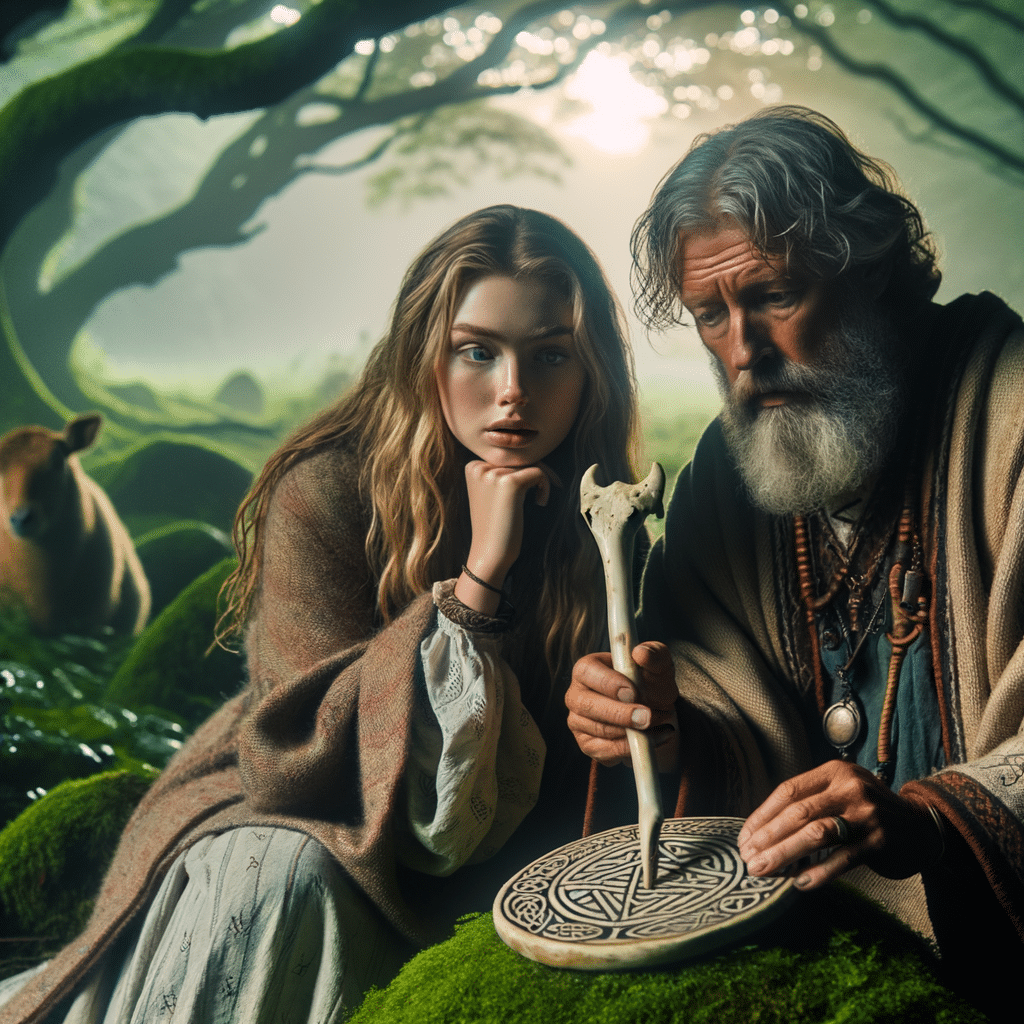
People have been interested in dreams since the start of consciousness. They are fascinating gateways between our waking world and other worlds that we can’t normally see. Druids were highly respected among the ancient Celts for their ability to interpret these nighttime visions and serve as a bridge between the mortal world and the divine secrets. This essay examines the druids’ place in Celtic society and their practices of dream interpretation, while also exploring how these ancient methods reflected their views on the natural world and human consciousness in a spiritual context.
![By Bernard de Montfaucon - J.R. Planché, "History of British costume" (1836) [1]reprinted in Knight, Charles: "Old England: A Pictorial Museum" (1845)immediate source: Liam's Pictures from Old Books - originally uploaded on Wikimedia Commons by Chris 73; reuploaded by Nyo.original from Bernard de Montfaucon, Antiquitas explanatione et schematibus illustrata vol. ii, p. 436. (engraver: Thiroux) [2]original description by Montfaucon:On trouve une partie de ce que Pline vient de dire , admirablement bien exprimé dans un bas relief d'Autun, publié par Auberi dans son livre in fol. des Antiquitez d'Autun, qui est entierement inconnu ; parce que l'Auteur étant mort après avoid imprimé le premier livre & une partie du second, les feuilles furent dissipées : celui qui m'a prêté cet exemplaire , qui est d'Autun, assure que c'est l'unique exemplaire qui reste. Dans ce bas relief , on voit un Druide couronné de feuilles de chêne ; ce qui revient parfaitement à ce que Pline vient de dire , qu'il ne font aucun acte de religion sans être ornéz de feuilles de chêne ; c'est apparemment le sacrificateur, & peutêtre le prince des Druides , dont parle Cesar , qui avoit une si grande autorité sur ceux de la secte ; marquée à ce qu'il semble par le sceptre qu'il tient à la main. L'autre Druide qui est auprès n'a point de couronne de chêne : mais il tient de sa main droite un croissant, tel qu'il est au sixiéme jour de la lune ; ce qui revient si parfaitement à ce soin scrupuleux des Druides , de ne faire la céremonie du Gui de chêne qu'au sixiéme jour de la lune , que je ne crois pas qu'on puisse doute que la figure du croissant, de la grandeur dont il est au sixiéme jour , ne soit exprimée ici par rapport à ce rit des Druides., Public Domain, https://commons.wikimedia.org/w/index.php?curid=2142439](https://i0.wp.com/connectparanormal.net/wp-content/uploads/2025/05/Two_Druids-1.png?resize=241%2C300&quality=80&ssl=1)
Druids in Celtic Society
In ancient Celtic civilization, the druids were the most learned members of society. They served as priests, judges, healers, astronomers, and keepers of oral knowledge. Their training was rigorous and could last up to twenty years, during which they memorized vast amounts of poetry, law, history, and religious knowledge—entirely without written records. The word “druid” likely derives from Celtic terms meaning “knowledge of the oak” or “those who know it,” reflecting their close connection to sacred groves where they held ceremonies and taught (Lewis, 2009).
Druids were not only religious leaders but also played significant political roles, advising chiefs and kings. They were central to both the spiritual and social life of Celtic civilization.
Dream Interpretation Across Civilizations
Many ancient civilizations, including Egypt, Mesopotamia, and Greece, practiced dream interpretation. Dreams are a universal human experience, often regarded as containing important messages. Throughout history, people have viewed dreams in diverse ways: as divine messages, prophetic visions, symbolic expressions of the unconscious, or the soul’s journey during sleep. In many ancient cultures, dream interpreters were highly respected for their ability to decode the symbols, emotions, and narratives experienced in sleep.
Druids and the Sacred Realm of Dreams
The druids perceived dreams as a sacred realm where the boundaries between this world and the Otherworld blurred. They believed the soul could transcend the limits of time and space during sleep, encountering spirits, ancestors, and gods. This belief aligned with their cyclical view of life, death, and rebirth—a never-ending spiral rather than a linear progression.
Dreams were not dismissed as mere fantasies but were considered real experiences in alternate realities. These visions could reveal insights into past lives, future possibilities, or divine plans, offering guidance for personal and communal decision-making (Fisher, 1959).

The Druidic Approach to Dream Interpretation
Dream interpretation was integral to the druids’ roles as spiritual leaders and advisors. Communities often consulted them for guidance on critical decisions, such as migration, warfare, or leadership changes, based on dreams experienced by notable individuals. The druids had sacred spaces for ritual dreaming—stone circles, cave sanctuaries, or forest groves—where people sought clearer visions from the gods and ancestors.
Druids likely used a sophisticated combination of symbolic analysis, natural correspondences, and intuitive understanding to interpret dreams. Their deep knowledge of the natural world—plants, animals, celestial movements, and seasonal cycles—provided a rich symbolic framework. For instance, a dream about a salmon might signify wisdom, while one about a boar could symbolize bravery or aggression in battle. Similarly, dreams involving specific plants, trees, or weather phenomena were interpreted through the lens of Celtic cosmology and oral traditions (Winters, 2024).
Rituals and Techniques for Dreaming
The druids placed great importance on purposeful dreaming. They employed various methods to induce meaningful dreams, such as fasting, sensory isolation, meditation with sacred plants, and sleeping in consecrated locations. Historical accounts suggest they performed ceremonial preparations before sleep, including prayers, chants, and the use of herbs to enhance dream recall or alter consciousness.
One notable practice was dream incubation, where individuals focused on specific questions before sleeping to receive symbolic answers in their dreams. The druids also recognized certain times of the year as particularly auspicious for prophetic dreaming. Celtic festivals like Samhain (October 31), Imbolc (February 1), Beltane (May 1), and Lughnasadh (August 1) marked transitions in the natural year when the veil between worlds was believed to be thinnest. Dreams experienced during these times or in sacred spaces were considered especially significant (Ross, 2012).
Communal and Cosmological Aspects of Dreams
Dream interpretation in Druidic tradition often had a communal dimension. If multiple individuals in a community reported similar dream symbols or themes, the druids saw the phenomenon as a powerful sign requiring immediate action. This collective approach reflected the Celtic worldview, which emphasized interconnectedness within a larger social and cosmic framework. Dreams were not merely personal events but could carry messages for the entire community, requiring the druids’ expertise to decode.
The Druids’ Concept of Consciousness
Druidic traditions likely included a belief in multiple aspects of the soul or consciousness. Comparative studies of Indo-European traditions and later Celtic folklore suggest that people believed parts of the soul could travel during sleep, while others remained with the body. This nuanced understanding allowed druids to explain a wide range of dream experiences, from mundane reflections on daily life to profound visions and interactions with the dead, without conflicting with their broader cosmological views.
The Decline of Druidic Practices
The Roman conquest and the spread of Christianity caused the gradual decline of druidic traditions, including their dream practices. However, some elements persisted in folk traditions. Prophetic dreaming and specific dream omens survived in rural Celtic communities well into modern times. Christian monks in Ireland, for instance, integrated aspects of druidic dream wisdom into a Christian framework, preserving fragments of the old tradition.
Roman historians like Pliny the Elder and Julius Caesar provide brief glimpses into druidic practices, but much remains unknown due to their reliance on oral transmission rather than written records (Hutton, 2009).
Conclusion
Druidic dream interpretation was a sophisticated spiritual practice that positioned druids as mediators between the visible and unseen worlds. By combining natural symbolism, ritual preparation, and an understanding of Celtic mythology and cosmology, they provided valuable insight and guidance to their communities. Although much of their knowledge has been lost, their perspective reminds us that dreams have long been regarded as sources of wisdom, healing, and connection to deeper realities.
In an era increasingly dominated by materialistic views of consciousness, the druidic approach offers a compelling alternative: that dreams may represent genuine interactions with profound layers of reality, deserving of thoughtful reflection and interpretation. This ancient wisdom could enrich our modern understanding of consciousness and its mysterious nocturnal journeys.
References
Fisher, P. F. (1959). Blake and the Druids. The Journal of English and Germanic Philology, 58(4), 589-612.
Hutton, R. (2009). Blood & mistletoe: The history of the Druids in Britain. Yale University Press.
Lewis, J. R. (2009). Celts, druids and the invention of tradition. In Handbook of contemporary paganism (pp. 479-496). Brill.
Ross, A. (2012). Ritual and the Druids. In The Celtic World (pp. 423-444). Routledge.
Winters, E. (2024). Embracing Druidry: A Comprehensive Journey from Celtic Past to Spiritual Present, Learn Druidism, Druids and Ancient Magic. Ember Winters.



Leave a Reply