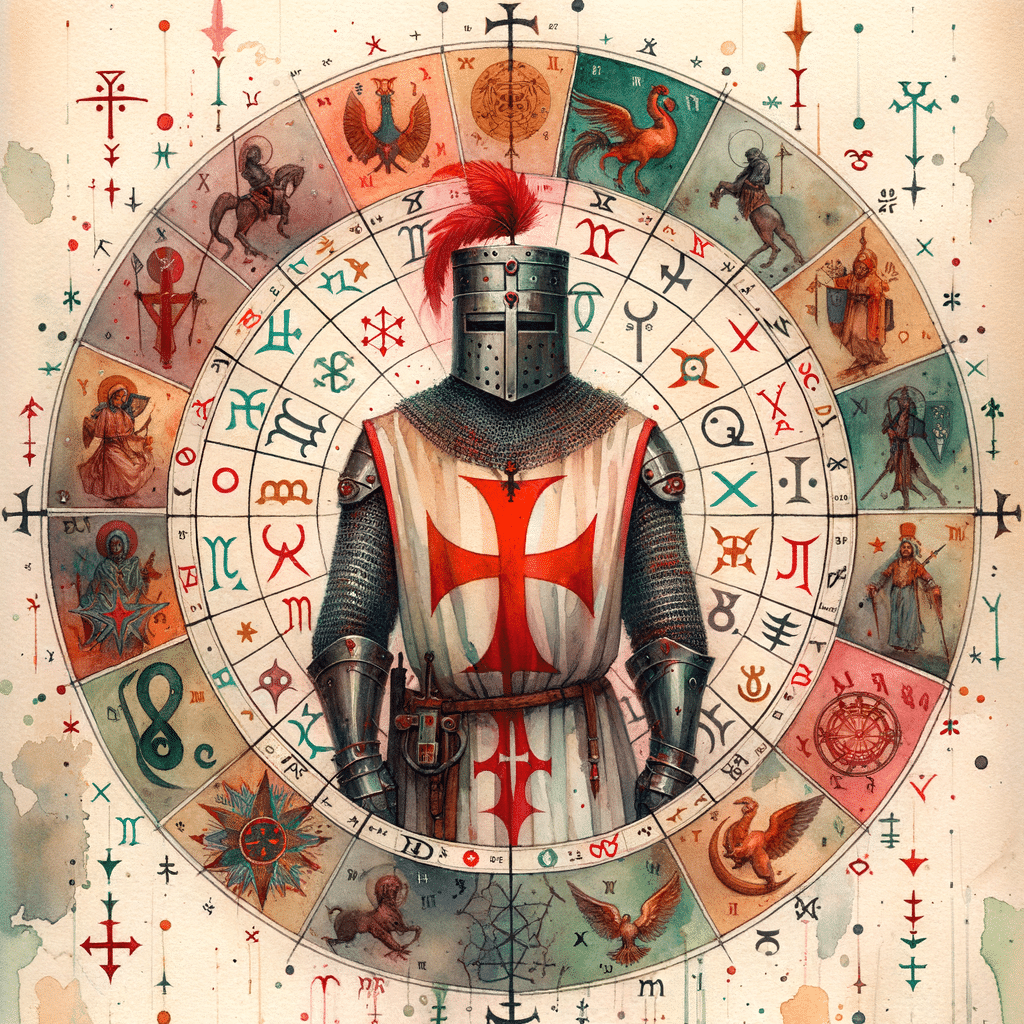
One of the most mysterious military religious orders in history, the Knights Templar have long enthralled academics and aficionados alike. Originally founded in the early 12th century to guard Christian pilgrims heading to Jerusalem, these military monks rapidly developed into a strong institution with great money, political clout, and an enigmatic legacy still felt today. Among the many intriguing features of Templar history is their possible connection with astrology, the age-old technique of deciphering celestial motions to grasp terrestrial events and human fate. The relationship between the knights bearing the red cross and the cosmic science of the stars offers an interesting junction of medieval Christianity, esoteric knowledge, and the cross-cultural interaction defining the Crusades.

Overview
Officially known as Christ and the Temple of Solomon, the Poor Fellow-Soldiers started their lives about 1119 when Hughes de Payens and eight other French knights took monastic vows of poverty, chastity, and obedience while pledging themselves to guard pilgrims in the Holy Land. After papal approval in 1129, the order spread quickly over Europe and the Middle East, building a network of preceptories, farms, and financial activities that made them medieval forerunners of modern banking. On medieval battlefields, where they developed a reputation for strict discipline and unflinching bravery, their unique white mantles featuring red crosses made them identifiable figures. Responsible only to the Pope and free from local laws, the Templars had a unique position in medieval society that afforded them remarkable freedom in their activities and quest for knowledge (Howarth, 1991).
Medieval astrology was a comprehensive system of knowledge spanning astronomy, philosophy, medicine, and divination. Far from being dismissed as simple superstition, it was seen as a valid science taught in colleges alongside natural philosophy and mathematics. Medieval astrologers examined celestial body movements to forecast weather, identify lucky periods for significant events, diagnose disease, and grasp human character. Deeply rooted in ancient Babylonian, Egyptian, and Greek traditions, subsequently enhanced by Arabic scholarship preserving and extending these systems during Europe’s Dark Ages, the practice had roots in astrology and had evolved into a key component of medieval intellectual life by the Crusades, sought for direction in both little and significant concerns by military leaders, popes, and monarchs (Tester, 1987).

Templar Astrology
Given their unique position at the junction of Western and Eastern knowledge systems, the Templars’ possible interest in astrology most likely derived from Having spent over two centuries in the Holy Land, they had unheard-of access to Arabic scientific books, including sophisticated astrological and astronomical writings not yet available in Europe. Often from noble homes, the educated members of the order would have possessed the literacy and intellectual curiosity needed to interact with these traditions. Furthermore, serving the Templars’ military and financial activities would have been the pragmatic use of astronomical knowledge for navigation, timekeeping, and agricultural planning. Some historians speculate that the Templars would have included this celestial knowledge in their organizational strategy, maybe arranging military operations under favorable astrological conditions (Jonas, 2011).
Tantalizing views of putative astrological links abound from archeological data from Templar sites. Architectural details featuring zodiacal images or astrological alignments abound in some Templar churches and commanderies. Sometimes the renowned circular churches constructed by the order, inspired by Jerusalem’s Church of the Holy Sepulchre, included exact solar alignments for solstices or equinoxes. Many Templar buildings’ octagonal form also points to possible cosmological meaning since the octagon was customarily connected with the meeting ground between heaven and earth. Though opinions among academics who warn against reading modern esoteric meanings into medieval religious art remain controversial, carved symbols at sites like Chinon in France and the Temple Church in London include celestial imagery that some researchers interpret as having astrological significance.
Documentary evidence of Templar astrological methods is still shockingly rare, partially because of the terrible loss of Templar records after their ban in 1307. Driven by political jealousy of their power and financial need for Templar wealth, King Philip IV of France planned a campaign of arrests and torture, forcing admissions of heresy from numerous knights. Among the charges levied against the order were allegations of idol worship and banned practices, although astrology particularly was not heavily used in these complaints. The surviving trial notes only oblique links to astrological or astronomical knowledge, such as charges about secret books and strange ceremonies, that might link to Sadly, this lack of knowledge has made perfect ground for speculative ideas that sometimes surpass the current data (Ralls, 2007).
Analysis
From scientific evaluations to more speculative assertions into the field of alternative history, modern ideas regarding Templar astrology vary. Like other educated medieval orders, some scholarly historians believe the Templars most likely had basic astrological knowledge common to their day, used mostly for practical needs including agricultural timing and navigation. More complex ideas hold that the Templars were protectors of hidden astrological knowledge gleaned from old mystery schools or perhaps alien sources. Though common in esoteric literature, these latter assertions usually lack strong historical data. Without necessarily assigning supernatural roots to this understanding, a middle line of interpretation notes that the Templars’ position at the cultural crossroads of East and West may have provided them with access to rather sophisticated astronomical and astrological knowledge for their time.
The Templars’ association with the Church adds still another difficulty in determining their astrological methods. Although the medieval Church embraced some elements of astrology—especially natural astrology addressing weather prediction and medicine—it denounced judicial astrology claiming to precisely foresee human actions, seeing this as a challenge to free choice and divine providence. The Templars would have gently negotiated these ideological differences as a religious order directly under the Pope. But their extraordinary autonomy and exposure to Eastern traditions could have given them more freedom to investigate astrological ideas than other religious groups. Some academics propose that the Templars might have combined Christian symbolism with astrological knowledge to provide a theologically acceptable framework for celestial observations, serving both practical and spiritual goals inside their order.
Our knowledge of the Templars’ relationship with astrology is further complicated by their spectacular collapse in the early 14th century. King Philip IV’s reasons were essentially political and financial rather than really focused on heretical practices when he challenged the order in 1307. Though most modern historians agree that these confessions are false, the coerced confessions taken under torture included admissions of several illegal practices, from idol worship to filthy initiation rites. Fascinatingly, although ecclesiastical authorities occasionally saw astrology with mistrust, it was not very often mentioned in the charges against the Templars. This absence could imply either that whatever astronomical knowledge or astrological practice was not substantial enough in Templar activities to justify mention (De Coster & Th, 2013).
The Knights Templar’s reputation has made them a magnet for ideas linking them to many esoteric traditions, including astrology. Legends stating that surviving Templars had disappeared underground, therefore preserving secret knowledge and laying the foundation for later groups like Freemasonry, surfaced following their formal demise. Although conventional historians find little proof of direct organizational continuity, the symbolic legacy of the Templars most obviously affected succeeding esoteric groups that clearly had astrological components. Often stressing astrological and alchemical knowledge as part of their alleged legacy, several neo-Templar orders arose by the 18th century, claiming affiliation to the original knights. Over the next decades, this retroactive relationship between Templars and astrology has evolved to produce layers of interpretation challenging to disentangle from historical reality.
Conclusion
At the junction of medieval religion, science, and cross-cultural interaction, the link between the Knights Templar and astrology ultimately poses an intriguing but perplexing historical topic. Although clear proof of systematic astrological activity within the Templars is still lacking, their unique position in medieval society—access to Eastern knowledge, exceptional autonomy, and educated membership—created circumstances where such interests could have blossomed. Their buildings’ architectural alignments, their exposure to Arabic astrological traditions, and their requirement for useful navigational skills all point at least to a basic interaction with the celestial sciences. Whatever the historical fact, the link between these warrior monks and the cosmic arts never fails to enthrall our minds and reminds us of the intricate interaction among faith, knowledge, and mystery that defined the medieval perspective. Maybe the most appropriate way to solve this historical riddle is one that reflects the medieval mind itself—open to the wonder of cosmic links yet anchored in the data accessible to us over millennia.
References
De Coster, P. L., & Th, B. (2013). The Knights Templar.
Howarth, S. (1991). The Knights Templar. Barnes & Noble Publishing.
Jonas, M. (2011). The Templar Spirit: The Esoteric Inspiration, Rituals and Beliefs of the Knights Templar. Temple Lodge Publishing.
Ralls, K. (2007). Knights Templar encyclopedia: the essential guide to the people, places, events, and symbols of the Order of the Temple. Red Wheel/Weiser.
Tester, S. J. (1987). A history of western astrology. Boydell & Brewer.



Leave a Reply