Said to prowl the old mountains and deep forests of the Ozark region spanning Arkansas, Missouri, Oklahoma, and portions of Illinois, the Ozark Howler is among the most perplexing cryptids found in America. For years, stories of this mysterious beast have been handed down among residents via oral traditions and campfire tales depicting a terrible nighttime predator. Although some reject the Howler as simple folklore or misidentified wildlife, believers cite consistent eyewitness records and regional customs spanning more than a century. The physical characteristics, documented actions, folkloric relevance, famous sightings, and general hypotheses about this intriguing American cryptozoological species are investigated in this essay.

Description
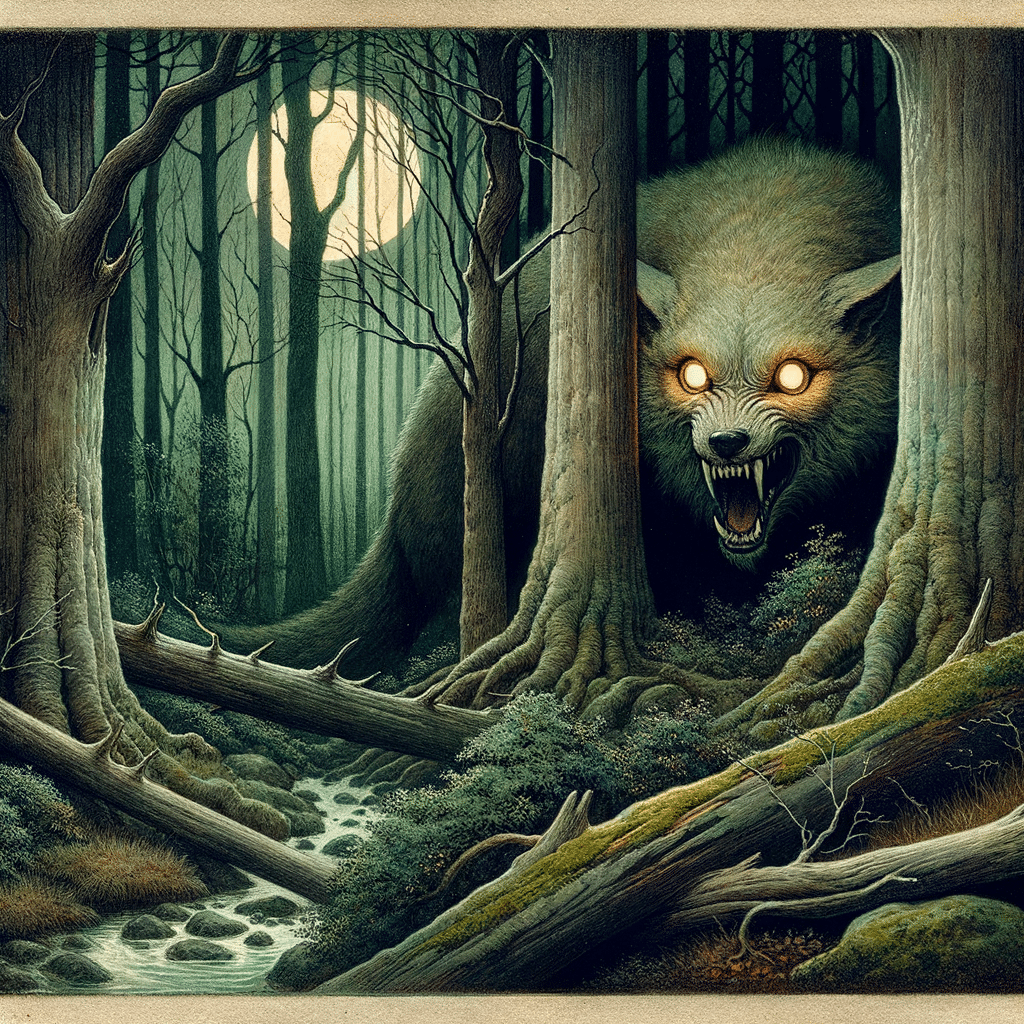
Though certain traits stay constant throughout most stories, physical descriptions of the Ozark Howler vary slightly between sources. Usually referring to a bear-sized creature, perhaps 4–7 feet tall, witnesses note a strong, muscular body weighing between 250 and 500 pounds. Large, noticeable horns projecting from its head—sometimes likened to those of a bull or elk—and brilliant red eyes piercing the darkness of the Ozark evenings define The Howler most uniquely. Usually with lighter patches, its coat is characterized as shaggy black or dark brown fur. Unusual physical traits like tufted ears or odd paw shapes not matching known regional species have been reported by certain witnesses (Carroll, 2021).
The behavioral traits ascribed to the Ozark Howler depict a picture of a generally nocturnal predator with territorial inclinations. Often said to be unlike any known animal in the area, the creature’s title stems from its unique vocalization—a bone-chilling mix of a deep, guttural roar and a high-pitched cry echoing throughout the mountains. Sightings near water sources, especially distant streams and ponds deep within the Ozark woodlands, point to the creature perhaps following game routes to hunting areas. Many times, witnesses document hostile territorial conduct like stalking campers or hikers from a distance without direct interaction. Though such assertions remain anecdotal without hard data, livestock disappearances and mutilations in isolated farm settings have sometimes been linked to the Howler (DeMello, 2024).
Deep roots of the Ozarks Howler folklore in the cultural tapestry of the area combines components from several traditions. Some folklorists follow the stories back to early European immigrants carrying Old World ideas about forest spirits and devils that might have combined with Native American customs regarding strong woodland phenomena. Later Howler stories may have been influenced by the customs of the Cherokee, Osage, and other indigenous people of the area regarding mystical woodland entities. Local variants of the mythology occasionally place the Howler, in line with banshee customs from Celtic folklore, as a harbinger of death or misery. Rising in local art, music, and literature as a representation of the wild, untamed essence of the Ozarks themselves, the creature has been ingrained in regional identity.
Beginning in the early 19th century, recorded sightings of the Ozark Howler span important clusters of events within particular eras. Early frontier journals occasionally speak of unusual howling animals that scared cattle and worried communities. In the 1940s and 1950s, a notable surge of sightings coincided with growing human activity in once isolated regions during post-war growth. More recently, the 1980s witnessed many testimonies from hikers and campers in Arkansas’s Buffalo National River region with multiple witness descriptions of comparable traits. Though some dismissers point out that the development of camera phones has not produced the unambiguous photographic evidence one would anticipate if such a big creature existed, modern sightings nevertheless occur on occasion. The majority of the evidence remains testimonial, with only a few hazy images and recordings of odd sounds serving as physical proof.

Analysis
From the commonplace to the remarkable, several ideas try to explain the Ozark Howler phenomenon. According to the misidentification idea, sightings arise from interactions with recognized species under odd settings or low visibility. Black bears, especially when seen in shadow or on hind legs, could explain the big, dark-furred monster reports. The odd howling sounds could be connected to mountain lions, whose howls can be shockingly similar to human wails, or possibly to the menacing calls of some owl species living in the area. Advocates of this view contend that even seasoned outdoor enthusiasts can mistake familiar animals when confronted unexpectedly or in low light, with fear and adrenaline further skewing views. A bear sighting combined with coincidental odd sounds from other animals could give the impression of one unidentified monster with composite traits.
A more fascinating scientific hypothesis holds that the Ozark Howler is a real undiscovered species, a cryptid in the most accurate sense. Certain cryptozoologists propose it may be another Pleistocene megafauna that somehow survived in the remote mountain area or a surviving population of the extinct saber-toothed cat (Smilodon). Others conjecture about hybrid species, maybe a cross between wolves and big cats, even though such natural hybridization would be biologically unheard of. More conservative biological theories propose an uncommon subspecies of known animals, such as a genetically different population of black bears with some atypical features. Advocates of the biological explanation point to the consistency of physical descriptions over many eras and from witnesses without prior knowledge of the legend, contending that such pattern consistency points to observation of an actual animal rather than pure invention.
Approaching the Howler as a cultural phenomenon rather than a biological reality, the psychological and sociological theories treat it as From this vantage point, the creature stands for a manifestation of group worries about wilderness areas and the unknown. Folklorists point out that mythical creatures representing the supposed threats of wild areas have been produced by frontier communities over history. With its rich forests, rocky terrain, and historical isolation, the Ozark area offers the perfect setting for such stories to grow and endure. Once aware of the Howler legend, people become more inclined to view uncertain events via that explanatory frame. Some scholars link the Howler to the idea of “ostension,” whereby folklore shapes how people understand real-world events. Observing that cryptid sightings typically coincide with times of social stress or fast change, cultural anthropologists speculate that the creatures might act as symbolic archives for community fears about modernization, environmental damage, or cultural change (Tremeear, 2011).
More deliberate beginnings for the Howler mythology are suggested by the fake theory. Some dubious scientists have hypothesized that the contemporary interpretation of the Ozark Howler might have started as a hoax or joke that got popular via media coverage and repeated performance (KHBS/KHOG 40/29 News, 2015). In cryptozoology, similar hoaxes have been recorded; one well-known example is the “Georgia Bigfoot” hoax that turned out to be a latex costume with possum elements. Internet study indicates that certain early online references to the Howler might have been a part of a student project or intentional folklore production. This theory, however, finds it difficult to explain the geographical distribution of comparable stories over the larger Ozark region and the historical depth of Howler references before the internet age. Should the Howler start as a hoax, it has evolved from those beginnings to become a real folkloric tradition with cultural value far beyond any initial fraud.
Comparative mythology in other cultural traditions. These studies expose amazing similarities between the Howler and several “guardian beast” figures discovered in mythology all over. From European customs of woodland ghosts to indigenous beliefs about territory-protecting entities, many civilizations have big, terrifying animals that impose limits between wilderness and civilization. The European idea of the “Wild Hunt” and several horned forest deities are reminiscent of the howler bear’s look and nighttime activities. This cross-cultural viewpoint implies that the Howler might show a geographically particular expression of a more general human inclination to personify wild areas as sentient, usually frightening entities. This approach respects such traditions as representations of human relationships with nature and cultural attempts to negotiate the psychological boundaries between known and unknown places, not discounting them as superstition.
Suggesting that the Ozark Howler phenomenon originates from a collection of elements rather than a single cause, the multi-causal theory provides maybe the most complete explanation. Under this perspective, the narrative most likely started with real but misinterpreted animal encounters and maybe mixed with indigenous and settler mythology. Cultural transmission altered these stories across generations; each retelling highlighted specific components and added local relevance. While intentional hoaxes or overblown narratives helped to further change the story, occasional real-life experiences with odd animals kept reinforcing and altering the mythology. The creature’s description might have changed over time to include features that set it apart from better-documented cryptids like Bigfoot, therefore generating a distinctive regional identification marker. This layered approach explains both the variances that have evolved over time and throughout many Ozark villages as well as the uniformity in basic features of Howler descriptions (Ocker, 2022).
Conclusion
Ultimately, the Ozark Howler is still a riddle that links folklore with cryptozoology and reflects both a possible unknown species and a potent cultural emblem of the Ozark area. Whether the monster is a real animal or merely a creation of human imagination and cultural transmission, its significance in regional identity and folklore remains undeniable. The recurring trend of sightings over generations suggests something intriguing in the narrative that speaks to our curiosity for the unknown and the likelihood that wilderness places might conceal secrets beyond scientific classification. The Ozark Howler will keep prowling the shadows of the physical terrain as well as the collective imagination of people who call the old Ozark Mountains home until conclusive proof surfaces one way or another.
References
Carroll, C. M. (2021). Missouri Ozarks Legends & Lore. Arcadia Publishing.
Davis, H. R. (2023). Looking for Bigfoot, Finding Only Myself.: An Introspective Lens on the Soul. Balboa Press.
DeMello, M. (2024). Bigfoot to Mothman: A Global Encyclopedia of Legendary Beasts and Monsters. Bloomsbury.
KHBS/KHOG 40/29 News. (2015, December 15). ‘Ozark Howler’ sighting at Devils Den? Game & Fish say photos are a ‘hoax’. 4029tv.com. https://www.4029tv.com/article/ozark-howler-sighting-at-devils-den-game-fish-say-photos-are-a-hoax/4957812
Ocker, J. W. (2022). The United States of Cryptids: A Tour of American Myths and Monsters. Quirk Books.
Tremeear, J. (2011). Haunted Ozarks. Arcadia Publishing.



Leave a Reply