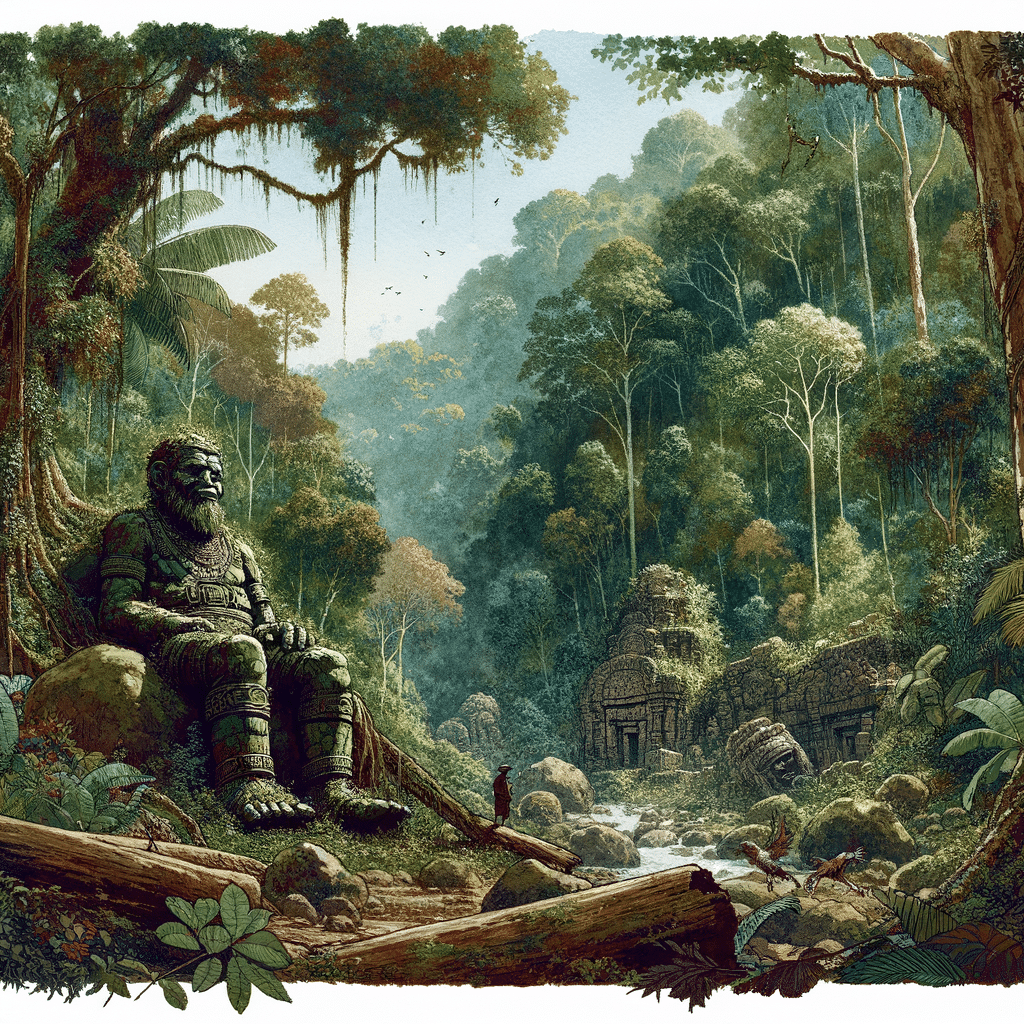
Giants in Peru: Key Points
-
Peruvian giant myths mix stories from both indigenous and colonial times. They tell of enormous beings that gods made and then destroyed.
-
In ancient mythology, giants were strong but not very smart, and they often ate other people.
-
Spanish invaders used Biblical ideas to change these myths to make them fit their plans for conquest.
-
The huge archeological constructions have people guessing about who built them.
-
People continue to see giants in distant areas today, portraying them as protectors of the environment.
-
Many explanations exist, ranging from cultural analogies to disputed statements about buried civilizations.

Introduction
The mysterious stories of giants in Peru are a fascinating mix of native myths, colonial stories, and modern accounts that continue to interest both locals and researchers. These stories cover thousands of years of Peruvian cultural history, starting with oral traditions before Columbus and continuing with claims of sightings that still happen in rural parts of the country today. The enormous stories of Peru give us a unique look at how ancient myths change over time while keeping some of their essential ideas. They show both cultural fears and efforts to explain strange events that have happened in the country’s complicated past.
Overview
The Inca and other ancient Peruvian societies have rich mythical traditions that often included giants as the first entities to live on Earth before humanity. In Inca legend, the god Viracocha made these beings, called “Jatun Runa” or “great people,” but they were eventually destroyed because they were too proud and didn’t follow the rules. Coastal Peruvian tribes like the Moche and Chimú also told legends about giants. Archeological records still bear witness to the enormous constructions these giants allegedly built. In these early stories, giants were generally seen as primal and chaotic forces that needed to be controlled before human civilization could grow (Russell, 2016).
Diverse Peruvian communities held various beliefs about the behavior of these mythological giants, yet there were some commonalities among them. Giants were thought to be strong but not smart, so clever people or gods could defeat them. In certain northern Peruvian stories, giants were said to eat a lot of food, including human flesh, which made them scary predators of early human groups. Coastal tales sometimes showed giants doing strange sexual things or having strange reproductive traits. This may have been because of taboos or because people were trying to demonstrate how different surrounding communities were.
History and Sightings
When Spanish conquistadors came to the Americas in the 16th century, they mixed native giant myths with European ideas of giants. This led to the creation of hybrid stories that served different political and religious agendas. Spanish writers like Pedro Cieza de León wrote about local myths of giants who used to live in parts of Peru. They saw these stories through a Biblical lens that linked them to the Nephilim recounted in Genesis. Colonial officials often pushed these linkages because they helped justify invasion by claiming that native people required protection from these terrible entities. During this time, giant mythology changed in a big way. They went from being vague spiritual beings to real giants whose remains might be found (Sowers, 1981).
Archaeological discoveries in Peru’s past have sparked interest in big legends from time to time. The huge stone blocks that fit together perfectly at places like Sacsayhuamán near Cusco, which weigh up to 200 tons, made people wonder if there were superhuman builders. During the 1940s and 1950s, rumors circulated about the discovery of massive skeletal remains in Peruvian caves. However, scientific authority has not confirmed most of these claims. These physical “evidences” made feedback loops with the mythology, which made huge stories seem more believable than just folklore, especially to people who didn’t believe what archaeologists said (Pratt, 2010).
Most of the modern sightings of giants in Peru happen in the Andes Mountains and the Amazon rainforest, which are both far away from colonial influence. Villagers in the Ucayali region have been talking about meeting Maykujàypa, woodland giants over eight feet tall that communicate by whistling and kidnapping those who go too far into their realm, since the middle of the 20th century (Redfern, 2015). People who speak Quechua around Lake Titicaca also say they’ve seen Hatu Runa, which they say are territorial beings that protect old ruins and underground pathways. These modern stories usually focus on the giants’ function as defenders of the environment, which suggests that their mythic purpose has changed throughout time to address modern environmental issues.
The most talked-about gigantic recent events happened in the 1990s, when numerous tour groups in the Sacred Valley said they saw very towering humanoid creatures watching them from faraway mountainsides before rapidly disappearing. These accounts got a lot of attention on early internet forums on cryptozoology and ancient mysteries, which helped spread the stories of Peruvian giants to people outside of Peru. Interestingly, these modern sightings usually describe the giants wearing clothes that look like old Inca clothes. This suggests that people are seeing them as more like ancestors than enemies. Despite the increase in tourists and surveillance technologies, clear photographic evidence remains scarce.

Analysis
There are many diverse theories about why big stories have lasted in Peru, from the supernatural to the scientific. Some theories become more popular throughout time, while others lose their appeal. Anthropologists usually think that large myths are cultural metaphors for things like primordial chaos, natural forces, or meeting groups from outside the culture, not real stories about huge monsters. Some scientists think that early Peruvians may have seen fossils of megafauna and believed they were the bones of humanoid giants that lived on Earth. Some archaeologists think that stories about huge builders might have come from people being amazed by the engineering skills of the ancient Peruvians, whose methods are still not fully understood by current science.
The paleontological idea gives a strong reason for enormous stories all throughout the planet, even in Peru. This perspective suggests that when ancient people discovered large fossilized bones of extinct megafauna, such as mastodons or enormous ground sloths that once inhabited South America, they may have believed these bones belonged to humanoid giants. Discovering these remains in caves or areas exposed by erosion could help clarify some regional legends of giants, particularly those describing creatures with unusual physical characteristics that may stem from misinterpreted animal anatomy. Folklorists have found comparable trends in civilizations all around the world. For example, fossil discoveries tend to happen in places where there are many big myths. This suggests that people everywhere tend to give human characteristics to things they don’t understand.
Psychological interpretations add another level of knowledge to epic stories by looking at them through the prism of cultural projections and communal archetypes. According to Jungian analysts, giants stand for our most basic anxieties about the overwhelming natural environment and our efforts to bring order to chaos. This argument makes more sense when you look at how Peruvian giant legends frequently have themes of civilization winning over primordial elements. This could be a reflection of how people’s egos develop on a societal level. Cognitive anthropologists say that huge size is a common mental shorthand for power across cultures. This makes giants a beneficial way to express fears about forces that can’t be controlled, such as natural disasters or political oppression.
The ethnohistorical method looks at gigantic stories as memories of real-life interactions between diverse groups of people in the past. This theory says that some Peruvian giant stories might be based on memories of meeting very tall groups of outsiders, with the discrepancies in height getting bigger over time as they were told and retold. Researchers have found written accounts of indigenous Amazonians seeing European explorers who were extraordinarily tall for the first time and describing them in ways that are quite similar to conventional giant mythology. These stories may have persisted due to cultural trauma resulting from conquest experiences, with giants serving as symbols of invading troops that disrupted traditional ways of life, particularly during the tumultuous colonial period.
Some experts who study language and culture think that translation mistakes and differences in how Quechua, Aymara, and European languages think about things may have made gigantic stories bigger. When Spanish chroniclers who didn’t know the local languages literally translated Andean languages, they may have turned figurative descriptions into what seemed like true stories of huge beings. Words that could have meant spiritual or moral greatness instead of physical size could have been misunderstood, making it seem like there was a connection between native myths and gigantic European traditions when there wasn’t one. Language confusion may have enhanced the credibility of some stories, leading to their continued recognition as historical facts.
Even though most academics don’t believe in the ancient astronaut theory, it is nevertheless very common when talking about Peruvian giants. People who believe in big tales say that they keep memories of aliens who came to Earth and built perfectly designed megalithic sites all over Peru with their high technology. This controversial view says that the strange looks, great power, and extensive knowledge of classic giants are actually descriptions of technologically advanced entities that ancient people didn’t understand. This hypothesis doesn’t have any scientific basis, but it’s nevertheless popular because people are interested in finding other ways to explain archeological puzzles and don’t like the fact that there are gaps in our understanding of past engineering marvels.
A more detailed geological explanation links big stories to Peru’s harsh terrain and frequent earthquakes. This perspective says that natural events like landslides, volcanic eruptions, and earthquakes—things that happen a lot in the Andes—were real proof that there were huge entities that could change the shape of the land. Indigenous cosmologies often said that strong beings caused these events. For example, stories of giants tossing rocks or stomping their feet may have been used to explain what people saw happening under the ground. The theory gets stronger since there are a lot of gigantic legends in places with spectacular geological characteristics and natural disasters that happen a lot. The evidence suggests that these legends assist societies in dealing with and getting ready for environmental hazards.
Alternative archaeologists who believe that giants are a real hominid species or an advanced ancient society whose presence has been systematically hidden are coming up with more challenging notions. A lot of the time, these interpretations link Peruvian giants to stories from throughout the world about lost civilizations, Nephilim fallen angels, aliens coming to Earth, or where humans came from that are very different from what most scientists agree on. Although these theories lack real-world evidence to support them, they are still culturally significant, particularly for tourism businesses and new religious movements that incorporate grand mythology into their beliefs. Most scientists don’t believe these kinds of assertions, but they do admit that there are still real archeological riddles around how ancient Peruvians built things (Aveni, 2000).
Conclusion
The giants of Peru, whether seen as real people or strong cultural symbols, nevertheless shape Peruvian identity and visitor stories in the 21st century. Peru’s archaeological landscape is full of real mysteries that keep giant stories alive in people’s minds. For example, the huge Nazca lines that can only be seen from above and the carefully built megalithic monuments that are spread out across the Andes. These legends are more than just superstitions; they are a part of a complicated cultural legacy that connects indigenous ways of knowing with colonial influences and modern doubts. As Peru struggles to figure out what it means to be a multicultural country, the giants that were said to have wandered its landscapes are still strong symbols of both the country’s huge past and its ongoing efforts to bring together many historical stories into a single national story.
References
Aveni, A. F. (2000). Between the lines: the mystery of the giant ground drawings of ancient Nasca, Peru. University of Texas Press.
Pratt, D. (2010). Lost civilizations of the Andes.
Redfern, N. (2015). The Bigfoot Book: The Encyclopedia of Sasquatch, Yeti and Cryptid Primates. Visible Ink Press.
Russell, G. (2016). An Introduction into Earth Giants. Rupkatha Journal on Interdisciplinary Studies in Humanities, 8(1), 322-354.
Sowers, G. F. (1981). There were giants on the Earth in those days. Journal of the Geotechnical Engineering Division, 107(4), 383-419.

Leave a Reply