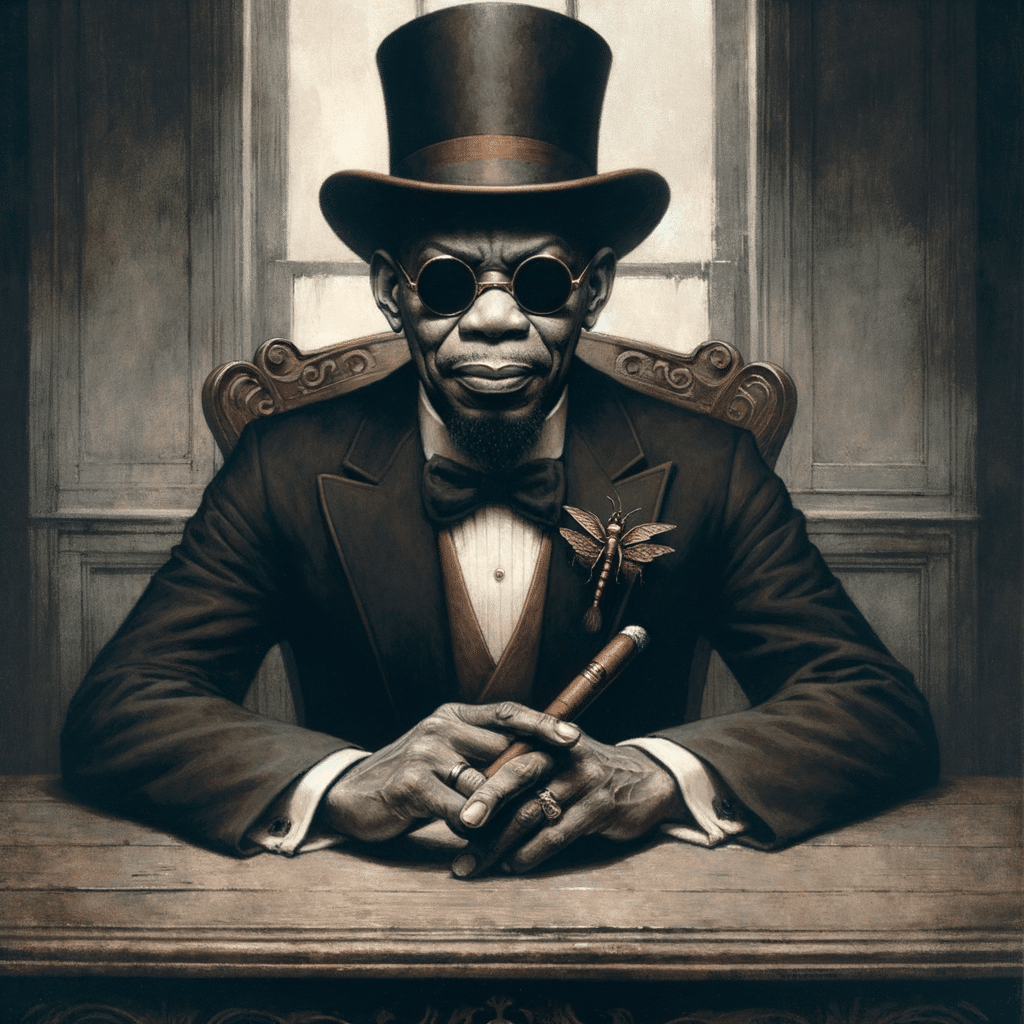
Baron Samedi: Six Key Points
-
Recognizable by his skeletal face and funeral attire, Baron Samedi governs death in Haitian Vodou.
-
Despite his grave role, he enjoys earthly pleasures like rum and lewd humor.
-
As death’s gatekeeper, he controls mortality by choosing which graves to dig.
-
Folklore shows him protecting souls from zombification and negotiating with the living.
-
He likely emerged from African-Catholic syncretism and symbolizes resistance against oppression.
-
His influence spans Haitian culture and global media, representing death as a transition rather than an end.

Introduction
Baron Samedi is one of the most well-known and powerful loa (spirits) in Haitian Vodou. People respect and fear him equally. He is the master of death and resurrection, which puts him in a special place between the living and the dead. His impact goes beyond religious practices and into pop culture, where his unique look and rebellious personality have captured the imaginations of people all over the world. This essay explores the complex character of Baron Samedi, examining his appearance, behavior, folkloric significance, and enduring impact on both Haitian culture and the wider world.
Overview
Baron Samedi’s appearance is instantly recognizable and deeply symbolic of his role as lord of the dead. Most of the time, he is shown in formal funeral clothes, like a black tailcoat, top hat, and dark sunglasses that hide his eyes, which are said to be those of a dead person. He has white paint on his face to look like a skull, and he often has cotton plugs stuffed into his nostrils, just like a body getting ready for burial. His creepy look is finished off with a walking cane, which shows that he has the power to lead souls to the afterlife. Some pictures of him show him with a cigar hanging from his mouth or a glass of rum in his hand, which suggests that he is hedonistic even though he has serious responsibilities (Miller, 1986).
Baron Samedi’s behavior is very different from his serious role, which shows that he has a spirit full of contradictions. He is the guardian of cemeteries and the dead, but he is well-known for his love of the pleasures of life. He freely drinks rum, smokes tobacco, and tells dirty jokes that would make even the most hardened sailor blush. He talks in a nasal voice, which is probably because he has cotton in his nose. He is also known for his dirty language and sexual innuendos. Baron Samedi can be scary and funny at the same time, going from a scary presence to a rude joker in a matter of seconds. His laughter is said to echo through cemeteries at night, a reminder that even in death, there exists a certain dark joy in his domain.
In Haitian Vodou folklore, Baron Samedi plays the crucial role of gatekeeper between life and death. He alone digs the graves and welcomes souls into the afterlife, so no one can die without his permission. This gives him a lot of power because he can either refuse to dig a grave, which would stop death, or he can speed up someone’s death if asked to do so. He is the leader of the Guédé family of loa, which are spirits that are connected to death, fertility, and resurrection. People also think that Baron Samedi protects children because all people will eventually go to his realm and become his subjects. His wife, Maman Brigitte, also has power over the dead, which makes their spiritual partnership very strong and balances the masculine and feminine sides of death (N’Diaye, 2021).
In Vodou ceremonies, Baron Samedi is invoked through specific rituals often involving drums, dances, and offerings. Devotees may offer rum, cigarettes, and traditional foods to honor him during these ceremonies. One significant ritual is the Ghede feast, where participants engage in exuberant celebrations of life and death, often through music, dance, and storytelling (Hernandez, 2017).

Analysis
There are many examples in folklore that show how complicated Baron Samedi’s character and powers are. One well-known story tells how he stopped a bokor (sorcerer) from taking a soul to turn it into a zombie. Baron Samedi, angry that someone had broken into his territory, went to the grave and drank the special potion that was supposed to trap the dead person’s soul. This made the bokor’s magic useless. Another story is about a rich man who made fun of Vodou rituals and then got sick with a disease that made him lose weight. His family desperately needed help from a houngan (Vodou priest) who could talk to Baron Samedi. The Baron agreed to spare the man’s life in exchange for a lavish offering and the construction of a shrine in his honor. These stories show that Baron Samedi can protect or punish people and that he can end or extend life based on his own judgment.
Theories about where Baron Samedi came from show how different cultures came together in Haiti’s past. Some scholars posit that he originated from the syncretism of West African religious traditions and Catholicism during the colonial era, potentially integrating aspects of Saint Gerard Majella, the patron saint of the deceased. Some people think that Baron Samedi became a symbol of resistance during slavery, representing freedom through death, which was the only state that slave owners couldn’t control. His disrespectful behavior could be seen as making fun of the formal clothes and behavior of European colonizers, which would undermine symbols of oppression. The Baron’s dual nature as both frightening and funny may also reflect the psychological coping mechanisms that enslaved people developed to deal with daily violence and death.
Baron Samedi’s influence goes far beyond religion; it has become a part of Haitian culture and is known around the world. His impact can be seen in Haiti’s art, music, and literature, where he represents the country’s complicated relationship with death and its history of revolution (Carey, 2010). Baron Samedi has been in many movies, comics, and video games around the world, but these portrayals often make his cultural importance seem less important or wrong. The commercialization of Vodou symbols has made people worry about cultural appropriation, but it has also made more people aware of Haitian spiritual traditions. This commercial representation raises questions regarding the commodification of Vodou traditions, as Latour (2005) aptly notes the disconnection between spiritual entities and their representations in mainstream culture.
During times of political unrest in Haiti, calling on Baron Samedi became a way to fight back. Protesters would sometimes dress like him to show that they were against oppressive governments. His lasting presence shows how spiritual figures can become powerful cultural icons that go beyond religious boundaries.
Conclusion
Baron Samedi represents the Haitian philosophical view of death as a transition rather than an end, teaching that death should motivate us to live life to the fullest instead of being afraid of its end. He is the guardian of the cemetery crossroads, and he reminds us that death is the great equalizer, taking everyone, rich and poor, strong and weak. Baron Samedi has been a constant in Haitian history, from colonial oppression to revolution to ongoing struggles. He has changed with the times but has always been death’s master and life’s unexpected defender. His contradictions reveal universal truths about being human: our fear of death, our desire for pleasure, and our need to find meaning in the face of the only thing we know for sure: life. Baron Samedi, with his skull-like grin and high glass of rum, still helps souls cross the final line, laughing in the face of nothingness.
References
Carey, J. (2010). Baron Samedi Night at the Movies; Poirot’s Apprentice. Southerly, 70(1), 99-100.
Hernandez, A. (2017). Rituals of Vodou: Spirit and the Practical Life. New York: Academic Press.
Latour, B. (2005). Reassembling the Social: An Introduction to Actor-Network-Theory. Oxford: Oxford University Press.
Miller, J. (1986). African Traditions in the Study of Voodoo. Journal of Caribbean Studies.
N’Diaye, D. B. (2021). Stitching Narratives That Matter: Baron Samedi Visits His New Orleans Cousins. Journal of American Folklore, 134(534), 458-461.




Leave a Reply