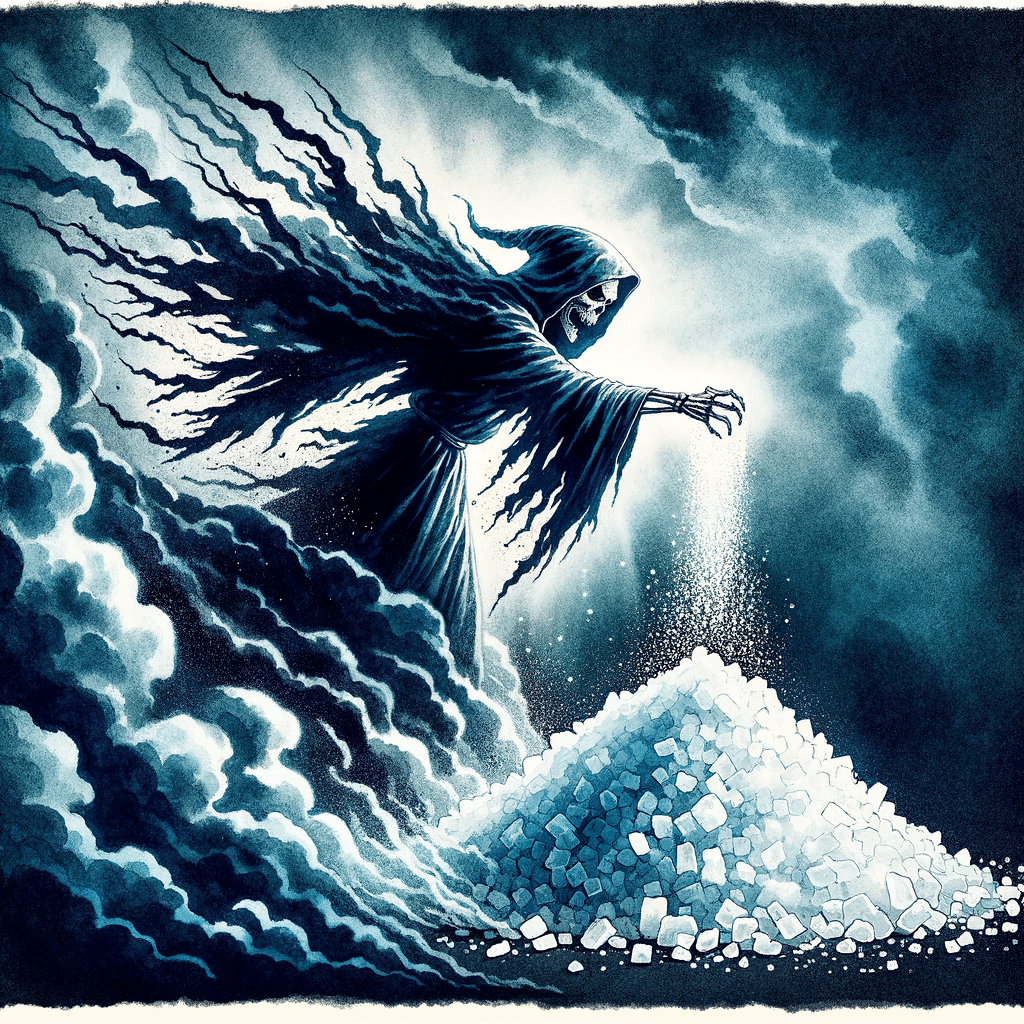
Salt and Evil Spirits: Key Points
-
Salt serves as a protective barrier against evil spirits across diverse cultures.
-
Evil spirits are non-physical entities that cause disturbances and feed on negative emotions.
-
Salt allegedly repels spirits through its crystalline structure or by forcing them to count grains.
-
Explanations include salt’s preservative nature, electromagnetic properties, and religious symbolism.
-
Modern paranormal investigators still use salt despite lack of scientific evidence.
-
Salt’s universal protective status suggests either cultural diffusion or natural symbolic associations.

Introduction
Salt, a basic mineral compound that has changed the course of human history because it is a nutritious preservative and flavor enhancer, is also an important part of many cultures’ beliefs about the supernatural. People have believed for thousands of years that this crystalline substance provides strong protection against hidden evil forces. From ancient civilizations to contemporary paranormal investigators, salt has preserved its status as a spiritual barrier and purifier, establishing limits that malevolent entities are purportedly unable to transcend. This essay will examine the complex relationship between salt and malevolent spirits, analyzing cultural traditions, paranormal theories, and the psychological underpinnings that may elucidate the enduring association of this modest mineral with supernatural safeguarding.
Overview
Salt has been thought to have important paranormal properties throughout history. Across many cultures and times, salt has been used as a shield against negative energies and evil beings. Many cultures think that salt has natural purifying properties that get rid of unwanted spiritual presences in spaces. People who believe these principles do things like sprinkling salt across doorways, around living spaces, or in the corners of rooms to make boundaries that spirits can’t cross. Some traditions even suggest carrying small pouches of salt for protection, while others use salt in ritual baths to get rid of negative energies or spiritual attachments that may have built up on the person (Stackert, 2010).
Many cultures believe that salt protects people from evil spirits. For example, in Ghana and The Gambia, traditional practices say that pregnant women should avoid certain foods to protect themselves from negative influences. Salt is used as a symbolic barrier against evil spirits. Pregnant women frequently eschew specific foods thought to attract malevolent entities, a practice corroborated by qualitative studies that underscore the influence of such beliefs on health behaviors during pregnancy (Bell et al., 2019; Parrish et al., 2023). Additionally, women in Ghana beseech divine safeguarding against adversities ascribed to malevolent spirits, thereby reinforcing the inclusion of salt in these protective ceremonies (Aziato et al., 2016).
Evil spirits, as defined in different belief systems, are usually thought of as non-physical beings that want to hurt people. In different cultures, these beings may be called demons, ghosts, djinn, or other supernatural beings. However, they all have similar traits when it comes to how they are thought to interact with our world. Many traditions say that these beings feed on negative feelings, making people sick, causing trouble, or bringing ill luck to make people scared and suffer so they can eat. People often say that evil spirits live in a parallel dimension or vibrational state that sometimes overlaps with our physical reality. This approach lets them affect the material world without being fully present in it. Their motivations are often depicted as varying from mischievous disruption to overt hostility, with certain traditions positing that these entities actively endeavor to possess, manipulate, or harm the living (Maxwell-Stuart, 2024).
Usually, the relationship between evil spirits and salt is one of opposition and repulsion. Folklore and paranormal theories say that the crystalline structure of salt may create energy fields or vibrations that make it extremely difficult for evil beings to show up or stay in physical spaces. Many traditions say that salt’s purity is the opposite of the evil spirits’ corrupted nature, which makes places that have been treated with salt unwelcoming to these beings. Some people believe that salt makes spirits count each grain before they can move on, which keeps them from making any more progress. Some theories say that salt is a spiritual “grounding agent” that connects ethereal energies to the physical earth, which stops the otherworldly power that keeps evil spirits alive.
Analysis
Various theories try to explain why salt is so important for supernatural protection in so many different cultures. One anthropological view says that salt’s historical value and ability to preserve food naturally linked it to life and protection against decay. This made it a symbol of life and a way to fight death and the spirits of the dead. Paranormal researchers speculate that salt could potentially disrupt electromagnetic fields associated with spirit activity. This capability could be because of its electromagnetic properties and ability to conduct energy. Some psychologists think that using salt in rituals creates a placebo effect, where the practitioner’s belief in protection actually makes them feel better and less scared. Meanwhile, religious scholars say that salt’s biblical links to covenant, purity, and preservation may have played a role in its use as a spiritual protective element in traditions that are influenced by Abrahamic religions.
Anthropological viewpoints indicate that salt frequently plays a crucial role in rituals designed to safeguard individuals from malevolence and misfortunes. Community practices often incorporate salt in amulets or in conjunction with herbs during healing ceremonies, thereby reinforcing the belief in salt’s supernatural properties that can mitigate spiritual threats (Johnson & Fongnzossie, 2020; TALİ, 2024). Salt’s symbolic and ritualistic importance in these situations shows that it is more than just a physical thing; it is also a culturally significant thing that can keep evil away (Coetzee et al., 2014).
Additionally, traditional practitioners in areas like Zimbabwe have recorded their utilization of ceremonial salt alongside particular herbs to dispel undesirable spiritual influences (Mudonhi & Nunu, 2021; Merawi & Belay, 2024). The combination of plants and salt in spiritual protection rituals shows how important these practices are to health and well-being. Ritualistic cleansing practices involving salt have been recorded as elements of communal rites intended to purify individuals perceived as spiritually impure, highlighting the persistent association between salt, malevolence, and spiritual purification across diverse communities (Ayikukwei et al., 2007). These customs embody a comprehensive perspective on health and social order, illustrating the vital interaction between spiritual and medical interventions.
Salt has become a part of modern paranormal research, but the level of scientific rigor varies. When ghost hunters and spiritual mediums try to talk to spirits, they often use salt circles or lines as protective barriers. They think that these make a safe space for them to do their work. Some paranormal researchers say they have seen strange electromagnetic fluctuations near salt barriers while doing research, but these reports are still anecdotal and not scientifically proven. Some modern spiritual practices have built on traditional uses by making special salt mixtures that include other minerals thought to make them more protective. For example, black salt (salt mixed with charcoal or other dark materials) is used to absorb negative energies. Even though scientists don’t agree on the use of salt in paranormal situations, it is still common in ghost hunting shows, spiritualist practices, and new age traditions.
The widespread use of salt as a form of spiritual protection raises intriguing questions about how people think and how they recognize patterns. Different cultures came up with similar ideas about how salt protects things on their own. This phenomenon could be because trade routes spread ideas between cultures or because salt has properties that naturally make people think of similar things. Some academics suggest that ancient perceptions of salt’s utilitarian effects—such as food preservation, medicinal uses, and its essential role in sustaining life—established a basis for spiritual beliefs regarding its protective qualities. The endurance of these beliefs in contemporary times, even within scientifically advanced societies, illustrates the profound entrenchment of specific symbolic associations in human cultural consciousness, surpassing rational explanations through their psychological and emotional impact.
Salt and evil spirits are often considered opposites, which is interesting because they are also considered opposites in other cultures, such as purity and corruption, and preservation and decay. Salt is often considered a symbol of permanence, covenant, and truth in many cultures. These are all qualities that are the opposite of the deceptive and chaotic nature that is often associated with evil beings. This symbolic conflict can be found in many religious texts and practices, such as Shinto rituals for purifying salt and the Bible calling believers “the salt of the earth.” Salt has more than just spiritual meanings; it also serves as a symbol of order against chaos. This symbolic framework elucidates the persistence of salt’s supernatural associations, even in communities where literal belief in malevolent spirits has waned.
Salt’s role in keeping evil spirits away goes beyond just ideas; it is also used in real-life situations in cultural traditions all over the world. In Japanese Shinto, small piles of salt called morijio are put at the entrances of businesses to keep negative energy away and bring in beneficial energy. If you spill salt, Eastern European traditions say to throw it over your left shoulder. This gesture is thought to hit any evil spirits that might be hiding behind you. Salt baths are recommended in Haitian Vodou and other similar religions to break curses or get rid of spiritual ties. In Persian culture, people burn salt to make a smoke barrier that keeps evil spirits away. The variety of these uses shows that people all over the world believe that salt has protective properties, and these beliefs have been adapted to meet the spiritual needs of different groups.
Conclusion
The connection between salt and evil spirits is one of the oldest supernatural beliefs that has lasted through time and across cultures. Whether examined through the perspectives of religious tradition, folklore, paranormal inquiry, or psychological evaluation, salt’s connection to spiritual safeguarding illustrates the profound manner in which physical substances can acquire symbolic significance that influences human conduct and offers solace amidst uncertainty. Although scientific evidence regarding salt’s efficacy against supernatural entities is lacking, its cultural significance as a protective agent illustrates how physical substances acquire metaphysical dimensions within human consciousness. The most interesting thing about this relationship might not be whether salt really keeps evil spirits away, but rather how this idea has brought people from different cultures together over long distances and periods of time, showing how we all contemplate protection from things we can’t understand or control in similar ways.
References
Ayikukwei, R., Ngare, D., Sidle, J. E., Ayuku, D., Baliddawa, J., & Greene, J. Y. (2007). Social and cultural significance of the sexual cleansing ritual and its impact on hiv prevention strategies in western kenya. Sexuality and Culture, 11(3), 32-50. https://doi.org/10.1007/s12119-007-9010-x.
Aziato, L., Odai, P. N. A., & Omenyo, C. N. (2016). Religious beliefs and practices in pregnancy and labour: an inductive qualitative study among post-partum women in ghana. BMC Pregnancy and Childbirth, 16(1). https://doi.org/10.1186/s12884-016-0920-1.
Bell, A. J., Arku, Z., Bakari, A., Oppong, S. A., Youngblood, J., Adanu, R., … & Moyer, C. A. (2019). ‘this sickness is not hospital sickness’: a qualitative study of the evil eye as a source of neonatal illness in ghana. Journal of Biosocial Science, 52(2), 159-167. https://doi.org/10.1017/s0021932019000312.
Coetzee, H., Nell, W., & Rensburg, L. v. (2014). An exploration of cultural beliefs and practices across the southern ground-hornbill’s range in africa. Journal of Ethnobiology and Ethnomedicine, 10(1). https://doi.org/10.1186/1746-4269-10-28.
Johnson, M. and Fongnzossie, E. F. (2020). Ethnobotanical survey of plants used as amulets among the banen ethnic group in ndiki sub-division (centre region of cameroon). Acta Universitatis Agriculturae Et Silviculturae Mendelianae Brunensis, 68(4), 741-753. https://doi.org/10.11118/actaun202068040741.
Maxwell-Stuart, P. G. (2024). Magic involving evil spirits. In Martín Del Rio (pp. 68-116). Manchester University Press.
Merawi, E. and Belay, T. B. (2024). Distribution, local use, and bio-prospecting opportunity of ocimum americanum l. in northwestern part of the amhara region, ethiopia. Sustinere: Journal of Environment and Sustainability, 8(1), 123-137. https://doi.org/10.22515/sustinere.jes.v8i1.383.
Mudonhi, N. and Nunu, W. N. (2021). Traditional practitioners and nurses’ perspectives on traditional medicine utilisation during antenatal care in matabeleland south province, zimbabwe. Health Services Insights, 14. https://doi.org/10.1177/11786329211034462.
Parrish, S., Vasan, S. K., Karpe, F., Hardy‐Johnson, P., Jarjou, O., Bittaye, M., … & Jobe, M. (2023). Concealed pregnancy as an act of care? a qualitative analysis of motivations for concealing and non-disclosure of early pregnancy in the gambia. BMC Pregnancy and Childbirth, 23(1). https://doi.org/10.1186/s12884-023-05710-6.
Stackert, J. (2010). The Variety of Ritual Applications for Salt and the Maqlû Salt Incantation. Gazing on the Deep: Ancient Near Eastern and Other Studies in Honor of Tzvi Abusch, 235-252.
TALİ, Ş. (2024). Metal cultural treasure of the ottoman: talisman seals. Safeguarding the World Culture Heritage – Advances and New Perspectives. https://doi.org/10.5772/intechopen.1006862.




Leave a Reply