The Witch of Wookey Hole: Key Points
-
The Witch of Wookey Hole is a famous English legend set in Somerset’s ancient limestone caves carved by the River Axe.
-
A medieval witch allegedly terrorized villagers until a monk turned her to stone with holy water, and a stalagmite formation still resembles her petrified figure.
-
Visitors report paranormal activity including temperature drops, shadowy figures, and disembodied voices.
-
Theories suggest the legend originated as Christian allegory, stories of a real hermit woman, or natural storytelling around unusual rock formations.
-
The legend has made Wookey Hole a major tourist attraction and central part of local identity.
-
The story shows how landscape and imagination create enduring cultural narratives that persist for centuries.

Introduction
The Witch of Wookey Hole is one of England’s oldest and most interesting legends. It combines natural beauty, medieval folklore, and supernatural mystery in the limestone caves of Somerset. For hundreds of years, people have been both fascinated and scared by stories of a wicked sorceress who used to live in the dark depths of these old caves. This story, which is deeply connected to the Mendip Hills, has grown from a simple folk tale into an important part of British culture. It has inspired many retellings and continues to draw in people who want to learn more.
Overview
The Wookey Hole Caves are a stunning geological feature that the River Axe carved out over millions of years as it flowed through the Mendip Hills in Somerset, England. The cave system is made up of a series of connected chambers that go deep into the limestone rock. The stalactites and stalagmites that hang from the ceiling and floor create a beautiful underground landscape that looks like it belongs in another world. The main rooms that visitors can see show off nature’s patient artistry, with mineral deposits creating dramatic stone columns and curtains that shine in artificial light. The caves stay cool all year, and the sound of water flowing through the passages makes the place feel both timeless and mysterious. Archaeological evidence reveals that humans have inhabited these caves since prehistoric eras, as evidenced by the millennia-old artifacts unearthed within their depths. The Great Cave, the largest room, opens up dramatically from the hillside and has been the main entrance to this underground world for many generations (Hall, 2021).
According to the Witch of Wookey Hole’s story, she was a wicked woman who lived alone in the caves during the Dark Ages. She practiced dark magic and cursed the villagers with her evil spells. Folklore says that she would come out of her underground lair to cast hexes on young lovers, ruin crops, and spoil the milk of the village’s cows, bringing misery to the whole area. People in the nearby settlements were afraid of her powers and didn’t want to get too close to the caves for fear of being hurt by her (Dyer, 2020).
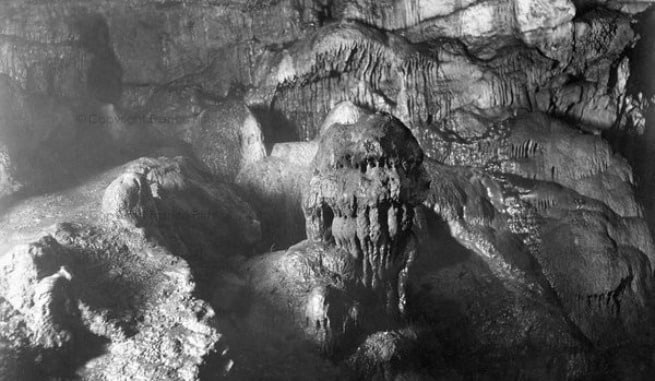
The villagers, desperate, went to the Abbot of Glastonbury and begged for divine help to get rid of this supernatural threat. The abbot sent a monk to face the witch. This monk was a holy man with a lot of faith and bravery who was ready to face the darkness that lived in the caves. The monk went into the caves with nothing but his prayers and a container of holy water, ready to get rid of the evil spirit. When he faced the witch in the depths of the Great Cave, she became enraged and attacked him, but the monk stayed true to his faith and splashed the holy water on her. The holy water hit the witch and turned her into stone right away, trapping her forever in the caves where she had lived. Visitors can still see a stalagmite formation in the first chamber that looks a lot like a hunched, robed figure. Locals have long thought that the statue was the petrified body of the witch herself.
There have been reports of strange events happening in Wookey Hole Caves since medieval times and up to the present day. Many visitors and staff members report witnessing unexplainable occurrences. Many people have said that the temperature drops suddenly in some parts of the caves, which is much more than what can be explained by the natural underground climate. They also say they feel like they are being watched or followed. Some who have been there say they heard whispers or laughter in the empty chambers. Others say they saw shadowy figures moving in the corners of their vision (Clarke, 2020).
When the caves became a popular tourist destination in the Victorian era, many people wrote about how they felt invisible hands touching them or pulling at their clothes as they explored the passages. Paranormal investigation teams have been to the caves more recently with electronic devices. They have reported strange electromagnetic readings and recorded what they think are spirit voices. People who work in the caves have their own strange stories to tell, like things moving on their own, unexplained footsteps in empty rooms, and a constant feeling of unease in certain places. The Witch’s Kitchen, one of the deeper rooms, is especially known for these things happening, and many people won’t go in there alone.

Analysis
There are many different ideas about the Witch of Wookey Hole legend, from purely mythical ones to attempts to explain it historically. Each one offers us a different view of how these kinds of stories come about and last. Some scholars posit that the narrative may have originated as a Christian allegory, devised by medieval monks to illustrate the supremacy of faith over paganism and to deter the continuation of pre-Christian customs in the area. This interpretation sees the story as propaganda meant to strengthen religious power when older beliefs were still strong in rural areas (Lane, 2011).
Some people think that the legend might be based on real events from history, like a real woman who lived as a hermit in the caves and was looked down upon by superstitious villagers who didn’t understand how she lived. Women who lived alone, practiced herbalism, or just didn’t fit in with what society expected of them were often accused of witchcraft in the Middle Ages. A woman who took refuge in the caves would have been an effortless target for people who were afraid (Roper, 2000). The finding of human remains in the caves in the early 1900s, including a skeleton that some said was a woman’s, seemed to support this idea. However, modern analysis has shown that these bones are from the Roman period, which is much earlier than the time when the legend says it happened.
Psychological theories posit that caves inherently elicit fear and awe within the human psyche, as they are realms of darkness and enigma that our ancestors likely linked to peril and the unfamiliar. People would have naturally told stories about the strange rock formations in Wookey Hole, especially the stalagmite that looks like a person, as they tried to explain and understand these wonderful natural events. From this perspective, the witch legend represents a classic example of pareidolia and narrative construction, where the brain imbues unclear natural features with meaning and narrative.
The Witch of Wookey Hole story has had a big effect on tourism, local identity, and the way people perceive folklore in general. The caves are now one of Somerset’s most popular tourist spots, mostly because of the witch story. Thousands of people come each year just to see the petrified witch and experience the caves for themselves. This fact has been good for the local economy, as it has helped businesses and jobs that rely on the steady stream of tourists drawn by the legend. The story has been added to lessons on folklore and local history, which helps keep traditional storytelling alive and teaches kids how to think critically about how legends grow and spread (Wookey Hole Caves, 2023).
The story has inspired writers, artists, and filmmakers to make novels, paintings, and documentaries that provide the legend a new twist and keep it alive in popular culture. The witch has become a symbol of the area, appearing in local festivals and celebrations and serving as a source of community pride and identity. The legend has impacted business and culture, but it also contributes to the ongoing discussions about how women, especially those who lived outside of social norms, have been treated. Accusations of witchcraft were often used to control and punish people who questioned authority or just didn’t fit in.
Conclusion
The Witch of Wookey Hole is more than just a ghost story or a place for tourists to visit. It shows how history, belief, and imagination come together to make lasting cultural stories. The story’s ability to fascinate and disturb has not diminished over the years, whether people see it as pure fiction, a distorted history, or something that touches on real supernatural events. The legend tells us that places can hold stories just as they can hold stone and water. Once these stories are part of the landscape, they are as important and permanent as the physical features themselves. The story of the witch will live on as long as the River Axe flows through the Mendip Hills and the limestone caves of Wookey Hole are open to visitors. These tales will keep this part of Somerset mysterious and amazing for generations to come.
References
Clarke, D. (2020). Marks of the Witch: Britain’s ritual protection symbols. Fortean Times, (392), 36-43.
Dyer, C. (2020). Wookey Hole: History and Folklore of a Somerset Landmark. Somerset Tourist Publications.
Hall, L. (2021). The Natural History of Somerset Caves. Geological Society of London.
Lane, B. (2011). ROMAN LEAVES AND THE ‘WITCH OF WOOKEY’. Wells Natural History and Archaeological Society Report 2010/2011, 38-42.
Roper, L. (2000). Witchcraft and Gender in Early Modern England: An Argument for a New Model. The Historical Journal, 43(2), 495-517.
Wookey Hole Caves. (2023). Visitor Information. Wookey Hole Attractions. Online Available at: https://www.wookey.co.uk/ Accessed: October 2023.


Leave a Reply