Sea Ghosts: Key Points
-
Sea ghosts are spirits believed to haunt the ocean, representing humanity’s fears about death and the unknown depths of our planet.
-
Ghosts are spirits of the deceased that remain in the physical world, appearing in various forms and often associated with unfinished business or tragic deaths.
-
Maritime folklore ties ghosts to ships and the sea, with stories serving as both entertainment and practical warnings about ocean dangers.
-
Famous examples include the Flying Dutchman, cursed to sail forever, and the Mary Celeste, mysteriously abandoned in 1872.
-
Paranormal theories suggest the ocean accumulates spiritual energy, while skeptics point to optical illusions, weather phenomena, and psychological effects of exhaustion.
-
Sea ghost stories have influenced maritime culture, literature, and safety practices while reminding us that the ocean remains mysterious despite modern technology.

Introduction
The ocean has always been a mysterious place, where the line between what is known and what is not known is blurred by waves that never end. Sailors have been telling stories of ghostly ships, phantom crews, and figures that appear in the mist and then disappear without a trace for hundreds of years. These sea ghosts are more than just stories told around the campfire. They are a symbol of humanity’s deepest fears about death, the afterlife, and the vast, unknowable depths that cover most of the earth. Sea ghosts have become an important part of maritime culture and still fascinate us today, whether they are real supernatural events or the wild imaginations of worn-out sailors.
Overview
The simplest definition of a ghost is that it is the spirit or soul of a dead person who is still in the physical world instead of moving on to whatever comes after death. People often say that they look like translucent or shadowy figures that can be solid one moment and disappear the next. Occasionally they can interact with the physical world, and other times they are just observers frozen in time. Ghosts have been linked to unfinished business, sad deaths, or strong feelings for certain people or places throughout history and in different cultures. The idea of a ghost suggests that some part of our consciousness can live on after we die and stay in our world. This idea speaks to our deep-seated need to believe that death is not the end. There are many different ways that spirits can show themselves, such as full-bodied apparitions, cold spots, unexplained sounds, or just a strong feeling of presence. However, the main idea stays the same: something of the dead lives on among the living (Guiley & Taylor, 1992).
The sea has its own unique connection to ghost stories, which have been passed down through generations of sailors and are based on the dangers they face. Sea ghosts are different from land-based ghosts in that they are often linked to ships and are cursed to sail forever on ships that can never reach port. There are many stories in maritime folklore about ghost ships with dead crews, phantom ships that show up as warnings of storms, and the spirits of sailors who drowned who call to the living to join them in the depths. These stories did more than just entertain; they also taught people to respect the ocean’s power, warned against sailing on cursed dates, and gave reasons for the strange disappearances and disasters that constantly happened during the age of sail. The long trips were boring and lonely, and there were real dangers like storms, disease, and navigation mistakes. These things made it easy for supernatural beliefs to grow. When you’re alone on a vast, dark ocean with only creaking wood and wind for company, it’s easy to imagine that the shadows moving across the deck might be more than mere illusions (Chainey & Winsham, 2021).
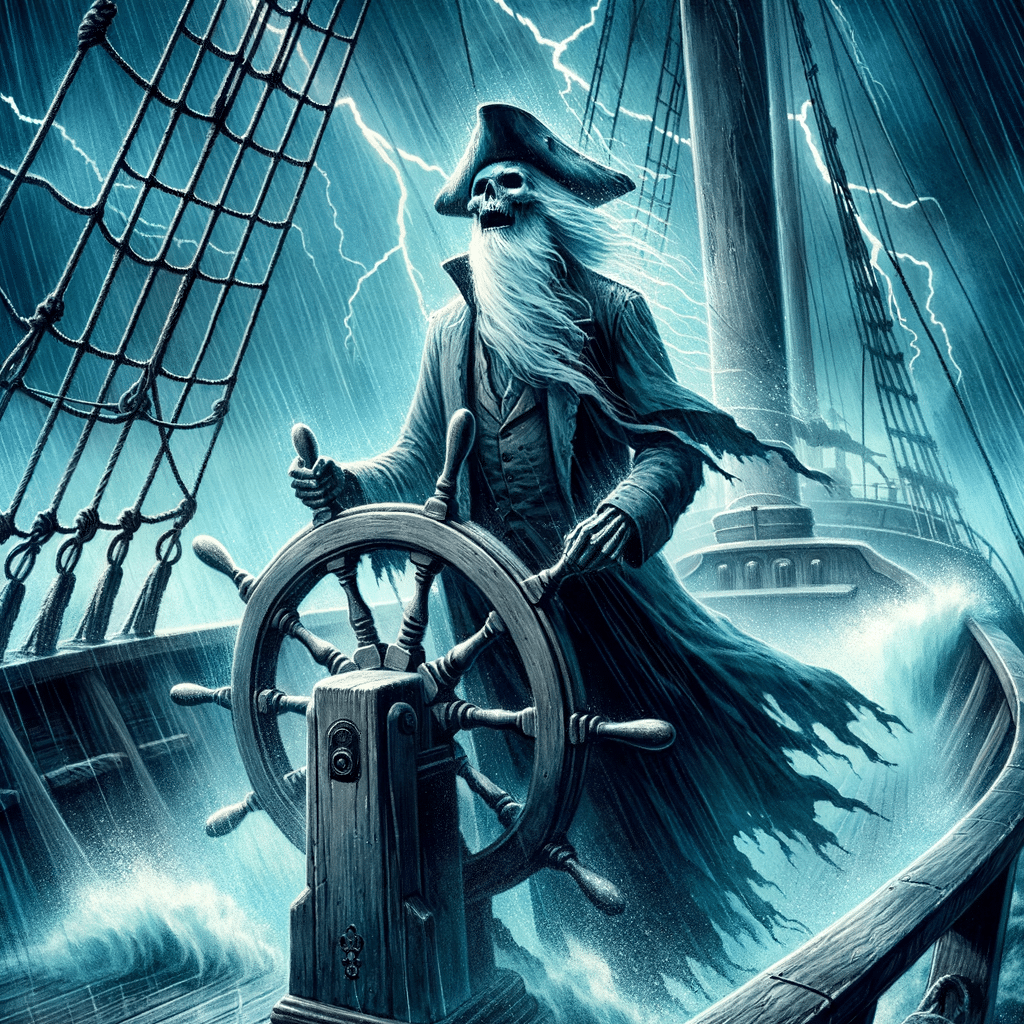
The Flying Dutchman is probably the most famous ghost ship story. It is said to be a ghost ship that will never be able to make port and will sail the oceans forever. The most common version of the story says that the ship’s captain, who was often called Hendrick van der Decken, made a blasphemous promise to go around the Cape of New Hope even if it took until Doomsday. Because of this, he was cursed to do that for all time. Sailors who said they saw the Flying Dutchman said they saw a ghostly ship with torn sails glowing with a strange, otherworldly light. This ship would often show up just before bad storms. The story spread so widely that even people in the British Royal Navy said they saw it. One famous sighting was in 1881, when the future King George V was a young midshipman.
Another well-known case is the Lady Lovibond, a British schooner that is said to have crashed on the Goodwin Sands in 1748 because a jealous crew member did something awful. It is believed to reappear every fifty years around the anniversary of the disaster. When the Mary Celeste was found adrift in 1872 with its crew mysteriously missing, it sparked many theories about everything from sea monsters to supernatural forces. It wasn’t really a ghost ship, but it did draw people interested. These stories live on because they touch on things that are essential to us, like betrayal, pride, love, loss, and the scary idea that some fates might be worse than death.

Analysis
There are many different ideas about what causes sea ghost phenomena, from the supernatural to the strictly scientific, with a lot of room for both. People who believe in the paranormal say that the ocean, which is a place of immense death and tragedy, naturally collects spiritual energy that shows up as ghostly encounters. Some paranormal researchers think that water may have properties that make supernatural events happen. For instance, it could function as a conduit for spiritual energy or store and replay traumatic events, akin to a residual haunting. They cite the consistency of details across independent sightings and the reliability of certain witnesses—seasoned sailors and naval officers with no incentive to fabricate accounts—as evidence that an authentic phenomenon is occurring.
Skeptics, on the other hand, give many logical reasons for seeing sea ghosts that don’t require believing in the supernatural. Optical illusions like fata morgana mirages can make ships that are far away look like they are floating above the water or make it look like there are ships that aren’t really there. St. Elmo’s fire, on the other hand, is a weather phenomenon that makes glowing plasma appear on ship masts and rigging. It could be mistaken for supernatural light. Exhaustion, dehydration, scurvy, and the boredom of long trips can all cause vivid hallucinations. Such behavior is because our brains are wired to see faces and figures in random shapes and shadows. Sailors who worked in shifts around the clock often didn’t obtain enough sleep, which can lead to very vivid and realistic hallucinations that the person who has them may still believe are real after the fact.
The story of the Flying Dutchman is a great example of the conflict between people’s hopes and the harsh, unpredictable nature of the sea. It symbolizes the aimlessness and despair inherent in the human condition, particularly when faced with the enormity of the sea, as examined through the perspective of contemporary existentialism (Pelzer, 2004). This story fits in with bigger ideas in maritime folklore that talk about how people who are lost at sea are always there and how the line between life and death becomes blurry in the in-between spaces of ocean journeys (Kent, 2023; Enzerink, 2021).
Impact
The legacy of maritime disasters and the memories they evoke can also give folklore a ghostly quality. For example, stories that come from the time after Pinochet’s dictatorship in Chile use the sea as a place of trauma and memory (Gray, 2023). In the same way, the haunting of storm apparitions and other supernatural events in Irish and Scottish folklore is a rich tapestry of stories in which maritime encounters with the otherworldly are considered reflections of cultural identity and collective memory (Fomin, 2011; Mathúna, 2021). The supernatural entities, spirits, and apparitions linked to storms and tempests, as documented in diverse maritime traditions, represent the amalgamation of natural and supernatural domains commonly found in folkloric narratives (Labelle, 2009).
In Indonesian culture, the figure of Nyi Roro Kidul, often seen as the guardian of the sea, shows how cultural myths can make the ocean seem like a place that both nurtures and traps souls. Folkloric figures impart fundamental societal values and eco-pneumatological insights that are vital for guiding human interactions with maritime environments (Kristianto et al., 2024). These stories talk about how the seas are dangerous and strange, but they also talk about how they teach maritime communities important lessons and moral values.
Furthermore, the captivating and formidable phenomenon of rogue waves, frequently referred to as “monsters of the deep,” enriches maritime folklore, as evidenced by historical narratives of sailors confronting these hazardous natural events. The recognition of rogue waves in scientific research and folklore highlights the ocean’s ability to inspire both fear and fascination (Ye et al., 2019). This thematic exploration encompasses the paranormal narrative surrounding sea ghosts by integrating scientific realities with folkloric interpretations.
Sea ghost stories have had a big effect on more than just entertainment; they have changed maritime culture, literature, and even real-world naval practices and policies. These stories were meant to warn sailors about the dangers of the sea and remind them to follow safety rules. Sailors were more likely to follow traditions and rules that kept them alive when they thought that certain behaviors might anger the ocean and turn them into ghosts. Ghost stories also helped sailors feel better about their dangerous and uncertain jobs by explaining things that couldn’t be explained and making them feel like the universe followed some kind of rules, even if those rules were supernatural. Maritime ghost stories have had a profound impact on literature and culture, inspiring many works from Samuel Taylor Coleridge’s The Rime of the Ancient Mariner to modern movies and books. These stories have changed how we perceive the ocean itself, making it seem like a mysterious, dangerous place where the normal rules don’t always apply and where ancient mysteries might still be hidden beneath the waves. Even now, when GPS and other modern technologies have made sea travel much safer than it used to be, ghost stories from the ocean are still popular. Their popularity may be because they touch on something deep inside us—the idea that the sea is still wild and untamable, no matter how much we know or how much technology we have.
Conclusion
Sea ghosts are an intriguing mix of folklore, psychology, history, and the questions people have always had about death and the afterlife. Regardless of whether we perceive them as authentic supernatural events, misidentified natural phenomena, or psychological manifestations arising from the distinctive stresses of maritime existence, they convey significant insights about ourselves and our connection to the ocean. These stories have lasted for hundreds of years because they do many things: they entertain, warn, comfort, and remind us that there are still things in the world that are challenging to understand. There will always be stories of ghosts on the water as long as people go to sea and face the dangers of wind and wave. Ships will disappear and sailors will be lost. Overall, it may not matter if sea ghosts are real in the literal sense. What matters is that they are real in the stories we tell, the fear they cause, and the reminder they provide us that the ocean is still a place where the impossible might be just beyond the next wave.
References
Chainey, D. D., & Winsham, W. (2021). Treasury of Folklore: Seas and Rivers: Sirens, Selkies and Ghost Ships. Batsford Books.
Coleridge, S. T. (1834). The rime of the ancient mariner. In Poetical works (pp. 186-209). William Pickering.
Enzerink, S. (2021). Black atlantic currents: mati diop’s atlantique and the field of transnational american studies. Journal of Transnational American Studies, 12(1). https://doi.org/10.5070/t812147127
Fomin, M. (2011). Maritime memorates and contemporary legends of storm apparitions and storm making in folklore traditions of ireland and scotland. Armenian Folia Anglistika, 7(2 (9)), 154-162. https://doi.org/10.46991/afa/2011.7.2.154
Gray, S. (2023). Unwieldy matter: liquid landscapes of memory in postdictatorship chilean film. Moving Image Review & Art Journal (MIRAJ), The, 12(2), 189-204. https://doi.org/10.1386/miraj_00116_1
Guiley, R., & Taylor, T. (1992). The encyclopedia of ghosts and spirits (pp. 277-279). New York: Facts on File.
Kent, L. (2023). Untamed storms: cinema’s oceanic contingency and mati diop’s atlantics. Studies in World Cinema, 3(2), 181-199. https://doi.org/10.1163/26659891-bja10031
Kristianto, A., Singgih, E. G., & Haryono, S. C. (2024). Nyi roro kidul and marine eco-pneumatology. International Journal of Asian Christianity, 7(1), 103-118. https://doi.org/10.1163/25424246-07010006
Labelle, R. (2009). Native witchcraft beliefs in acadian, maritime and newfoundland folklore. Ethnologies, 30(2), 137-152. https://doi.org/10.7202/019949ar
Mathúna, S. M. (2021). Fishing, fishing boats and traditional lore based on maritime memorates collected in the 19th and 20th centuries in ireland and scotland. Studia Celto-Slavica, 12, 105-120. https://doi.org/10.54586/gwhf2143
Pelzer, P. (2004). The flying dutchman and the discontents of modernity. Myths, Stories, and Organizations, 137-150. https://doi.org/10.1093/oso/9780199264476.003.0009
Ye, Y., Zhou, Y., Chen, S., Baronio, F., & Grelu, P. (2019). General rogue wave solutions of the coupled fokas–lenells equations and non-recursive darboux transformation. Proceedings of the Royal Society A: Mathematical, Physical and Engineering Sciences, 475(2224), 20180806. https://doi.org/10.1098/rspa.2018.0806
Leave a Reply