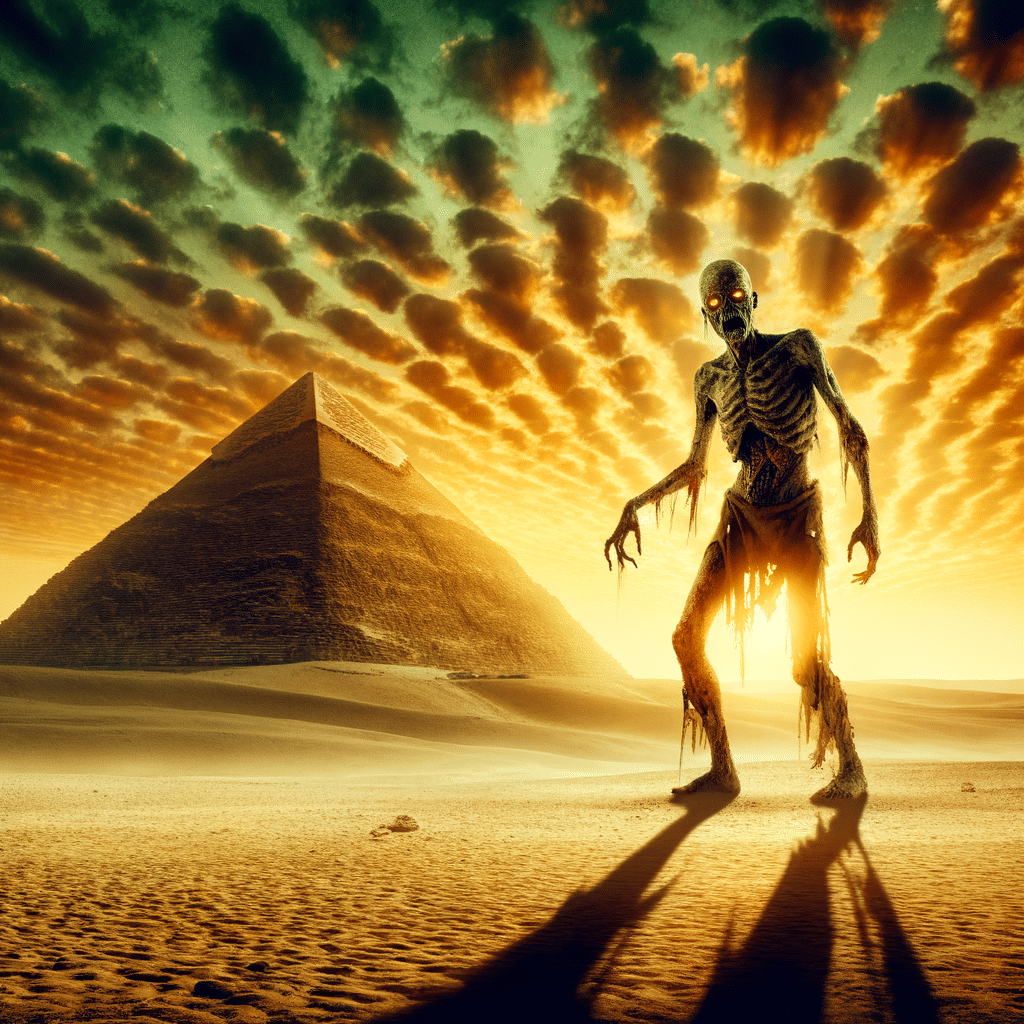
Zombies in Ancient Egypt: Key Points
-
The ancient Egyptians believed in restless spirits of the improperly buried who retained intelligence and sought revenge, unlike modern mindless zombies.
-
Modern zombies are decaying, consciousless bodies driven by hunger, while Egyptian undead were spiritual beings with intact personalities resulting from failed burial rituals.
-
Egyptian mummification aimed to preserve bodies for afterlife transition, not create walking corpses, and improper preservation could cause supernatural consequences.
-
Scholars believe these undead myths arose from mummification practices and harsh conditions, serving to deter tomb robbery and reinforce social obligations to the deceased.
-
Egyptian undead mythology influenced later cultures through archaeological discoveries and tomb curse stories like King Tutankhamun’s, shaping modern popular culture.
-
Both Egyptian and modern zombie narratives address fears about death’s boundaries, though Egyptians emphasized individual souls while modern versions focus on collective biological threats.

Introduction
The idea of the undead has fascinated people from all over the world for thousands of years. Ancient Egypt is one of the most fascinating civilizations to have dealt with ideas of life after death and reanimated bodies. We usually think of zombies as being in modern horror movies and pop culture, but the ancient Egyptians had their own complicated stories about the dead who walked among the living. Their complex ideas about the afterlife, how to keep the body safe, and the risks of not following proper burial practices show that they were distressed about what might happen if the natural order between life and death was upset. Studying how ancient Egyptians viewed their undead can help us understand their worldview and how all people fear death and the afterlife.
Overview
In modern popular culture, zombies are usually shown as reanimated corpses that have lost their humanity and are wandering around looking for brains or flesh to eat. People often consider these creatures to be slow-moving, rotting bodies with little brain activity, driven only by an unquenchable hunger and without their old personalities or memories. The modern zombie is a body that has completely lost its soul or consciousness. It is now just a shell that is being controlled by a supernatural or viral force. This scary picture has become a staple of horror movies and TV shows, representing fears about getting sick, losing your identity, and the end of society. The zombie apocalypse story has especially captured people’s imaginations around the world. It shows how the dead can overrun the living and how civilization can fall apart under the weight of an unstoppable plague (Khan, 2024).
Ancient Egyptian mythology, on the other hand, had entirely unique ideas about the undead. This was because they had very detailed ideas about death, mummification, and the journey to the afterlife (Booth, 2022). The Egyptians didn’t have a single word or idea that meant the same thing as “zombie” today, but they were terrified of the dead coming back to hurt people. Their mythology included several beings that could be called undead, like the restless dead who were buried wrong or those who didn’t make it to the afterlife. These beings were not mindless creatures; they were souls trapped between worlds that often had intelligence and specific grudges or unfinished business that made them come back. The ancient Egyptians thought that a person was made up of different spiritual parts, such as the ka (life force), ba (personality), and akh (transfigured spirit). Harming any of these parts could lead to supernatural problems.
One of the most important parts of ancient Egyptian undead mythology was the idea of the restless dead, which were people who hadn’t been buried properly or had died in a violent or unexpected way. People thought that these poor souls were stuck on Earth and couldn’t finish their journey to the afterlife, which could be dangerous for the living. The Egyptians went to enormous lengths to ensure that burial practices were done correctly because they were afraid of what would happen if they didn’t. They thought that a body that wasn’t thoroughly prepared could lead to a vengeful spirit or a soul that was stuck. Unlike today’s zombies, who are basically animated corpses with no thoughts, these ancient Egyptian undead still had their memories and personalities. They also often wanted justice or revenge for wrongs done to them while they were alive. People feared supernatural punishment from those who had wronged or ignored them, not mindless consumption.

Theories and Analysis
The ancient Egyptians had a complicated relationship with mummification, which is very different from the decaying bodies in modern zombie fiction. The Egyptians believed that the body had to be preserved so that the soul could reunite in the afterlife and become an akh that lived with the gods. The complicated embalming process, taking out organs, and careful wrapping were all meant to keep the body intact forever, not to make it a walking corpse, but to make it easier for the person to move on to the next world (Wright, 1987). The Egyptians thought that if something went wrong during this process, or if tombs were broken into and mummies were disturbed, there could be serious supernatural effects. Tomb curses and warnings inscribed on burial chambers were not merely superstitious threats; they embodied sincere convictions regarding the protective wrath of the deceased and the deities overseeing them (Redfern & Steiger, 2014).
The disparity between ancient Egyptian notions of the undead and contemporary zombie mythology illustrates fundamentally divergent cultural anxieties and worldviews that influenced each society’s comprehension of death and its consequences. Contemporary zombies frequently symbolize anxieties regarding the loss of humanity, epidemic illness, and the disintegration of social order, originating from a secular perspective that perceives death as a definitive biological conclusion that can solely be reversed through unnatural interventions (Naji & Al-Ghareeb, 2022). In contrast, the undead in ancient Egypt came from a very spiritual view of the universe in which death was just a change, and the greatest fear was failing to achieve immortality in the afterlife. The Egyptians thought that the body and soul were connected but could be separated. They believed that specific rituals and moral guidelines were necessary to ensure safe passage to the afterlife. In contrast, most modern zombie stories say that the body and mind are always together until an outside force brings the body back to life without the mind. These differing perspectives illustrate how each culture’s prevailing beliefs regarding the essence of existence, the soul, and the afterlife influenced their distinct interpretations of the undead.
Scholars have proposed diverse theories to elucidate the origins and significance of undead beliefs in ancient Egyptian culture, utilizing archaeological evidence, religious texts, and comparative mythology. Some researchers propose that Egypt’s advanced mummification techniques and intricate tomb constructions may have engendered anxieties regarding the deceased, as the preservation of bodies facilitated a tangible presence of the dead that remained perceptible and accessible to the living. Some people say that the harsh realities of life in the past, like plague, famine, and war, made it impossible to avoid undesirable burials. This led to cultural stories that explained and warned against these mistakes. The economic worth of tombs and their contents might have contributed, as apprehensions of undead retribution could act as supernatural deterrents against tomb robbery, augmenting physical security measures with psychological deterrents that surpass terrestrial law.
The psychological dimension of these beliefs is substantial, as ancient Egyptian concepts of the undead likely served essential social and emotional functions in helping individuals cope with grief and maintain moral behavior. The idea that the dead could come back if they were wronged or ignored may have made people feel more responsible for taking care of their deceased family members and keeping their tombs in decent shape, which helped keep cultural practices going from one generation to the next. These beliefs also helped people understand why undesirable things happened to them or their communities, saying that they were caused by supernatural forces instead of adverse luck or human error. From an anthropological standpoint, the intricate mythology surrounding death and the possibility of detrimental returns of the deceased established a holistic framework that confronted the ubiquitous human confrontation with mortality while simultaneously reinforcing significant cultural principles regarding familial obligation, appropriate ritual practice, and ethical conduct subject to evaluation in the afterlife.
Impact
The influence of ancient Egyptian undead mythology transcended their civilization, shaping subsequent cultures and ultimately enriching the diverse array of undead legends that endure in various manifestations today. When archaeologists opened ancient Egyptian tombs in the 1800s and 1900s, stories of curses and mummies’ revenge caught the public’s attention. This led to many stories, movies, and other forms of popular culture that mixed ancient beliefs with modern sensibilities. The curse of King Tutankhamun’s tomb, whether genuine or fabricated, attained legendary status and contributed to the establishment of the vengeful mummy archetype in Western popular culture (Silverman, 1987). These stories, even though they often twist or exaggerate real Egyptian beliefs, show how powerful ancient ideas about death and coming back to life have been for thousands of years.
The way the ancient Egyptians kept religious and funerary texts also made sure that their ideas about the afterlife and the dangers of dying in the wrong way would live on for future generations to study and understand. The Book of the Dead, pyramid texts, and coffin texts are all examples of documents that supply detailed instructions on how to navigate through the afterlife. They also show how complicated Egyptian theology was when it came to death, judgment, and resurrection. These texts discuss different dangers that a soul might face in the afterlife, such as demons, hostile gods, and the possibility of complete destruction if they fail Osiris’s judgment. The written preservation of these beliefs enabled them to impact subsequent religious and philosophical traditions, influencing early Christian concepts regarding bodily resurrection and the interplay between the physical and spiritual dimensions of human existence.
Comparing ancient Egyptian undead mythology with modern zombie stories reveals both universal themes and culturally specific differences, revealing profound insights into human nature and our response to death. Both ancient Egyptians and contemporary audiences exhibit a fundamental anxiety regarding the transgression of the boundary between life and death, although the manifestations of this anxiety are shaped by their distinct cultural contexts and prevailing belief systems. The ancient Egyptian version put more emphasis on individual souls, moral judgment, and the importance of doing things right, while modern zombie stories often focus on group threats, biological reasons, and staying alive against all odds. But they both serve similar psychological purposes: they help us face our fears about death, contemplate what makes us human, and think about what happens if we don’t honor the dead or keep social order.
Conclusion
The ancient Egyptians had a very complex view of death and the afterlife, which led to a rich mythology. This mythology was different from modern zombie ideas, but it still dealt with the same basic human fears about what happens when the dead don’t rest peacefully. Their beliefs about the undead were deeply connected to their complicated religious view of the world, which saw death not as an end but as a change that needed to be carefully navigated and followed through with rituals. These old beliefs still have an effect on modern culture, inspiring many retellings and new interpretations that use Egyptian images and ideas in new ways. Examining the ancient Egyptians’ perspective on the undead not only teaches us about history but also underscores the profound human desire to comprehend death, maintain connections with the deceased, and establish boundaries between the worlds of the living and the dead, all in an attempt to protect us from our deepest anxieties about death and its aftermath.
References
Booth, C. (2022). A History of the Undead: Mummies, Vampires and Zombies. Pen and Sword History.
Khan, S. A. (2024). Ancient Zombies. Indian Literature, 68(1 (339), 32-47.
Naji, M. T., & Al-Ghareeb, S. L. (2022). Zombie: A Metaphor of Modern World. Journal of Education College Wasit University, 48(1), 435-442.
Redfern, N., & Steiger, B. (2014). The zombie book: the encyclopedia of the living dead. Visible Ink Press.
Silverman, D. (1987). The Curse of the Curse of the Pharaohs. Expedition, 29(2), 56.
Wright, G. R. H. (1987). African Demons and Dead Egyptians. AZANIA: Journal of the British Institute in Eastern Africa, 22(1), 77-82.
Leave a Reply