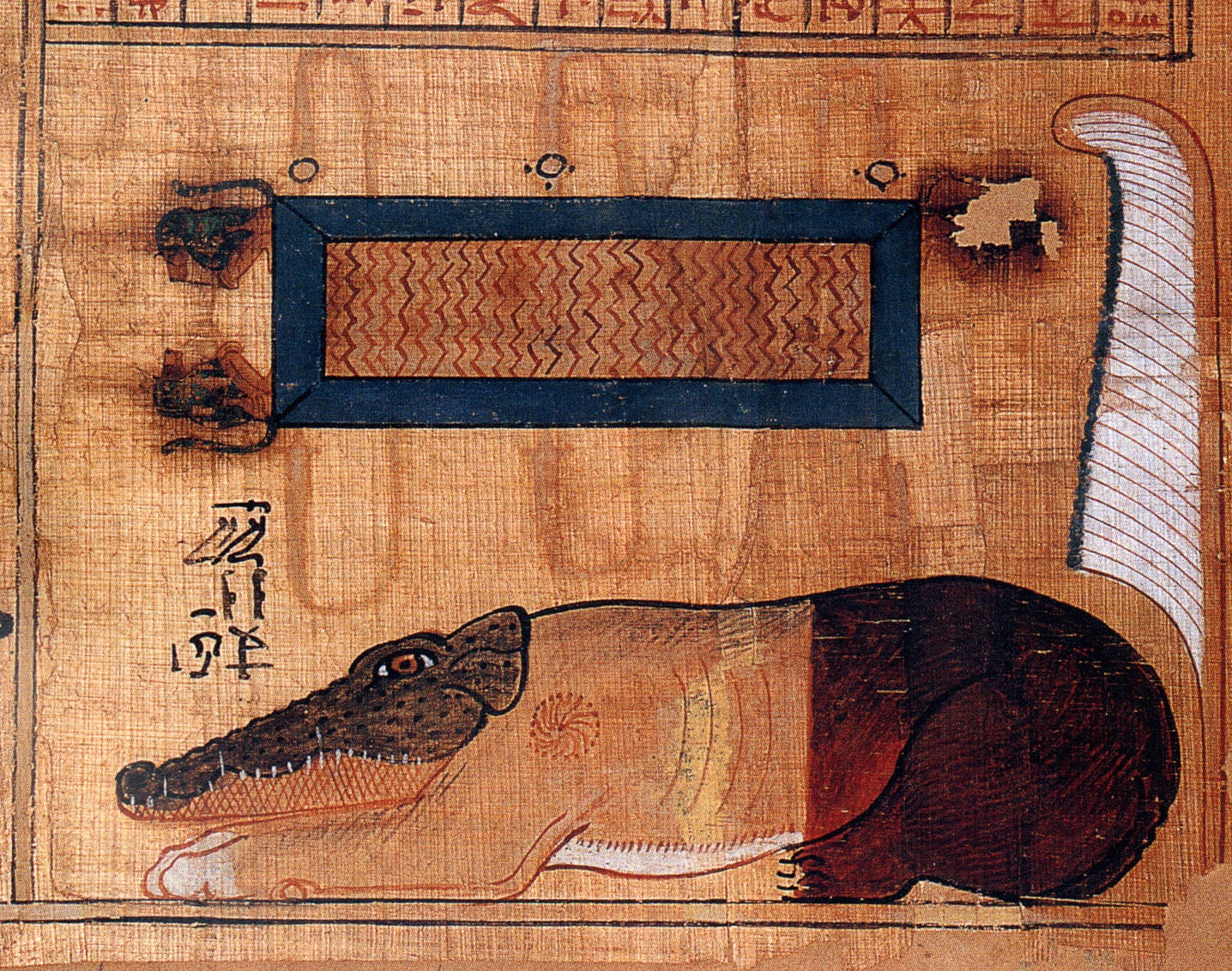
Ammit, Egyptian Demon: Key Points
-
Ammit was a composite creature with a crocodile head, lion body, and hippopotamus hindquarters who devoured unworthy souls in the Egyptian afterlife.
-
Egyptian demons were complex supernatural forces that maintained cosmic balance rather than representing pure evil like in Western traditions.
-
Ammit waited during the weighing of the heart ceremony to devour hearts heavier than Ma’at’s feather, causing complete annihilation.
-
Scholars argue about whether Ammit was a demon or a justice agent. Her mixed form, which included Egypt’s most dangerous animals, represented chaos.
-
Ammit’s mythology motivated elaborate funerary practices, reinforced social norms, and influenced later religious traditions while appearing in modern popular culture.
-
Ammit represented absolute cosmic justice in a meritocratic afterlife where moral accountability extended beyond death through proper preparation.

Introduction
Ammit, the devourer of the dead, is one of the most frightening and interesting figures in ancient Egyptian mythology. Ammit was not like the good gods who helped souls through the afterlife or the protective gods who kept evil away. Instead, she was the worst thing that could happen to someone who did something wrong in the Egyptian cosmic order. Her presence in the Hall of Two Truths during the weighing of the heart ceremony exemplified the ancient Egyptians’ deep conviction in divine justice and the irrevocable essence of spiritual demise. To understand Ammit, you need to look at more than just her role in Egyptian mythology. You also need to look at the bigger picture of demons in Egyptian religious thought, the theological debates about her nature, and how she has affected both ancient and modern ideas about judgment and damnation.
Ammit and Egyptian Demonology
In ancient Egyptian mythology, demons were not always evil beings who were against God’s order. This is very different from how demons are thought of in the West today. Egyptian demons, or “hostile spirits,” were complicated supernatural beings that were part of the natural cosmic balance instead of being against it. These beings lived in liminal spaces and served as protectors, punishers, or obstacles that souls might come across on their journey through the Duat, the Egyptian underworld. Many demons were meant to protect people from chaos and keep the universe in order, while others were meant to represent specific dangers or diseases that could affect the living. The Egyptians did not see these beings as bad by nature; instead, they saw them as necessary parts of a universe that had both creative and destructive forces. Priests and the dead could get past these dangerous beings by using magic and ritual knowledge, either by appeasing them, using magical spells written down in funerary texts, or by showing that they were worthy by acting properly in life (Lucarelli, 2013).
Ammit had a unique and scary look that combined traits from three of the most feared animals in ancient Egypt. Her body was made up of the head of a crocodile, the front body and mane of a lion, and the back of a hippopotamus. This made her a chimeric creature with raw predatory power from many sources. The name “Ammit” means “devourer” or “eater of the dead.” Other texts call her “the bone eater” or “eater of hearts,” which shows how scary her job is. Ammit didn’t have a cult or temple like the other big gods did, which suggests that Egyptians were more afraid of her than they were of her. She lived in the Hall of Two Truths, next to the scales where the god Anubis weighed the hearts of the dead against the feather of Ma’at, which stood for truth and cosmic order. Her presence there was permanent and unavoidable, a constant reminder that every soul would be judged and that moral responsibility went beyond death (Bane, 2014).
Ammit’s specific role in Egyptian funerary mythology was during the Weighing of the Heart ceremony, which was probably the most important part of the deceased’s journey to the afterlife. The Egyptians thought that the heart held the essence of a person’s character and actions. When a soul arrived in the Hall of Two Truths, the heart was placed on one side of the scales and the feather of Ma’at was placed on the other. Forty-two divine judges watched as the god Thoth, who was the scribe of the gods, wrote down the results of the weighing. If the heart was lighter than or equal to the feather, which meant that the person had lived a life of truth, justice, and good behavior according to Ma’at, they could go to the paradise of the Field of Reeds. But if the heart was heavy with sins like theft, murder, blasphemy, or cruelty, it would tip the scales and show that the soul was not worthy. If the heart was heavier because of the sins done in life, Ammit was supposed to eat it, which would send the unworthy soul to oblivion and erase its existence from the afterlife (Martin, 2020).
In ancient Egyptian religion, the journey to the afterlife was full of problems, and divine figures were given roles that kept the cosmic order in place. Ammit represents a punitive dimension of this order, signifying the repercussions of earthly conduct (Martin, 2020). The obliteration of the soul represents a profound existential dread, resonating with humanity’s apprehension of oblivion and the absence of legacy in the afterlife, reflecting fears and moral teachings prevalent in various cultures’ mythologies.

Theories
For many years, scholars of Egyptian religion have been trying to figure out whether Ammit is a demon or something else entirely. On one hand, she clearly acted as an instrument of divine punishment, carrying out the gods’ judgment instead of her own evil will. This might make her more of an agent of cosmic justice than a demon in the traditional sense. Her job was not to tempt, corrupt, or lead souls astray, but to get rid of those who had already failed the test of righteousness while they were alive on Earth. Some scholars contend that this functional distinction differentiates her from the malevolent demons that tormented travelers in the Duat or afflicted the living with illness and misfortune. However, other researchers argue that Ammit’s position among the many supernatural beings that lived in the Egyptian afterlife, along with her terrifying looks and role as a source of fear, makes her fit into the larger group of Egyptian demons (Lynn, 2019). The debate ultimately illustrates the intricacy of Egyptian theological classifications, which did not consistently correspond with subsequent Western religious structures that aimed to distinctly differentiate between angels, demons, and neutral spiritual entities.
Many ideas have come up about what Ammit meant symbolically and psychologically in ancient Egyptian culture and spirituality. Some scholars think that her mixed form represents chaos itself, combining parts of creatures that lived on the dangerous edges of Egyptian civilization, where the Nile’s life-giving order gave way to wilderness. The crocodile hid in the river, the lion prowled the desert, and the hippopotamus, which was linked to some protective gods, was known to be one of the most dangerous animals in Egypt, killing many people. Ammit represented the ultimate destruction that would come to anyone who left Ma’at and embraced isfet, which means chaos and disorder (Lynn, 2019). Other interpretations posit that Ammit symbolized the Egyptians’ profound apprehension regarding mortality and the repercussions of moral transgression, acting as a significant motivator for ethical conduct in life. Some people think that the ancient Egyptians believed that everyone would go to the afterlife, but the fact that they had a creature like this in their mythology shows that this is not true. Instead, the fear of Ammit turned the afterlife into a reward that had to be earned by doing the right thing. This created a religious system that used the threat of punishment in the afterlife to enforce moral and social rules.
The idea of Ammit also makes us think about how Egyptians thought about divine mercy and justice. The judgment scene allowed neither appeals nor second chances nor redemption once a person’s heart was burdened by sin, unlike certain later religious traditions that suggest repentance, divine intervention, or grace as ways to save the wicked (Mancini, 2004). Ammit’s role was predetermined, which implies a cosmic justice that worked according to set rules instead of God’s whims or favoritism. But this seeming rigidity was softened a bit by the large amount of funerary literature that gave the dead spells, declarations, and magical knowledge to help them on their journey through the afterlife. The “negative confession,” in which the deceased denied committing various sins before the forty-two judges, along with protective amulets and properly conducted funerary rites, served as spiritual preparation and defense. This preparation meant that even though justice was absolute, people were given the tools and knowledge they needed to meet its standards. The priesthood played a very important role in making sure that the dead had access to these resources, no matter what their social status was in later periods of Egyptian history.
Impact
The proliferation of funerary texts and the elaborate burial practices that defined Egyptian civilization for millennia are evidence of Ammit’s influence on ancient Egyptian society. The fear she instilled drove the living to devote immense resources to death preparations, including the construction of elaborate tombs and the commissioning of personalized Books of the Dead inscribed with the deceased’s name and suitable incantations. As intermediaries who could help souls through the dangers of the afterlife, including Ammit herself, the priesthood had a lot of power and money. In many tomb paintings and papyri, artists showed the weighing of the heart scene. Ammit’s unique shape served as a visual reminder of how important the judgment process was. These pictures helped to keep social norms by showing what happened when people broke Ma’at, which supported the pharaonic order that said it was in charge of truth and justice on Earth. Over the course of Egyptian history, beliefs about the afterlife became more democratic, allowing everyone, not just the rich and powerful, to be judged and go to paradise. This made Ammit’s threat more important to the culture, as it now applied to everyone, not just the elite.
Ammit’s impact transcended ancient Egypt, shaping subsequent religious and cultural traditions in the Mediterranean and Near Eastern regions. Greek and Roman tourists who went to Egypt learned about her mythology and added parts of it to their own ideas about how the underworld judges people. However, they often made big changes to fit their own religious beliefs. Some early Christian theologians, who were educated in Alexandria and knew about Egyptian traditions, may have used the idea of final judgment and eternal consequences to come up with ideas about heaven and hell. However, it is hard to say for sure how these ideas came to be (Osman, 2005). The visual motif of weighing souls is present in numerous ancient religious traditions. Each culture cultivated its unique symbolism; however, the Egyptian depiction featuring Ammit poised to consume the unworthy stands as one of the earliest and most fully realized representations of this concept. Some medieval European artists painted demons that looked like a mix of animals, like Ammit. This could mean that these images were passed down through indirect means over hundreds of years.
In recent years, Ammit has made a comeback in popular culture, showing up in books, TV shows, movies, and video games as a symbol of ancient Egyptian magic and divine punishment. Modern works of fiction often make her role simpler or change it, sometimes showing her as an evil force that needs to be stopped instead of an impersonal agent of cosmic justice. These adaptations show how people today tend to make supernatural beings more personal and tell stories about the fight between good and evil. In contrast, the original Egyptian idea of Ammit saw her as playing an important role in a balanced cosmic order. As Egyptologists have learned more about Egyptian demonology and how it fits into bigger religious and social systems, more scholars have become interested in Ammit. Contemporary analyses increasingly acknowledge that Ammit’s function cannot be comprehended in isolation but must be evaluated within the framework of Egyptian beliefs regarding Ma’at, the conceptualization of the heart as the locus of consciousness and morality, and the evolution of afterlife beliefs throughout Egyptian history. This scholarly focus has illuminated how Ammit’s mythology embodies essential Egyptian notions of justice, responsibility, and the correlation between ethical behavior and cosmic order.
Conclusion
Ammit is one of the most psychologically and theologically complicated characters in ancient Egyptian mythology. She represents the civilization’s deep concern with moral responsibility and eternal consequences. Her function as the devourer of unworthy hearts set her apart from both the benevolent deities who assisted the righteous and the malevolent demons who tormented souls indiscriminately in the afterlife. The academic discourse regarding her designation as a demon illustrates the overarching difficulty of imposing Western religious frameworks onto Egyptian philosophy, in which supernatural entities fulfilled various roles within a cosmic framework that harmonized creation and annihilation. The mythology of Ammit had a big effect on ancient Egyptian society. It changed how funerals were done, strengthened social norms, and gave people a strong reason to act morally. Her influence went beyond Egypt and affected later Mediterranean religions. It still inspires modern cultural works. In the end, Ammit is not just a scary monster; she is also a complex theological idea that made the Egyptian afterlife a meritocracy where cosmic justice was both absolute and, for the righteous, attainable through moral living and proper preparation.
References
Bane, T. (2014). Encyclopedia of demons in world religions and cultures. McFarland.
Lucarelli, R. (2013). Towards a Comparative Approach to Demonology in Antiquity: The Case of Ancient Egypt and Mesopotamia. Archiv für Religionsgeschichte, 14(1).
Lynn, H. (2019). Evil Archaeology: Demons, Possessions, and Sinister Relics. Disinformation Books.
Mancini, A. (2004). Maat revealed, Philosophy of justice in ancient Egypt. Buenos Books America LLC.
Martin, J. D. (2020). Scales and balances. Between Making and Knowing, 53-61. https://doi.org/10.1142/9789811207631_0006
Osman, A. (2005). Christianity: An Ancient Egyptian Religion. Simon and Schuster.




Leave a Reply