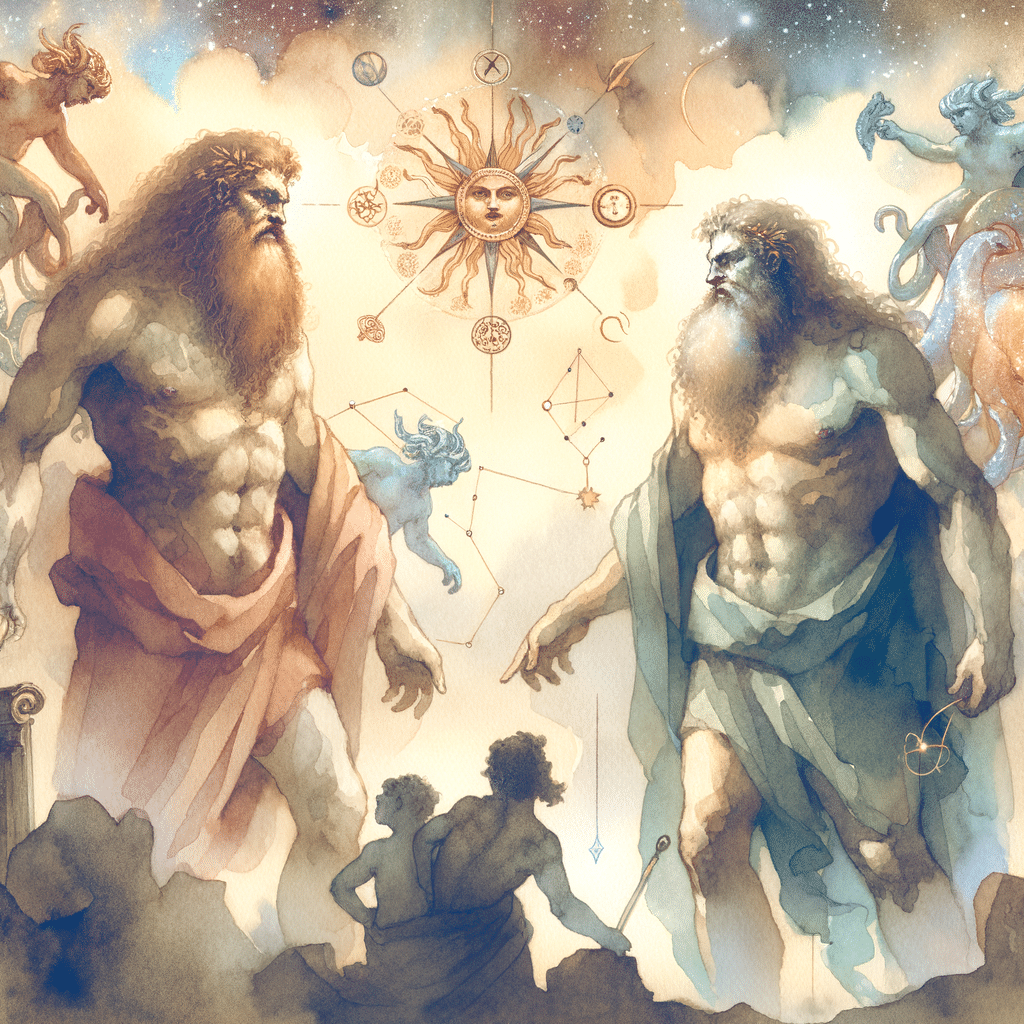
Astrology and Nephilim: Key Points
-
The ancient connection between astrology and the Nephilim explores how celestial knowledge and mysterious biblical giants intersect in religious and mythological traditions.
-
Astrology interprets how celestial bodies influence human affairs, while the Nephilim were mysterious giants described as offspring of divine beings and humans.
-
According to the Book of Enoch, fallen angels taught humanity forbidden astrological knowledge when they descended to Earth and fathered the Nephilim.
-
Theories suggest the Nephilim possessed cosmic understanding through their divine heritage, or that their angelic fathers brought celestial secrets from heaven.
-
This association impacted religious thought, with Christians condemning astrology while occult traditions embraced it as ancient wisdom.
-
The enduring fascination reflects human questions about our cosmic place and explores the power and consequences of forbidden knowledge.

Introduction
The ancient world was full of mysteries that still fascinate people today. One of the most intriguing topics is how celestial observation and biblical enigmas come together. People have always looked to the stars for guidance, meaning, and a more profound understanding of their place in the universe. They also had to confront stories of beings that seemed to exist between the divine and mortal realms. The link between astrology and the Nephilim is an intriguing mix of two old ways of thinking. It suggests that the heavens above and strange beings below might be more connected than we usually think. This relationship encourages us to examine how our forebears comprehended the motions of celestial bodies and the existence of remarkable beings that coexisted with them.
Overview
Astrology is the study of how planets, stars, the sun, and the moon affect people and things that happen on Earth. Many different cultures have used this practice for thousands of years. For example, the Babylonians carefully tracked the movements of the planets, and the Egyptians built their pyramids in line with the stars. Astrologers in ancient times thought that the positions of the stars and planets at the time of a person’s birth could tell them about their personality, future, and life path. They made up complicated systems of zodiac signs, houses, and planetary aspects. We might consider personal horoscopes to be just a way to tell the future, but they were actually a very advanced way to understand time, predict the seasons for farming, read omens for kings and kingdoms, and make sense of the cosmic order that governed existence. Ancient civilizations perceived the sky as a dynamic script authored by divine entities, conferring immense power and knowledge upon those capable of interpreting it (Tester, 1987).
The Nephilim, however, are one of the most mysterious and controversial figures in biblical and apocryphal literature. Genesis 6:4 is the first place we hear about these beings. They are said to be the offspring of the “sons of God” and the “daughters of men,” living on Earth before and after the flood. The text characterizes them as giants and formidable warriors of great renown, although the specifics of their lineage and purpose continue to provoke significant scholarly and theological discourse. Different cultures have understood the Nephilim in different ways. Some consider them to be real giants born from fallen angels and human women, while others consider them to be powerful human rulers or tyrants. Still others consider them to be a symbol of corruption and the mixing of the divine and mortal worlds. The Book of Enoch, an old Jewish book that isn’t in most biblical canons, goes into much more detail about these beings. It says they were the children of angels called the Watchers, who arrived on Earth and taught people things they shouldn’t have. Their presence in ancient texts indicates they embodied a significant disturbance to the cosmic order, entities that ought not to exist and whose existence tainted the world (Scodel, 2021).
When we look at the forbidden knowledge that ancient texts say the Watchers taught to people, we start to see the link between astrology and the Nephilim. The Book of Enoch says that when these angels arrived at Earth, they didn’t just have children with human women; they also told people things that were meant to stay secret. Some of these forbidden teachings were about astrology, reading signs from the sky, and using heavenly observations to tell the future. This implies that astrology, in certain traditions, was regarded as knowledge derived from transgressive entities rather than from authentic divine revelation or human inquiry. The ramifications of this association are significant—should astrological knowledge originate from the Nephilim or their celestial progenitors, it embodies the essence of prohibited wisdom, knowledge humanity was never intended to acquire. This connection could be why some religious groups have always looked down on astrology or even condemned it. They don’t see it as harmless superstition; they see it as a remnant of ancient corruption (Roberts, 2025).
People consider the Nephilim to be hybrids, born from the “sons of God” and the “daughters of men” (Genesis 6:4). This blending can be likened to astrological interpretations, indicating a relationship between celestial events and terrestrial occurrences. In Hellenistic astrology, daimons are considered spirits that connect the divine and mortal worlds and affect people’s fates. This phenomenon is similar to the story of the Nephilim, who were beings that lived in both worlds (László, 2018). These frameworks posited that the positions of celestial bodies at birth could determine an individual’s destiny, paralleling the Nephilim’s mythology of formidable entities whose existence was linked to momentous terrestrial occurrences (Beck, 2015).

Theories
Numerous theories have attempted to explain the connection between these star studies and the mysterious giants over the years. One viewpoint posits that the Nephilim, possessing a partially divine essence, had an intrinsic comprehension of cosmic principles that ordinary humans could not inherently grasp. By teaching people astrology, they shared this supernatural knowledge with them, giving them a glimpse of patterns and influences that were beyond what people could normally see. Another theory says that the fallen angels who had the Nephilim were actually celestial beings in the most literal sense. They were beings who had lived in the heavenly realms and had seen planets and stars move. They brought this celestial knowledge with them when they fell to Earth, but they ruined it by giving it to the unwise and immature. A third reading says that the connection is more symbolic than literal. Both astrology and the Nephilim stand for how dangerous it is for people to go beyond their limits in search of knowledge and power that upsets the natural order set by God.
Astrology has traditionally been regarded as a framework for comprehending human fate through celestial patterns. The idea that the positions of the stars affect human affairs is similar to the Nephilim, whose unusual traits have been considered both good and bad in biblical stories. Horoscopic interpretations in ancient Babylonian culture incorporated astronomical observations, demonstrating how cultural cosmologies shaped humanity’s understanding of its place in the celestial framework (Pilloni, 2024). This notion implies that the Nephilim may be regarded as embodiments of discordant astrological forces, resulting in disorder.
Astrology’s methods often include looking at celestial events to figure out people’s personalities and futures. This is similar to the interpretive traditions about the Nephilim, which look at their role in human history from a theological perspective and suggest that adverse celestial influences led to their controversial legacy of violence and tyranny (Ochocinski, 2024). Astrological practices, especially during the Renaissance, sought to reconcile chaotic interpretations with a systematic understanding, similar to how Nephilim narratives evolved across various religious contexts, which led to a reassessment of their importance within biblical history (Methuen, 2005).
Impact
For thousands of years, this connection has had an effect on religious thought, occult traditions, and cultural stories. Many early Christian writers opposed astrology, believing it to be associated with fallen angels and forbidden knowledge. They saw it as a practice that could lead people away from faith and into dangerous spiritual areas. This suspicion made astronomy (the scientific study of heavenly bodies) and astrology (the practice of interpreting them) complicated. Religious leaders tried to tell the difference between real celestial observation and what they thought was demonic deception. In occult and esoteric traditions, the link between the Nephilim and astrology has been accepted rather than rejected. Practitioners see this ancient knowledge as a strong way to learn about hidden truths and tap into supernatural powers. These traditions frequently depict the Watchers and their teachings as a benevolent gift to humanity, a Promethean act of defiance that liberated mortals from ignorance, albeit at a cosmic expense. The story has also made its way into popular culture, showing up in everything from fantasy books to conspiracy theories. The idea of ancient giants teaching celestial wisdom to primitive humans fits into bigger stories about lost civilizations and hidden knowledge.
The link between these two old ideas also makes us contemplate how our ancestors saw the structure of reality itself. If the Nephilim were real beings who knew about the stars, this suggests a way of thinking that is very different from how most people think today, where the lines between heaven and earth and material and spiritual were much more blurry. In this cosmology, the movements of planets were not merely physical phenomena to be observed and predicted; they were expressions of spiritual forces and divine intentions that could be comprehended and possibly influenced by individuals possessing the appropriate knowledge. The giants who walked the earth back then weren’t just bigger people; they were beings who connected the two worlds, living bridges between the heavenly and earthly. This interpretation posits that the flood’s destruction served not only as a retribution for moral transgressions but also as a means of severing a connection that had grown too perilous, thereby closing a portal between worlds that ought to remain distinct.
Contemporary scholars persist in grappling with the implications of these ancient linkages, examining them from diverse viewpoints. Scholars of ancient Near Eastern literature consider these texts as artifacts of their time, reflecting the cosmological and theological concerns of ancient societies striving to understand their existence. They note that many old cultures had stories about giants, fallen gods, and heavenly knowledge. These stories may have been about common human fears about power, knowledge, and the relationship between gods and people. Theological interpreters contend over whether these passages ought to be interpreted literally or symbolically, with some asserting that the Nephilim were actual beings and their teachings authentically supernatural, while others advocate for metaphorical interpretations emphasizing moral and spiritual lessons over historical or cosmic assertions. People who are interested in alternative history and ancient mysteries often see these links as proof of advanced ancient civilizations or contact with aliens. They see the Nephilim as advanced beings from other worlds and astrology as a remnant of their superior scientific knowledge.
Conclusion
The persistent intrigue regarding the correlation between astrology and the Nephilim reflects a profound aspect of human consciousness—our quest to comprehend our position in the cosmos and the genesis of our knowledge. These ancient tales encourage us to contemplate the essence of humanity and the boundaries between various realms of existence, regardless of whether we interpret them as literal or interpret them as symbolic. They remind us that knowledge has always been thought of as a kind of power that can either help or hurt people, depending on how they acquire it and use it. The tale of entities descending from the heavens to impart forbidden knowledge to humanity resonates across cultures and epochs because it encapsulates a fundamental aspect of the human experience—our insatiable curiosity, our aspiration towards the transcendent, and the perils associated with transgressing boundaries we may not fully comprehend. Overall, whether these connections are based on real events, spiritual truths, or mythological stories about deeper issues, they still make people who look up at the stars and wonder what secrets they might hold.
References
Beck, R. (2015). Astrology. Oxford Classical Dictionary. https://doi.org/10.1093/acrefore/9780199381135.013.885
László, L. (2018). Greenbaum, dorian gieseler. the daimon in hellenistic astrology: origins and influence. Aestimatio: Critical Reviews in the History of Science, 13, 101-114. https://doi.org/10.33137/aestimatio.v13i0.32735
Methuen, C. (2005). Claudia brosseder. im bann der sterne: caspar peucer, philipp melanchthon und andere wittenberger astrologen. Renaissance Quarterly, 58(01), 292-294. https://doi.org/10.1353/ren.2008.0641
Ochocinski, J. (2024). É astrologia ma non é astrologo: john aubrey’s brief lives and astrology. Notes and Records: The Royal Society Journal of the History of Science. https://doi.org/10.1098/rsnr.2024.0006
Pilloni, A. (2024). The astrological schemes behind bīt niṣirtu and ki in the babylonian horoscopes. Journal of Ancient Near Eastern History, 11(1), 1-26. https://doi.org/10.1515/janeh-2023-0014
Roberts, S. (2025). The Rise and Fall of the Nephilim: The Untold Story of Fallen Angels, Giants on the Earth, and Their Extraterrestrial Origins. Red Wheel Weiser+ ORM.
Scodel, R. (2021). Heroes and Nephilim. Gods and Mortals in Early Greek and Near Eastern Mythology, 6, 169.
Tester, S. J. (1987). A history of western astrology. Boydell & Brewer.



Leave a Reply