Wormholes and Paranormal Portals: Key Points
-
Wormholes are theoretical spacetime tunnels, while paranormal portals are folkloric gateways, yet both represent shortcuts through reality. This similarity reveals humanity’s desire to understand existence’s boundaries.
-
Both challenge our understanding of absolute space and time, suggesting reality is more flexible than experienced. Some speculate paranormal portals might be wormhole-like formations where spacetime is unstable.
-
This connection influences thinking about consciousness and reality while explaining inexplicable experiences. It reflects hope that the universe contains undiscovered wonders.
-
Wormholes require exotic matter and massive energy, making them mathematical curiosities rather than realities. The gap between theory and paranormal claims remains vast.
-
Scientists use mathematics, while paranormal researchers use eyewitness accounts, yet both seek hidden aspects of reality. This reveals insights about human inquiry and exploration.
-
Critics warn that conflating physics with paranormal claims dilutes scientific rigor. However, maintaining skepticism and curiosity best serves cosmic exploration.

Introduction
Scientists and science fiction fans have been fascinated by the idea of wormholes for a long time. They are thought to be tunnels through spacetime that could connect faraway points in the universe. Recently, an interesting parallel has come up in talks about how these cosmic events are like what paranormal researchers call “portals” or “gateways” to other dimensions. Theoretical physics includes wormholes, while stories and strange experiences primarily depict paranormal portals. However, the similarities between these two ideas show how deeply humans want to understand the limits of reality and our place in it. This essay examines the connections between wormholes and paranormal portals, scrutinizing the theories that link them and reflecting on the broader implications of these ideas for our understanding of the universe.
Portals and Wormholes
Wormholes and paranormal portals are both examples of the same basic idea: they are shortcuts or passages between different places or dimensions that go around normal spacetime. In 1935, Einstein and Rosen were the first to suggest that wormholes might exist as solutions to the equations of general relativity. They said that the fabric of spacetime could fold in ways that connect faraway points. Paranormal investigators and witnesses of unexplained phenomena have similarly described locations where the normal rules of reality seem to break down, places where people or objects reportedly vanish only to reappear elsewhere, or where beings from other realms allegedly cross into our world. Both ideas question our usual views of space and time as fixed and linear. Instead, they suggest that reality might be much more flexible and connected than we usually think (Jones & Flaxman, 2023).
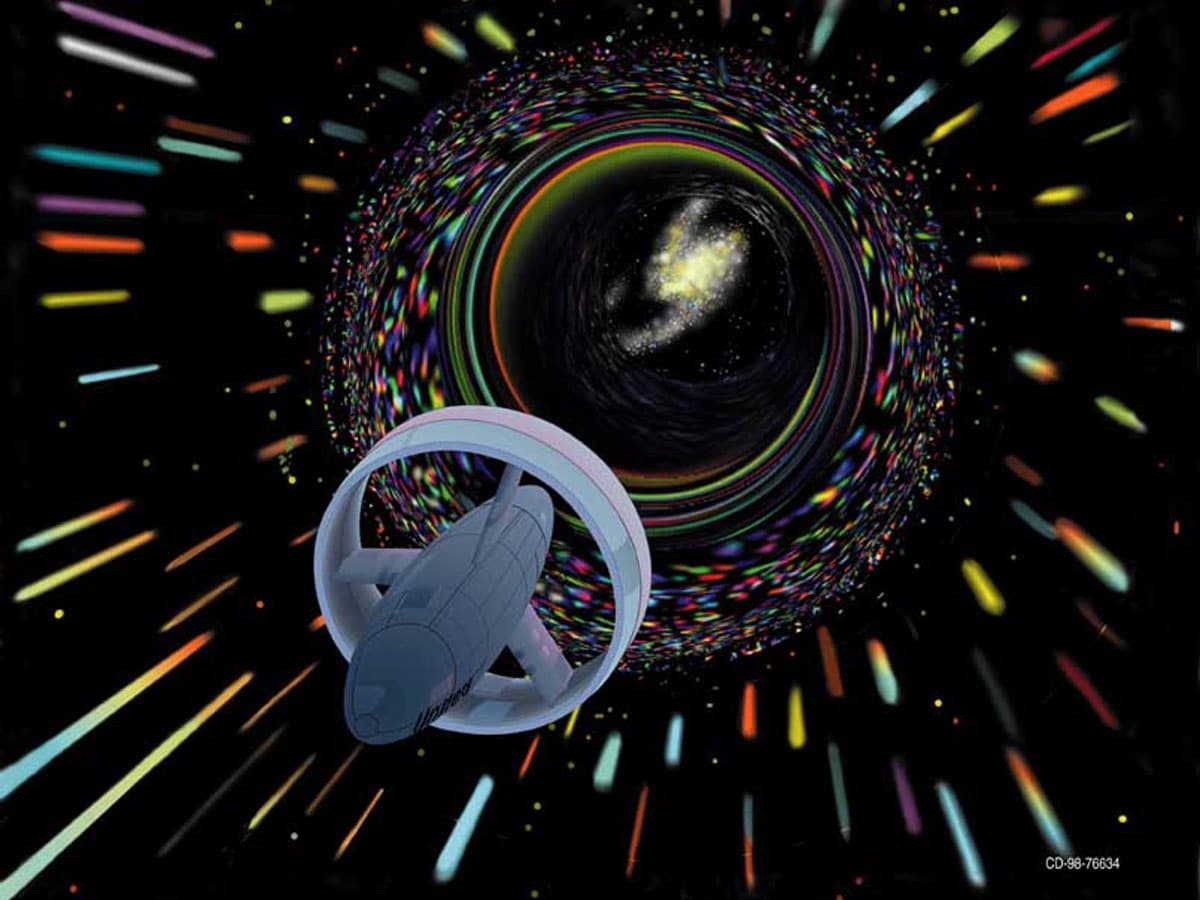
Wormholes are based on scientific theory, especially general relativity. Einstein’s equations say that wormholes, which are also called Einstein-Rosen bridges, are tunnels through spacetime that connect points in the universe that are far apart. Theoretical research indicates that these structures might facilitate faster-than-light travel, potentially circumventing the extensive distances commonly linked with cosmic travel. This idea aligns with modern physics’ efforts to understand dark matter and cosmological events, which could utilize these theories to gain insights into the structure of the universe (Elahi & Najafabadi, 2020; Alcubierre, 2016). Recent research investigates the intricacies of portal-like structures arising from dark matter phenomena, proposing avenues for inter-sector relationships through “portals” within particle physics, thereby enriching frameworks across various dimensions (Hardy, 2018).
On the other hand, paranormal portals come from stories, legends, and mystical and metaphysical tales. People often think of them as supernatural gateways that let people interact with other realities or spiritual dimensions. They are mostly used as metaphors in stories about transcending or paranormal activities. The stories about these portals focus on how they help people talk to spirits, travel through time, or move between dimensions in metaphysical experiences (Abed, 2024). These phenomena align with cultural motifs present in various religions and spiritual practices, highlighting the interaction between human consciousness and perceived supernatural experiences (Kite et al., 2021). These investigations invoke the concept of liminality—the transitional phase between two distinct existential realities, wherein portals represent thresholds to transformed states of consciousness or otherworldly dimensions (Lewis et al., 2021; Collins‐Gearing, 2023).
![Alain r, Creative Commons Attribution-Share Alike 3.0, Wormhole.png Copy
[[File:Wormhole.png|Wormhole]]](https://i0.wp.com/connectparanormal.net/wp-content/uploads/2025/11/Wormhole.png?resize=300%2C240&quality=80&ssl=1)
Theories
The theoretical framework linking these concepts frequently revolves around the idea of higher dimensions and the plasticity of spacetime itself. Some physicists who work with string theory and other advanced models think that our universe might be in a higher-dimensional space, which is sometimes called the “bulk.” In this space, the rules that govern our three-dimensional experience don’t always apply (Hawking, 1988). In this context, paranormal researchers might think that what they see as portals or gateways are actually natural or spontaneous formations that are similar to microscopic wormholes. These formations might happen where the fabric of spacetime is very thin or unstable. Some scientists believe that certain locations on Earth, such as those where strange events occur or individuals disappear, may be at the intersection of electromagnetic or gravitational anomalies, potentially causing these phenomena. While mainstream physics typically dismisses these connections, the possibility of wormholes raises the possibility of explanations that connect science and the paranormal, even if only slightly.
The cultural and psychological ramifications of associating wormholes with paranormal portals transcend mere academic discourse, shaping our perceptions of consciousness, reality, and the boundaries of human understanding. Some researchers have looked at stories of strange disappearances in places like the Bermuda Triangle or people stepping through doorways and ending up in different times or places through the lens of theoretical physics. This combination of scientific ideas and paranormal events meets a deep human need to identify logical reasons for things that don’t make sense, even if those reasons go against what is known to be true in science. The popularity of books, movies, and TV shows that address these themes shows that we are all interested in the idea that reality might have hidden layers that can be accessed through certain conditions or places. Whether these portals exist in any tangible form or signify psychological, neurological, or cultural phenomena, their association with wormhole theory illustrates humanity’s persistent aspiration that the universe harbors yet-to-be-discovered marvels (Harwood-Smith, 2017).
From a scientific perspective, the discourse on wormholes potentially emerging as observable phenomena in our reality encounters significant theoretical and practical challenges. Wormholes, if they exist, would probably be tiny, maybe at the quantum level. To stay stable long enough for anything to pass through them, they would need strange matter with negative energy density. No one has ever seen exotic matter, and making or keeping a macroscopic wormhole would take a tremendous amount of energy, possibly the mass-energy equivalent of a star. Because of these things that can’t happen in real life, most physicists see wormholes as intriguing mathematical puzzles instead of real things that could be found or used. But the same equations that make wormholes theoretically possible don’t completely rule out the possibility of them happening naturally. Some researchers are still looking into whether quantum fluctuations or other strange processes might sometimes create temporary openings in spacetime. However, there remains a significant disparity between these theoretical possibilities and the extravagant claims of paranormal portal experiences. However, that is where imagination and speculation live.
The similarity between scientific and paranormal investigations into these phenomena also reveals important information about how people think and believe. Scientists investigate wormholes using mathematical models, experimental predictions, and stringent testing of general relativity, whereas paranormal researchers frequently depend on eyewitness accounts, environmental measurements, and patterns in reported phenomena. However, both groups are fundamentally trying to figure out what is real and what isn’t by mapping the unknown. The scientific method necessitates reproducibility and falsifiability, criteria that paranormal portal assertions generally fail to satisfy; however, the inquiries posed by both factions regarding the essence of space, time, and consciousness intersect in intriguing manners. This convergence suggests that, regardless of the tangible existence of paranormal portals, they serve as thought experiments that enable the examination of the implications of advanced physics within a more intuitive and human framework.
Impact
If either were true, it would change our view of the universe and how we navigate it. If we could make or discover traversable wormholes, we could travel across enormous distances in space in an instant. This could make interstellar exploration possible and turn humans from a planet-bound species into real citizens of the galaxy. If paranormal portals exist as naturally occurring phenomena, comprehending and utilizing them could grant access to alternate dimensions, temporal states, or realities, thereby augmenting human experience beyond current imagination. The repercussions for physics, philosophy, and spirituality would be significant, compelling a reevaluation of essential beliefs regarding causality, consciousness, and the very framework of existence. Even the pursuit of these ideas, regardless of their ultimate validity, propels science forward by stimulating researchers to conceive innovative possibilities within the universe and to devise novel technologies and methodologies for exploring the boundaries of reality.
Critics are right to say that mixing theoretical physics with paranormal claims can be a problem because it can impart false credibility to things that aren’t real and make scientific research less rigorous. Examples of real scientific ideas supporting false beliefs abound in the history of pseudoscience. The link between wormholes and paranormal portals could follow this pattern. Scientists studying wormholes employ meticulous mathematical calculations and testable theories. On the other hand, many claims about paranormal portals don’t have the evidence or methodological rigor that science needs. This doesn’t mean all paranormal experiences are worthless or that science won’t eventually explain them, but it does mean we should be skeptical and know the difference between guesses and facts. If the conversation between these fields sparks scientific curiosity and leads to more thorough research into strange experiences, it can be useful. However, if it makes false comparisons between different standards of evidence, it can be harmful.
As our scientific knowledge grows and our technology develops better, the link between wormhole physics and paranormal portal theories may change. Improvements in quantum mechanics, the detection of gravitational waves, and our comprehension of dark matter and dark energy may ultimately yield novel insights into the manipulability or traversability of spacetime in unforeseen manners. If future discoveries indicate that consciousness, quantum entanglement, or other inadequately comprehended phenomena influence the fabric of reality, such discoveries may establish connections between contemporary paranormal assertions and scientific comprehension. Alternatively, more comprehensive theories could conclusively eliminate specific possibilities, elucidating reported portal experiences through established physics, psychology, or neurology. Either result would signify an advancement in human knowledge, bringing us nearer to a more comprehensive and precise comprehension of the universe we inhabit.
Wormholes are mostly linked to empirical theories and mathematical modeling in physics. On the other hand, paranormal portals are more subjective and open to interpretation in human culture and consciousness. The convergence of wormhole theory and paranormal phenomena exemplifies humanity’s overarching quest for cosmic significance; both function as narratives that shape our comprehension of existence and reality. For instance, in physics, concepts such as quantum entanglement imply connections that extend beyond traditional narratives. This concept is similar to ideas in spiritual or metaphysical frameworks that say the universe has many hidden dimensions and connections (Neep, 2016).
Conclusion
The persistent intrigue surrounding wormholes and paranormal portals ultimately signifies profound inquiries regarding existence that surpass any singular discipline or methodology of knowledge. Both ideas make us think that reality could be stranger, more wonderful, and more complicated than what we see every day. They offer us hope that the universe has mysteries that we can discover and understand. Wormholes are still only a theory in physics, and paranormal portals are still a hot topic between experience and explanation. However, the notion of their connection holds significance for human culture and imagination. They remind us that the limits of what we know are constantly changing, that what seems impossible today might be discovered tomorrow, and that the best way to move forward in our never-ending search for knowledge about the universe and our place in it is to be both skeptical and open-minded.
References
Abed, M. A. (2024). The influence of theosophy on modern painting. American Journal of Social Sciences and Humanity Research, 4(4), 42-48. https://doi.org/10.37547/ajsshr/volume04issue04-07
Alcubierre, M. (2016). Astronomy and space on the big screen: how accurately has cinema portrayed space travel and other astrophysical concepts?. Mètode Revista De Difusió De La Investigació, 0(7). https://doi.org/10.7203/metode.7.8530
Collins‐Gearing, B. (2023). The threads that weave me. M/C Journal, 26(6). https://doi.org/10.5204/mcj.3016
Elahi, F. and Najafabadi, M. M. (2020). Neutron decay to a non-abelian dark sector. Physical Review D, 102(3). https://doi.org/10.1103/physrevd.102.035011
Hardy, E. (2018). Higgs portal dark matter in non-standard cosmological histories. Journal of High Energy Physics, 2018(6). https://doi.org/10.1007/jhep06(2018)043
Harwood-Smith, J. (2017). Portals. In The Routledge Companion to Imaginary Worlds (pp. 56-64). Routledge.
Hawking, S. W. (1988). Wormholes in spacetime. Physical Review D, 37(4), 904.
Jones, M. D., & Flaxman, L. (2023). This Book is from the Future: A Journey Through Portals, Relativity, Worm Holes, and Other Adventures in Time Travel. Red Wheel/Weiser.
Kite, T., Ravenni, A., Patil, S. P., & Chluba, J. (2021). Bridging the gap: spectral distortions meet gravitational waves. Monthly Notices of the Royal Astronomical Society, 505(3), 4396-4405. https://doi.org/10.1093/mnras/stab1558
Lewis, T., Markham, A., & Holcombe-James, I. (2021). Embracing liminality and “staying with the trouble” on (and off) screen. M/C Journal, 24(3). https://doi.org/10.5204/mcj.2781
Neep, D. (2016). State‐space beyond territory: wormholes, gravitational fields, and entanglement. Journal of Historical Sociology, 30(3), 466-495. https://doi.org/10.1111/johs.12126

Leave a Reply