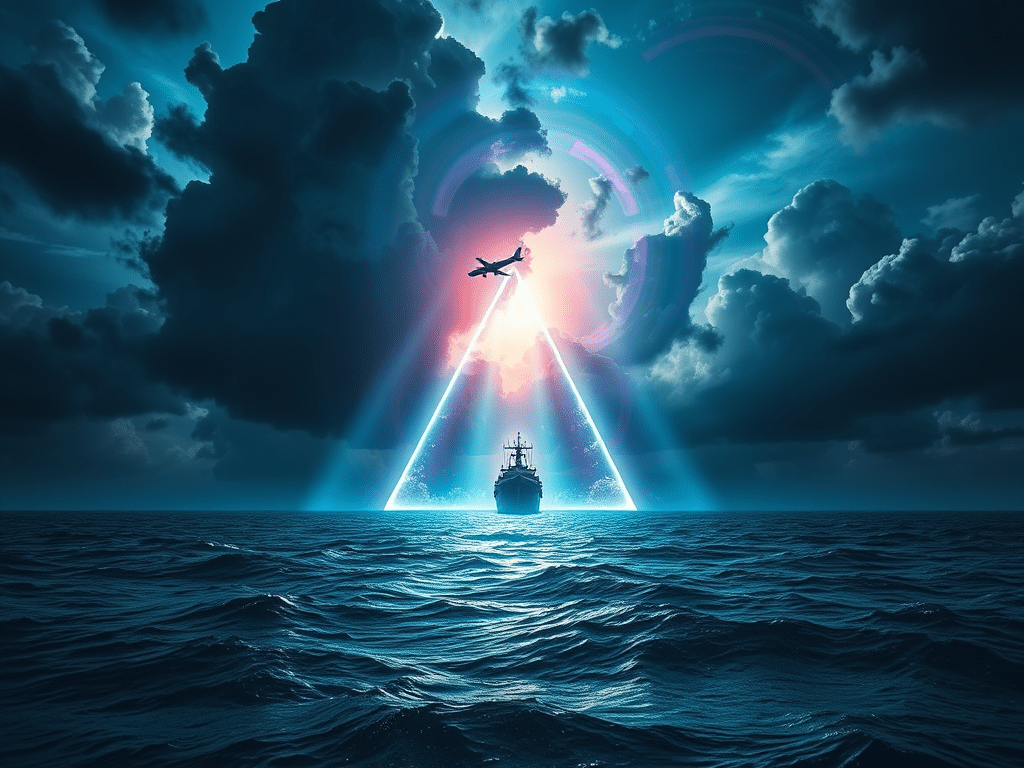
Bermuda Triangle and Portals: Key Points
-
The Bermuda Triangle is a 500,000 square mile Atlantic region between Miami, Bermuda, and Puerto Rico, famous for disappearances of ships and aircraft including Flight 19 in 1945.
-
Paranormal portals are theorized gateways connecting different dimensions or times where physics might break down, drawing from ancient mythology and modern theoretical concepts like wormholes.
-
Some theorists suggest the Triangle contains portals that transport vessels to other dimensions rather than destroying them, explaining why wreckage is never found.
-
Scientific explanations include methane eruptions, rogue waves, magnetic anomalies, and strong currents, while speculative theories involve alien abduction and time warps.
-
Scientists remain skeptical since disappearance rates aren’t statistically higher than other ocean regions, and most incidents have conventional explanations like human error or weather.
-
The mystery has significantly impacted culture through media and entertainment while sparking discussions about critical thinking and the limits of human knowledge.

Introduction
The Bermuda Triangle has long held a grip on the public’s imagination, remaining one of the most persistent enigmas of our era. This roughly triangular expanse of the Atlantic, defined by Miami, Bermuda, and Puerto Rico, has gained notoriety for the mysterious vanishings of vessels and planes. One of the more captivating theories surrounding these disappearances posits the existence of paranormal portals within this mysterious expanse of ocean. These portals, if they exist, could serve as gateways, connecting our world to alternate dimensions or realities.
Overview
The Bermuda Triangle, a vast expanse of ocean covering roughly 500,000 square miles, has long been associated with a string of mysterious vanishings, some of which date back hundreds of years. The region captured public fascination during the 1960s and 1970s. It was then that writers and investigators started chronicling incidents involving ships and aircraft that appeared to disappear completely. Flight 19’s vanishing act in 1945, a training mission gone awry for five Navy bombers, is a well-known episode. Then there’s the USS Cyclops, which disappeared in 1918, taking 309 souls with it. The area’s reputation is built on many similar cases, even though the exact number of events and their mysterious nature are still debated (Berlitz & Valentine, 1974).
In various metaphysical and supernatural beliefs, paranormal portals are thought to be gateways or doorways. These are believed to connect different dimensions, times, or levels of reality. Portal theory suggests that these openings in space-time could allow for the instantaneous movement of objects or beings between different realities (Bhattacharjee, 2017). These portals are often described as places where the usual rules of physics don’t apply or where unusual electromagnetic activities create conditions that lead to dimensional rifts. This idea draws on both ancient myths, where stories often include portals to other worlds, and modern theoretical physics, which explores concepts like wormholes and parallel universes.
The idea of “portals,” often found in fiction but also seen in various cultural myths and modern media, has become a part of discussions about the Bermuda Triangle. The concept implies the existence of portals to other dimensions or time travel, linking it to broader discussions on quantum tunneling. This phenomenon has been metaphorically compared to the mysteries of the Bermuda Triangle (Nguyen, 2024).
The Bermuda Triangle’s reputation for vanishing vessels and aircraft led some to speculate about paranormal portals, a theory that gained traction as people tried to make sense of the area’s many mysteries. Some researchers have suggested that the Bermuda Triangle is located above a naturally occurring portal, or a series of portals, that opens and closes at times. These portals are said to be responsible for the disappearance of ships and aircraft. This theory suggests that the missing ships weren’t destroyed. Instead, they might have been moved to a different dimension, time, or place in space. This approach could explain why we often don’t find any wreckage. Some researchers have proposed that the area’s unique geographical and magnetic properties might create conditions that occasionally cause disruptions in the fabric of reality. Books, documentaries, and television shows have popularized these ideas, presenting the Bermuda Triangle as a gateway to the unknown (Everhart, 2024).

Theories
Different theories have been proposed to explain the Bermuda Triangle, ranging from scientific to paranormal ideas. Natural phenomena offer potential explanations. Methane hydrate eruptions, for instance, could theoretically lower water density, leading to the swift sinking of vessels. Furthermore, the region has been known to experience strange weather patterns and the sudden emergence of rogue waves. The area has been found to have magnetic anomalies, which could interfere with compass readings and navigation systems. The Gulf Stream’s swift currents are a concern, as they could rapidly scatter debris, complicating any attempts at recovery. More speculative theories suggest explanations that include alien abduction, UFOs, time travel, and electromagnetic vortices, which could create conditions similar to those of theoretical portals.
The oceanographic conditions of the Bermuda Triangle are a key factor in its reputation, and they can definitely affect how safe it is to navigate through the area. The Gulf Stream, a powerful ocean current that begins in the Gulf of Mexico, traverses the Bermuda Triangle. This current is known to generate swift and often erratic shifts in both ocean currents and weather patterns. Unexpected storms and rough seas, which can develop quickly in the area, could cause the sudden disappearance of ships (Geyer et al., 2005).
Furthermore, the area’s susceptibility to tropical storms and hurricanes poses significant risks for both aircraft and vessels. Studies have suggested that these weather events can suddenly increase wave heights and wind speeds, which could lead to dangerous situations, especially for smaller boats or those not prepared for such conditions (Chaffey & Tañedo, 2020). Some storms seem to materialize out of nowhere, and forecasts don’t always see them coming.
Another theory suggests that magnetic anomalies in the Bermuda Triangle are a contributing factor. Certain areas within the Bermuda Triangle are known for their unusual magnetic fields, which can interfere with navigational instruments. The result can lead to disorientation for pilots and navigators (Boyarsky et al., 2022). Historical records indicate that navigators sometimes reported compass errors, which could have caused them to make mistakes (Kondo, 2001). However, while magnetic anomalies might play a role, human error is the main cause of mistakes in navigation. Studies show that, despite modern navigation tools like GPS, mistakes in calculations and crew decisions often lead to accidents in this difficult area (Okada et al., 2019).
Scientists remain skeptical about both the Bermuda Triangle mystery and the idea of portals. Critics argue that the number of disappearances in the Bermuda Triangle isn’t statistically higher than in other busy ocean areas, especially when you consider how much traffic there is. Studies have shown that many of the disappearances in the Bermuda Triangle can be explained by human mistakes, mechanical problems, or severe weather conditions that weren’t well documented when they happened. The U.S. Coast Guard and other maritime agencies do not view the Bermuda Triangle as particularly dangerous. Moreover, the idea of paranormal portals lacks scientific evidence and contradicts current physics. As a result, most scientists consider these ideas to be pseudoscience.
Impact
Despite the scientific community’s skepticism, the Bermuda Triangle and its connection to paranormal phenomena have had a significant cultural impact. The enigma has spawned a veritable library of books, films, TV shows, and documentaries, all of which still manage to hold the attention of people everywhere. This fascination reflects a more profound human need to believe in the unknown and the possibility that our understanding of reality includes unexplained events that current science can’t fully explain. The triangle, a shape that has captivated people’s imaginations, now symbolizes the unknown, inspiring both serious investigation and imaginative exploration. Indeed, its enigmatic reputation has bolstered the region’s allure. Boat tours and diving adventures, all centered on the area’s secrets, have become popular draws for visitors.
The Bermuda Triangle’s influence goes beyond entertainment, affecting how we view unexplained events and the limits of what we can know. The ongoing discussion about the Triangle has sparked debates about the importance of critical thinking, the careful evaluation of evidence, and the difference between correlation and causation. Moreover, the case has highlighted how modern myths are created and spread in today’s world, which is heavily influenced by mass media and the widespread sharing of information. Whether people see the disappearances as caused by paranormal portals or as tragic events made more sensational by the media, the phenomenon has encouraged investigation, questioning, and the search for answers. The story reminds us that while skepticism and scientific rigor are essential, we shouldn’t completely dismiss the human imagination and our natural curiosity.
Conclusion
The Bermuda Triangle continues to captivate, a puzzle where reality, myth, and our collective curiosity about the unexplained converge. Even though scientific evidence suggests that the area isn’t more dangerous than other busy sea routes, the idea of paranormal explanations, like the existence of portals to other dimensions, continues to attract public interest. As our understanding of physics, oceanography, and atmospheric science improves, we may eventually develop complete explanations for the events that have occurred in this area. Until then, the Bermuda Triangle will probably continue to be a place where we project our hopes, fears, and ongoing curiosity about the mysteries that may still exist in the world.
References
Berlitz, C., & Valentine, J. M. (1974). The Bermuda Triangle. New York: Doubleday.
Bhattacharjee, S. (2017). Science Behind Paranormal Activities. International Journal of New Technology and Research (IJNTR), 3(3), 108-112.
Boyarsky, A., Mikulenko, O., Ovchynnikov, M., & Shchutska, L. (2022). Searches for new physics at snd@lhc. Journal of High Energy Physics, 2022(3). https://doi.org/10.1007/jhep03(2022)006
Chaffey, I. and Tañedo, P. (2020). Vector self-interacting dark matter. Physical Review D, 101(7). https://doi.org/10.1103/physrevd.101.075005
Everhart, C. (2024). Vortex: The Bermuda Triangle Mystery. Joy Kitchen University Press.
Geyer, M. B., Jung, T., & Bertschinger, P. (2005). Unusual mass in the hepatic portal of an 86-year-old woman. Ultraschall in Der Medizin – European Journal of Ultrasound, 26(03), 231-233. https://doi.org/10.1055/s-2004-813719
Kondo, F. (2001). Benign nodular hepatocellular lesions caused by abnormal hepatic circulation: etiological analysis and introduction of a new concept. Journal of Gastroenterology and Hepatology, 16(12), 1319-1328. https://doi.org/10.1046/j.1440-1746.2001.02576.x
Nguyen, H. V. L. (2024). Quantum tunneling: history and mystery of large amplitude motions over a century. The Journal of Physical Chemistry Letters, 16(1), 104-113. https://doi.org/10.1021/acs.jpclett.4c02914
Okada, S., Muneuchi, J., Furuno, W., & Kamimura, T. (2019). Preduodenal portal vein associated with complex congenital heart disease and heterotaxy syndrome: an unexpected cause of common complaint. The American Surgeon, 85(4), 233-234. https://doi.org/10.1177/000313481908500417




Leave a Reply