Stone Giants: Key Points
-
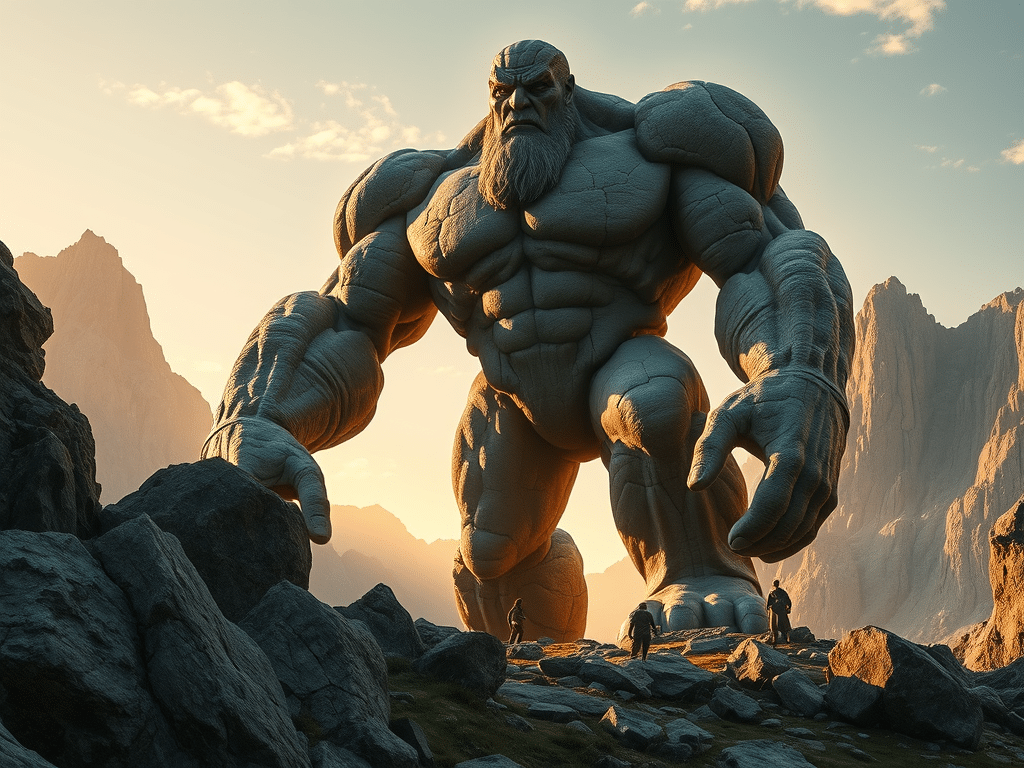
Stone giants are humanoid beings fifteen to twenty feet tall with rock-like bodies that provide natural armor and extreme longevity.
-
They are reclusive, contemplative creatures who prefer mountain solitude and engage in artistic pursuits rather than aggression.
-
Stone giants occupy a middle position in the giant hierarchy and maintain respectful but distant relationships with other giant races.
-
Mythological stone giant figures appear across cultures, including Norse, Greek, Native American, and Japanese traditions.
-
In Dungeons & Dragons and modern gaming, stone giants are defined by rock-throwing abilities and serve as challenging mountain guardians.
-
Stone giants symbolize geological permanence, the passage of time, and humanity’s relationship with nature’s impersonal forces.

Introduction
Stone giants are intriguing figures in both ancient mythology and modern fantasy fiction. These entities possess immense power and resemble the earth’s bedrock. These huge creatures have fascinated people for thousands of years. From Norse mythology to contemporary role-playing games, they have been featured in stories. They are different from other types of giants in folklore and fantasy worlds because of their distinctive traits, such as their rocky appearance, habits like living in mountainous regions, and relationships with other giants that often depict them as solitary or misunderstood beings. To understand stone giants, you need to look at their physical characteristics, their role in mythology, and how they have changed throughout time to become part of the gaming culture that keeps their legend alive today.
Physical Characteristics and Behavioral Traits
Stone giants look like living stone beings, and they commonly combine elemental or geological symbols with humanoid shapes. This ties together themes of endurance, ancient memory, and the clash of the primal and the intelligent, which are reflected in their portrayal as both formidable beings and symbols of nature’s timelessness. Many historical sources look into stories about stone-like beings from folklore, rock-based intelligence, or myths centered around stone that are very similar to the idea of stone giants (e.g., images of stone beings or ancient tales as imaginative creations) (Sipos, 2024). The broader literature on Stone Age or lithic figures in fantasy situates stone giants within a continuum of “stone people” or terrestrial entities inhabiting alternative realms (Plotz, 2023; Morris & Morris, 2012). These works frequently underscore how such entities encode memory, time, and the material history of a world, which corresponds with stone giants as representations of geological memory and lengthy durée inside fantasy realms (Townend, 2024).
Stone giants are usually shown as enormous humanoid beings whose bodies are made of or seem a lot like rock and stone. People often say that their skin is gray, looks like granite, or feels and looks like aged stone. This feature gives them natural armor that makes it impossible to hurt them. In most pictures, these giants are between fifteen and twenty feet tall. They are strong and muscular enough to throw huge boulders as weapons or to mold stone with their hands. Their features are often rough and angular, as if they were carved from rock instead of flesh. Many reports say that they have stone-like bumps or crystalline formations emerging from their bodies. A stone giant weighs a lot, frequently in tons, and their footsteps are supposed to shake the ground below them. This physical makeup makes them powerful and long-lasting; some stories say they can survive for thousands of years, slowly wearing down like the mountains themselves (Wizards of the Coast, n.d.). Stone giants usually act in ways that show how much they love the soil and mountains they live on. Most of the time, they are shown as reclusive animals that like to live in deep caves, high mountain peaks, and distant underground chambers where they may be far away from the civilizations of smaller species (Fandom, n.d.). People typically consider stone giants to be thoughtful and artistic. They spend their lengthy lives carving detailed sculptures, making detailed cave paintings, or playing stone-throwing games that show off their amazing power and accuracy. Stone giants are often shown as neutral or even peaceful unless someone invades their territory or threatens their homes. This breed is different from other aggressive giant species. Many myths say that they have a strong spiritual connection to the earth and can feel vibrations through stone. Some stories even say that they can shape rock in ways that combine physical power with an almost magical mastery of geology, allowing them to create complicated mounds and manipulate the landscape to their advantage. When their civilization is depicted, it is usually portrayed as basic and fair, with respect earned through artistic talent and physical strength rather than through conquest or wealth.
Relationships Within Giant Hierarchies
Stone giants have a complicated place in the hierarchy and interactions between the many giant races, often serving as mediators or builders due to their unique abilities and characteristics that influence their social standing within the Ordning. In a lot of fantasy worlds, giants live in a structured society called the Ordning. Different types of giants have distinct social roles based on their natural traits and ideals. In general, stone giants are stronger and more advanced than hill giants and other more primitive giant varieties, but not as strong as storm giants and cloud giants. Stone giants don’t like to be around other giants very much; therefore, their relationships with them are frequently based on respect rather than warmth. They also don’t get involved in the bigger political machinations of giant-kind, as they prefer to remain neutral and focus on their craftsmanship and trade. When they do engage with other enormous races, it’s usually to trade. Stone giants barter their magnificent masonry and carved wares for things they can’t make themselves. Stone giants rarely fight with other giants because they prefer to live in isolated areas and usually avoid competing for the same resources or dwelling spots. However, when these kinds of fights do happen, stone giants are tough opponents since their inherent armor and ability to blend in with rocky terrain make them hard to beat, even for more aggressive giant types (5etools, n.d.).
Many cultures around the world find entities in mythology that resemble stone giants, even though they don’t always go by that name. In Norse mythology, there are mountain giants and entities made of primordial rock. Some researchers believe that certain jötnar were intended to resemble stones. In Greek mythology, the Titans and Giants fought the Olympian gods. Some of these gods were linked to mountains and stone. The Cyclopes from Greek mythology weren’t quite stone giants, but they were powerful craftsmen who worked with stone and metal deep inside mountains. Some Native American myths tell of huge stone entities or spirits that live in rocky regions and mountains. In Japanese folklore, rocky peaks and stone formations are associated with kami, or mountain spirits. Many of these myths include similar motifs, such as a link between giants and mountains, the usage of stone or rock as weapons, and the idea that these beings are old and will last forever. People may have been in awe of huge geological formations and wanted to know how mountains and amazing rock structures came to be, which is why these kinds of legends are found all across the world.

Modern Gaming Representations
In recent games, especially Dungeons & Dragons, stone giants have become well-defined creatures with specific traits and jobs (M., 2021). In D&D, stone giants are usually shown as big, strong creatures that live in mountains or underground and are adept at throwing rocks with deadly accuracy. The game gives them certain stats, skills, and personality traits that make them tough enemies for player characters. For example, they have high strength scores, their stone-like hide gives them natural armor, and they can throw rocks across long distances. In D&D, stone giants often protect mountain routes or old underground complexes. Adventures with them could need discussion as much as fighting, since these giants are usually shown to be more rational than their more hostile cousins, which allows for unique interactions and negotiations that can enhance the storytelling experience in gameplay. Other gaming systems and video games have used similar ideas, with stone giants showing up in games like World of Warcraft and The Elder Scrolls series as strong attackers or neutral NPCs living in rocky areas. Modern gaming has made many parts of stone giant lore the same across games, but it has also let people come up with new ideas, such as their roles as guardians of nature or wise mentors, so these creatures stay fresh and exciting in different games. The popularity of stone giants in games has brought them to new generations who might not have come across them in mythology or traditional fantasy books.
Cultural and Symbolic Significance
There are many ideas on why stone giants are so popular and what they might mean in terms of human culture and psychology. Some researchers say that stone giants are like mountains and other geological elements, adding human traits to the huge, ancient rock structures that make up landscapes. This interpretation is consistent with humanity’s inclination toward anthropomorphism and the pursuit of comprehending natural occurrences through relevant narratives. Another idea is that stone giants stand for stability and the slow passage of time, which is different from the short and frail lives of people. Their connection to stone, which is one of the most durable natural elements, stands for strength, durability, and the weight of time. From a psychological standpoint, stone giants may symbolize the daunting and impersonal facets of nature, elements that predate humanity and will persist beyond it. Some fantasy scholars say that the difference between stone giants and other types of giants shows different sides of human fear and admiration. For example, stone giants represent a more neutral, contemplative force, while fire giants represent chaotic destruction and frost giants represent tyrannical rule. The reoccurring motif of giants throwing stones may possibly be related to ancient siege warfare and the terrifying force of catapults and trebuchets, which were made into living, breathing forms.
Scholars like Townend and Morris & Morris have shown that Tolkien and other authors’ stories have had a big impact on how modern fantasy builds its worlds. In these settings, stone giants or stone figures could be like ancient monuments or living protectors that keep epic adventures, moral tests, and the hero’s journey grounded in a fully realized reality (Townend, 2024; Morris & Morris, 2012). Earthsea and other classic fantasy look at the conflict between “secondary worlds” and getting to deeper truths, frequently through representations of elemental forces or stone-like sentience. Plot-focused assessments underscore fantasy’s ability to address human anxieties around power, knowledge, and responsibility through legendary entities that obscure the distinction between reality and symbolism (e.g., the extensive discourse on fantasy’s tradition and its connection to real-world issues (Аністратенко & Kotsur, 2023)). Literature on magic realism elucidates the manner in which fanciful elements, such as animated stones, obscure the distinctions between reality and imagination. In these readings, stone giants could seem like dreamy or symbolic tools that explore memory, history, and the boundaries of rational explanation in stories that are influenced by fantasy (Raj & Shalini, 2024; Sipos, 2024).
Conclusion
Stone giants are still an important part of fantasy worlds because they represent the meeting of sheer physical power, old knowledge, and the basic energies of the earth. These entities have changed over time, but they still retain the same basic traits that make them easy to spot, such as their immense size, strength, and often a connection to nature or the earth. They started out in many mythical traditions and are now a big part of fantasy gaming. Their physical presence, the way they act, their relationships with other giants, and their symbolic meaning all help them stay important in stories. Stone giants are still captivating to both players and audiences, whether they are enemies in a dungeon, tragic figures who are misunderstood by smaller races, or wise old people who remember when the mountains were young. They tell us that even in fantasy realms made up of our ideas, certain things are as unchangeable and permanent as stone. They are monuments to the power of mythology and the human impulse to fill our world with beings bigger than ourselves.
References
5etools. (n.d.). Stone giant. Retrieved March 7, 2026, from https://5e.tools/bestiary/stone-giant-mm.html
Аністратенкo, А., & Kotsur, A. (2023). Fantasy interpretation model for historiography fantasy novel plus AH subgenre. Current Issues of Social Sciences and History of Medicine, (2), 104–108. https://doi.org/10.24061/2411-6181.2.2022.364
Fandom. (n.d.). Stone giant. Forgotten Realms Wiki. Retrieved March 7, 2026, from https://forgottenrealms.fandom.com/wiki/Stone_giant
M., J. (2021, October 11). 5 new stone giant statblocks for DnD 5e. Empty Hexes. https://www.emptyhexes.com/monster-mondays/stone-giants
Morris, W., & Morris, M. (2012). The collected works of William Morris. https://doi.org/10.1017/cbo9781139343091
Plotz, J. (2023). Earthsea and the fantasy tradition. In Ursula Le Guin’s Earthsea (pp. 20–35). Oxford University Press. https://doi.org/10.1093/oso/9780192847881.003.0002
Raj, B., & Shalini, K. (2024). Diving into the enigma: The magic realism of Haruki Murakami’s Kafka on the Shore. Shanlax International Journal of Arts Science and Humanities, 11(S2-March), 69–72. https://doi.org/10.34293/sijash.v11is2-march.7513
Sipos, N. (2024). Prequels, sequels and everything else. AEASH, 20(1), 93–102. https://doi.org/10.14232/americana.2024.1.93-102
Townend, M. (2024). Stories. In J.R.R. Tolkien: A very short introduction (pp. 21–36). Oxford University Press. https://doi.org/10.1093/actrade/9780192882042.003.0003
Wizards of the Coast. (n.d.). Stone giant. D&D Beyond. Retrieved March 7, 2026, from https://www.dndbeyond.com/monsters/5195220-stone-giant?msockid=350da039440c6c0c1012b42645df6d23

Leave a Reply