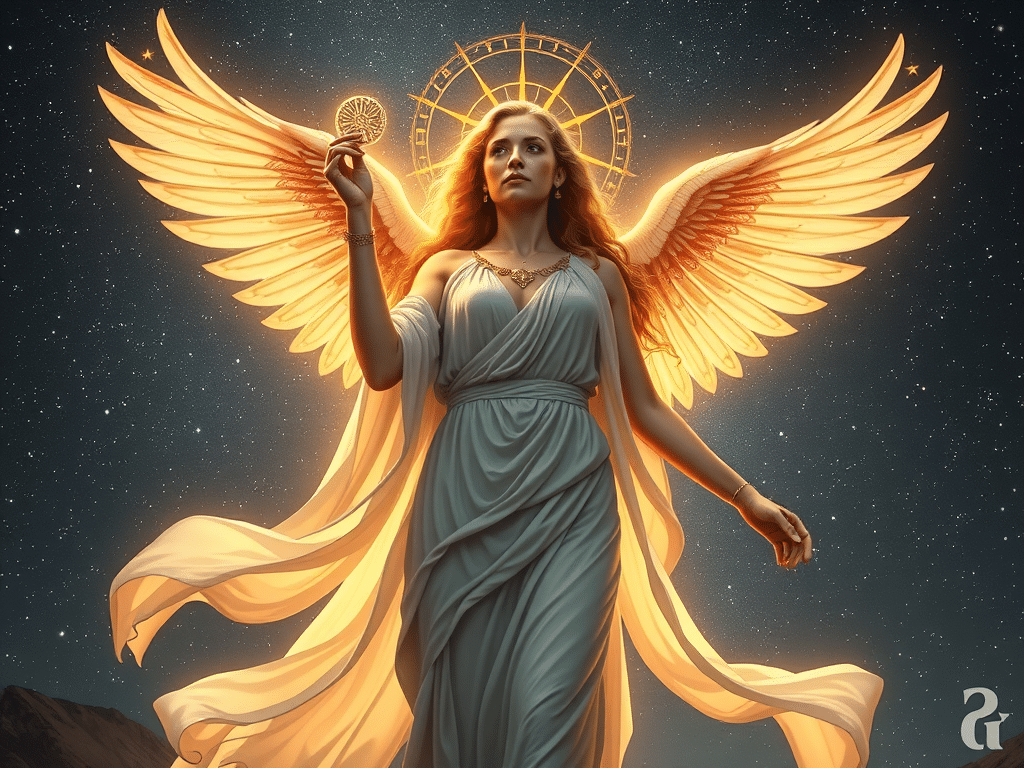
Asteria, Greek Goddess of the Stars: Key Points
-
Asteria was a Titaness born to Coeus and Phoebe, sister to Leto, and mother of Hecate. Her divine powers centered on astrology, stellar prophecy, and nocturnal divination.
-
When Zeus pursued her, Asteria transformed into a quail and plunged into the sea, becoming the island of Delos. She later provided sanctuary for her sister Leto to give birth to Apollo and Artemis.
-
Asteria occupied a liminal position between Titan and Olympian orders, representing resistance through transformation. Her mythology portrays her as a figure of autonomy and protective care toward persecuted women.
-
Direct worship of Asteria was limited, with religious attention focusing on Delos itself. Her daughter Hecate received widespread cultic devotion throughout the ancient world.
-
Scholars interpret her myth as explaining Delos’s sacred status and as a symbol of female resistance. Her story may also personify meteoric phenomena observed by ancient Greeks.
-
Her mythology has influenced literature and art across centuries and experienced revival in modern Neopagan traditions. Feminist reinterpretations celebrate her autonomy and transformative sacrifice.
Introduction
Asteria, a titaness in Greek mythology, is a somewhat mysterious figure. Her name translates to “starry one,” and ancient Greek religious beliefs connect her story to the stars. Although her role is less prominent than those of her divine relatives, her story explores fundamental themes of transformation, protection, and the cosmic order that the Greeks believed governed the universe. Her story, glimpsed through scattered mentions in old writings, reveals the intricate family trees and connections that defined the Greek gods. Furthermore, her links to stars, prophecy, and the art of divination at night suggest a goddess of considerable mystical importance. This analysis investigates the complex character of Asteria, considering her beginnings, defining qualities, position within the celestial order, and the lasting influence of her mythos on both ancient religious practices and contemporary understandings.
Description
Asteria’s beginnings are rooted in the Titan generation that came before the Olympian gods. She was born to Coeus and Phoebe, Titans known for their connection to intellectual pursuits and prophetic insight. Asteria’s sister was Leto, the mother of Apollo and Artemis. This made Asteria the aunt of these two prominent Olympian gods, linking her directly to some of the most influential figures in Greek myth. She wed her cousin Perses, a Titan linked to ruin and battle. From this union came a daughter, Hecate, a goddess of considerable power, known for her dominion over magic, crossroads, and witchcraft. Asteria’s ancestry paints a picture of her as a figure entwined with celestial understanding, the gift of foresight, and the workings of the arcane. Her kin, in turn, personified different facets of divine insight and otherworldly influence. The presence of such strong divine traits in her family suggests that Asteria was meant to be a channel for celestial and prophetic power, even though her story isn’t as well-known as those of her relatives.
Asteria’s powers were mainly linked to astrology, predicting the future by studying the stars, and divination done at night. This made her a goddess who controlled the mystical understanding of celestial events. According to ancient accounts, she was said to be gifted with deciphering dreams and portents that manifested in the darkness, when the stars were out, and their arrangements were legible to those with a special kind of knowledge. Some stories connect her with falling or shooting stars, linking her to the meteoric events that ancient people often saw as messages from the gods or signs of important events. Some legends attribute the very invention of astrology to her, or at the very least, place her among the earliest gods to engage in its practice. This ability made her a protector of those who looked to the stars to decipher their destinies and fortunes. Her abilities linked her to the Titans’ focus on cosmic order and the intellectual understanding of nature, which set her apart from the more emotionally driven Olympian gods who would eventually replace the Titans.
Ancient texts provide few physical descriptions of Asteria. However, the imagery associated with her consistently emphasizes stars and the night, reflecting her divine role. She was envisioned as a being of pure starlight, her figure possibly shimmering or even translucent, mirroring the vastness of the night. Some poetic descriptions went so far as to say her clothing was crafted from the very fabric of darkness, punctuated by tiny, twinkling stars. Later artistic interpretations, even without surviving ancient visual evidence, often depict her with stars in her hair or a cloak that resembles the sky. These depictions are based on the symbolic meanings related to her name and the roles she played. The absence of specific physical depictions in the ancient sources could indicate her more abstract character as a divinity governing cosmic powers, rather than one defined by human emotions and relationships. Such absence suggests she functioned more as a representation of celestial events than as a goddess with a fully human form. Her ethereal quality would have distinguished her from the more vividly depicted Olympian gods, emphasizing her connection to the mysterious and intangible world of the stars.
Asteria in Greek Mythology
Asteria’s metamorphosis into a quail, undertaken to evade Zeus’s advances, is significant, as it underscores her connection to avoidance and the intangible characteristics frequently linked to heavenly entities (Cardiel & Romera, 2021). Her transformation symbolizes the conflicts and power dynamics found in many Greek myths, particularly those that explore the goddess’s independence in contrast to male gods. Later mythographers tell us that Zeus, like he had with many others, pursued Asteria with a strong desire. Asteria, instead of yielding to Zeus, decided to run. When it looked like there was no way out, she morphed into a quail and dove into the ocean, hoping to evade the god’s pursuit. As she hit the water, she transformed into Delos, the island once known as Asteria or Ortygia—”quail island,” a name that spoke of its elusive nature. This was a landmass adrift, a floating piece of earth that roamed the Aegean without a permanent home. This metamorphosis constitutes a striking instance of defiance and self-denial within Greek myth, as Asteria fundamentally reshaped her being to safeguard her independence and self-respect.
Later, the island Asteria became important in Greek mythology. It provided a place for her sister Leto to hide. Leto was fleeing Hera’s anger because she was pregnant with Zeus’s children, Apollo and Artemis. Leto, hunted by Hera and with nowhere to safely give birth to Zeus’s child, eventually reached Delos, a drifting island. There, Asteria, now transformed, offered sanctuary to her sister, staying put long enough for the divine births to take place. Following the birth of Apollo and Artemis on Delos, the island was secured to the ocean’s depths with unbreakable chains. This act transformed Delos into a profoundly sacred place within Greek religious practice, housing significant cult centers dedicated to both Apollo and Artemis. Asteria’s enduring agency and compassion are evident in this display of sisterly solidarity, even after her metamorphosis. This act reframes her exile and transformation as a demonstration of deep familial loyalty and cosmic importance.
Asteria, in the Greek pantheon, straddled the divide. She existed between the Titans, the ancient order, and the Olympians, the newer gods. This placement allowed her to serve as a bridge, a link between these two cosmic eras, evident in her connections and the changes she underwent. As a Titaness, she defied the Olympian gods, opting for transformation instead of submission. This choice marked her as a symbol of resistance to the new regime, but she resisted differently than her fellow Titans, not through the violent clashes that characterized the Titanomachy. Asteria’s position as Hecate’s mother linked her to a Titan-born deity whom Zeus, following the Olympian triumph, explicitly respected, permitting her to maintain considerable influence and status. This aspect suggests that the new order still held Asteria’s ancestry in high regard. Because of its geographical and religious importance as Asteria’s new form, Delos remained a constant presence in Greek religion, even though her original worship had changed. Therefore, her position exemplifies the complex negotiations and adjustments between old and new divine orders that characterized Greek religious thought, where complete replacement was less common than syncretism and transformation.
When we explore Asteria’s role in broader mythological stories, we see similarities with other gods, particularly Hecate, who is also associated with magic and the night. These connections highlight the diverse stories in Greek mythology about women, emphasizing their power, intelligence, and complex relationship with the universe (Müller & Troschel, 1842). In the larger context of Greek mythology, Asteria is often linked to the Nymphs, who are beautiful minor goddesses. These nymphs represent different parts of nature, such as springs, mountains, and rivers. Nymphs, celebrated for their captivating looks, also possess a gentle, caring nature. Literature also connects nymphs with healing and natural springs. For instance, the goddess Artemis, associated with the Nymphs, frequently serves as a guardian of springs. This reinforces the idea of nature’s nurturing qualities, as shown by divine beings. However, the main points and interpretations of specific academic sources on this topic may vary (Ablin et al., 2013).
Theories
Asteria’s mythological character is defined by her independence, dignity, and protective nature, particularly toward female relatives facing danger or persecution. Her choice to change herself, rather than give in to Zeus’s advances, shows a strong claim to control over her body. This aspect is especially striking in a mythological context where divine sexual assault was disturbingly common, often portrayed as unavoidable or even something to be desired. Leto’s reception and the provision of refuge for the births of Apollo and Artemis demonstrate empathy and support for other women contending with the perilous sexual dynamics of the divine sphere, thereby providing sanctuary when no alternative existed. These actions align with the wider mythological patterns related to her daughter Hecate, who also acted as a protector of women, particularly during vulnerable times like childbirth and death. Asteria’s limited mythology suggests a deity whose actions, though few, were characterized by principle and care, unlike the unpredictable or vengeful behaviors often seen in many Greek gods and goddesses.
Evidence for the direct worship of Asteria as a distinct deity is limited. Most religious practices focused on the sacred island she was associated with, rather than on her human-like form. Delos evolved into a major pan-Hellenic sanctuary, especially revered for the worship of Apollo. Festivals, oracles, and pilgrimages drew Greeks from all over the Mediterranean to the titaness’s former island. Some scholars suggest that certain nighttime rituals or astrological practices might have included Asteria’s name or honored her as a goddess of star-based divination. However, direct evidence of such worship is rare in the surviving texts. Hecate, her daughter, was worshiped more widely and more thoroughly documented. Mystery cults and popular devotion were especially strong in Asia Minor and later throughout the Hellenistic and Roman worlds. It’s possible that worship of Hecate also included implicit honors for Asteria. The lack of significant temples or cult sites dedicated to Asteria might indicate her transformation into a geographical feature. This change would have shifted her worship to the island itself, which was considered sacred.
Scholarly analyses of Asteria’s myth have examined diverse symbolic and anthropological aspects of her narrative, thereby uncovering deeper significances within the surface-level account of divine pursuit and metamorphosis. Some scholars interpret her transformation as a mythological explanation for the origin and sacredness of Delos. This story, a type of origin myth, connects the island’s religious importance to a history of divine events and sacrifice. Feminist interpretations of the myth highlight Asteria’s act of transformation as a demonstration of autonomy when confronted with sexual pressure. This portrayal distinguishes her as an exceptional female character within Greek mythology, one who, through her ingenuity and determination, successfully avoids divine assault. Astronomical interpretations suggest that her myth may preserve ancient Greek observations of meteors, shooting stars, or other celestial events that appeared to fall from the sky into the sea, with Asteria representing these mysterious occurrences. Furthermore, certain scholars interpret her narrative as a reflection of genuine historical changes in religious observance, wherein the metamorphosis signifies the incorporation of earlier Titan-centric veneration into more recent Olympian religious sites, especially the ascendance of Delos as the hallowed origin of Apollo.
Impact
Asteria’s mythological legacy transcends its origins in ancient religious observance, permeating the wider cultural consciousness and shaping literary, artistic, and symbolic portrayals of feminine self-determination, metamorphosis, and celestial enigma. Renaissance and early modern poets occasionally used Asteria as a symbol of chastity, achieved through extreme self-sacrifice. They used her story to celebrate female virtue and resistance to male power. Asteria has seen a resurgence in contemporary neopagan and Wiccan circles. Her connections with the stars, the mysteries of the night, and her status as Hecate’s mother increasingly attract practitioners. They weave her into their rituals and devotional acts, essentially reconstructing or reinterpreting ancient goddess worship. Modern feminist readings of Greek mythology often highlight Asteria’s story as an example of female resistance and solidarity. The story contrasts her active choice with the many myths that portray women as passive victims. Her legacy continues to shape how we think, largely because of her link to Delos. This island, an archaeological treasure trove, still captivates both researchers and visitors. A goddess once ruled this place, choosing to embrace the ocean instead of succumbing to it. The name Asteria has been used in modern scientific language. A recent research article describes a framework called Asteria, which is designed to capture dark matter in celestial objects. This argument connects the goddess’s identity to scientific research and advances in understanding the universe’s mysteries (Leane & Smirnov, 2023).
Asteria’s influence extends beyond mythology, appearing in various cultural representations, including art. The connections between ancient art and mythology are complex. Visual art and literature often reflect Asteria’s themes, such as celestial beauty and transformation. Her portrayal invites comparison to other divine figures, such as Aphrodite, whose narratives explore complex themes of love, beauty, and transformation; however, these similarities are open to contextual interpretation (Cardiel & Romera, 2021). Furthermore, the Greek Charites, or Graces, possibly related to Asteria, represent the connection between beauty and divine favor in Greek culture, although interpretations differ (Francis, 2002).
Modern interpretations of Asteria resonate with contemporary themes in both feminism and environmentalism. The goddess’s character has become a symbol for the ecofeminist movement. This movement uses her to represent a non-patriarchal, nature-focused spirituality, which opposes cultural narratives that have historically marginalized female deities (Rigby, 2001). Therefore, Asteria represents a figure of empowerment, encouraging a new understanding of women’s roles in both mythological and modern stories. Asteria has also become a symbol in modern interpretations of mythology, representing themes of independence and cosmic femininity. Her story is often told alongside the more prominent tales of male deities, which highlights the difficulties faced by female characters in a mythological world that is primarily controlled by men. Scholars have noted that these stories reflect broader cultural views on gender roles, both in the past and today (Andriaka et al., 2023), even though interpretations can vary greatly.
In conclusion, the limited evidence from ancient sources suggests that Asteria was a Titaness. Her importance comes not from a detailed mythology but from the deep symbolic meaning of her one significant act of transformation and resistance. Her family tree branches out to some of the most significant personalities in Greek religion. Her lineage includes prophetic parents, a powerful sister, and a formidable daughter, Hecate. Her nephew, Apollo, also figures in her story, positioning her squarely within the divine circles that dealt with cosmic understanding and mystical might. Her status as a goddess of the stars and nighttime prophecy reflects the ancient Greeks’ attempts to understand and categorize celestial events. Moreover, her transformation into Delos represents a significant blending of myth and religious geography. Even though Asteria wasn’t directly worshiped frequently, her influence on Greek religion was significant. Such influence was mainly because of the sacredness of Delos and the importance of her daughter, which helped her remain a notable figure throughout ancient times and beyond. Modern retellings of her story continue to explore themes of female independence, selfless love, and the ability to change, demonstrating how ancient myths remain relevant to modern issues and ways of thinking.
References
Ablin, J., Häuser, W., & Buskila, D. (2013). Spa treatment (balneotherapy) for fibromyalgia—A qualitative-narrative review and a historical perspective. Evidence-Based Complementary and Alternative Medicine, 2013, 1–5. https://doi.org/10.1155/2013/638050
Andriaka, R., Sukarno, S., & Setiarini, R. (2023). Gender stereotypes in Rick Riordan’s The Lightning Thief. International Journal of Multidisciplinary Research and Analysis, 6(5). https://doi.org/10.47191/ijmra/v6-i5-55
Cardiel, J., & Romera, R. (2021). The Pozo Moro reliefs (Chinchilla, Spain): A Mediterranean hero between East and West. Oxford Journal of Archaeology, 40(3), 250–267. https://doi.org/10.1111/ojoa.12226
Francis, J. (2002). The Three Graces: Composition and meaning in a Roman context. Greece and Rome, 49(2), 180–198. https://doi.org/10.1093/gr/49.2.180
Leane, R., & Smirnov, J. (2023). Dark matter capture in celestial objects: Treatment across kinematic and interaction regimes. Journal of Cosmology and Astroparticle Physics, 2023(12), 040. https://doi.org/10.1088/1475-7516/2023/12/040
Müller, J., & Troschel, F. H. (1842). System der Asteriden. F. Vieweg und Sohn. https://doi.org/10.5962/bhl.title.11715
Rigby, K. (2001). The goddess returns: Ecofeminist reconfigurations of gender, nature, and the sacred. In F. Devlin-Glass & L. McCredden (Eds.), Feminist poetics of the sacred: Creative suspicions. Oxford University Press. https://doi.org/10.1093/oso/9780195144680.003.0002




Leave a Reply