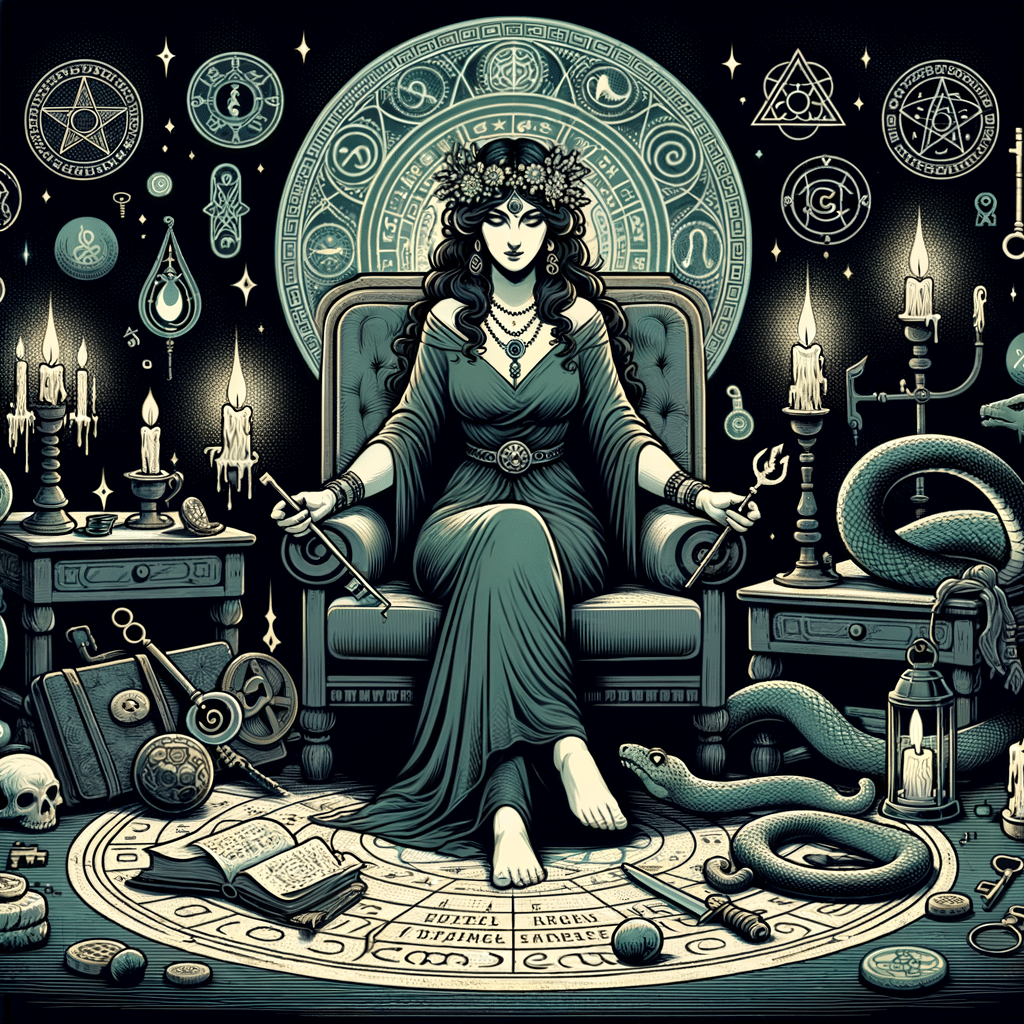
Greek mythology’s Hecate is a powerful goddess with deep intricacy and a multidimensional character. Often associated with magic, witchcraft, and the paranormal, Hecate’s influence extends far beyond these realms, encompassing aspects of decision-making, direction, and the intersection of multiple life pathways. This essay delves into the history of Hecate, her roles in mythology, and her enduring influence on archaic customs and beliefs.
Hecate is traditionally considered the daughter of Perses and Asteria, the Titans. Her lineage is important because it connects her to ethereal and potent realms. Asteria, connected to astrology, necromancy, and prophetic dreams, and Perses, connected to peace and destruction, bestowed on their daughter a diverse range of skills and traits. Asteria, as the goddess of the night and the stars, in particular alludes to a mystical and ethereal ancestry. This lineage places Hecate in a special place in the pantheon because it combines chthonic and heavenly aspects.
The Crossroads Goddess
The crossroads is one of Hecate’s most enduring emblems. Ancient Greeks viewed crossroads as areas of power and mystery, where the veil between realms was thin. Hecate is the goddess of crossroads, representing the idea of choice and the possibility of several life paths. She provides advice to people who must make important decisions by standing at the intersections of reality and metaphor. This function depicts her as a liminal deity, ruling over changes and metamorphoses.
Hecate’s pivotal role in Greek mythology is evident through her involvement in the stories of Demeter and Persephone. Persephone’s mother, Demeter, mourned the loss of her daughter to Hades and devoted a significant amount of time to her search. Hecate was the one who gave Demeter the vital assistance and direction she needed during this difficult journey. Hecate helped Demeter identify the best route to locate Persephone by holding torches to light the way. This episode emphasizes Hecate’s function as a compass in the face of obscurity and uncertainty, having the ability to pass through both the living and the dead.
Hecate’s ability to freely travel between worlds emphasizes her connection to the Underworld even more. Because of this ability, she can bridge the divide between life and death and is a powerful figure in both the mortal and divine realms. Her connection to the underworld also reflects concepts of rebirth and metamorphosis, which are essential components of her nuanced persona.

Magic and the Occult
Hecate has had a significant impact on the fields of witchcraft and magic. Classical Greece regarded Hecate as a powerful goddess, bestowing magical powers upon those who invoked her. The occult frequently invoked Hecate for her expertise in the mystical arts, reflecting this adoration.
Magicians coveted Hecate’s favor because they believed she had the power to direct and influence the paranormal. She was a major character in spells, rituals, and divinations because of her control over magic. Her associations with the night and the moon, historically associated with the ethereal and the enigmatic, further enhanced Hecate’s mystical aura.
Impact
Her diverse character and her roles in mythology and the occult highlight Hecate’s ongoing significance. Mythologists and academics frequently highlight her special status as a deity who surpasses traditional limitations. For example, the classicist Sarah Iles Johnston points out that Hecate is a potent emblem of metamorphosis and potential because of her affiliation with liminal areas and her ability to traverse multiple realms.
Modern times still regard Hecate as a mysterious and sacred character. Modern Neopagan and Wiccan rites frequently invoke Hecate as a goddess of witchcraft and the moon, reflecting her ancient traits. Those who are looking for spiritual and personal development can relate to her symbolism as a mentor during changes and her affiliation with the mystical arts.
Conclusion
Hecate is a notable example of a complex and versatile goddess whose influence is evident in many facets of mythology and daily life. Hecate personifies the concepts of transformation, guidance, and choice—from her beginnings and ancestry to her pivotal roles in mythology and the occult. Her enduring presence as a compelling and captivating figure in Greek mythology is a testament to the human curiosity about the mystical and the unknown that has endured throughout history. She continues to enchant and inspire.
Further Reading
Johnston, S. I. (1990). Hekate Soteira: A Study of Hekate’s Roles in the Chaldean Oracles and Related Literature. Scholars Press. Reasons for Selection:
Sarah Iles Johnston is a renowned classicist whose work provides an in-depth analysis of Hecate’s roles in ancient texts. This book explores Hecate’s depiction in the Chaldean Oracles, offering a detailed understanding of her mystical and philosophical significance. Johnston’s rigorous academic approach makes this a valuable resource for understanding the broader context of Hecate’s worship and her place in ancient esoteric traditions.
Kraemer, R. S. (1992). Her Share of the Blessings: Women’s Religions among Pagans, Jews, and Christians in the Greco-Roman World. Oxford University Press. Reasons for Selection:
This book provides a unique perspective on the role of women in ancient religions, including the worship of goddesses like Hecate. Kraemer’s work situates Hecate within the broader context of women’s religious practices in the Greco-Roman world, highlighting her significance in these communities. By examining the intersection of different religious traditions, this book enriches the understanding of Hecate’s multifaceted nature and her appeal across various cultural boundaries.
Burkert, W. (1985). Greek Religion: Archaic and Classical. Harvard University Press. Reasons for Selection:
Walter Burkert’s comprehensive survey of Greek religion is considered a foundational text in the study of ancient Greek religious practices. The book provides essential background on the religious landscape in which Hecate was worshipped, offering insights into her place among other deities. Burkert’s authoritative analysis and detailed exploration of Greek religious practices make this book an indispensable resource for understanding the broader context of Hecate’s worship and influence.


Leave a Reply