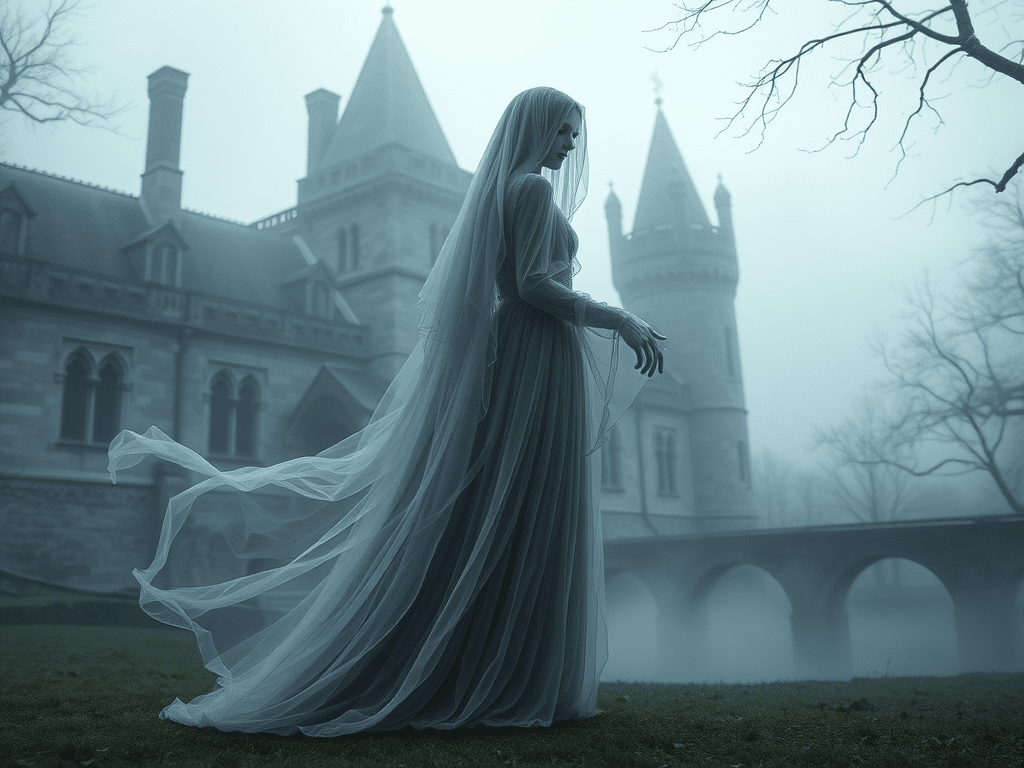
Grey Lady Ghosts: Key Points
-
Grey lady ghosts are spectral apparitions distinguished by their grey-toned appearance in period clothing, ranging from pale silver to dark charcoal shades. They manifest with varying degrees of visibility, from semi-transparent to seemingly solid forms.
-
Grey ladies exhibit repetitive behavioral patterns, walking familiar routes and appearing oblivious to observers. They often display signs of distress like weeping, suggesting emotional ties to their locations.
-
In European folklore, grey ladies are often identified as tragic former residents of noble families. These stories become intertwined with the history of specific castles and estates.
-
Theories range from psychological explanations like pareidolia to paranormal hypotheses including residual hauntings. Skeptics cite pattern recognition while researchers suggest genuine spiritual phenomena.
-
Grey lady stories significantly influence literature, film, and tourism at historic sites. These tales attract visitors and contribute to cultural memory and preservation efforts.
-
The fascination with grey lady ghosts reflects human concerns about mortality and the afterlife. These apparitions represent our questions about death and lingering spiritual presence.

Introduction
The grey lady ghost, a spectral figure, constitutes a compelling and enduring subset of reported apparitions, appearing throughout history and across diverse cultures. Distinct from the conventional white ghosts of popular culture or the more sinister dark figures occasionally encountered, grey lady ghosts inhabit a middle ground, a characteristic that many observers regard both disconcerting and unforgettable. These apparitions have garnered the interest of paranormal investigators, folklorists, and the general populace, thereby stimulating discourse concerning the essence of hauntings, historical recollection, and the human engagement with the supernatural (Valk, 2018). Consequently, the examination of grey lady ghosts provides a distinctive perspective on how various epochs and societies have conceptualized death, memory, and the potential for post-mortem existence.
Description
Grey lady apparitions are primarily identified by their spectral forms, which are characterized by a spectrum of grey shades, from light silver to deep charcoal, a feature that is evident in both their clothing and their overall ghostly appearance (Matless, 2008). Eyewitnesses frequently report these entities as attired in intricate dresses, gowns, or robes crafted from grey materials, suggesting historical periods that span from the medieval period to the Victorian era; numerous accounts specifically highlight the somber, mourning-like nature of their garments. This grey coloration is sometimes linked to the mourning practices of earlier centuries, during which widows and those in mourning would don grey as a transitional hue between the deep black of mourning and the resumption of everyday attire. Furthermore, in many reports, these ghosts are observed with considerable clarity and detail, enabling observers to discern specific features of their clothing, such as lace collars, embroidered designs, or distinctive period accessories like veils or gloves.
The physical appearance of grey lady ghosts goes beyond their clothing, including other characteristics that witnesses have reported in many encounters. Many descriptions include details about the ghost’s face, hair, and overall behavior. Some accounts describe the ghost as somewhat transparent or misty, while others depict a more solid, lifelike quality that initially makes observers think they are seeing a living person. The grey color often extends to the ghost’s skin and hair, creating a single-color look that witnesses frequently describe as both hauntingly beautiful and deeply sad. Witnesses have reported different levels of visibility, with some grey lady ghosts appearing as complete figures, while others show only parts of their bodies, perhaps just the upper body, or appear and disappear as they move through hallways or across rooms.
Grey lady ghosts often exhibit behavioral patterns that set them apart from other ghostly entities. These spectral figures are frequently observed traversing specific routes within structures, often following pathways they would have known during their lifetimes, such as hallways leading to bedrooms, staircases, or gardens they once cared for. Grey ladies are generally characterized by their slow and deliberate movements, occasionally appearing to be searching for something or someone, and they frequently seem unaware of the presence of the living. Numerous accounts describe these ghosts as displaying signs of distress or sorrow, with witnesses reporting that the apparitions appear to be weeping, wringing their hands, or exhibiting other gestures of grief or anxiety, which has prompted speculation regarding the emotional states that might tether spirits to earthly locations.
Grey Lady Ghost Examples
Grey lady ghosts occupy a prominent place in folklore across numerous cultures, with particularly rich traditions in European ghost lore, where castles, manor houses, and ancient estates frequently claim to host such apparitions. In British folklore especially, grey ladies are often identified as former residents of noble or wealthy families who experienced tragic circumstances such as betrayal, lost love, or untimely death, with their grey attire symbolizing eternal mourning. Stories of grey ladies have been passed down through generations, often becoming intertwined with the history of specific locations and serving as cautionary tales or romantic legends that reflect the values and anxieties of the communities that preserved them. These folkloric accounts often attribute specific identities to the grey ladies, complete with detailed backstories involving forbidden romances, family curses, or historical events that provide context for their continued presence, though the veracity of these stories is often impossible to verify.
Innes (2023) examines the renowned “Grey Lady” ghost at Hampton Court Palace, observing that Catherine Howard and Sybil Penn have historically been associated with the apparition. He notes that reports of the Grey Lady’s presence at Hampton Court date back to the 1800s, with inhabitants claiming to have heard sounds resembling a spinning wheel, which is thought to be linked to Sybil Penn. Furthermore, Innes investigates the spectral entity known as ‘the Grey Lady’ at Glamis Castle, identifying her as the ghost of Janet Douglas, who is said to haunt the castle’s lengthy corridors.
Roland (2024) describes the “ghost of a grey lady” being observed by staff members within a building, with the descriptions aligning with a photograph of actress Ellen Terry. Roland also mentions the famous “Brown Lady of Raynham Hall” ghost, believed to be Lady Dorothy Walpole, who died in 1726. These ghost stories provide a way to look at various real-life accounts and stories about out-of-body experiences, unusual sightings, and other paranormal events.
Cowdell (2014) discusses how often “Grey Lady” ghost stories appear in hospitals, mentioning former nurses who reported seeing them, such as those at St. Thomas’s and St. George’s Hospital in London. He notes that the Grey Lady at the old St. George’s Hospital was usually thought to be the ghost of a nurse who died after falling down a main back staircase. Witnesses indicate that the Grey Lady ghost is generally perceived as a benevolent figure, despite variations in the stories across different hospitals.

Theories
Theories attempting to explain the grey lady ghost phenomenon range from psychological interpretations to paranormal hypotheses, each offering different frameworks for understanding these persistent reports. Skeptical researchers often point to psychological factors such as pareidolia, sleep paralysis, or the power of suggestion, arguing that the human tendency to perceive patterns and faces in ambiguous stimuli, combined with cultural expectations about what ghosts should look like, creates the conditions for ghost sightings. Other theories propose that grey ladies might be residual hauntings, a type of phenomenon in which traumatic or emotionally significant events are somehow recorded in the environment and replayed under certain conditions, similar to a recording, which would explain why these apparitions often follow the same routes and appear oblivious to observers. Paranormal investigators who entertain the possibility of authentic spiritual occurrences propose that grey ladies may represent spirits tethered to the earthly realm, either because they are unable or unwilling to depart, often due to unresolved matters, intense emotional bonds to specific locations or individuals, or an unawareness of their death.
Ghost stories, particularly those featuring female apparitions like grey ladies, frequently arise in settings characterized by personal or collective trauma. Pinto posits that ghost narratives can function as a conduit for individuals to articulate their experiences of oppression and powerlessness, implying that these spectral entities can symbolize unresolved societal problems necessitating recognition and resolution (Pinto, 2023). This perspective is consistent with Kim-Kiteishvili’s assertion that specters can represent the enduring effects of colonial histories, suggesting that grey ladies serve as reminders of marginalized voices and suppressed narratives within cultural memory (Kim-Kiteishvili, 2023). These portrayals mirror cultural frameworks that endeavor to express historical wrongs and emotional states via the metaphor of spectral presences.
Theoretical frameworks concerning spectrality offer additional insight into the comprehension of grey lady ghosts. Spectrality can be analyzed as a concept that engages with the depiction of historical traumas and their influence on the modern world. Lim observes that ghost stories subvert conventional understandings of temporality, depicting haunting as a fragmented interaction among the past, present, and future, thereby challenging linear historical interpretations (Lim, 2001). This suggests that grey lady apparitions represent enduring traumatic memories, perpetually affecting those who experience them.
Understanding the psychological aspects of ghostly encounters is crucial for explaining the persistence of figures like the grey lady in both folklore and personal accounts. Dagnall et al. propose that haunting phenomena frequently correlate with environmental conditions and psychological states, thereby highlighting a complex relationship between physical environments and individual beliefs (Dagnall et al., 2020). Furthermore, the “Haunted People Syndrome,” as described by Laythe et al., posits that psychological factors shape subjective interpretations of ghostly encounters, potentially accounting for the frequent appearance of grey lady figures in the context of personal traumas or unresolved grief (Laythe et al., 2021).
Furthermore, the spectral presence of grey ladies frequently resonates with individual encounters with bereavement, a connection evident in the narratives found across diverse cultural traditions. Glazier et al. observe that local ghostly folklore frequently mirrors communal convictions and shared historical contexts, implying that the grey lady archetype functions as a communal vessel for the collective recollection of loss and sorrow (Glazier et al., 2025).
Impact
The influence of grey lady ghost narratives transcends mere amusement, significantly shaping literature, tourism, historical conservation initiatives, and cultural identity. Numerous novels, films, and television series have incorporated grey lady ghosts as pivotal figures or atmospheric components, capitalizing on the potent symbolism of mourning, loss, and unresolved psychological distress that these apparitions embody.
Historic sites that are reputedly haunted by grey ladies frequently observe that these narratives are central to their attraction, drawing visitors fascinated by the paranormal and bolstering the economic health of these sites, while simultaneously fostering awareness of historical occurrences and the need for preservation. The enduring presence of grey lady stories within local folklore functions to preserve the bonds between communities and their histories, ensuring the survival of memories of historical figures and events that might otherwise be lost, even as the stories themselves undergo transformation to mirror modern concerns and values.
As an illustration, consider the particular narrative, “The Grey Woman,” authored by Elizabeth Gaskell in 1861, which presents a character who metamorphoses into a “ghostly ‘Grey Woman’” following her suffering at the hands of her husband, thereby appearing to her brother as though she had “risen from the dead.” “The Grey Woman” employs ghostly and uncanny motifs to examine the phenomenon of “ghosting” experienced by women in a patriarchal context, thereby illustrating the capacity of male power to erase or suppress female agency. Gaskell’s utilization of the short story form and the Gothic mode facilitated the articulation of radical perspectives on male dominance, female bonds, and the complexities inherent in gender (Wallace, 2004).
The persistent allure of grey lady apparitions underscores fundamental dimensions of human psychology and our continuous engagement with mortality, memory, and the enigmatic.
Grey lady ghosts remain significant in societal memory and the processing of loss and grief, regardless of whether people perceive them as authentic paranormal entities, psychological manifestations, or cultural constructs. These spectral figures, characterized by their symbolic grey attire and their persistent presence in familiar locations, serve as reminders of the numerous individuals whose narratives have influenced our world. The grey lady ghost phenomenon addresses fundamental inquiries about the afterlife and the potential for the deceased’s essence to continue within the spaces they cherished or experienced hardship, encompassing a wealth of folklore, diverse interpretations, and considerable cultural influence.
References
Cowdell, P. (2014). Ghosts and their Relationship with the Age of a City. Folklore, 125(1), 80-91.
Dagnall, N., Drinkwater, K., O’Keeffe, C., Ventola, A., Laythe, B., Jawer, M., … & Houran, J. (2020). Things That Go Bump in the Literature: An Environmental Appraisal of “Haunted Houses”. Frontiers in Psychology, 11. https://doi.org/10.3389/fpsyg.2020.01328
Gaskell, E. (1861). The grey woman. All the Year Round, 4, 564-5
Glazier, J., Mitchell, D., Wipff, Z., & Cochran, N. (2025). Paranormal Folklore in Western Georgia: A Critical Narrative Analysis of Apparitions. Anthropology of Consciousness, 36(2). https://doi.org/10.1111/anoc.70005
Innes, B. (2023). Ghost Sightings. Amber Books Ltd.
Kim-Kiteishvili, J. (2023). Specters of comfort women: Biopolitical colonial warfare, questions of humanity, and the haunted future. Violence an International Journal, 4(1-2), 48-70. https://doi.org/10.1177/26330024231213102
Laythe, B., Houran, J., Dagnall, N., & Drinkwater, K. (2021). Conceptual and clinical implications of a “Haunted People Syndrome”.. Spirituality in Clinical Practice, 8(3), 195-214. https://doi.org/10.1037/scp0000251
Lim, B. (2001). Spectral Times: The Ghost Film As Historical Allegory. Positions Asia Critique, 9(2), 287-329. https://doi.org/10.1215/10679847-9-2-287
Matless, D. (2008). A geography of ghosts: the spectral landscapes of Mary Butts. cultural geographies, 15(3), 335-357.
Pinto, L. (2023). Greetings from the Pink Palace: An Architecturally, Paranormally, and Politically Accurate Ghost Story. Studies in Social Justice, 17(3), 515-520. https://doi.org/10.26522/ssj.v17i3.4337
Roland, P. (2014). Ghosts and the Spirit World: True cases of hauntings and visitations from the earliest records to the present day. Arcturus Publishing.
Valk, Ü. (2018). Ontological Liminality of Ghosts: The Case of a Haunted Hospital. Storied and Supernatural Places: Studies in Spatial and Social Dimensions of Folklore and Sagas, 12, 93.
Wallace, D. (2004). Uncanny Stories: The Ghost Story as Female Gothic. Gothic Studies, 6(1), 57-68.




Leave a Reply