Mad Gasser of Mattoon: Key Points
-
The Mad Gasser of Mattoon allegedly terrorized an Illinois town in September 1944 by spraying toxic gas into homes, causing temporary paralysis and illness in victims.
-
Witnesses described a tall, thin man in dark clothing carrying a spraying device, though no physical evidence was ever found despite dozens of reports over two weeks.
-
The incident caused widespread panic, disrupted daily life, prompted armed patrols, and attracted national media attention while becoming a classic case study in mass psychology.
-
The dominant theory is mass hysteria, with psychologist Donald Johnson arguing the incidents were psychosomatic reactions amplified by media coverage during the anxious World War II era.
-
Alternative theories suggest a real perpetrator conducting chemical pranks, environmental gas leaks, or a specific suspect named Farley Llewellyn with chemistry knowledge and possible grudges.
-
Modern hybrid theories propose one or two genuine attacks may have sparked a wave of copycat reports, demonstrating how fear can transform perception and blur fact from fiction.
Introduction
The Mad Gasser of Mattoon, a figure shrouded in mystery, still captivates and divides opinion, a strange episode in American history. In September 1944, this elusive individual allegedly unleashed a wave of terror on a small Illinois town. The bizarre story centers on a prowler who supposedly pumped toxic gas into homes through open windows, leaving victims temporarily incapacitated and unwell. The question of whether the Mad Gasser was a genuine criminal, a product of mass hysteria, or something else entirely continues to intrigue researchers and historians, even after more than eighty years. The event provides a fascinating glimpse into the ways fear, media influence, and community dynamics can converge during periods of anxiety and strain.

Overview of the Mad Gasser
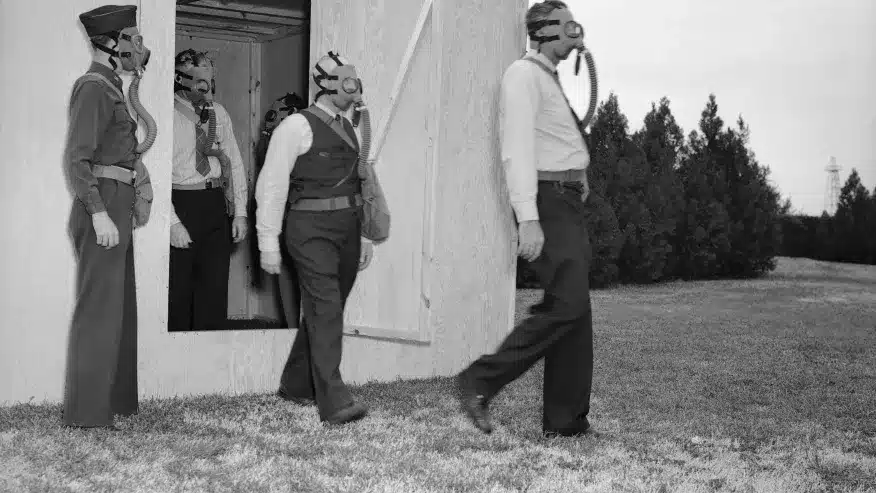
Witnesses described the Mad Gasser as a tall, slender man, often clad in dark attire, occasionally topped with a snug cap or hood. Victims described a shadowy figure hovering near their windows, followed by a cloying, sweet smell that permeated their houses. The supposed assailant was said to be incredibly quick and nimble, disappearing into the darkness before law enforcement could respond. Some witnesses mentioned the figure wearing something resembling a gas mask or breathing apparatus, though the details of these descriptions were inconsistent. The elusive attacker was rumored to possess a spraying device, yet no physical proof of such a tool was ever found.
The strange occurrences began on the evening of August 31, 1944, when police in Mattoon started receiving reports of a mysterious prowler supposedly gassing homes with a substance that induced nausea and paralysis (Maruna, 2003). Over the next fortnight, a wave of similar accounts flooded in from the townspeople. They spoke of a tall, gaunt figure, clad in dark attire, who vanished before the police could catch him. Bartholomew and Weatherhead (2024c) observed that the police tried to pinpoint the supposed gas attacker by having victims smell various chemicals. However, the investigation indicated that the described characteristics of the gas attacks didn’t match the properties of any known wartime gases. The whole affair threw the community into disarray. Armed patrols sprang up, and many residents were too frightened to sleep soundly.
The first report came from Urban Raef, a Mattoon resident. He claimed someone had sprayed gas into his bedroom window, leaving him feeling sick and partially paralyzed. His wife also reported a sweet smell and experienced burning sensations in her mouth and throat. The following day, Mrs. Kearney, another victim, came forward. She reported a similar assault, alleging that someone had sprayed gas into her bedroom through an open window, rendering her legs temporarily useless. The local paper, the Daily Journal-Gazette, began publishing sensational stories about the attacks as word of these events spread rapidly among the approximately 15,000 residents in the area.
In the weeks that followed, reports of the Mad Gasser began to surge throughout Mattoon. Between September 1st and the 13th, police received numerous calls from frightened residents. Residents reported experiencing gassing or spotting a shadowy figure near their homes. The attacks appeared to follow a consistent pattern, usually happening late at night when the victims were either asleep or getting ready for bed. Nausea, vomiting, leg paralysis, trouble breathing, and a burning feeling in the mouth and throat were among the symptoms described by those who claimed to have been attacked. As the accounts multiplied, fear gripped the town. Residents formed armed patrols, and many kept their windows shut and locked, even though it was still summer.
The height of the panic came around September 10th. Reports of several attacks that night left the entire community in a state of terror. Police were on the job day and night, but despite their efforts, they found no solid proof of an assailant. No gas residue was ever found at any of the supposed crime scenes, and no physical evidence connected the incidents. By September 12th, the police chief had gone public, suggesting that many of the reported incidents were probably fabrications and advising the public to stay composed. The local paper, which had been running front-page articles about the Mad Gasser, started to downplay the events, and the reports soon dwindled. The final supposed sighting occurred on September 13, 1944.
Impact
The Mad Gasser scare had a deep and varied effect on Mattoon, demonstrating how swiftly fear can take hold of a community. The Mad Gasser scare upended the town’s daily routine for two weeks. Many residents were too frightened to sleep in their beds, and some temporarily moved in with friends or family. People stayed at home at night, which negatively impacted local businesses. The atmosphere of distrust led neighbors to closely monitor each other, with some even accusing others of being the culprit. The extensive media coverage of the Mattoon events transformed the town from a typical Midwestern community into a subject of national interest and mockery, with newspapers across the country reporting on the unusual occurrences. The psychological impact on residents who believed they had been attacked was significant, even though the attacks were later shown to be false, and some people needed medical help for their symptoms.
The Mattoon incident’s social and historical context significantly shaped the circumstances that sparked collective anxiety. Bartholomew and Weatherhead (2024c) note that local newspapers published stories about the possible use of poison gas by Nazis, and an escaped Nazi was reportedly seen in the area just before the first reports of gassing. This context, marked by World War II fears of enemy attacks on American soil, probably made the community more likely to believe in the existence of a gas-wielding attacker. The media’s portrayal of the events further intensified public anxiety. Sensationalized newspaper articles contributed to the stories rapidly spreading throughout the town. Once officials and the press started to downplay the reports, even hinting that no actual assailant was involved, the incidents abruptly stopped. These instances demonstrated the significant influence of social validation and media portrayals in keeping such events alive.
The Mad Gasser case also left a mark on how researchers and psychologists view collective behavior and mass hysteria. It became a standard case study in psychology classes and textbooks, showing how suggestion and fear can manifest as physical symptoms, even when no real danger is present. The media’s function in exacerbating and possibly instigating the panic became a focal point for academic inquiry, prompting an examination of journalistic ethics amidst periods of societal strain. This particular event unfolded during World War II, a time when Americans were already apprehensive about possible enemy assaults on their homeland, potentially conditioning the populace to accept the reality of a gas-using assailant. This historical backdrop further intensified the incident’s importance, illustrating how widespread societal fears can translate into localized episodes of panic.

Theories
Various hypotheses have been advanced to account for the Mad Gasser occurrence, each presenting a distinct interpretation of the events that transpired in Mattoon. The mass hysteria theory, put forth by psychologist Donald Johnson in his exhaustive examination of the events, posits that the entire affair was a psychological construct, devoid of an actual assailant. This perspective holds that the initial accounts might have stemmed from genuine misinterpretations of commonplace smells or perhaps minor occurrences that were then exaggerated. Subsequent reports, however, were the product of suggestion, anxiety, and the influence of expectation. Johnson contended that the victims’ reported symptoms were psychosomatic, stemming from fear and the brain’s remarkable capacity to generate physical sensations based on belief. This theory is bolstered by the absence of any physical evidence, the lack of serious injuries, and the fact that the reports dwindled almost immediately after authorities and the media began to label them as fabrications.
Johnson’s (1945) investigation represented the inaugural systematic field study of the Mattoon incident, scrutinizing the documented accounts and psychological dimensions underlying what he characterized as a “mental epidemic.” His examination juxtaposed two competing explanations: the “gasser” hypothesis, which posited that the observed symptoms stemmed from a gas released by a tangible assailant, and the competing hypothesis of mass hysteria. Johnson’s findings indicated that the symptoms experienced by the victims were consistent with those observed in cases of hysteria, and the available evidence favored a diagnosis of mass hysteria over the existence of an actual gas-wielding perpetrator. This study subsequently attained prominence as a frequently cited work on collective behavior, thereby reinforcing the Mattoon case’s position as a seminal example within the psychological discourse on mass hysteria.
Contemporary theoretical perspectives have endeavored to offer a more sophisticated comprehension of collective anxiety episodes, such as the Mattoon case. Bartholomew and Victor (2004) propose a social-psychological theory to elucidate collective behavior characterized by atypical somatic responses, which they designate as “collective anxiety attacks.” Their theory posits that collective anxiety is precipitated by a shared belief in a threatening rumor, which amplifies fear, alters perception, and engenders psychological stress that subsequently influences individuals’ somatic reactions. This framework transcends simplistic dismissals of such occurrences as “hysteria” and, instead, investigates the social mechanisms through which anxiety disseminates within a community and manifests as physical symptoms. The theory posits the veracity of the symptoms reported by individuals, irrespective of the accuracy of the assumed causative agent.
Conversely, certain scholars and historians have critiqued the exclusive reliance on mass hysteria, contending that it insufficiently accounts for the accounts of the affected individuals. An alternative hypothesis proposes the possibility of a tangible instigator, potentially a local resident —engaged in a prank or experiment involving chemical substances. Proponents of this viewpoint emphasize the coherence and specificity of the initial victims’ accounts, noting that certain reported symptoms align with exposure to particular industrial chemicals available at that time. Environmental elements could also trigger the events. Perhaps gas leaks from factories or peculiar atmospheric conditions, which intensified naturally occurring gases in specific locations, were to blame. Some say the perpetrator, if there was one, may have had access to chemicals. The person in question could have been a factory worker or maybe a student or teacher from a nearby school with a chemistry lab.
A more complex theory, put forth by researcher Scott Maruna, proposes that the Mad Gasser was a real individual named Farley Llewellyn. Llewellyn, a local man with a chemistry background, was known for his odd behavior. He might have held grudges against some of the victims. Llewellyn had studied chemistry and possessed the knowledge to concoct simple irritant gases. Furthermore, his family connections could have provided a motive for some of the initial victims. Conversely, this hypothesis remains both speculative and contentious, given the absence of definitive evidence directly associating Llewellyn with the events and the fact that he was neither formally investigated nor charged. Critics have challenged the theory, suggesting it could unjustly blame an individual based on circumstantial evidence and fail to sufficiently account for the spread of attacks to victims with no discernible link to Llewellyn. Furthermore, even if Llewellyn had been implicated in the initial incidents, the mass hysteria theory could still elucidate the subsequent surge in reports.
The Mattoon case is not unique; similar incidents of alleged gas attacks have been recorded in other regions. Maruna (2003) examines a similar occurrence of gassings that transpired in Botetourt County, Virginia, roughly ten years prior to the Mattoon event. Bartholomew and Weatherhead (2024b) analyze the “Mad Gasser of Botetourt County” episode from the early 1930s, observing that a substance discovered near a suspected gassing in Botetourt County underwent analysis, which determined it to be a standard fly spray. This finding implies that certain purported attacks might have represented psychogenic phenomena or misinterpreted commonplace events, reinterpreted through the prism of community apprehension. Furthermore, Stahl and Lebedun (1974) correlate these instances with other cases of collective illness, including a 1972 episode in which approximately thirty-five female employees at a data processing center exhibited severe physical symptoms following exposure to what they perceived as a mysterious gas, thereby illustrating the persistence of such collective anxiety episodes in contemporary contexts.
Contemporary scholars have advanced hybrid theories, positing that a genuine event and mass hysteria may have coexisted. This perspective suggests that one or two authentic attacks, potentially involving an irritant, possibly a prank that escalated, initiated a series of imitative reports and psychosomatic responses within the populace. This theory acknowledges the detailed and consistent nature of the initial accounts while also recognizing the psychological elements that undoubtedly contributed to the swift dissemination of subsequent reports. Furthermore, the hybrid approach explains the abrupt decline in incidents following the debunking of the narrative by authorities and the media, implying that, although mass hysteria was undoubtedly a factor, an initial element of truth may have ignited the panic.
Conclusion
The Mad Gasser of Mattoon presents a persistent enigma, defying straightforward classification and straddling the boundary between tangible events and the realm of the imagination, as well as between personal experience and societal response. Regardless of whether the phenomenon stemmed from an actual assailant, widespread psychological contagion, environmental influences, or a confluence of these factors, the occurrence illuminates significant insights into human psychology and the capacity of fear to reshape perception. This case exemplifies how communities under duress can construct their narratives of danger and how media dissemination can exacerbate these narratives, thereby complicating the task of differentiating between reality and fabrication. Over eighty years after the purported activities of the Mad Gasser in Mattoon, the incident continues to engage both scholars and the general public, serving as a testament to the fact that the most intriguing mysteries often compel us to scrutinize the fundamental nature of reality and the dependability of human perception.
References
Bartholomew, R. E., & Victor, J. S. (2004). A social-psychological theory of collective anxiety attacks: The “Mad Gasser” reexamined. The Sociological Quarterly, 45(2), 229-248.
Bartholomew, R. E., & Weatherhead, P. (2024a). The bogeyman: An introduction to phantom assailants. In Social panics & phantom attackers: A study of imaginary assailants (pp. 1-56). Springer Nature Singapore.
Bartholomew, R. E., & Weatherhead, P. (2024b). Mad gassers and ethereal terrorists. In Social panics & phantom attackers: A study of imaginary assailants (pp. 217-242). Springer Nature Singapore.
Bartholomew, R. E., & Weatherhead, P. (2024c). Social panics & phantom attackers: A study of imaginary assailants. Springer Nature.
Johnson, D. M. (1945). The “phantom anesthetist” of Mattoon: A field study of mass hysteria. The Journal of Abnormal and Social Psychology, 40(2), 175-186.
Maruna, S. (2003). The Mad Gasser of Mattoon: Dispelling the hysteria. Swamp Gas Book Co.
Stahl, S. M., & Lebedun, M. (1974). Mystery gas: An analysis of mass hysteria. Journal of Health and Social Behavior, 15(1), 44-50.


Leave a Reply