Aliens in Popular Culture: Key Points
-
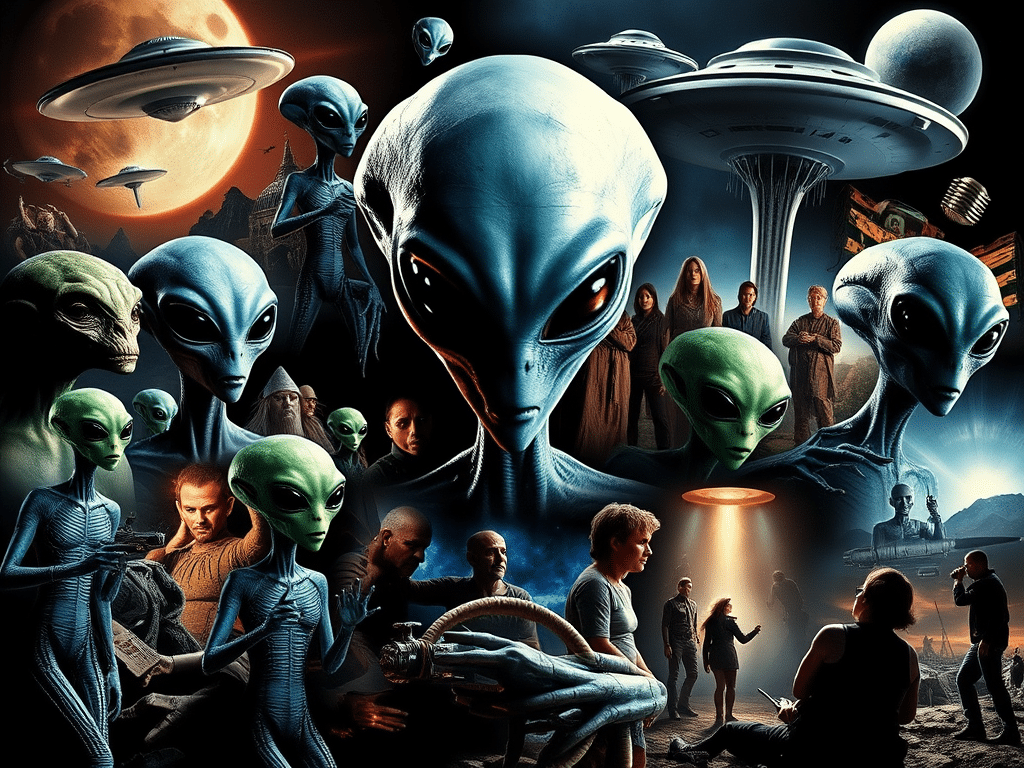
Popular culture portrays aliens in diverse forms that reflect human fears, hopes, and questions about our place in the universe, ranging from malevolent invaders to benevolent guides.
-
Little green humanoids, particularly the modern “Grays,” represent the most recognizable alien archetype, appearing in works like The X-Files (Carter, 1993-2002, 2016-2018) and Close Encounters of the Third Kind (Spielberg, 1977).
-
Invasion aliens embody anxieties about conquest and existential threats, from The War of the Worlds (Wells, 1898) to Independence Day (Emmerich, 1996), emphasizing human resilience against overwhelming odds.
-
Ancient or godlike aliens propose that advanced beings shaped human civilization, as seen in Stargate (Emmerich, 1994) and Ancient Aliens (Prometheus Entertainment, 2009-present).
-
Friendly aliens offer hope for guidance and friendship, exemplified by E.T. the Extra-Terrestrial (Spielberg, 1982) and Star Trek (Roddenberry, 1966-1969).
-
Popular culture aliens have profoundly impacted public discourse and scientific inquiry, inspiring space exploration careers and providing frameworks for discussing complex contemporary issues.

Introduction
The allure of extraterrestrial life has consistently captivated popular culture, integrating aliens and unidentified flying objects into the shared consciousness through cinematic works, television programs, literary compositions, and various other forms of media. From the inception of science fiction narratives to contemporary cinematic franchises, aliens have functioned as reflective instruments, mirroring our most profound apprehensions, aspirations, and inquiries regarding humanity’s position within the cosmos. These extraterrestrial entities have undergone significant transformation throughout the years, influenced by scientific advancements, societal concerns, and evolving cultural perspectives. The depiction of aliens within popular culture encompasses a wide array of entities, ranging from hostile invaders intent on annihilation to benevolent mentors imparting knowledge and technological progress, with each category offering insights into the human experience and our engagement with the enigmatic.
The Cultural Iconography of UFOs and Alien Beings
The portrayal of extraterrestrial beings and unidentified flying objects (UFOs) has emerged as a hallmark of contemporary entertainment and modern mythos. UFOs, or Unidentified Flying Objects, are frequently depicted as enigmatic vehicles possessing technology that surpasses human understanding, often represented as streamlined saucers, triangular craft, or vessels with propulsion systems that are beyond the scope of current scientific comprehension. These spacecraft have attained iconic status, immediately identifiable by their silhouette and firmly entrenched in our collective cultural awareness. The aliens themselves are depicted with varying degrees of biological realism, ranging from entities that adhere to evolutionary principles to beings so fundamentally different that they challenge our fundamental understanding of life. Popular culture has redefined these extraterrestrial beings, evolving them from simple narrative elements into intricate characters and symbols that probe xenophobia, scientific advancement, spirituality, and the potential trajectory of humanity in the cosmos. Dean (1998) investigates how both serious UFO investigators and their popular culture equivalents leverage fears, phobias, and conspiracy theories prevalent in American society, using aliens as cultural symbols to address novel dynamics of democratic politics.
Archetypal Alien Forms: From Little Green Men to Ancient Gods
The archetype of diminutive, green-skinned humanoids constitutes one of the earliest and most persistent representations of alien existence within popular culture. These small entities, frequently portrayed with disproportionately large heads, expansive black eyes, and slender gray or green forms, gained prominence in mid-twentieth-century science fiction and have persisted as a fundamental component of alien iconography. Initially, the “little green men” trope was associated with elements of whimsy and, at times, derision, appearing in pulp magazines and B-movies as either playful pranksters or subjects of comedic misinterpretation. However, this archetype evolved significantly with reports of alleged alien encounters, particularly the famous Roswell incident of 1947 and subsequent claims of alien abductions throughout the latter half of the twentieth century. The modern incarnation of this type, often called “Grays,” has become deeply associated with conspiracy theories, government cover-ups, and the UFO phenomenon, appearing in serious science fiction works like The X-Files (Carter, 1993-2002, 2016-2018) and Close Encounters of the Third Kind (Spielberg, 1977) as well as countless documentaries and speculative investigations. Their distinctive appearance, with its blend of the familiar and the uncanny, has made them perhaps the most recognizable alien type in global popular culture, symbolizing both the wonder and terror of potential first contact with an advanced extraterrestrial civilization.
Invasion aliens represent humanity’s deepest anxieties about vulnerability, conquest, and the possibility of encountering a superior hostile force. This category includes ruthless extraterrestrial conquerors who view Earth and its inhabitants as resources to be exploited, territories to be colonized, or threats to be eliminated, reflecting historical and contemporary fears about imperialism, war, and existential threats to human survival. H.G. Wells’ The War of the Worlds (1898) established many conventions of this archetype, depicting technologically superior Martians who devastate human civilization with advanced weaponry, a narrative that has been adapted and reimagined countless times across various media. More recent examples include the relentless xenomorphs of the Alien franchise (Scott, 1979; Cameron, 1986), the world-destroying forces in Independence Day (Emmerich, 1996), and the parasitic invaders of The Thing (Carpenter, 1982), each presenting unique variations on the invasion theme while exploring different aspects of human response to existential threat. These hostile aliens often serve as allegories for real-world concerns, from Cold War nuclear anxiety to fears about pandemics, environmental collapse, or the dehumanizing effects of advanced technology. The alien invasion narrative typically emphasizes human resilience, ingenuity, and unity in the face of overwhelming odds, suggesting that our species’ greatest strength lies in our ability to adapt, cooperate, and fight for survival when confronted with forces beyond our comprehension.
Ancient or godlike aliens represent a fascinating intersection of science fiction with mythology, spirituality, and alternative history theories. This archetype proposes that advanced extraterrestrial beings visited Earth in humanity’s distant past, influencing or even creating human civilization, technology, religion, and culture in ways that fundamentally shaped our development as a species. The “ancient astronaut” theory, popularized by writers like Erich von Däniken and brought to mainstream attention through shows like Ancient Aliens (Prometheus Entertainment, 2009-present), suggests that many historical mysteries, from the construction of the pyramids to the creation of ancient texts and artifacts, can be explained by extraterrestrial intervention. This theme is present in fictional works like Stargate (Emmerich, 1994; Wright & Glassner, 1997-2007) and Prometheus (Scott, 2012), which explore the idea that an advanced alien race created humanity. These godlike beings often have powers that go beyond reality, are immortal, or possess technology so advanced it seems magical. This archetype blurs the lines between science and mysticism, appealing to both our spiritual needs and our interest in scientific possibilities. The appeal of this archetype comes from its ability to reframe human history as part of a larger cosmic story, suggesting that our existence has purpose and meaning in a universe with beings of great power and knowledge.
Unlike stories of invasion, stories about friendly or aiding aliens show them as wise teachers, curious explorers, or advantageous allies who come to Earth with peaceful or selfless goals. These aliens embody humanity’s hope that we are not alone in the universe and that more advanced civilizations might offer guidance, protection, or friendship rather than conquest or destruction. Steven Spielberg’s E.T. the Extra-Terrestrial (1982) remains perhaps the most iconic example of this archetype, depicting an alien stranded on Earth who forms a profound emotional bond with a human child, emphasizing themes of empathy, understanding, and the universal nature of loneliness and connection. Other notable examples include the philosophical Vulcans of Star Trek (Roddenberry, 1966-1969), who mentor humanity toward a more enlightened future, and the whimsical aliens of Close Encounters of the Third Kind (Spielberg, 1977), whose arrival represents wonder and transcendence rather than threat. Television shows like Doctor Who (Newman & Lambert, 1963-1989, 2005-present) feature extraterrestrial protagonists who actively protect Earth and champion human potential, while films like Arrival (Villeneuve, 2016) present aliens whose inscrutable motivations ultimately prove beneficial to humanity’s evolution. These benevolent entities frequently function as conduits for social critique, embodying aspirations we seek to realize, including rational thought, tranquility, ecological responsibility, and the resolution of trivial disputes in favor of a broader perspective and collective collaboration.

Theoretical Perspectives on Alien Narratives
Numerous theories endeavor to elucidate our cultural preoccupation with extraterrestrial life and the specific manifestations of these portrayals within popular culture. Psychological perspectives propose that aliens act as projections of our subconscious fears and aspirations; hostile invaders symbolize anxieties regarding the unfamiliar, loss of autonomy, or threats to our established way of life, whereas benevolent aliens represent desires for parental support, redemption, or the overcoming of human constraints. Sociological viewpoints posit that narratives involving extraterrestrial beings mirror prevailing societal anxieties; specifically, narratives of invasion frequently arise amidst geopolitical strife or societal instability, whereas accounts of amicable aliens tend to surface during periods characterized by optimism regarding scientific advancement and international collaboration. Certain scholars suggest that these archetypal narratives resonate with fundamental evolutionary predispositions, with our reactions to fictional alien encounters reflecting primordial survival mechanisms associated with interactions with unfamiliar groups or threats. Furthermore, cultural theorists observe that representations of aliens frequently function as indirect means of engaging with sensitive subjects, thereby enabling authors and filmmakers to address contentious issues such as racism, imperialism, religious orthodoxy, or sexual identity through the metaphorical detachment afforded by science fiction contexts. The enduring presence and transformation of these extraterrestrial archetypes across successive generations imply that they address core psychological and cultural requirements. They offer structures for comprehending our position in an increasingly intricate and interconnected global landscape, while simultaneously addressing inquiries concerning identity, diversity, technology, and the trajectory of human civilization.
Kuhn’s (1990) examination of contemporary science fiction films highlights their use of established genre conventions, particularly the portrayal of otherness through alien and humanoid machine characters, as a focal point for cultural and film theory. Through a compilation of essays designed to fully incorporate science fiction cinema into the domains of cultural and film theory, Kuhn argues that what was once considered simple genre entertainment actually offers complex explanations for social dynamics and cultural concerns. The alien figure, regardless of its disposition, offers filmmakers and writers a degree of detachment, allowing them to explore contentious social issues without directly confronting audiences with unsettling realities about human conduct and societal frameworks.
Lewis (2000) investigates a significant aspect of American culture, specifically UFOs, and assesses its influence on modern society, encompassing subjects such as religious convictions and online platforms. The compendium of extraterrestrial belief-related topics illustrates the profound integration of these ideas within American culture, manifesting in diverse areas including music, religious movements, and online communities. Dean (1998) offers a parallel analysis of cultural representations of aliens, narratives of UFOs and abduction, technological advancements in computing and communication, and political disengagement to elucidate American paranoia, concentrating on the dissemination of alien themes from subcultures into various media.
The Broader Impact of Aliens in Popular Culture
The influence of aliens in popular culture transcends mere entertainment, significantly shaping public dialogue, scientific investigation, and even religious and philosophical perspectives in impactful and occasionally unforeseen manners. These fictional portrayals have molded public perceptions of the potential for actual extraterrestrial life, with scientific studies indicating that the expectations of many individuals regarding alien contact are significantly shaped by cinematic and television portrayals rather than scientific likelihood or astronomical investigation. The prevalence of Grays and flying saucers in popular culture has reached a point where purported real-world UFO sightings often feature entities and vehicles that conform to these fictional archetypes, thereby prompting intricate inquiries into the interplay between imagination, anticipation, and sensory experience. Moreover, the narratives surrounding extraterrestrial life have motivated numerous scientists, engineers, and astronauts to embark on careers in space exploration and astrobiology; many researchers acknowledge the influence of works such as Star Trek (Roddenberry, 1966-1969) or Contact (Zemeckis, 1997) as pivotal in their decision to investigate the universe. These narratives have also furnished the lexicon and conceptual structures necessary for addressing significant concerns, including climate change, artificial intelligence, genetic engineering, and globalization, thus facilitating the exploration of intricate subjects through accessible and emotionally resonant storytelling. The diverse alien archetypes have become ingrained in our collective cultural lexicon, serving as immediately identifiable symbols that traverse national and linguistic divides to convey concepts of otherness, apprehension, optimism, inquisitiveness, and the expansive mysteries enveloping our planet.
Kripal (2011) investigates the correlation between literature on alien abductions and popular cultural artifacts, positing that the former constitutes the experiential foundation of science fiction and superhero mythology. This viewpoint contests traditional boundaries separating fiction from claimed reality, suggesting instead that cultural narratives and personal experiences mutually influence and validate one another. Kripal examines the depictions of conventional almond-eyed aliens by comic book writers and artists, including Grant Morrison, and notes that certain creators avoid the term “aliens,” opting for alternative terminology.
Bökös (2019) examines the importance of alien-human interactions as a primary thematic element in the science fiction genre, particularly in invasion narratives. Through an analysis of specific science fiction films—Invasion of the Body Snatchers, The Host, and Avatar—in light of postcolonial theories, Bökös examines how these films engage with the destructive consequences of colonization on both human and extraterrestrial societies. Martins Simoneti (2022) examines how science fiction films, particularly the invasion plot subgenre, reflect and challenge colonial paradigms and contemporary subjectivity through narratives focused on extraterrestrial encounters. Martins Simoneti’s analysis of films such as Independence Day and War of the Worlds illustrates how extraterrestrial narratives can perpetuate colonial hierarchies through the deployment of disembodiment and anthropocentrism. Nevertheless, not all invasion narratives merely reproduce these problematic structures; Martins Simoneti investigates Arrival and Annihilation to show how invasion stories can subvert colonial frameworks and offer alternative modes of encounter by challenging notions of identity, progress, and the human/nonhuman distinction.
Kuhn (1990) analyzes the critical frameworks utilized in the evaluation of science fiction cinema, including societal critique, ideological foundations, intertextuality, and the articulation of repressed desires. These analytical approaches each reveal distinct facets of alien narratives’ cultural function, whether as reflections of contemporary society, vehicles for dominant or subversive ideologies, texts engaged in dialogue with other cultural works, or manifestations of collective unconscious fears and desires. Lewis’s (2000) work offers an encyclopedic examination of extraterrestrial beliefs and their influence on modern America, encompassing subjects like Music and UFOs, Naked Aliens, Roswell, and War of the Worlds. This extensive compilation of alien-related cultural occurrences demonstrates the pervasive nature of these themes within American culture, establishing them as reference points and shared symbols that are readily employed across various contexts.
Conclusion
In summation, the varied portrayals of aliens within popular culture collectively represent a complex mix of human imagination, fear, ambition, and philosophical exploration, encompassing everything from diminutive green humanoids to invading forces and from ancient, godlike entities to benevolent visitors. These extraterrestrial archetypes have developed in tandem with human society, mirroring evolving anxieties, values, and aspirations, while consistently serving as reflective tools through which we scrutinize ourselves and our position in the universe. The persistent appeal of extraterrestrial narratives across diverse media platforms underscores their distinctive capacity to engage with core inquiries concerning existence, awareness, ethics, and significance, thereby transcending cultural and generational boundaries. These fictional entities, whether portrayed as menacing or reassuring, antagonistic or supportive, consistently engage audiences due to their ability to facilitate an exploration of the human condition through the juxtaposition of the familiar and the utterly foreign. As scientific advancements broaden our comprehension of the cosmos and the prospect of actual extraterrestrial life shifts from conjecture to legitimate scientific investigation, these popular culture aliens are poised to undergo continuous evolution, adaptation, and inspiration, functioning as both sources of entertainment and instruments for contemplating humanity’s fundamental questions regarding our origins, our future, and our place within an unfathomably expansive and enigmatic universe.
References
Alien [Film]. (1979). 20th Century Fox.
Aliens [Film]. (1986). 20th Century Fox.
Ancient Aliens [TV series]. (2009–present). A&E Networks.
Annihilation [Film]. (2018). Paramount Pictures.
Arrival [Film]. (2016). Paramount Pictures.
Avatar [Film]. (2009). 20th Century Fox.
Bökös, B. (2019). Human-alien encounters in science fiction: A postcolonial perspective. Acta Universitatis Sapientiae, Film and Media Studies, (16), 189–203.
Close Encounters of the Third Kind [Film]. (1977). Columbia Pictures.
Contact [Film]. (1997). Warner Bros.
Dean, J. (1998). Aliens in America: Conspiracy cultures from outerspace to cyberspace. Cornell University Press.
Doctor Who [TV series]. (1963–1989, 2005–present). BBC.
E.T. the Extra-Terrestrial [Film]. (1982). Universal Pictures.
The Host [Film]. (2006). Showbox.
Independence Day [Film]. (1996). 20th Century Fox.
Invasion of the Body Snatchers [Film]. (1956). Allied Artists Pictures.
Kripal, J. J. (2011). Mutants & mystics: Science fiction, superhero comics, and the paranormal. University of Chicago Press.
Kuhn, A. (Ed.). (1990). Alien zone: Cultural theory and contemporary science fiction cinema (Vol. 1). Verso.
Lewis, J. R. (2000). UFOs and popular culture: An encyclopedia of contemporary mythology. Bloomsbury Publishing USA.
Martins Simoneti, C. A. (2022). “More human than human”: Colonial logics and the modern subject in science fiction films. Journal, 184–211.
Prometheus [Film]. (2012). 20th Century Fox.
Stargate [Film]. (1994). Metro-Goldwyn-Mayer.
Stargate SG-1 [TV series]. (1997–2007). Metro-Goldwyn-Mayer Television.
Star Trek [TV series]. (1966–1969). Desilu Productions; Paramount Television.
The Thing [Film]. (1982). Universal Pictures.
War of the Worlds [Film]. (2005). Paramount Pictures.
Wells, H. G. (1898). The war of the worlds. William Heinemann.
The X-Files [TV series]. (1993–2002, 2016–2018). Ten Thirteen Productions; 20th Television.


Leave a Reply