Haunted Banks: Key Points
-
Haunted banks are unique paranormal sites where intense emotions and tragic events create supernatural activity, with their secure architecture believed to trap spiritual energy.
-
Associated ghosts include former employees who died suddenly, robbery victims, and criminals who met violent ends, all remaining attached to locations of their tragedies.
-
Examples include Canada’s Old Ontario Bank haunted by a Depression-era manager, Tombstone’s Wells Fargo building with frontier spirits, and Ecuador’s Banco Central with colonial apparitions.
-
Theories range from the stone tape theory of traumatic recordings in building materials to psychological factors and architectural features that create misinterpreted phenomena.
-
These legends boost tourism, preserve historic buildings from demolition, and inspire popular culture representations in literature, film, and television.
-
Haunted bank stories humanize impersonal institutions and reflect our complex relationship with money, mortality, and the human dramas unfolding in financial spaces.

Introduction
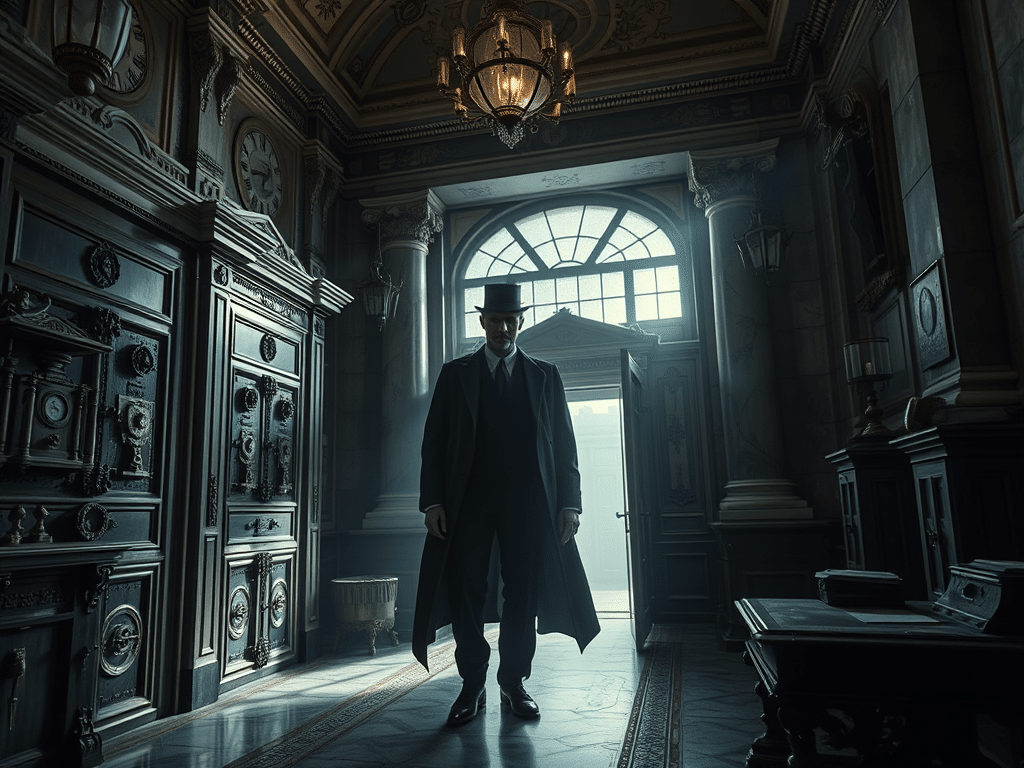
In paranormal stories, haunted banks are special because they are where business, sorrow, and the supernatural all meet. Over the ages, these banks have collected many ghost stories and strange events that no one can explain. They have seen a lot of human drama, from economic collapse to violent robberies. Banks’ cold marble rooms and huge vaults seem to echo not only with the sound of transactions but also with the voices of people whose lives were forever changed inside those walls.
Haunted Banks
In supernatural stories, banks are often considered places where spiritual energy is stored because they are both places of hope and sadness, making them perfect for supernatural activity. These institutions occupy a unique cultural space where individuals both make and lose significant amounts of money, often resorting to desperate actions, and the pervasive weight of financial anxiety affects the entire building. Paranormal investigators say that banks have a special energy that is different from other business buildings. This could be because banks are places where people feel a lot of strong emotions, from happiness to complete sadness. Some theories suggest that the thick walls and secure buildings designed to safeguard material wealth could also harbor spiritual energy.
Several types of ghosts, each with its own tragic tale, are believed to be associated with banks. People who used to work at banks and died quickly, either naturally or in an accident at work, are said to still be connected to the places where they worked and continue doing the same things they did in life. People who were robbed, either workers or customers, are thought to have the most common hauntings. The explanation is because their sudden and traumatic deaths leave behind the kind of energetic imprint that paranormal researchers think causes hauntings. Some stories also suggest that the spirits of bank robbers, who either died during failed heists or were later executed for their crimes, return to the locations where they committed their last desperate acts.
Folklore from all over the world tells many stories about specific evil banks, each with its own intriguing plot. People say that the Old Ontario Bank in Bowmanville, Canada, is cursed by a former manager who hanged himself in the building during the Great Depression. Visitors have heard footsteps and felt like someone was watching them. In Tombstone, Arizona, the Wells Fargo building, which was a bank in the 1880s, is said to be haunted by people who died in the town’s violent frontier days. Paranormal investigators have observed cold spots and shadowy figures roaming the historic building. The Spanish conquistadors and native people who died in battles over gold that was once stored at the Banco Central in Quito, Ecuador, are said to haunt the building, which dates back to colonial times. People report seeing their ghosts near the old vault areas.
The City of London, which has long been the center of British banking, literally embodies the link between finance and the gothic by incorporating ancient artifacts and gothic elements into the modern financial landscape. “The Bank Nun,” a ghost that is said to be Sarah Whitehead, whose brother was put to death for forgery in 1812, is said to visit the Bank of England itself (Long, 2014). Following her brother’s execution, Whitehead persistently inquired of bank employees, “Have you seen my brother?” until her demise. Her spirit is said to still be searching (Long, 2014). This haunting is similar to what Crosthwaite (2011) calls the “hermetic environments” of high finance, where the weight of sorrow and history fills modern banking spaces.
Folklore from today still talks about evil banks in many different parts of the world, which suggests that these stories are still around today. The old Bank of Montreal building in Toronto is haunted by Dorothy, a bank teller who killed herself with the bank’s revolver after having an affair with a married coworker (Boyle, 2015). Once the largest bank branch in Canada, the building now houses the Hockey Hall of Fame. Cleaning staff said they were scared to work after dark because of strange noises, and they wouldn’t use the bathroom upstairs, so a new one had to be built in the basement (Boyle, 2015). In Western Georgia, stories discuss a building that is thought to have been an old bank where a suicide or murder happened and where the ghost of a worker was seen in the windows (Glazier et al., 2021).

Theories and Impact
There are many ideas, both psychological and supernatural, that try to explain why hauntings happen so often in banks. The stone tape theory, which is popular among paranormal researchers, says that traumatic events can be stored in a building’s materials in some way. This phenomenon is especially true for buildings that contain a lot of quartz or other crystalline materials, like the marble and granite that are often used to build banks. Psychologists believe that the cultural perception of banks as sites of financial stress and anxiety may predispose individuals to interpret unusual occurrences as supernatural, particularly in historical edifices with documented tragic narratives. Another theory is based on the way banks are built. It says that their high ceilings, echo-prone interiors, and often confusing plans create strange sounds and visual effects that people might mistake for supernatural events.
The study of these supernatural stories by academics shows how people use supernatural language to justify events that don’t fit into normal logical frameworks. Glazier et al. (2025) used Critical Narrative Analysis to look at first- and second-hand stories of supernatural folklore in Western Georgia. They wanted to find out what dominant discourses there were and how the storytellers tried to defend their experiences. By looking at things in this way, we can see that haunted bank stories are more than just fun. They help people cope with stress, talk about their worries about the economy, and remember the past. These stories have been told for hundreds of years and across many cultures, which suggests that they meet psychological and social needs that can’t be met by purely rational economic speech.
The effects of haunted bank stories extend beyond mere myths. They have real effects on tourists, historic preservation, and pop culture. Many supposedly haunted old bank buildings have become museums, restaurants, or small hotels. The paranormal reputations of these buildings bring in many tourists, which is good for the local economy. Additionally, these ghost stories play a crucial role in preserving old bank buildings that might otherwise be demolished, as they generate interest and motivate people to protect them. Furthermore, the many stories about haunted banks have had an effect on literature, film, and TV. The image of the haunted bank has become a common trope in horror media, from the vault scene in many spooky thrillers to paranormal investigation shows that focus on the subject.
Victorian writers wrote a lot about the connection between money and ghosts, using ghost stories to express worries about the financial system. The story The Ghost in the Bank of England (1879), which was published anonymously but was inspired by Wilkie Collins, is about a ghostly cashier, a mysteriously listed banknote, and charges of forgery against the narrator (Smith, 2013). Smith (2013) says this story suggests that money is the abstract form that rules and haunts social relationships. This means that the real ghost that haunts society is not a supernatural being, but the financial system itself. In the same way, Charlotte Riddell’s ghost stories used ghostly figures to show how deeply worried she was about how dangerous nineteenth-century economics were and how there was always the risk of going bankrupt (Bissell, 2014).
In interesting ways, the supernatural in financial literature wasn’t always presented as scary. In some cases, ghosts were good spirits that helped living characters with their money problems. In many of Riddell’s stories, beneficial ghosts actively helped characters with their money problems, for example, by revealing dishonest inheritors or giving them important financial information (Bissell, 2014). However, Bissell (2014) says that these stories often showed the Victorian financial system—which included working, banking, and saving—as inherently dangerous and scarier than the ghosts themselves. This flipping of roles, where the everyday financial system becomes scarier than magical beings, shows deep-seated cultural worries about the weakening of the economy and the vagueness of money systems.
When talking about failing banks, the global financial crisis of 2007–2008 brought supernatural language into everyday financial conversation in ways that had never been seen before. Terms like “zombie banks” became popular in the media. During this time of economic collapse, financial workers in London and Paris are said to have turned to psychics and clairvoyants for help, hoping that supernatural means could help them cope with the uncertainty (Crosthwaite, 2011). This event shows how trouble can make even the most logical people contemplate the supernatural when normal ways of thinking don’t work. The use of supernatural language to talk about new financial ideas and the people who came up with them shows that people are deeply uncomfortable with the complicated systems that run modern economies (Crosthwaite, 2011).
Conclusion
The fact that some banks are haunted shows us something deep about how we feel about money, death, and memory. Not only do these stories have supernatural elements that keep people interested, but they also bring institutions that are often considered cold and impersonal to life, reminding us that behind every transaction and inside every vault is the possibility for a human drama. Whether you believe in ghosts or think these stories are just made up by people’s minds, haunted banks are a strong reminder that the places where we do our most important financial business are also the places where the full range of human experience takes place. People are still interested in these ghost stories, which suggests that as long as banks are important to our economy, their ghost stories will live on, providing a supernatural contrast to the logical world of banking.
References
Bissell, S. (2014). Spectral economics and the horror of risk in Charlotte Riddell’s ghost stories. Victorian Review, 40(2), 73-89.
Boyle, T. (2015). Haunted Ontario 4: Encounters with ghostly shadows, apparitions, and spirits. Dundurn.
Collins, W. (1879). The ghost in the Bank of England. Belgravia.
Crosthwaite, C. F. C. P. (2011). Phantasmagoric finance: crisis and the supernatural in contemporary finance culture. In Criticism, crisis, and contemporary narrative (pp. 188-210). Routledge.
Glazier, J. W., Mitchell, D. S., Wipff, Z., & Cochran, N. (2025). Paranormal folklore in Western Georgia: A critical narrative analysis of apparitions. Anthropology of Consciousness, e70005.
Long, D. (2014). Bizarre London: Discover the capital’s secrets & surprises. Simon and Schuster.
Riddell, C. (Various dates). Ghost stories. Multiple publishers.
Smith, A. (2013). Money and machines: Wilkie Collins’s ghosts. In The ghost story, 1840–1920 (pp. 49-68). Manchester University Press.


Leave a Reply