Slender Man: Key Points
-
Slender Man is an unnaturally tall, faceless humanoid in a black suit who emerged from internet folklore in 2009, creating an unsettling “uncanny valley” effect.
-
He stalks victims over time, particularly children, appearing in backgrounds before abducting them through psychic influence that causes paranoia and physical symptoms.
-
Created by Eric Knudsen on Something Awful forums in 2009, the character was collaboratively expanded by online communities into “digital native” folklore.
-
His cultural impact includes video games, films, and widespread recognition, but it turned tragic when two girls stabbed their classmate in 2014, claiming Slender Man inspired them.
-
Scholars interpret him as embodying modern anxieties about internet anonymity and stranger danger while following archetypal patterns from traditional worldwide folklore.
-
The phenomenon demonstrates how the internet generates powerful modern mythology and serves as a cautionary tale about viral content blurring fiction and reality.

Introduction
One of the most famous and important figures to come out of internet myth in the twenty-first century is the Slender Man. This nameless, unusually tall figure in a black suit fascinates millions of people worldwide. What began as a simple internet idea has grown into a complex cultural phenomenon that has affected horror fiction, popular media, and academic discussion. What started as an entry in a paranormal photography contest on an online site in 2009 quickly turned into a modern mythology that shows how powerful it can be for people to work together to tell stories in the digital age. How the Slender Man went from being a made-up character to a cultural icon shows a lot about how folklore changes and spreads in our linked world.
As an important example of modern folklore, the Slender Man movement rose from the depths of the internet and shows how complicated it is to make culture digitally. This character started out on the Something Awful forum and quickly became a multifaceted legend with the help of community involvement through memes, creepypasta (user-generated horror stories), and multimedia adaptations (Smith, 2017; Sayad, 2021). This paper unites various academic perspectives on Slender Man to illustrate the character’s cultural significance and its dissemination.
Physical Description and Behavioral Patterns
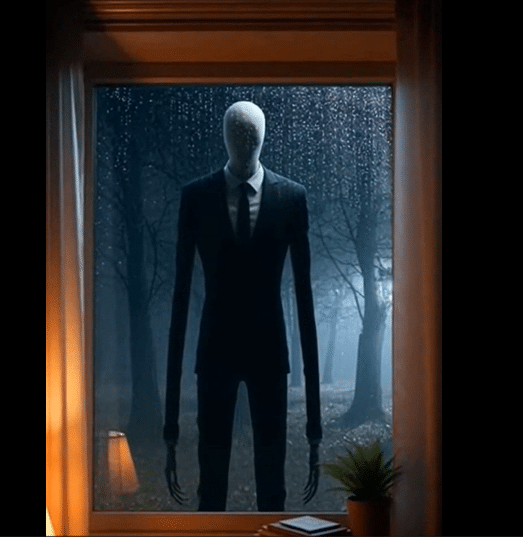
Slender Man’s appearance is both simple and deeply disturbing, which is a big part of why people still like him so much. He is pictured as an incredibly tall and thin humanoid figure that is usually between eight and fifteen feet tall and has arms and legs that are too long, making him look like an insect. The thing that makes him stand out the most is that he doesn’t have any facial features at all. There are no eyes, nose, mouth, or any other features that would make a face unique. He always wears a black business suit with a white shirt and a black tie, which is an odd choice that causes cognitive dissonance by combining his mundane professional clothes with his strange appearance. In many pictures, Slender Man has tentacle-like parts that stick out of his back or can grow from his chest, making him look even more alien and scary. This mix of the familiar and the completely wrong leads to what psychologists call the “uncanny valley” effect, where something looks almost human but is different enough to make us sick and scared.
People assert that Slender Man’s actions align with established themes from numerous stories and reported encounters. Most of the time, he is shown stalking his victims for long periods of time, showing up in photos or at the edges of forests, becoming more and more present in their lives until they finally face him. The main people he goes after are usually kids and young adults, though different stories explain why this is the case. People who are being chased by Slender Man often have trouble remembering things, become paranoid, get nosebleeds, and cough a lot. A cough is how he communicates. He is linked to dense woods and empty places, and he likes to hang out in the areas between civilization and the wild. When he finally gets his victims, many of them are never seen again. Sometimes their bodies are found stuck on tree branches in the middle of nowhere in the woods. His precise and patient approach makes him especially scary because his victims know they are being chased but feel like they can’t get away from what seems like their inevitable fate.

Origins and Digital Folklore Evolution
Slender Man’s history goes back to June 10, 2009, when Eric Knudsen, going by the name “Victor Surge,” shared two photos that had been changed to the “Create Paranormal Images” thread on the Something Awful forums. The pictures showed groups of kids with a tall, shadowy person lurking in the background. They were accompanied by made-up stories about mysterious disappearances. The online community responded quickly and enthusiastically to this creation, making their own stories, photos, and videos starring the entity. This made it stand out from many other internet hoaxes. Through a process called “crowdsourcing creativity,” the Something Awful community created Slender Man’s mythology by setting rules and traits while leaving enough room for individual opinion. This collaborative creation of folklore quickly spread to other sites, such as YouTube, where the Marble Hornets web series made the “found footage” style of telling Slender Man stories popular, and to Creepypasta Wiki, where hundreds of Slender Man stories were saved and shared. Folklore usually changes slowly over many generations through oral custom. But Slender Man’s mythology became clear in just a few months thanks to digital networks. This is what folklorists call “digital native” or “internet-age” folklore.
The myths and legends about Slender Man have spread to many different types of media, making his place in modern society even stronger. As noted previously, one well-known adaptation is the web series Marble Hornets, which explores trauma and loneliness in the digital age and shows how technology can change human experiences (Hubber, 2025; Sayad, 2021). These versions show how the stories about Slender Man are connected to real-life problems like bullying, mental health, and how common online harassment is, encasing larger social stories in a scary framework (Sayad, 2021; Peck, 2015). Curlew (2017) and Jurković (2023) both say that the Slender Man mythos is even more powerful as a modern cultural product that can reflect and amplify people’s fears because it is linked to the larger discussion of surveillance culture.
Cultural Impact and Real-World Consequences
Slender Man has had a huge and varied effect on culture, going far beyond the online groups where he first appeared. Many computer games have been based on him, including the incredibly popular Slender: The Eight Pages and its follow-up, which have been downloaded millions of times and inspired many others. There have been books, documentaries, and even a Hollywood movie with this figure that came out in 2018. Popular culture has made Slender Man a well-known figure. TV shows, Halloween outfits, and academic papers studying digital folklore and collaborative mythology have featured Slender Man.
Slender man took an evil turn in 2014, when two 12-year-old girls in Wisconsin stabbed a friend 19 times, saying they were trying to become “proxies” of Slender Man, which means they would do what he said (Associated Press, 2019). This terrible event caused a debate around the world about internet culture, kids’ access to scary material, mental health, and the difference between fiction and reality. A judge sent both of the juveniles to mental health institutions.
The phenomenon of Slender Man raises significant questions regarding intellectual property rights in the realm of internet folklore. When more than one person creates and changes a character, it’s harder to figure out who legally owns it. Smith looks at what copyright and ownership mean in the collective creation of Slender Man. He stresses how changing internet folklore is and how standard legal frameworks may not be able to keep up with how quickly culture changes (Smith, 2017; Sayad, 2021). This is part of a bigger trend in digital culture where the lines between who wrote something are becoming less clear. This phenomenon makes us think again about who owns the rights to collective stories.
Theoretical Interpretations and Cultural Anxieties
There are many theories and analyses that try to explain why Slender Man is so popular and what he stands for in modern society. From a psychological perspective, many researchers say that Slender Man represents modern worries about being attacked by strangers, having your child taken, and how vulnerable young people are in a world that is becoming more linked and where threats can come from anywhere. The character’s facelessness is thought to symbolize the dangers of being anonymous online. According to folklorists, Slender Man follows archetypal patterns found in traditional folklore around the world, from the German Der Großmann to the Scottish Fear Dubh. The result suggests that he plays on deep-seated, maybe global, fears about tall, strange figures lurking in dark places. According to some cultural critics, Slender Man is a criticism of corporate culture. His businessman’s suit is considered a metaphor for how modern capitalism “consumes” people, especially young people. Literary experts have looked at how Slender Man stories work as modern fairy tales, complete with moral lessons about being lost alone, the risks of being curious, and the presence of evil. Some thinkers think that Slender Man represents the collective unconscious of internet culture because he was made by many people working together without a single author. They see him as a digital representation of shared fears and creative urges that can only come out of communicating through networks.
The making of Slender Man is a wonderful example of how internet fiction works, since it was created by many people working together. As a contest, people were asked to take creepy pictures of an unknown person standing tall over children. This process led to the creation of many myths and stories involving images (Smith, 2017; Sayad, 2021). Smith talks about how Slender Man changed over time as a group effort, with people on different platforms reinterpreting and remixing the original images and stories, adding to the complicated web of this urban legend (Smith, 2017; Peck, 2015). The story is based on many famous monster stories from folklore, where the monster represents social problems and cultural fears. The urban legend is a common way of telling stories, both orally and digitally (Boyer, 2013; Peck, 2015).
Boyer (Boyer, 2013; Curlew, 2017) asserts that Slender Man embodies numerous contemporary cultural anxieties, particularly those pertaining to societal surveillance and control. This fear is made worse by the fact that stories about Slender Man are spread through digital channels that are not monitored. He is tall, has no face, and is often portrayed as a scary figure on the edges of society. These traits make him a powerful symbol of modern fears about the unknown and unseen threats that are common in surveillance culture (Jurković, 2023; Curlew, 2017). Also, because the Slender Man tale is digital, it fits easily into discussions about folklore around the world, as people from different backgrounds reinterpret and change the story to fit their situations (Jurković, 2023; Asimos, 2020).
Conclusion
The Slender Man phenomenon marks a significant shift in the creation and dissemination of folklore in the digital era. It shows that the internet can create mythology as powerful and meaningful as traditional stories. From his exact beginnings in 2009 to his rise to fame as a cultural icon, Slender Man shows how working together to create something can make it bigger than its original purpose and take on a life of its own. His influence goes beyond entertainment, into important conversations about media literacy, mental health, and the duties that come with making and sharing content in digital spaces that are all linked. Slender Man has earned his place in the pantheon of modern monsters, whether he is considered a warning about the power of viral content, an example of postmodern collective art, or just a good scary bad guy. As internet culture changes, the tall, nameless man in the black suit reminds us of how quickly lies can spread, how deeply they can affect people, and how very quickly the lines between stories and reality can blur in our digital world.
References
Asimos, V. (2020). The Slender Man: The Internet’s playful creation of a monster. In M. Coward-Gibbs (Ed.), Death, culture & leisure: Playing dead. Emerald Publishing. https://doi.org/10.1108/978-1-83909-037-020201016
Associated Press. (2019, October 24). Wisconsin ‘Slender Man’ attack victim who was stabbed 19 times speaks out for the first time, has ‘come to accept all of the scars.’ Chicago Tribune. https://www.chicagotribune.com/2019/10/24/wisconsin-slender-man-attack-victim-who-was-stabbed-19-times-speaks-out-for-the-first-time-has-come-to-accept-all-of-the-scars/
Boyer, T. (2013). The Anatomy of a Monster:. Preternature Critical and Historical Studies on the Preternatural, 2(2), 240-261. https://doi.org/10.5325/preternature.2.2.0240
Curlew, A. (2017). The legend of the Slender Man: The boogieman of surveillance culture. First Monday. https://doi.org/10.5210/fm.v22i6.6901
Hubber, D. (2025). Slender is the night: The traumatized interface of Marble Hornets. Horror Studies, 16(2), 173-190. https://doi.org/10.1386/host_00101_1
Jurković, T. (2023). The clash of digital and traditional monsters: Slender Man adaptations and the Balkan culture. Journal of Adaptation in Film & Performance, 16(1), 147-159. https://doi.org/10.1386/jafp_00094_1
Peck, A. (2015). Tall, Dark, and Loathsome: The Emergence of a Legend Cycle in the Digital Age. Journal of American Folklore, 128(509), 333-348. https://doi.org/10.5406/jamerfolk.128.509.0333
Sayad, C. (2021). Conclusion: Beyond horror: An Internet legend and the faking of reality. In The ghost in the image (pp. 113–122). Oxford University Press. https://doi.org/10.1093/oso/9780190065768.003.0006
Smith, C. (2017). Beware the Slender Man: Intellectual Property and Internet Folklore. SSRN Electronic Journal. https://doi.org/10.2139/ssrn.3005668

Leave a Reply