Hungry Ghosts: Key Points
-
The concept of hungry ghosts, or pretas, originates from Buddhist cosmology as beings trapped by excessive craving and desire from past lives.
-
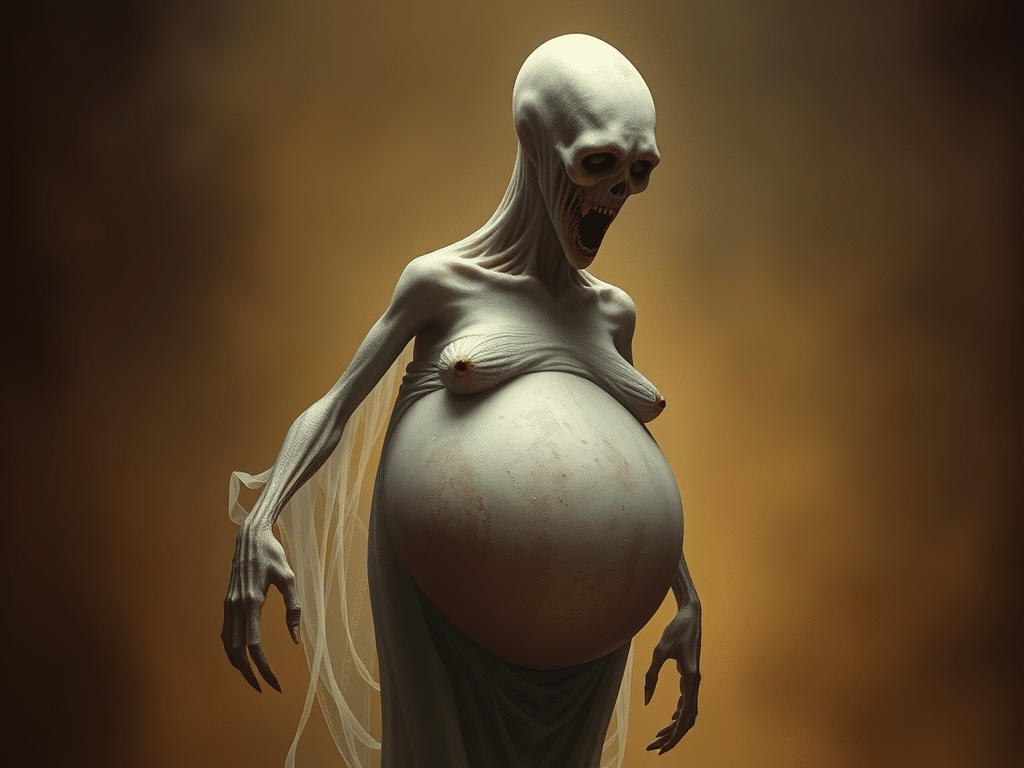
Hungry ghosts are depicted with enormous swollen bellies, impossibly thin needle-like necks, and tiny pinhole mouths that make consuming food nearly impossible.
-
Beings become hungry ghosts due to karmic actions like extreme greed, stinginess, and hoarding, especially those who died with intense unfulfilled material desires.
-
Hungry ghosts endlessly wander searching for food and water but cannot consume what they seek, as substances turn to fire or poison in their mouths.
-
Buddhist traditions address hungry ghosts through compassionate rituals including food offerings during festivals and recitation of mantras to help pretas find relief.
-
The hungry ghost concept remains relevant today as a metaphor for addiction and consumerism, reinforcing Buddhist teachings about generosity and the dangers of attachment.

Introduction
In Buddhist cosmology, one of the six realms of existence is inhabited by hungry ghosts, who reflect beings stuck in a state of constant wanting and being unhappy. These beings, which are called “pretas” in Sanskrit and “gaki” in Japanese, are the results of greed, jealousy, and spiritual poverty from past lives. In some Buddhist traditions, the idea of hungry ghosts is taken literally. It’s also a strong metaphor for understanding why people suffer and how desire works in our own lives.
Buddhist cosmology says that the world is made up of many levels and that living things are reborn over and over again into different realms. This is caused by karma and the problems of want, hate, and ignorance. Most people agree that there are six of these realms: gods (devas), humans, animals, hungry ghosts (pretas), beings from hell, and, in some stories, gods or demigods who are jealous (asuras) (Burley, 2017; Pemarathana, 2013; Woodhouse et al., 2015). The desire world (kāmadhātu) has “five, or in some accounts six, main destinations (gatis) in which one could potentially be reborn,” with the usual five being gods, people, animals, the spirits of the dead (pretas), and beings from hell (Burley, 2017). This cosmological theory doesn’t just describe things; it also gives us a moral map of what happens when we do different things (Payne, 2025; Pemarathana, 2013).
The Preta Realm in Buddhist Cosmology
Buddhism says that all living things are stuck in a circle of death and rebirth called samsara. Depending on their karma, they move through six realms: the god realm, the demigod realm, the human realm, the animal realm, the hungry ghost realm, and the hell realm. There are hungry ghosts that live in the preta realm, which is connected to our human world but has different kinds of pain. These beings are not permanent fixtures; they are souls temporarily stuck in this state until their bad karma runs out. After that, they can be reborn into a different realm based on their good and evil acts.
The word “preta” comes from the Sanskrit words “pra” + “i,” which mean “to go forth.” Its precise meaning is “the dead” (White, 1986). The Pāli word for this word, “peta,” has the same meaning. White points out that “the English translation of ‘hungry ghost’ is a descriptively apt one” but also somewhat inaccurate, because the preta is not a ghost in the Western sense. Unlike the fox spirits of Chinese folklore, it is the soul of a person that cannot appear in another body. Instead, it is a unique way of rebirth (White, 1986; Esler, 2016). The preta “does not last during transmigration but constitutes a state into which one is incarnated” (Esler, 1996). This difference in ontological status is important: the hungry ghost is a being in its own right, subject to the same rules of karma and rebirth as all other conscious beings, and it can die as a hungry ghost and be reborn into a higher realm (Capper, 2021).
The preta realm is distinct from the antarā-bhava, a state between death and rebirth. Some Buddhist schools accept this idea, while others do not. Lee says, “The concept of preta—commonly known as ‘hungry ghost,’ one of the six destinies of the sensuous realm in the Buddhist cosmological system—appears to have a connotation similar to that of the antarā-bhava, although the antarā-bhava seems to have a broader meaning than the preta” (Lee, 2014).
Physical Characteristics and Karmic Origins
The way hungry ghosts look is always described in Buddhist writings and art as purposely horrifying and pitiful. They are usually depicted with huge, swollen bellies that indicate their constant hunger and necks so thin they are barely larger than a needle, making it almost impossible for them to swallow food or drink. People often say that their mouths look like tiny pinholes, which emphasizes how they can’t satisfy their intense hunger even though food and water are always around them. Some traditions describe them as having dry, flaky skin stretched over bones that stick out, limbs that are always skinny, and hair that falls out in clumps. This creates an image of extreme hunger and pain that serves as a visual warning of what happens when you want too much.
In many Buddhist traditions, hungry ghosts are talked about in colorful and sometimes gross ways. They are usually shown as skinny beings with huge, swollen bellies and small, narrow throats or mouths, which means they can’t satisfy their constant hunger and thirst (Payne, 2025; Mahadev, 2019; Arensen, 2017). Pretas are said to have “bottomless stomachs and agonizingly narrow throats,” and they have “voracious and unmitigated desires for the worldly things they knew in life” (Mahadev, 2019). The Tibetan Book of the Dead describes hungry ghosts as beings that “eat odors” and “are hungry but cannot eat; therefore, they feed on the smells of burnt offerings” (Nahm, 2011).
Hungry ghosts come from certain karma actions and mental states that people developed in past lives. People who turn into hungry ghosts usually did terrible things because they were very greedy, cheap, or jealous, especially those who saved money while others suffered or who lied and tricked others to get what they wanted. People who were too protective, wouldn’t share their resources with those in need, or were deeply envious of other people’s success build up the bad karma that leads to rebirth as a preta. Also, people who died with strong unfulfilled attachments or desires, especially for material things or sensual pleasures, are more likely to reincarnate in the hungry ghost world, where their cravings become their pain.
When hungry ghosts act, they keep looking for things but can’t find them. They are very frustrated. These beings appear to constantly search for food, water, and happiness. But when they find what they’re looking for, their bodies don’t let them eat it. When they drink water, it may turn to fire or pus in their mouths or evaporate before it reaches their lips. This incident is a symbol of how their ego and greed have poisoned even the most basic food. It is said that some hungry ghosts eat gross things like poop, dead bodies, or the gifts left at funerals. This shows how low their extreme attachment has brought them. Their constant competition with other pretas for limited happiness creates a perpetual state of scarcity, despite the possibility of abundance. Depending on the nature of their karmic debts, they also often have to deal with extra pains like burning heat or freezing cold.
From the perspective of Cambodian Buddhism, pretas are “tall, stretched, emaciated forms with tiny, puckered mouths” who are “forced to ceaselessly forage for food in disgusting waste, food that never satisfies their hunger but instead turns foul on their tongues” (Arensen, 2017). Folklore says that this being’s physical traits are real because of the karmic forces that brought it to this state (Payne, 2025; Osterhold & Fernandes-Osterhold, 2023) and not just a metaphor.
For hungry ghosts, the worst part of their pain is always wanting something and not being able to get it. Payne says that the “hungriness” of the hungry ghost is both a physical and a mental state. It shows the karmic effects of a life ruled by greed, stinginess, and attachment (Payne, 2025). As Mahadev (2019) says, the prēta are “subject to ceaseless thirst and hunger” and are “karmically incapacitated by their desire,” which means they can’t move on to a better rebirth.
Buddhist books say that the main karmic reason for being reborn as a hungry ghost is a type of moral failure that involves being greedy, cheap, and unwilling to give. This trait is known as mātsarya in Sanskrit and macchariya in Pāli. It means “a certain kind of meanness” that includes “not wanting to give or share, which could be called ‘miserliness’ or ‘stinginess,’ as well as being unfair, unkind, and spiteful” (Osterhold & Fernandes-Osterhold, 2023). Buddhist stories and monastic legal codes use the suffering of hungry ghosts and the wrongdoings of humans that lead to this fate as warnings to help both lay and monastic readers escape it (Osterhold & Fernandes-Osterhold, 2023).
White’s study of the Petavatthu, also known as the Pāli “Book of Ghost Stories,” reveals the main way that karma works: “The main reason people become petas is because they neglected to show kindness to the needy Sāvaka-saṅgha” (White, 1986). This means that not being kind to others, especially the monastic community, which is considered the living embodiment of the Buddha’s lessons in the world, is the main reason why people are reborn as hungry ghosts (White, 1986). In this way, the “hungry ghost doctrine” is closely linked to the Buddhist morality of giving (dāna) and the community of monks.

Ritual Responses and Religious Practices
Buddhist traditions have come up with many different ways to deal with hungry ghosts. These are based on kindness and the idea that these beings are in pain and need help. Offering food and drink to pretas is one of the most common things people do. The act is done during certain holidays or days on the lunar calendar, like the Ghost Festival or Hungry Ghost Month, which is celebrated in many Buddhist communities in East Asia. Both monks and lay practitioners recite some mantras and sutras, such as the Sutra for Feeding Hungry Ghosts. These are thought to supernaturally make the throats and mouths of hungry ghosts bigger so they can eat the gifts and temporarily feel better. Families also make offerings at shrines and temples by burning paper copies of food, money, and other things that become real food in the ghost world. They do these tasks with respect and try to avoid doing anything that could bother or anger wandering spirits during sensitive times.
In East and Southeast Asia, one of the most elaborate ways people deal with the hungry ghost belief is through ghost festivals. The Ullambana festival, which is also called the Ghost Festival or the Hungry Ghost Festival, is held in China on the fifteenth day of the seventh lunar month. It is thought that hungry ghosts are let out of their realm and can roam the world of the living (Payne, 2025; Chan, 2008). During this time, people make offerings of food, money, and other items to feed and please the hungry ghosts (Hackley, 2015).
According to Lao Buddhism, there is an annual ghost festival where “disembodied and hideous specters are believed to be released from hell and enter the world of the living” (Ladwig, 2012). Ladwig describes this festival as a process of “transformative hospitality” in which both the ghost-guest and the human-host are changed: “Ghosts as guests can escape hell, receive a new body, and re-enter the cycle of reincarnations, while humans can practice a Buddhist ethic of hospitality based on the confrontation with a horrifying and pitiful species of beings” (Ladwig, 2012). This way of putting it emphasizes the religious significance of the festival for both the living and the dead, and how meeting hungry ghosts can help people become better people (Ladwig, 2012).
Contemporary Relevance and Psychological Interpretations
The concept of a “hungry ghost” encompasses a multitude of meanings that extend beyond the belief in supernatural entities. From a psychological perspective, hungry ghosts represent people who are addicted to substances or food and can’t stop craving them, no matter how much they buy or consume. The physical traits of pretas are likened to people who suffer from eating disorders, drug abuse, and consumerism in modern society, where even those who have a lot of money still feel deeply empty and unhappy. Comparative religion scholars have found similarities between the idea of “hungry ghosts” and ideas from other traditions, like the restless dead in Western folklore or the idea of “earthbound spirits.” The association suggests that many cultures have tried to understand beings stuck between life and death, driven by unfulfilled desires.
Along with the animal realm and the hell realms, the realm of hungry ghosts is always put at the bottom of the list of bad outcomes (High, 2013; Woodhouse et al., 2015). People who are born into these lower realms “are said to be driven by their illusory passions and desires, keeping their wild minds in check” (High, 2013). Buddhist monasteries often have pictures of the Wheel of Life (bhavacakra), which shows all living things going around and around these six realms. It includes “gods, humans, animals, hungry ghosts, and the hot and cold hells” (Woodhouse et al., 2015). Three different Buddhist schools all agree on this view of the universe, but they say it in different ways and with different emphases (Payne, 2025; Burley, 2017; Osterhold & Fernandes-Osterhold, 2023).
The “hungry ghost” idea is one of the most vivid and important philosophical ideas in Buddhist ethics, soteriology, and theology. According to the Buddhist view of cyclic existence (saṃsāra), hungry ghosts live in a separate realm. They are portrayed in different ways in different Buddhist traditions, such as Theravāda, Mahāyāna, Vajrayāna, and their regional forms in South, Southeast, and East Asia (Payne, 2025; White, 1986; Burley, 2017). These different ways show a wide variety of cosmological, moral, ritual, and psychological meanings (Payne, 2025; White, 1986; Burley, 2017). According to Payne (2025), Ladwig (2012), and Osterhold and Fernandes-Osterhold (2023), hungry ghosts are more than just intriguing mythological creatures. They are powerful symbols of what happens when you break moral rules, how karma and rebirth work, and how ritual and positive behavior can change your life.
You can’t say enough about how hungry ghost beliefs have changed Buddhist practice and society. They reinforce basic teachings about how dangerous attachment is and how important it is to be kind. The preta realm shows people what happens when they are greedy and self-centered, which encourages them to develop dana, or kindness, by regularly sharing and giving to others. Dana is one of the most important Buddhist virtues. The idea of hungry ghosts has changed morals and social norms in places where Buddhism is popular. It encourages people to be kind and earn merit by giving to those in need and making offerings. Hungry Ghost Festivals in China, Taiwan, Singapore, and Vietnam have become important cultural events that combine religious practice with community gathering. They include elaborate ceremonies, opera performances, and giving food to both ghosts and people in need who are still alive. This event turns personal spiritual practice into group social action.
Conclusion
People today still believe in the idea of a “hungry ghost,” which is more than just an old myth or quaint folk belief. Many contemporary interpreters, including Buddhist educators engaging with Western students and psychologists exploring Eastern philosophy, posit that the hungry ghost metaphor elucidates addiction, consumerism, and the pervasive sense of discontent in affluent societies characterized by material wealth alongside spiritual impoverishment. The picture of beings with huge appetites but tiny throats perfectly captures the paradox of modern life. People have access to more money and resources than ever before, but they also feel more anxious, depressed, and empty. So, the old Buddhist teaching about hungry ghosts can still teach us a lot about human psychology and social problems. Also, the ways that people have found to help these suffering beings remind us how important it is to be kind and generous and think about more than just our wants and needs.
References
Arensen, L. (2017). The dead in the land: Encounters with bodies, bones, and ghosts in northwestern Cambodia. The Journal of Asian Studies, 76(1), 69-86. https://doi.org/10.1017/s0021911816001662
Burley, M. (2017). Conundrums of Buddhist cosmology and psychology. Numen, 64(4), 343-370. https://doi.org/10.1163/15685276-12341470
Capper, D. (2021). How Venus became cool: Social and moral dimensions of biosignature science. Zygon: Journal of Religion and Science, 56(3), 666-677. https://doi.org/10.1111/zygo.12703
Chan, Y. K. (2008). Popular Buddhist ritual in contemporary Hong Kong: Shuilu fahui, a Buddhist rite for saving all sentient beings of water and land. Buddhist Studies Review, 25(1), 90-105. https://doi.org/10.1558/bsrv.v25i1.90
Dossett, W. (2020). Klesas and pretas: Therapy and liberation in Buddhist recovery from addiction. Implicit Religion, 22(2), 215-242. https://doi.org/10.1558/imre.40694
Esler, J. (2016). Chinese ghosts and Tibetan Buddhism. Modern China, 42(5), 505-534. https://doi.org/10.1177/0097700415604425
Hackley, C. (2015). How the hungry ghost mythology reconciles materialism and spirituality in Thai death rituals. Qualitative Market Research: An International Journal, 18(4), 427-441. https://doi.org/10.1108/qmr-08-2014-0073
High, M. (2013). Cosmologies of freedom and Buddhist self‐transformation in the Mongolian gold rush. Journal of the Royal Anthropological Institute, 19(4), 753-770. https://doi.org/10.1111/1467-9655.12063
Ladwig, P. (2012). Visitors from hell: Transformative hospitality to ghosts in a Lao Buddhist festival. Journal of the Royal Anthropological Institute, 18(S1), S90-S102. https://doi.org/10.1111/j.1467-9655.2012.01765.x
Lee, S. (2014). The meaning of ‘mind-made body’ (S. manomaya-kāya, C. yisheng shen) in Buddhist cosmological and soteriological systems. Buddhist Studies Review, 31(1), 65-90. https://doi.org/10.1558/bsrv.v31i1.65
Mahadev, N. (2019). Karma and grace. HAU: Journal of Ethnographic Theory, 9(2), 421-438. https://doi.org/10.1086/706043
Nahm, M. (2011). The Tibetan book of the dead: Its history and controversial aspects of its contents. Journal of Near-Death Studies, 29(3), 373-398. https://doi.org/10.17514/jnds-2011-29-3-p373-398
Osterhold, H., & Fernandes-Osterhold, G. (2023). Chasing the numinous: Hungry ghosts in the shadow of the psychedelic renaissance. Journal of Analytical Psychology, 68(4), 638-664. https://doi.org/10.1111/1468-5922.12949
Payne, R. K. (2025). Hungry ghosts and flaming mouths. Dialog, 64(3), 125-131. https://doi.org/10.1111/dial.70003
Pemarathana, S. (2013). Evolution of the Theravāda Buddhist idea of ‘merit-transference’ to the dead, and its role in Sri Lankan Buddhist culture. Buddhist Studies Review, 30(1), 89-112. https://doi.org/10.1558/bsrv.v30i1.89
White, D. G. (1986). “Dakkhiṇa” and “Agnicayana”: An extended application of Paul Mus’s typology. History of Religions, 26(2), 188-213. https://doi.org/10.1086/463074
Woodhouse, E., Mills, M. A., McGowan, P. J. K., & Milner-Gulland, E. J. (2015). Religious relationships with the environment in a Tibetan rural community: Interactions and contrasts with popular notions of indigenous environmentalism. Human Ecology, 43(2), 295-307. https://doi.org/10.1007/s10745-015-9742-4



Leave a Reply