Boggarts: Key Points
-
Boggarts are enduring creatures from British and Northern European folklore, known for their unsettling mix of mischief and malice in the lives of ordinary people.
-
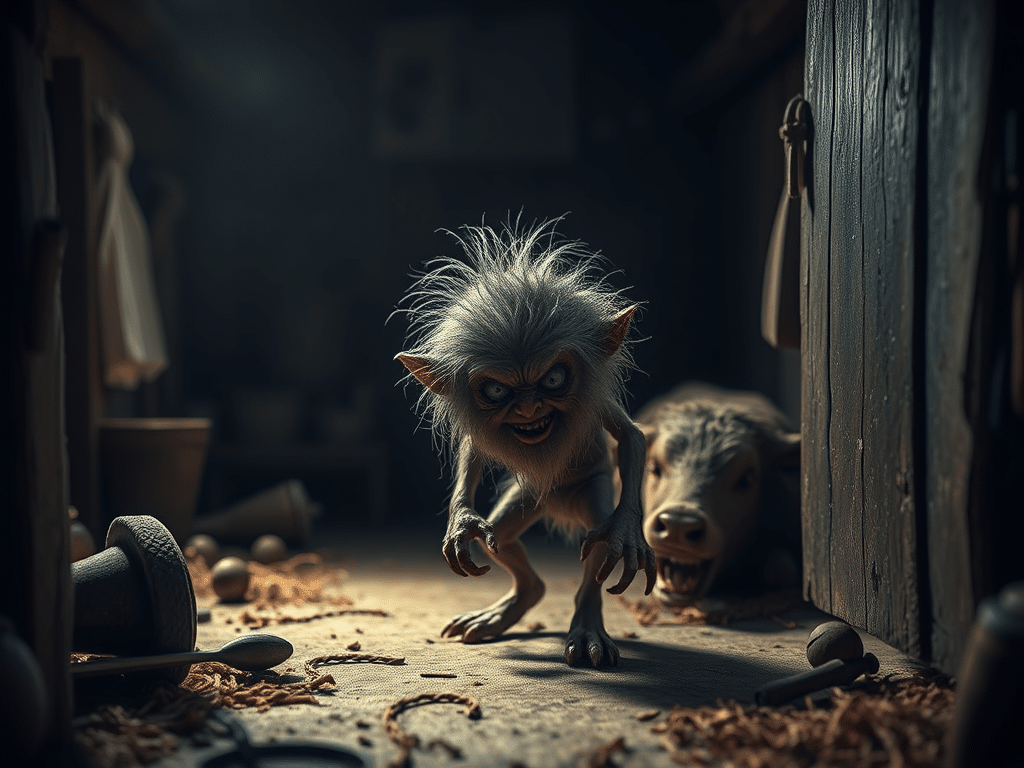
They are typically described as small, hairy, and grotesque humanoid figures, though many traditions depict them as little more than a barely visible dark shadow.
-
Their behavior centers on escalating domestic disruption, tormenting households through spoiled food, frightened livestock, and harassed children until life becomes unbearable.
-
Folk remedies included salt, horseshoes, and food offerings, with the golden rule being never to name the creature, though fleeing rarely worked as boggarts often followed their victims.
-
Scholars see boggarts as serving to explain misfortune in a pre-scientific world while also reflecting domestic anxiety and preserved pre-Christian beliefs about spirits of place.
-
The boggart’s cultural impact ranges from shaping rural English life to inspiring modern fantasy, most famously through J.K. Rowling’s globally popular reimagining in Harry Potter.

Introduction
Boggarts are among the most enduring and fascinating creatures in British and Northern European folklore, haunting the imaginations of rural communities for centuries and persisting into modern popular culture with remarkable tenacity. Unlike many mythological creatures that occupy grand, distant realms, boggarts have always been intimately connected to the everyday lives of ordinary people, lurking in homes, barns, and along lonely country lanes. Their strange combination of mischief, malice, and mystery has made them a subject of genuine cultural fascination, and understanding them reveals much about the fears, humor, and worldview of the communities that believed in them.
Historical Origins and Regional Distribution
The boggart was historically a much-feared bogey primarily associated with the Midlands and the north of England, with particular prominence in the “greater Lancashire” region during the nineteenth century (Young, 2014). Widdowson (1971) identified the boggart as one of several frightening figures belonging to the English tradition of folklore, grouping it alongside related terms such as “boggard,” “boggins,” and “boggle.” The word “bogle” is the oldest known name for a goblin in this tradition, and its etymological roots show that it is related to a larger family of supernatural names. Widdowson further noted that the special English form “boggle” suggests a linguistic relationship to “boggart,” with these terms potentially tracing back to the primitive form “bogge” and possibly connecting to the Welsh word “bug,” meaning ghost, bugbear, or hobgoblin. The historical literature suggests that boggart beliefs spread across place-names and local lore, indicating a durable, place-bound category rather than a uniformly standardized creature (Young, 2022a). This supports the idea that boggarts are a local ontological bundle instead of a type of creature that doesn’t change. The descriptions of the boggart vary considerably based on story and location.
Physical Appearance and Shapeshifting Abilities
The physical appearance of a boggart is notoriously difficult to pin down, partly because the creature is so deeply embedded in oral tradition, where descriptions naturally varied from region to region. In many accounts from Yorkshire and Lancashire, boggarts are described as small, hairy, and grotesque humanoid figures, roughly the size of a child but covered in coarse, matted fur with disproportionately long fingers and sharp, clawed nails. Their faces are frequently said to be twisted and unsettling, featuring wide mouths filled with uneven teeth, sunken eyes that gleam in the dark, and an overall impression of something just resembling a human being. Some traditions describe them as shapeless or barely visible, appearing only as a dark, shambling silhouette at the edge of one’s vision, which speaks to the way folklore often leaves the most frightening details deliberately vague. In the Harry Potter universe created by J.K. Rowling, the boggart was famously reimagined as a shapeshifting creature that assumes the form of whatever the observer fears most, a brilliant literary interpretation that captures the deeply personal and psychological terror that traditional boggarts were always meant to evoke (Rowling, 1999).
The physical characteristics attributed to boggarts varied considerably across accounts, reflecting the creature’s association with shape-shifting and transformation. Houlbrook (2017) detailed multiple nineteenth-century folktales from Boggart Hole Clough, an urban park in Manchester, which described the creature variously as a “strange elf,” a “bargaist,” and a shape-shifter that assumed the form of a cow. This multiplicity of forms contributed to the boggart’s fearsome reputation, as communities could never be certain what appearance the creature might take.
In terms of behavior, boggarts are primarily defined by their disruptive, malicious mischief, which distinguishes them from the merely playful brownie or hobgoblin. A boggart attached to a household would reportedly sour milk overnight, tangle hair, pinch sleeping children, knock objects off shelves, hide tools, and cause animals in the barn to behave erratically and with uncharacteristic fear. What makes boggart behavior particularly notable in the folklore record is its escalating nature—a boggart rarely starts with its worst offenses but instead begins with small annoyances before gradually intensifying its torments if ignored or provoked. Some accounts describe boggarts as malevolent entities that could drag people from their beds, cause illness in livestock, and make life so unbearable that entire families were driven from their homes. Boggarts associated with outdoor spaces, sometimes called “lane boggarts” or “field boggarts,” were said to mislead travelers on dark roads, causing them to wander in circles or stumble into bogs and ditches, behaviors that closely parallel descriptions of will-o’-the-wisps and other mischievous nature spirits across European traditions.
Managing a boggart was a delicate and often thankless task, and the folklore surrounding methods of control reflects how seriously communities took the threat. One of the most widely documented pieces of advice was to never give a boggart a name, as doing so was believed to permanently bind it to a place or person and dramatically worsen its behavior—a belief that likely reflects older magical thinking about the power of names to fix and solidify supernatural relationships. Salt was a commonly recommended deterrent, as it was across a wide range of European supernatural traditions, and horseshoes hung above doorways were believed to repel boggarts alongside other malevolent spirits. In some traditions, leaving a small gift of food—typically milk or bread—was thought to appease a household boggart temporarily, though this practice blurred the line between managing a boggart and negotiating with it. The most drastic and frequently told piece of advice in the folklore record was simply to flee: many tales describe families packing their belongings and leaving a boggart-infested home entirely, only to discover that the boggart had somehow traveled with them, a deeply unsettling narrative motif that emphasizes the creature’s persistent, almost personal nature of attachment.

Scholarly Interpretations and Cross-Cultural Parallels
Scholars and folklorists have put forth numerous persuasive theories to elucidate the boggart tradition and its implications for the societies that upheld it. Some researchers, including those working in the tradition of functionalist folklore analysis, argue that boggart stories served a practical social purpose by providing explanations for misfortunes—spoiled food, ill animals, bad harvests, household accidents—that otherwise had no clear cause in a pre-scientific world. The boggart effectively acted as a communal scapegoat, a named source of blame that helped people process bad luck without fracturing social relationships or blaming neighbors. Other analysts have read boggarts through a psychological lens, noting that the creature’s physical proximity to humans and its habit of tormenting people in domestic spaces makes it an almost perfect externalization of domestic anxiety and the fear of the home as an unsafe space. There is also a compelling argument that the boggart tradition preserves very old pre-Christian spiritual beliefs about genius loci—the spirits of place—and that what were once considered localized nature spirits were gradually reinterpreted as malevolent troublemakers as Christian frameworks reshaped how supernatural beings were morally categorized. The regional specificity of boggart folklore, with distinct traditions concentrated especially in the north of England, further supports the idea that these creatures were deeply tied to local identity and landscape.
Understanding boggart lore requires recognition of a fundamental division in how these creatures were categorized and understood. Young (2014) identified two primary types: domestic boggarts associated with houses and country boggarts associated with rural sites such as bridges, woods, and lanes. This distinction reflects how communities conceptualized supernatural threats as either intimate household presences or dangers lurking in the landscape beyond domestic spaces. The domestic boggart tradition is illustrated in the tale recounted by Harland (1882), which describes a localized version of a story about a sprite following a family attempting to move away from it. This narrative, which Harland noted shares characteristics with tales of Irish sprites and Scotch brownies, demonstrates the boggart’s persistent and troublesome nature within household contexts. Harland observed that almost every old house or hall in Lancashire claimed the distinction of having a ghost or boggart, with various kinds including lubber-fiends and arch-boggarts.
Studies of chthonic creatures and death personifications in other cultures (Khakass lizard, Mansi forest man, Armenian and Slavic demonologies) demonstrate how diverse cultures encode fear, boundary violations, or the underworld in animal or humanoid forms, often tied to place-based beliefs and rituals. These works illustrate methodological and conceptual parallels for understanding boggarts as boundary-crossing entities that inhabit liminal spaces (gates, doors, roads) in folklore and ritual practice (Burnakov, 2021; Панченко, 2021; Burnakov, 2019; Sahakyan, 2021). The broader folklore encyclopedia and cross-cultural surveys emphasize that folklore routinely uses animal and hybrid figures to encode social values, dangers, and moral lessons, which is conceptually compatible with boggart studies that emphasize variability and locality rather than a fixed taxonomy (Green, 2010; Belova & Petrukhin, 2007).
Cultural Impact and Modern Adaptations
The cultural impact of boggarts, both historically and in contemporary times, has been surprisingly broad and meaningful. In historical terms, the boggart shaped the daily behaviors and anxieties of rural English communities for generations, influencing everything from how people named their children to how they designed and maintained their homes, and many English place names—Boggart Hole Clough in Manchester being a well-known example—preserve the creature’s presence in the landscape even today. The tradition also fed into the broader ecosystem of British children’s literature and ghost stories, contributing to a rich heritage of domestic supernatural horror that includes everything from Victorian ghost tales to modern horror fiction. J.K. Rowling’s interpretation in the Harry Potter series brought the boggart to a global audience in the 1990s and 2000s, and her reimagining as a fear-embodying shapeshifter arguably deepened public engagement with the original folklore tradition rather than replacing it, inspiring many readers to seek the older folk accounts. The boggart also continues to appear in fantasy literature, tabletop role-playing games, and modern horror, maintaining a creative vitality that few folkloric creatures can match.
Place-names provide crucial evidence for understanding how boggarts were integrated into the physical and mental landscapes of northern England. Harland (1882) explained the term “Boggart Hole” as meaning a hollow haunted by a bar-gheist or gate-ghost, describing a specific location in Lancashire known as “Boggart Hole Clough.” Young (2014) examined these boggart place-names systematically, noting that almost every example of a “Boggart Hole” is located close to water and in or on the edge of a narrow, steep, often wooded valley. In Lancashire, such geographical features were typically called “cloughs,” creating the characteristic combination seen in names like Boggart Hole Clough. This strong link between boggart locations and certain types of land shows that people believed some areas were more likely to have supernatural beings, possibly because they were on the edge between farmed and wild land or because they seemed dangerous and mysterious.
The transition of the boggart from a feared supernatural entity to a cultural heritage symbol represents a significant shift in how communities engage with folkloric traditions. Houlbrook (2017) illustrated how the boggart figure and its associated traditions have been adapted and recontextualized in the twenty-first century through commercial uses, park visitor information, and local school projects at Boggart Hole Clough. This transformation demonstrates folklore’s dynamic nature, as creatures once invoked to explain mysterious occurrences or frighten children into obedience become sources of local pride and educational opportunity.
Perhaps the most prominent modern reinterpretation of the boggart appears in contemporary fantasy literature. Hartmann (2017) explored the boggart’s appearance in J.K. Rowling’s Harry Potter and the Prisoner of Azkaban, examining how Rowling adapted traditional British folklore for her fictional wizarding world. The study detailed the boggart’s role in the novel, including its habits and the method by which students at Hogwarts learn to defeat it. Hartmann’s comparison of Rowling’s boggart to versions found in British folktales highlighted significant differences, particularly regarding the prominence of shape-shifting abilities. While shape-shifting appeared in traditional accounts, Rowling elevated this characteristic to the creature’s defining feature, with her boggart assuming the form of whatever its victim fears most. This adaptation demonstrates how folkloric elements can be selectively emphasized and transformed to serve narrative purposes while maintaining recognizable connections to source traditions.
Conclusion
Ultimately, the boggart stands as a remarkably resilient piece of cultural mythology that has survived and adapted across centuries, shifting from a rural folk belief into a globally recognized supernatural archetype without losing its essential character. What makes the boggart so enduring is perhaps its fundamental relatability—it is a creature of the home, of the familiar, of the small and daily disturbances that unsettle ordinary life, and in that sense it speaks to anxieties that have never fully disappeared. Whether encountered in a seventeenth-century Yorkshire farmhouse or on the pages of a twenty-first-century fantasy novel, the boggart remains a powerful symbol of the uncanny, the disruptive, and the mischievously malevolent forces that humans have always suspected lurk just at the edges of their comfortable, domestic lives.
References
Belova, O., & Petrukhin, V. (2007). «Kurica ne ptica …» Demonologičeskaja ornitologija v krosskul’turnom prostranstve [Demonological ornithology in cross-cultural space]. Studia Mythologica Slavica, 10, 197–206. https://doi.org/10.3986/sms.v10i0.1711
Burnakov, V. A. (2019). The image of a lizard in folklore and rituals of the Khakass (late 19th – mid 20th century). Vestnik NSU Series: History and Philology, 18(5), 166–177. https://doi.org/10.25205/1818-7919-2019-18-5-166-177
Burnakov, V. A. (2021). The snake and its chthonic essence in traditional beliefs, language and folklore of the Khakass. Vestnik NSU Series: History and Philology, 20(5), 142–153. https://doi.org/10.25205/1818-7919-2021-20-5-142-153
Green, T. A. (Ed.). (2010). Folklore: An encyclopedia of beliefs, customs, tales, music, and art. Bloomsbury. https://doi.org/10.5040/9798400652103
Harland, J. (Ed.). (1882). Lancashire folk-lore: Illustrative of the superstitious beliefs & practices, local customs & usages of the people of the County Palatine. J. Heywood.
Hartmann, L. (2017). The black dog and the boggart: Fantastic beasts in Joanne K. Rowling’s Harry Potter and the Prisoner of Azkaban and where to find them in mythology and traditional folklore. Wissenschaftliche Beiträge aus dem Tectum Verlag, 41.
Houlbrook, C. (2017). The suburban boggart: Folklore of an inner-city park. Gramarye: The Journal of the Sussex Centre for Folklore, Fairy Tales and Fantasy, 11, 19–32.
Панченко, Л. Н. (2021). Персонажная структура мансийского фольклора: Лесной мужчина Мисхум [Character structure of Mansi folklore: Forest man Miskhum]. Ежегодник финно-угорских исследований, 15(1), 60–71. https://doi.org/10.35634/2224-9443-2021-15-1-60-71
Rowling, J. K. (1999). Harry Potter and the prisoner of Azkaban. Scholastic.
Sahakyan, H. A. (2021). Characters of legends about a demon harming potential in Armenian, South Slavian traditions and in the author’s text of A. Remizov. Studies in Theory of Literary Plot and Narratology, 16(2), 90–102. https://doi.org/10.25205/2410-7883-2021-2-90-102
Widdowson, J. D. A. (1971). The bogeyman: Some preliminary observations on frightening figures. Folklore, 82(2), 99–115.
Young, S. (2014). What is a boggart hole? Nomina, 37, 73–107.
Young, S. (2022a). The boggart: Folklore, history, place-names and dialect. University of Exeter Press. https://doi.org/10.47788/kzlh9484
Young, S. (2022b). The boggart sourcebook: Texts and memories for the study of the British supernatural. University of Exeter Press. https://doi.org/10.47788/qxua4856


Leave a Reply