Amethyst Dragons: Key Points
-
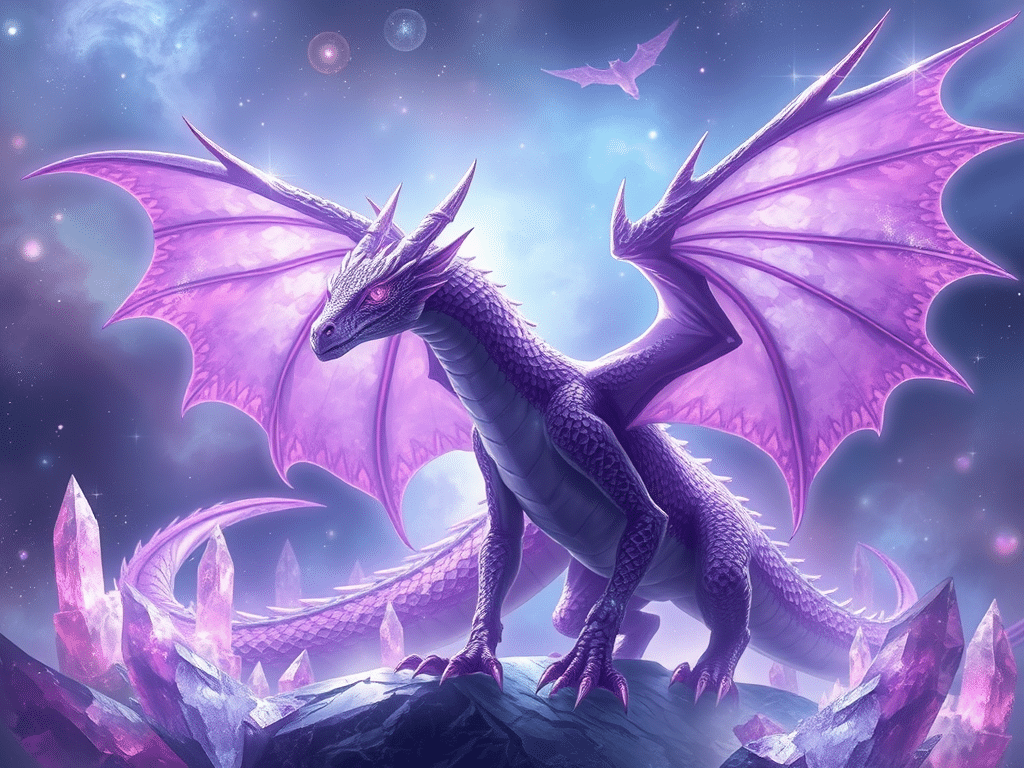
Amethyst dragons have translucent purple crystalline scales that shimmer like gemstones, with semi-transparent wings and luminescent eyes.
-
These dragons are philosophical creatures driven by curiosity and knowledge rather than greed, maintaining neutral alignment and preferring solitary contemplation.
-
They differ from other dragons through highly developed psionic abilities and motivations based on intellectual pursuit rather than moral convictions.
-
The Astral Plane serves as their primary home, a timeless realm where they build crystalline lairs from solidified thought-matter.
-
Their planar connection grants unique psionic powers, including consciousness projection, thought reading, and enhanced planar travel abilities.
-
First appearing in 1970s D&D supplements, they were revived in Fifth Edition’s Fizban’s Treasury of Dragons (2021) with updated psionic mechanics.

Introduction
In fantasy stories, especially those set in tabletop role-playing games, amethyst dragons are some of the most mysterious and intriguing animals. These magnificent beings have a special place in draconic mythology and orders, named for the way their purple crystalline scales shine from the inside. Aside from their more well-known chromatic (colorful) and metallic (shiny) relatives, amethyst dragons are a third type of dragon that has fascinated players and writers for many years. Because they are mysterious, have strong abilities, and live in strange places, they are fascinating to study and learn more about.
Physical Characteristics and Behavior
The beautiful amethyst dragon gets its name from the valuable stone that shapes it, and its scales closely resemble the gemstone. Their bodies are covered in clear purple scales that range in color from light lavender to deep violet. These scales often look like they have swirling levels of color that change depending on the lighting. These scales look like they have many faces because they are crystal-like and reflect and bend light in beautiful ways. The dragon’s eyes usually have an inner glow that is said to have a hypnotic effect that can stop people in their tracks. Compared to dragons that are bigger, they tend to have sleeker, more elegant bodies. Their graceful lines and shapes give the impression that they are both strong and quick. Their wing membranes often look partly see-through because they have deeper purple veins going through them, like a gemstone’s insides.
Amethyst dragons are known for acting in a philosophical and introspective way, which makes them different from other dragon types that are more violent or want to get things. They are very thoughtful and reflective beings who often meditate or think about big ideas and secrets in the universe for decades at a time. These dragons like to be alone, so they build their homes in places where they won’t be bothered while they work on their intellectual projects. Even though amethyst dragons like to be alone, they are not naturally hostile toward other intelligent beings. They may talk to people who approach them with respect and intellectual curiosity. They are very impartial when it comes to moral and ethical issues, and they watch conflicts and events with a detached interest instead of passionate engagement. Despite their calm demeanor, they can become extremely dangerous enemies when their studies or areas come under threat.
The Astral Plane
The link between amethyst dragons and the Astral Plane is a key part of their uniqueness. The Astral Plane is where these beings live. It is a place of pure thought and psychic energy where time moves differently and matter is in different states. Because amethyst dragons are so thoughtful and psychic, this environment is ideal for them. It lets them live in a place where mental strength is just as important as physical strength. Because the Astral Plane, a dimension that exists outside of time, is timeless, amethyst dragons can study and meditate for a very long time, much longer than they could on the Material Plane. They can gain a lot of information and philosophical insights over what seems like endless time. Their homes on the Astral Plane are usually made up of crystal formations or buildings made from thought-matter that has solidified. Such behavior shows that they are gemstones and that they are skilled with psionic energy. The dragons move through this silvery void with ease. Their bodies have changed to make it possible for them to live easily in a place where gravity operates differently and basic needs like eating and sleeping are unnecessary.
Amethyst dragons can connect to the Astral Plane, allowing them to see things and wield powers that dragons confined to the material world cannot easily comprehend. These dragons have psionic skills that let them change reality in subtle but profound ways. They inhabit a realm where thoughts transform into tangible entities, blurring the boundaries between mind and matter. Their awareness can be sent over very long distances, they can see what other beings are thinking, and they can even make temporary structures out of pure mental energy. The Astral Plane is also a hub connecting different worlds. Because of this, amethyst dragons have a special understanding of the geography of other worlds and can easily move between them. Because they spend so much time in this timeless world, they often don’t care about the problems of mortals and look at the short lives of people on the material plane with a mix of philosophical distance and interest. When amethyst dragons do build homes on the Material Plane, they always pick places that have strong ties to the Astral Plane, which is a dimension of existence that connects different realms, like old psychic sites or places where the walls between the planes get thinner.

Differences from Other Dragons and RPG History
There are a few key differences between amethyst dragons and other types of dragons that show how special they are in the world of dragons. Unlike chromatic dragons like red or black dragons, which tend to be evil and driven by greed, cruelty, or dominance, amethyst dragons take a neutral stance and are inspired by learning and curiosity. They differ from metallic dragons like gold or silver dragons because they lack the noble traits and desire to actively help human races that those dragons do. The mental abilities of amethyst dragons are much more advanced than those of most other dragon species. These abilities give them mind powers that go beyond the usual breath weapons and spellcasting skills of their kin. They also have unique habitat tastes. Instead of mountains, forests, or oceans, which are what most dragons like, they like the Astral Plane and places that are strongly connected to psionic energy. Compared to gold dragons’ thick, metal armor or red dragons’ tough, rubbery hide, their scales are made of crystals, which makes them less vulnerable.
Role-playing games have had amethyst dragons for a long time. They were first introduced as a gem dragon in early versions of Dungeons & Dragons. There was an original Dungeons & Dragons supplement called Dungeons & Dragons Supplement IV: Eldritch Wizardry that came out in the mid-1970s. Later versions added to and improved upon them. Advanced Dungeons & Dragons gave gem dragons, like amethyst dragons, much more depth. They were shown to be neutral dragons with strong psionic powers who lived mostly on the Astral Plane. Several extras and monster books included these monsters during Second Edition AD&D, solidifying their place in the game’s world. When the Third Edition came out, gem dragons, like amethyst dragons, got more changes to how they worked and more information about their history, but they were not as important in the core rulebooks. In the fourth edition, they got new jobs and changed their abilities to fit the new way the universe was set up. When Fizban’s Treasury of Dragons came out in 2021 for Fifth Edition, it brought amethyst dragons and their gem dragon relatives back to life for a whole new generation of players. The new story and rules stressed their psionic nature and link to the Far Realm.
Conclusion
When used in fantasy role-playing, amethyst dragons are an interesting mix of dragon power, psionic abilities, and philosophical thought. Their unique crystalline look makes them physically stand out from all other dragon types. Their neutral alignment and intellectual pursuits also make them intriguing characters for stories that go beyond the usual dragon encounter. The fact that these dragons have been used in many different versions of role-playing games shows how popular they are and how easily the idea can be changed to fit new game systems and worlds. Amethyst dragons continue to add to the rich tapestry of fantasy games, whether they are mysterious quest givers, fearsome guardians of old knowledge, or complex bad guys with reasons other than greed or malice. Their presence reminds both players and game masters that dragons don’t have to be simply good or evil and that the most intriguing encounters are often with creatures whose goals and points of view are very different from our own.
References
Adult amethyst dragon. (n.d.). 5etools. Retrieved March 2, 2026, from https://5e.tools/bestiary/adult-amethyst-dragon-ftd.html
Amethyst dragon. (n.d.). Forgotten Realms Wiki. Retrieved March 2, 2026, from https://forgottenrealms.fandom.com/wiki/Amethyst_dragon
Amethyst dragon. (n.d.). World Anvil. Retrieved March 2, 2026, from https://www.worldanvil.com/w/forgotten-realms-djverne12/a/amethyst-dragon-species
Amethyst dragon (5e). (2024, March 5). Dungeons and Dragons Wiki. Retrieved March 2, 2026, from https://dnd-wiki.org/wiki/Amethyst_Dragon_(5e)
Gygax, G., & Blume, B. (1976). Dungeons & Dragons supplement IV: Eldritch wizardry. TSR, Inc.
Mearls, M., & Crawford, J. (2014). Dungeons & Dragons player’s handbook (5th ed.). Wizards of the Coast.
Perkins, C., Wyatt, J., & Williams, S. (2008). Dungeons & Dragons monster manual (4th ed.). Wizards of the Coast.
Wizards of the Coast. (2000). Dungeons & Dragons monster manual (3rd ed.). Wizards of the Coast.
Wizards of the Coast. (1989). Advanced Dungeons & Dragons monstrous compendium (2nd ed.). TSR, Inc.
Wyatt, J., Perkins, C., & Haeck, J. (2021). Fizban’s treasury of dragons. Wizards of the Coast.


Leave a Reply