Farafra Desert Haunting: Key Points
-
The Farafra Desert is a remote white chalk landscape in Egypt’s Western Desert, known for its otherworldly formations and reputation as Pharaoh Akhenaten’s haunting ground.
-
Akhenaten reigned around 1380-1336 BC and replaced Egyptian polytheism with worship of the sun disc Aten, but his successors systematically erased his legacy after his death.
-
Reported phenomena include vanishing supplies, anguished desert cries, sightings of an elongated figure, compass malfunctions, and unexplained electronic failures.
-
Believers theorize Akhenaten’s spirit wanders due to his cursed memory and destroyed legacy, with the mineral-rich landscape possibly recording traumatic historical energy.
-
Skeptics attribute reports to heat exhaustion hallucinations, desert animals, wind-created sounds, iron deposits affecting equipment, and psychological suggestion from knowing the legends.
-
The legend explores themes of power and erased history, with the desert’s isolation providing an ideal setting that continues to profoundly affect visitors regardless of explanation.

Introduction
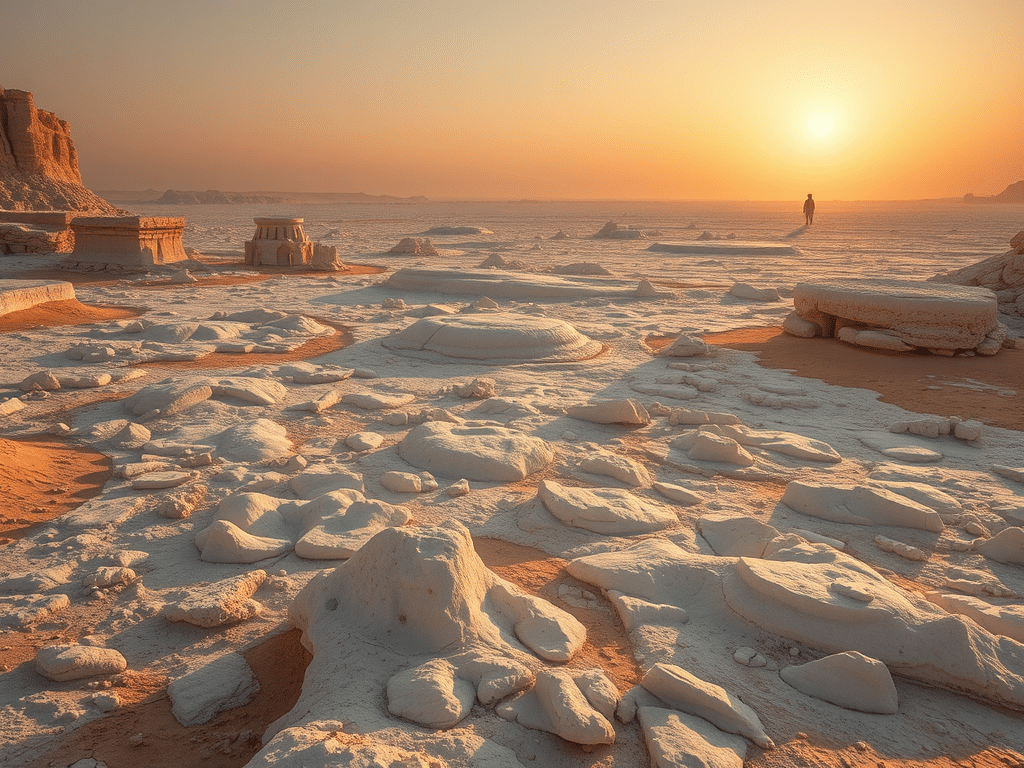
The Farafra Desert is in the Western Desert, about 370 miles southwest of Cairo. It is one of the most mysterious and beautiful places in Egypt. This remote oasis depression is about 980 square miles big and is known for its strange white chalk rock formations that shine in the hot desert sun. The landscape looks like it belongs on the moon, and both tourists and scientists are interested in it. Known for its stark natural beauty, the Farafra also bears a darker reputation as the haunting place of Pharaoh Akhenaten’s restless spirit. Bedouins, travelers, and researchers who go into its remote areas have recorded many supernatural events. Being very far away from everything else, being close to old Egyptian sites, and having many strange things happening there have made this already-mysterious desert a hub for people interested in Egypt’s supernatural history.
The Farafra Oasis is a geographically defined oasis in Egypt’s Western Desert. It is part of Egypt’s larger desert environment. Scholarly sources keep referring to this place as a unique desert environment within the Egyptian Western Desert. It is sometimes talked about in terms of its oasis system and paleoenvironmental setting (Barich, 2012). The Farafra Oasis is used as a starting point when talking about Egypt’s desert landscape and helps us understand how settlements and transportation networks moved through desert areas.
The Farafra Depression has scenery that is unlike any other in Egypt. Wind erosion has sculpted its bright white limestone and chalk formations into strange and fantastical shapes over thousands of years. The most famous thing about the area is White Desert National Park, where these chalk structures rise out of the sand like frozen ghosts. During the day, their pale surfaces make the deep blue sky almost blinding, and at night, they cast creepy shadows. Extremes of temperature are very common. In the summer, daytime temperatures often reach over 110 degrees Fahrenheit, and at night, they drop to almost freezing. The few plants that exist in the area are primarily tough desert species that have adapted to the harsh conditions. For example, there are acacia trees near water sources and many drought-resistant bushes. Few people live there, and most of them live in the small town of Farafra, where about 5,000 people live. Their families have lived in the haven for generations. There are long stretches of desert that separate this area from other settlements, making it very remote. Many tourists find the feeling of being alone to be both beautiful and unsettling.
Akhenaten’s Revolutionary Reign and Religious Transformation
Akhenaten was born around 1380 BC as Amenhotep IV. He became king of Egypt during the 18th Dynasty and started one of the biggest changes in religion and culture in history right away. In the first few years of his rule, he stopped worshiping Egypt’s traditional pantheon of gods and instead encouraged worship of only the Aten, the solar disc. This change is seen by many scholars as the start of the world’s first monotheistic faith. This major change affected politics as well as religion, as it pressured the Amun priests, who had become a threat to royal authority. Akhenaten started a religious change that was based on the Aten. He moved toward a form of solar monotheism that put less importance on traditional Theban gods and cults. It is this change in religion that makes Akhenaten’s rule unique and is at the heart of Amarna research (David, 2024; Dodson, 2012, 2019; Hartwig, 2025; Hodgkinson, 2017).
His old name was Amenhotep, which was a tribute to the god Amun. Akhenaten, which means “effective for the Aten,” was his new name. He also left Thebes, which was the usual capital, to build a new city called Akhetaten, which is now known as Amarna. During Akhenaten’s early years, the royal title changed to represent the political and religious changes that came with Atenism. The new titles and name change from Amenhotep IV to Akhenaten were a deliberate break from traditional titles and state ideology (Zapletniuk, 2018). This change in the king’s title is considered a sign of his unique role in the Aten cult and in changing the way the government works to fit with solar religion (David, 2024; Zapletniuk, 2018).
Egyptian art from that time shows him with a very strange body: an elongated skull, feminine features, a belly that sticks out, and thin limbs. This has sparked extensive speculation about his medical condition and the symbolic significance of these depictions. His rule lasted about seventeen years. He was married to the beautiful Nefertiti and had several daughters with her. The boy-king Tutankhamun was probably his son. Egypt’s traditional priests and nobles worked hard to erase his legacy after he died around 1336 BC. They destroyed his city, smashed his monuments, and tried to erase his name from historical records, calling him a heretic who had caused chaos in Egypt (Bhatia, 2022).
From a geographical and ecological perspective, the Farafra Desert helps us understand how desert environments affected ancient Egyptian political and religious plans, such as Akhenaten’s Amarna changes. Even though Farafra isn’t where most of the inscriptions and monuments from the Amarna period are found, the Amarna project required moving political and religious activities to a desert city and the area around it. People often talk about the Amarna urban project, which included Akhenaten’s creation of a new capital city in the desert, in terms of its urban planning, geography, and ideological signals (David, 2024; Dodson, 2012; Hartwig, 2025; Hodgkinson, 2017). So, places like Farafra in the desert are important for understanding how the geography of the desert affected state-level projects during the Amarna period.

Supernatural Phenomena and Theories of Explanation
The supernatural phenomena attributed to Akhenaten’s spirit in the Farafra Desert encompass a wide range of reported experiences that have been documented over decades by travelers, guides, and local Bedouin tribes (Theoldstone, n.d.). One of the most common things that people report is that goods mysteriously disappear from campsites. When travelers wake up, they find that food, water containers, or equipment are missing, even though there are no human or animal tracks in the sand nearby. Even when more than one person is present and keeping watch, items often disappear during brief moments when attention shifts.
Bedouin guides who travel through the area often say they hear screams of pain reverberating across the desert in the quiet hours before dawn. The sounds are clearly human, but they also have a surreal quality to them and seem to come from nowhere but the air itself. Some people say they saw a tall, elongated figure moving through the chalk formations at dusk. The figure’s shape looked a lot like the statues of Akhenaten, but when they got close, the figure disappeared. Compasses and GPS devices have been known to not work properly in some parts of the desert, either spinning around in circles or giving wrong readings that leave visitors confused and lost even when the sky is clear and landmarks can be seen (Ghost of the Farafra Desert, n.d.).
A lot of people on different expeditions have said they suddenly and strongly felt like they were being watched or followed, along with a deep sadness and anger that seemed to come from the environment itself. Strange mists or light anomalies that couldn’t be seen with the human eye can sometimes be seen in photos taken in the area. Electronic equipment, especially recording devices, often loses power or stops working for no apparent reason. Local folklore asserts that the priests who followed Akhenaten cursed his memory, rendering his spirit incapable of resting. People say that Akhenaten roams the desert, searching for his lost city and the religion he destroyed upon his death.
Theories that try to explain these strange events run from the supernatural to the scientific. Each theory offers a unique perspective on the events documented in the Farafra. Some supernatural believers say that Akhenaten’s spirit really haunts the area because his religious revolution was violently put down and his statues and memory were harmed. They say that such a terrible event in history could connect a spirit to the physical world. According to their reasoning, ancient Egyptian beliefs put a lot of value on keeping one’s name and memory alive for the afterlife. Erasing Akhenaten’s heritage would have resulted in eternal soul torment. Some paranormal researchers think that the high mineral content in chalk and limestone formations, especially quartz, might act as a natural recorder for emotional energy. The theory could lead to what parapsychologists call the “stone tape” phenomenon, in which traumatic events are imprinted on the environment and play back in certain situations. Critics argue that the events being reported can only occur in the desert, where individuals experience extreme isolation, high temperatures, and limited sensory input. These conditions are known to cause hallucinations, auditory illusions, and mental discomfort. They say that the missing supplies might have been taken by desert foxes, birds, or other scavengers that are active at night and leave few tracks in the windswept sand. The strange noises could have been the wind blowing through the chalk formations or the calls of desert animals that were distorted by the way the land sounds. There may be iron-rich deposits in the rocks that are causing the electromagnetic oddities. These deposits are known to mess up navigational equipment. According to psychological theories, the power of suggestion plays a big part. People who have heard the stories are more likely to see normal events through the lens of the supernatural. This is called confirmation bias. Cultural anthropologists say that ghost stories and supernatural beliefs about rulers who have died are common in many civilizations. These stories often serve social purposes, like keeping cultural memory alive, teaching moral lessons, or expressing worries about power, legacy, and what will happen if people question religious and social norms.
Cultural Memory and Lasting Legacy
There is no direct archaeological evidence that Akhenaten lived in the Farafra Desert, but the fact that he was exiled and condemned in history links him to that place. In old Egyptian religion, the Western Desert, which includes Farafra, stood for chaos and death. It was very different from the ordered, fertile lands along the Nile, which stood for life and divine order. Not long after Akhenaten died and his city at Amarna was left empty, his name was taken off lists of kings, his monuments were destroyed or defaced, and his successors, especially Horemheb, undid all of his religious changes. In ancient Egyptian society, this damnation, or condemnation of memory, was one of the worst punishments that could be given because it meant that the person would never live again in the afterlife. Some scholars think that Akhenaten’s mummy may have been taken from where it was buried and thrown away somewhere unknown, maybe in the desert, so that he could never live forever. For ancient Egyptians, the connection between Akhenaten, who questioned divine order, and the wild western desert would have been profound. This is why later stories about his traveling spirit ended up in such an unpleasant place. The Farafra is one of the most remote and otherworldly places in the Egyptian desert. This makes it a magnificent place for a legendary cursed pharaoh to live, since the landscape itself seems to exist outside of regular reality.
Modern studies of the Farafra phenomenon have had mixed results. While some researchers claim to have witnessed unexplainable events, others maintain that natural causes can only account for the reports. Several paranormal investigation teams have gone into the White Desert for the night to record any supernatural behavior they may have seen or heard. They have brought electromagnetic field detectors, thermal cameras, and audio recording devices with them. These investigations have recorded strange temperature changes, electromagnetic fields, and sounds. The investigators say these could be proof, but critics point out that this kind of equipment is notoriously sensitive to environmental factors and prone to false positives. Academic researchers and Egyptologists usually stay away from supernatural claims because they see them as folklore rather than historical fact. However, some do admit that these stories show how Akhenaten’s controversial rule has affected culture to this day. The Bedouin people who live in the area have a more nuanced view. They respect the desert and know that some of it is hard to explain, but they don’t fully support or reject supernatural theories. Tourists come to see the chalk formations’ natural beauty or the supernatural. Guides say that even lost visitors can have unsettling experiences in the deep desert that make them question their beliefs.
People attribute the haunting of the Farafra Desert to a complex combination of historical sorrow, cultural memory, extreme environmental conditions, and human psychology. Whether you believe that Akhenaten’s spirit really is haunting the area or think it is just a natural occurrence, the stories have deep meanings about power, religious belief, the short-lived nature of human accomplishments, and how far societies will go to get rid of people who question their beliefs. Akhenaten, who dared to change Egyptian religion and society to fit his ideas but had everything he built destroyed after he died, is a strong symbol of ambition, failure, and what it costs to go against the norm. The desert, with its stark beauty and harsh conditions, is a good setting for these kinds of stories because it seems magical by its very isolation and otherworldliness. People who visit the area today have to balance respecting local views, being skeptical of science, and their own personal experiences. They often find that the truth is somewhere between things that are easy to explain and things that are hard to understand. Although the stories of disappearing goods and strange noises may remain unproven, they persist as guides share them with travelers and as tales recounted by locals. There is no doubt that the Farafra Desert has a profound effect on people, whether it’s through real supernatural contact, psychological projection, or just the overwhelming sense of time and space that is typical of Egypt’s desert areas.
Conclusion
The story of Akhenaten’s cursed spirit wandering the Farafra Desert is an interesting mix of old history, cultural memory, and the way people like to give mysterious places tales that make sense. Stories about a heretic pharaoh who was sentenced to endless restlessness for his role in a religious revolution fit right in with the harsh beauty of the White Desert, with its ghostly chalk formations and extreme isolation. Skeptics can easily come up with natural explanations for the things that people have seen and heard, like animals in the desert or the psychological effects of living in harsh environments. But the fact that the same people have seen and heard these things repeatedly suggests that something deeply affects those who enter this place. The Farafra continues to amaze and frighten visitors, whether it’s the real ghost of Egypt’s most controversial pharaoh, the psychological weight of knowing that you stand in a landscape that has seen thousands of years of human history, or just your mind’s reaction to sensory deprivation and physical extremes. In the end, the story is about bigger issues like legacy, memory, and how societies remember or try to forget their most difficult historical figures. Akhenaten is always seen as a sign of what it takes to make big changes and how impossible it is to completely erase the past.
References
Barich, B. (2012). Farafra Oasis. https://doi.org/10.1002/9781444338386.wbeah15157
Bhatia, R. (2022, March 21). 10 allegedly haunted places you can visit in Egypt. TheTravel. https://www.thetravel.com/most-haunted-places-you-can-visit-in-egypt/
David, A. (2024). Contextualizing Akhenaten’s reliefs in the Israel Museum, Jerusalem and Hecht Museum, Haifa. Journal of the American Research Center in Egypt, 60(1). https://doi.org/10.5913/jarce.60.2024.a003
Dodson, A. (2012). Akhenaten (Amenhotep IV). https://doi.org/10.1002/9781444338386.wbeah15023
Dodson, A. (2019). Akhenaten (Amenhotep IV), 1–3. https://doi.org/10.1002/9781444338386.wbeah15023.pub2
Ghost of The Farafra Desert. (n.d.). In Rifqi Present Urban Legends Wiki. Retrieved March 3, 2026, from https://rifqi-present-urban-legends.fandom.com/wiki/Ghost_of_The_Farafra_Desert
Hartwig, M. (2025). Royal ideology and elite integration in Theban tombs as precursors to the Amarna period. Arts, 14(5), 125. https://doi.org/10.3390/arts14050125
Hodgkinson, A. (2017). Amarna: Urban manufacture of luxury items. https://doi.org/10.1093/oso/9780198803591.003.0010
Theoldstone. (n.d.). The White Desert, also called The Farafra Desert is a national park in Egypt known for its snow-white to cream coloured… [Tumblr post]. Tumblr. Retrieved March 3, 2026, from https://www.tumblr.com/theoldstone/166725292871/the-white-desert-also-called-the-farafra
Zapletniuk, O. (2018). Features of changes of Akhenaten’s titulary. Bulletin of Taras Shevchenko National University of Kyiv History, (136), 28–31. https://doi.org/10.17721/1728-2640.2018.136.1.05

Leave a Reply