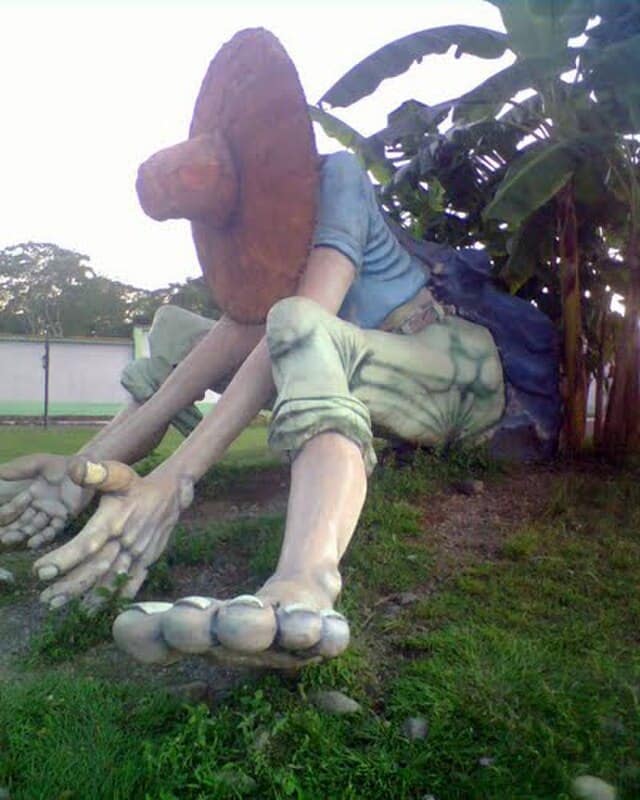
El Silbón: Key Points
-
El Silbón is a legendary Venezuelan ghost from the llanos region that serves as a moral lesson about family respect.
-
The story tells of a young man who murdered his father and was cursed to wander eternally carrying his father’s bones in a sack.
-
El Silbón appears as an impossibly tall, skeletal figure with hollow eyes and tattered clothing, carrying a sack of rattling bones.
-
His distinctive whistling of the musical scale sounds close when far and distant when near, and he targets those who disrespect families.
-
The legend reinforces family values and serves as a metaphor for the inescapable weight of guilt from terrible actions.
-
El Silbón remains important in Venezuelan culture, teaching children proper behavior and inspiring numerous artistic works throughout Latin America.

Introduction
The legend of El Silbón is one of Venezuela’s scariest and most long-lasting folk tales. It has been told for centuries in the llanos, or plains region, of the country. This ghostly figure is more than just a scary story for kids; it stands for the cultural values, moral lessons, and collective imagination of rural Venezuelan communities. El Silbón’s story has spread beyond its home region and become an important component of Latin American folklore. It has attracted the interest of historians, writers, and those who are interested in South America’s supernatural traditions.
Most of the time, the story of El Silbón starts with a sad act of patricide that happened in a moment of angry wrath. The most popular version of the story says that a spoiled young man from a rich family asked his father to make him a special feast of deer liver. When the father came back after hunting empty-handed, the son became very angry. The young man killed his own father in a fit of rage, and other versions of the story say that he cooked and ate his father’s body, which makes the story even more gruesome. When the boy’s grandfather found out about this terrible crime, he cursed his grandson, chained him to a stake, and whipped him before letting ravenous dogs chase him into the wilderness for the rest of his life. As a last punishment, the grandfather put the father’s bones in a sack that the son would have to carry for the rest of his life. This is how El Silbón was born, doomed to wander the earth as a tortured ghost paying for his terrible crime.
In local folklore, El Silbón is usually thought of as a masculine spirit who makes a hazardous whistle or spectral call. This is seen as a warning or sign. This falls into a larger group of ghosts or supernatural entities that folklore studies say are often used to impart moral or societal lessons (Banat et al., 2022; Sastrawati, 2019). The whistling theme serves as a unique sensory indicator in many regional retellings, acting as a discernible signal that facilitates the interpretation of events or actions within the narrative (Shibasaki et al., 2024; Banat et al., 2022).
Physical Description and Behavior
El Silbón is said to be a very tall, skeletal person who looks like a ghost traversing the fields and countryside at night. Witnesses say he can reach heights of six meters or more, and his thin form makes him look like he is towering over the landscape. However, some reports say his height changes or that he looks bent over from the weight of his burden. People say that he looks terrible, with empty eyes, pale or rotting skin, and an overall feeling of death and sorrow that follows him everywhere he goes. He wears the torn-up remains of what used to be nice clothes or, in some cases, the basic clothes of a peasant. Most noticeably, he carries a big sack on his back that is full of his father’s bones, which rattle and clank as he goes through the dark.
El Silbón’s demeanor and traits are just as unique as his looks, and his whistling is the most well-known part of his presence. People call him “The Whistler” because he whistles a tune made up of the musical notes do, re, mi, fa, sol, la, si (C, D, E, F, G, A, B). This creepy melody is both his signature and a warning to anyone who might meet him. The funny thing about his whistle is that it sounds close when he’s far away and far away when he’s close. This makes people who hear it confused and scared since they can’t tell if they’re in danger right immediately. People say that El Silbón goes after people who drink too much, cheat on their spouses, or treat their families badly, especially those who hit their spouses or don’t show their parents respect. This makes him a supernatural enforcer of moral behavior and respect for family.
In cross-cultural analysis, El Silbón exhibits characteristics akin to other regional ghost legends wherein the haunting serves educational purposes, intertwining the supernatural with moral instruction or societal repercussions (e.g., misconduct or familial or communal infractions) as examined in folklore ethnography and theory (Sulaiman & Karim, 2020; Leontis, 2020; Kusmana & Jaja, 2019). The academic research underscores that these entities are frequently integrated into the moral economy of the community, not just as terrifying figures but as enforcers of normative standards (Banat et al., 2022; Holle, 2005; Dewi & Agung, 2023).

Theories and Cultural Impact
Different hypotheses have come forth to explain where the El Silbón mythology came from and why it has stayed alive in Venezuelan and Latin American society. Some folklorists think that the story is meant to teach people to respect their parents and traditional family values. They see the main character’s harsh punishment as a warning against being disobedient and ungrateful. The story may also show how people worried about class conflicts and the moral decay that can come with money and privilege. The initial sinner is generally shown as a spoiled upper-class person whose sense of entitlement led to his downfall. Some people think that El Silbón is a symbol of group guilt and the mental weight of wrongdoing. The fact that he is always walking and carrying bones shows how awful things can never be forgotten or escaped, and they will haunt the person who did them forever.
The El Silbón motif is most thoroughly recorded in Andean-Caribbean-adjacent cultures (Venezuela and parts of Colombia) as a spectral harbinger associated with starvation, guilt, or familial wrongdoing. This regional breadth corresponds with overarching folkloric trends in which revenant figures serve as social commentators throughout Latin America, maintaining communal boundaries and norms (Banat et al., 2022; Sulaiman & Karim, 2020; Kusmana & Jaja, 2019). Some sources place El Silbón within a broader context of pan-Latin American or Iberian-influenced haunting narratives, employing the supernatural to convey personal or community memory, a typical approach in Latin American folklore studies. The academic agreement recognizes regional particularities (local name variants, whistle motifs, and moral subtexts) while affirming the common structural function of these spirits in folklore (Banat et al., 2022; Sulaiman & Karim, 2020; Kusmana & Jaja, 2019).
El Silbón serves as a pedagogical symbol representing the repercussions of moral transgressions, especially within familial or communal settings. This corresponds with the overarching assertion in folklore studies that ghost narratives frequently include normative messages and societal values for audiences across several generations (Kusumohastuti, 2023; Shibasaki et al., 2023; Sulaiman & Karim, 2020). The ghost story serves a genuine function.
The story of El Silbón has had a big effect on Venezuelan culture and still affects how people in the llanos region think about their link with the supernatural and moral behavior. Many parents and grandparents still use El Silbón’s name to teach their kids to respect their elders and act properly. This makes the tale a part of how many people raise their kids. The story has inspired many works of art, such as books, movies, music, and paintings. This shows that it is still a powerful source of cultural expression and creative inspiration. El Silbón has become well-known not just in Venezuela but also in Latin America and among Spanish-speaking communities around the world. It is part of the rich tapestry of folklore that binds people from different cultures via shared stories of morality, justice, and the results of people’s deeds.
Folklore about people like El Silbón can be used to establish local identity and boost tourism. In these cases, stories become cultural capital for place branding and instructive storytelling. Research on folklore tourism explicitly examines how tales can enhance locations, educate visitors, and safeguard local knowledge, while also recognizing the potential commercialization of sacred or ethically significant narratives (Pratiwi et al., 2023; Wahyani et al., 2022). This is important for places where El Silbón is still a living oral tradition and could be a cultural asset.
From a practical perspective, El Silbón can be examined as a localization of “ghost folklore” that intersects with modern cultural economies—namely, education, tourism, and cultural heritage. Scholarly research on folklore in tourism underscores that such traditions can be utilized to enhance comprehension and enjoyment of local culture, while simultaneously cautioning against potential over-commercialization. This dual option is significant for communities that maintain El Silbón tales (Pratiwi et al., 2023; Wahyani et al., 2022).
Conclusion
El Silbón is still one of the most interesting characters in Latin American folklore. He is a ghostly reminder of how important family ties and moral behavior are. The story keeps changing as people repeat it again and again, but the basic point stays the same: betraying those who love and care for us can have horrible effects. El Silbón is a fascinating story that has been told for generations and shows how stories may change cultural norms and pass on wisdom.
References
Banat, B., Yahya, H., Ahmad, B., & Halabiyah, F. (2022). Popular Beliefs in the Palestinian Society: An Analytic Study. Open Journal of Social Sciences, 10(09), 340-367. https://doi.org/10.4236/jss.2022.109022
Dewi, N., & Agung, I. (2023). An Analysis of Main Character in the Book “Bawang Merah and Bawang Putih”. Humanitatis Journal of Language and Literature, 9(2), 285-294. https://doi.org/10.30812/humanitatis.v9i2.2380
Holle, K. (2005). Myth and Legend in Family Therapy: Maintaining the Distinction Between the Sacred and Secular in Family Process. Contemporary Family Therapy, 27(4), 507-519. https://doi.org/10.1007/s10591-005-8236-8
Kusmana, S., & Jaja, J. (2019). Study of Legends and Folklores as Efforts to Develop Instructional Materials in High Schools. https://doi.org/10.2991/isseh-18.2019.54
Kusumohastuti, F. (2023). Revealing the historical side of the Yogyakarta Wotgaleh Tomb: Mataram Prince Jaka Umbaran. Gema Wiralodra, 14(3), 1292-1300. https://doi.org/10.31943/gw.v14i3.519
Leontis, A. (2020). Introduction: Mapping the Territory. 1-14. https://doi.org/10.7591/9781501737015-004
Pratiwi, D., Firmansyah, O., Hawa, A., Gayatri, S., & Muhajir, A. (2023). Utilization of Folklore in Optimizing Ngarai Sianok Tourist Destination in Bukittinggi West Sumatra Indonesia. Aphorisme Journal of Arabic Language Literature and Education, 4(2), 60-70. https://doi.org/10.37680/aphorisme.v4i2.3774
Sastrawati, I. (2019). The Effect of Using Local Wisdom-Based Reading Materials on the Students’ Reading Comprehension. Journal of Advanced English Studies, 2(1), 8. https://doi.org/10.47354/jaes.v2i1.49
Shibasaki, S., Nakadai, R., & Nakawake, Y. (2023). Biogeographical distributions of trickster animals. https://doi.org/10.32942/x2q305
Shibasaki, S., Nakadai, R., & Nakawake, Y. (2024). Biogeographical distributions of trickster animals. Royal Society Open Science, 11(5). https://doi.org/10.1098/rsos.231577
Sulaiman, S., & Karim, S. (2020). The Traces Investigation of Oral Literature As A Cultural Identity on Madura Island. https://doi.org/10.4108/eai.12-10-2019.2292224
Wahyani, A., Ma’ruf, A., Rahmawati, F., Prastiwi, Y., & Rahmawati, L. (2022). Content Analysis of Nationalism Character Education in Wonogiri Folklore as An Elementary School Literacy Media. Journal of Innovation in Educational and Cultural Research, 3(3), 499-507. https://doi.org/10.46843/jiecr.v3i3.224



Leave a Reply