Purple Lady Ghosts: Key Points
-
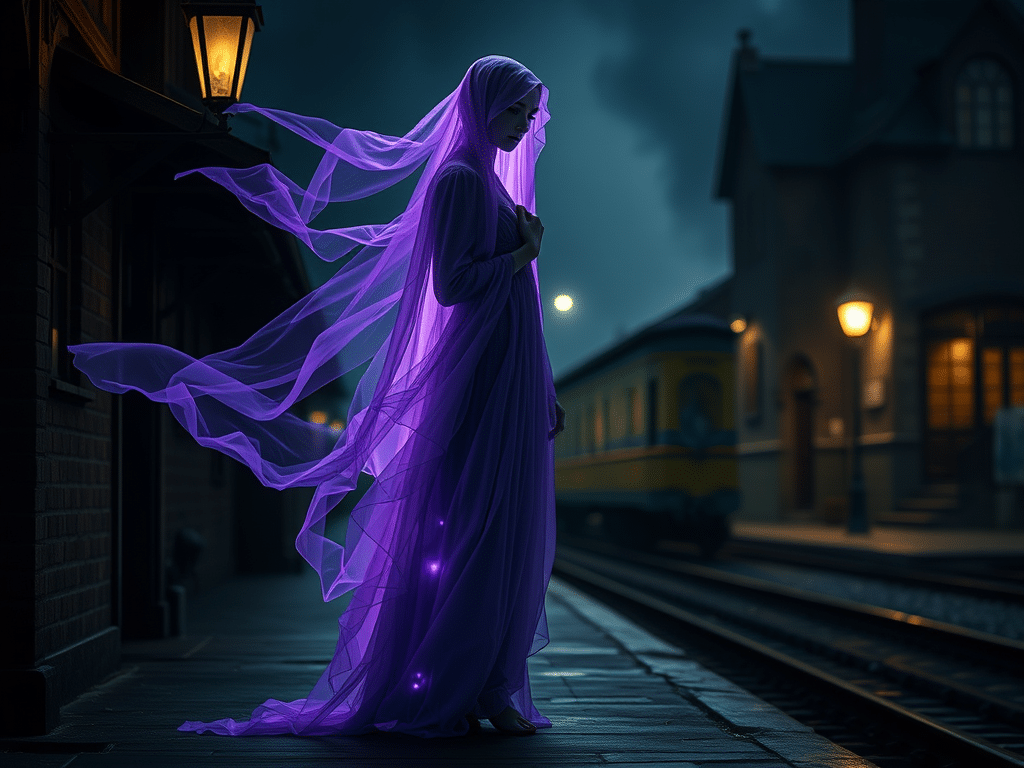
Purple lady ghosts are distinctive spectral figures in violet or lavender period gowns with an ethereal, pulsing luminescence.
-
These entities display purposeful behavior, appearing at specific times and places, often emanating feelings of melancholy and seeming to wait for someone.
-
The Purple Lady of the Rio Grande Train Depot is believed to be a woman who died waiting for a lover who never arrived.
-
Documented since the 1920s and connected to a tragic event, three old ladies, including one in purple, haunt the Borgvattnet Vicarage in Sweden.
-
Theories range from energy frequencies to optical illusions, while these legends significantly impact tourism and serve cultural functions in preserving historical memory.

Introduction
One of the most unique and lovely things about ghost stories is the purple lady ghosts. Both believers and non-believers have shown interest in these ghost stories for hundreds of years. People from all around the world have seen these ghostly figures throughout history. People recognize them by their flowing clothes and unusual violet or lavender colors. The color of purple lady ghosts is peculiar, and they do different things when they show up. Such behavior is what makes them different from white or gray ghosts. By studying these things, we can learn how cultural concepts, historical events, and human psychology all work together to create legends that still have an impact on popular culture and regional customs.
Ghosts, hauntings, and poltergeist phenomena have a long history in folklore, psychology, anthropology, and cultural studies. Both conventional and contemporary studies classify haunt-type encounters as experiential, narrative, and sociocultural phenomena. Dagnall et al. (2020) clarify that environmental and contextual factors influence haunt-type experiences, whereas reviews in environmental psychology focus on ambient variables and perceptual susceptibilities in the documentation of these experiences. This foundation enables the analysis of a gendered category of haunt tales, referred to as “purple ladies,” within the framework of extensive ghost folklore and media representations (Janeček, 2023; Kozlovic, 2017).
Physical Characteristics and Behavioral Patterns
Many stories have quite similar ways of describing how purple lady ghosts look. This could suggest that there is either a strong cultural trend or an actual paranormal phenomenon. People who experience these ghosts typically remark that they seem like women from the past, either clearly or somewhat unclear. They sometimes wear Victorian or Edwardian outfits that look like they are glittering with varied shades of purple, from light lavender to deep violet. One thing that sets spectral forms apart from other types of ghosts is that they usually have a ghostly glow. Some people say that the purple color seems to alter in brightness or pulse depending on how they feel or how bright it is. There are many accounts of how their garments move and flow like they are moving on their own, without any wind or strength. They feel like they’re in another universe when such an event happens.
The way purple lady ghosts act is usually extremely different from the way ghosts do in movies and on TV. They often act deliberately and sometimes talk to others, leading to surprising interactions that differ significantly from typical ghost portrayals in popular media. People often say that these ghosts appear at certain times and in certain places. This information reveals a persistent haunting pattern in which the ghost relives certain activities or events from their life on Earth. But purple lady ghosts are not the same as residual hauntings because they sometimes seem to know that people are viewing them. They may make eye contact, converse with witnesses, or look at them. People report that these ghosts don’t look scary; they usually look sad or frustrated instead. Many people who have seen them say they feel a great deal of grief or longing coming from them. Some myths indicate that purple lady ghosts may walk through walls and closed doors, wander up and down stairs that may not be there anymore, or stand at windows and look out as if they are waiting for someone who will never come.

Cultural Significance and Notable Cases
In mythology and culture, color-coded or named ghost portraits (such as “White Lady,” “Red Lady,” or other color epithets) are essential cultural symbols that stand for moral, emotional, or gendered values. Anthropological and folklore studies of ghost stories in Western cities show that color-enhanced ghosts are well-known symbols in public haunt legends and media portrayals, and they affect how people remember and perceive hauntings (Janeček, 2023; Wilt et al., 2025). For this reason, there are fewer purple lady ghosts than red or white lady ghosts.
The Purple Lady of the Rio Grande Train Depot in Salt Lake City, Utah, is one of the most well-known and long-lasting purple lady ghost stories in the US. People have seen her from the start of the 1900s. People who have seen her say they saw a woman in a lovely purple Victorian dress in the waiting rooms and on the platforms of the depot. She always seems to have a small backpack or luggage with her. People in the neighborhood believe that she is the ghost of a woman who died while waiting for a train that never came. This implies that she must constantly monitor the station. Those who work for the railroad, security guards, and those who travel late at night have all reported that they feel cold spots when she is there, hear the sound of silk fabric moving when no one is there, and feel awful when she visits. People have spotted the ghost in the old depot and on the platforms outside. She seems to get on trains that have already ceased running occasionally. It seems like she comes around more in the winter, especially on the anniversaries of train catastrophes that happened in the depot’s past (Adams, 2017).
There are many female ghosts at the Borgvattnet Vicarage in Sweden, which is fascinating. Since the 1920s, three ghosts have startled those who reside in or visit the neighborhood. The ghost in the purple outfit is one of them. The three elderly women who frequently visit this lonely vicarage all dress in different styles. One is wearing a gray dress, another is wearing a purple dress, and the third is wearing black mourning clothes. People often see them in different parts of the old structure. People say that the purple lady appears in the upper rooms and passageways, sometimes seated in rocking chairs that move on their own. She seems most active at night, when the shadows on the old wooden flooring of the vicarage are longer. Many vicars who lived in the mansion wrote about their encounters with the purple woman in church records. They stated she would stand at the foot of the beds, look out the windows, or walk up the stairs slowly. People suspect that the three women are connected to something awful that happened in the vicarage’s past, perhaps a family fight or a disease that killed many people. Borgvattnet Vicarage is one of the most famous haunted places in Sweden due to its reported hauntings. People from all around the world come to see it (The Little House of Horrors, 2026).
Scientific and Psychological Interpretations
There are many different opinions about what the purple woman ghost sightings represent. Some of them are based on science, while others are just guesswork. The situation illustrates that those who believe in the paranormal and scientists who aren’t sure are still arguing. Some parapsychologists believe that energy frequencies associated with specific emotions could produce the color purple. They believe that violet light could be a unique frequency that comes from times that were hazardous or emotionally charged. Skeptics claim that more likely explanations, such as pareidolia (when the brain views random items as recognizable patterns), the weather making optical illusions, or social norms that affect how witnesses see things, are to blame. Another thought is that the purple color may be related to historical events. For example, rich Victorian women favored purple dyes and fabrics; therefore, women who wore purple became a prevalent stereotype that still survives in folklore and cultural memory. Some scientists have looked into the concept that objects in the environment, including mineral deposits, electromagnetic waves, or even certain types of mold, could make people see things that aren’t there, like purple ghosts.
Stories about purple lady ghosts have a profound impact on both the mind and society. Stories about purple lady ghosts impact not only the economies of the haunted places but also tourism and book sales. People are more likely to go to sites that say they’ve seen the purple lady ghost and that have a lot of history. Ghost tours and paranormal investigations are now important ways for historical preservation initiatives that are experiencing problems to make money, as they attract visitors who are interested in local legends and contribute to the funding needed for maintaining historical sites. These stories are important for culture because they help people connect with their past, understand historical disasters, and feel like there is a link between the past and the present. People continue to fear death, unfinished business, and the belief in life after death, which explains their ongoing interest in purple lady ghosts. Some people enjoy these stories, while others do not. Purple lady ghosts today stand for women’s grief, the end of the aristocracy, and the lasting effects of historical injustice, especially when it comes to how little authority women had and how terrible their lives were in the past.
Conclusion
The phenomenon of purple lady ghosts, whether explained through paranormal or psychological frameworks, remains a fascinating aspect of unusual folklore that consistently generates fresh narratives and interpretations. These violet-hued apparitions are not just ghost stories; they are cultural touchstones that help people confront grief and loss, express how society feels, and remember the past. The commonality of stories from different cultures and ages shows either a real paranormal event that needs to be researched more closely or a profound psychological pattern that is embedded into human consciousness. No matter what someone believes about the supernatural, knowing about purple lady ghosts can help us understand how people make sense of strange things that happen, how folklore changes and stays the same over time, and how the line between history and myth is blurry in the collective memory. As long as people want to connect with the past, purple lady ghosts will keep haunting the long hallways of old buildings. Their unusual beauty and sorrowful presence will attract new generations.
References
Adams, A. (2017, November 1). Ghost investigation: Does the ‘Purple Lady’ haunt the Rio Grande, or do other restless souls? KSL TV. https://ksltv.com/local-news/ghost-investigation-does-the-purple-lady-haunt-the-rio-grande-or-do-other-restless-souls/694927/
Barrett, W. (n.d.). Hauntings and poltergeists (pp. 187–210). https://doi.org/10.1037/13812-013
Barušs, I. (2023). Anomalous physical phenomena (pp. 125–148). https://doi.org/10.1037/0000361-006
Dagnall, N., Drinkwater, K., O’Keeffe, C., Ventola, A., Laythe, B., Jawer, M., Massullo, B., Caputo, G. B., & Houran, J. (2020). Things that go bump in the literature: An environmental appraisal of “haunted houses.” Frontiers in Psychology, 11, Article 1328. https://doi.org/10.3389/fpsyg.2020.01328
Evener, V. (2015). Wittenberg’s wandering spirits: Discipline and the dead in the Reformation. Church History, 84(3), 531–555. https://doi.org/10.1017/s0009640715000499
Harte, T. (2000). Contextual mediation of perceptions during hauntings and poltergeist-like experiences: A replication and extension. Perceptual and Motor Skills, 91(2), 451–459. https://doi.org/10.2466/pms.2000.91.2.451
Ironside, R. (2024). Ghost hunting events and storytelling. Event Management, 28(4), 649–654. https://doi.org/10.3727/152599524×17077053867629
Janeček, P. (2023). Prague ghostlore of the late 19th century: Suburban ghosts between moral panic and vernacular spectacle. Estudis de Literatura Oral Popular / Studies in Oral Folk Literature, 11, 11–29. https://doi.org/10.17345/elop202211-29
Kozlovic, A. K. (2017). Cinematic ghosts: Haunting and spectrality from silent cinema to the digital era, edited by Murray Leeder [Review]. Alphaville: Journal of Film and Screen Media, 12, 116–122. https://doi.org/10.33178/alpha.12.09
Laythe, B., Houran, J., Dagnall, N., & Drinkwater, K. (2021). Conceptual and clinical implications of a “haunted people syndrome.” Spirituality in Clinical Practice, 8(3), 195–214. https://doi.org/10.1037/scp0000251
Lombroso, C. (1909). Haunted houses (pp. 269–303). https://doi.org/10.1037/13627-012
Santo, D., & Barceló, G. (2021). New media and the digitized paranormal: Instrumentation, affective atmospheres, and the production of history in Chile. Journal of the Royal Anthropological Institute, 27(2), 321–339. https://doi.org/10.1111/1467-9655.13492
Simmonds-Moore, C. (2024). Exploring the correlates and nature of subjective anomalous interactions with objects (psychometry): A mixed methods survey. Frontiers in Psychology, 15, Article 1365144. https://doi.org/10.3389/fpsyg.2024.1365144
The Little House of Horrors. (2026, March 18). Borgvattnet vicarage. https://thelittlehouseofhorrors.com/borgvattnet-vicarage/
Wilt, J., Exline, J., Pait, K., Gemmen, A., Smith, S., & Fong, T. (2025). Bridges to the spirit world: A qualitative study of beliefs about how ghosts and spirits communicate. Imagination, Cognition and Personality, 45(1), 20–46. https://doi.org/10.1177/02762366251337043

Leave a Reply