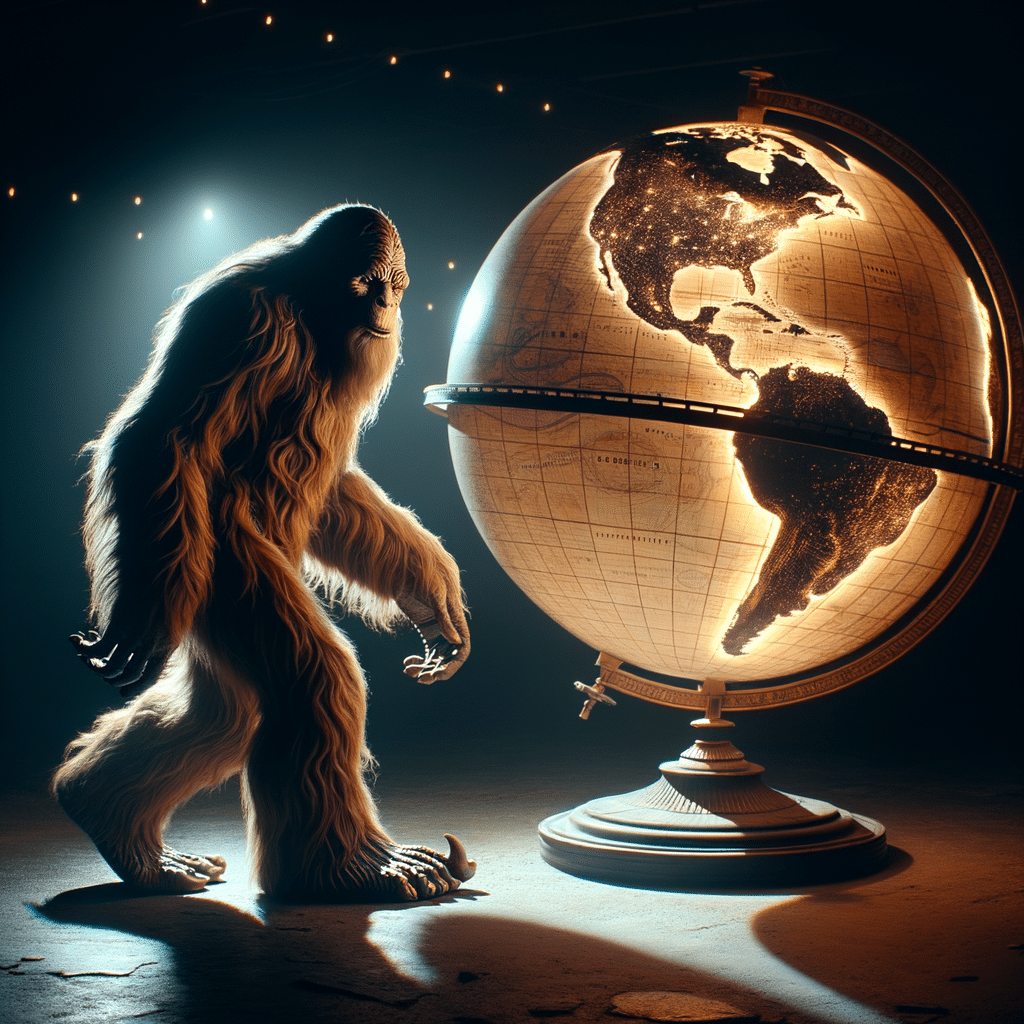
There is more to Bigfoot than just North America. This creature is seen all over the world!
Bigfoot creatures, which are also called hairy humanoids or wild men, have been fascinating people for hundreds of years. There are stories that these mysterious beings live in different parts of the world, and each culture has its own name and description for them. This essay will look at the different names for bigfoot creatures around the world. It will also talk about their unique traits and the cultural importance of these stories.
In North America, Bigfoot is known as Sasquatch in Canada and Bigfoot in the United States.

The word Sasquatch comes from the language of the Halkomelem people, who live in British Columbia’s Pacific Northwest region. Many pictures taken by eyewitnesses show this mysterious creature as being a large, bipedal primate with long arms and a thick coat of fur. Bigfoot is named after its distinctively oversized feet which leave unusually large prints when it walks through wooded areas. People have reported seeing these animals all over the USA and Canada in places like California, Oregon, Washington state, British Columbia, Alaska, New York and even Maine. Sightings usually occur in remote or rural parts of these locations which are densely forested and far away from civilization.
Many believers attribute the sightings to the existence of an undiscovered primate species, while skeptics argue that the sightings are the result of hoaxes, misidentifications, or folkloric exaggerations.
Native American tribes have passed down stories of this creature for generations, often describing it as a shy, nocturnal being that prefers to avoid human contact.
Most indigenous people have different tribal names for the creature. Known as the “wild woman of the woods,” Dzunukwa is a giant, hairy creature in the mythology of the Kwakwaka’wakw people, an Indigenous group from the Pacific Northwest coast of Canada. In the folklore of the Sierra Nevada region, the Washoe and Paiute tribes refer to a hairy, bipedal creature as “Omah” or “Oo-mah.” The Seminole people, native to Florida, have legends about the Skunk Ape, a large, foul-smelling, hairy creature that dwells in the swamps of the southeastern United States.
Yeti is in Nepal and Tibet.
The Yeti is a mysterious creature that has sparked the imagination of people for centuries. It is also called the “Abominable Snowman.” It is often described as a large, bipedal humanoid with white or gray fur that helps it blend in with its snowy environment. Reports of sightings date back hundreds of years, and local legends even tell stories of their supernatural power.
The Yeti has become an important part of Himalayan culture, featured in myths and folklore around the region. As such, many expeditions have been launched to try to uncover evidence about this mythical creature’s existence.

Yowie is a creature from Australia.
This primate like being is believed to be a large, bipedal ape-like creature with a thick coat of fur and a big head in the shape of a dome. It is said to live deep in the forests and remote areas of Australia, similar to North American Bigfoot and Sasquatch. Its strength is legendary, as it can supposedly lift heavy objects with ease. The footprints it leaves behind are distinct from those of other animals, allowing people to tell that something strange has been around.
Throughout Australian history there have been many reports by both native Australians and European settlers alike claiming they have seen or interacted with the Yowie themselves. Some describe it as being very friendly while others portray it as an aggressive beast that should not be approached without caution. Despite these accounts, most scientists remain skeptical about its existence due to lack of physical evidence or reliable sightings over time which would verify its presence once and for all.
The Almasty is in Russia and Central Asia.
This humanoid is a mysterious creature that has been reported in parts of Eastern Europe and Central Asia for centuries. It is generally described as being large, hairy, bipedal, with a hunched back and long arms. Additionally, it has distinctive facial features such as an unusually prominent brow ridge. Reports of sightings are common amongst shepherds, hunters, and other locals living in remote mountain regions where the Almasty is said to roam.
Some scientists believe that the Almasty could be related to Neanderthals or some unknown species of human due to its humanoid physical characteristics and behaviors observed by eyewitnesses. However, this hypothesis remains largely speculative as there have not been any specimens collected or DNA evidence discovered to confirm or deny these claims. Nevertheless, the legend of the Almasty continues to fascinate people around the world who remain curious about this elusive creature’s true origins.
Sumatra has the Orang Pendek.
This cryptid has been described as a bipedal creature that is covered in thick fur and is estimated to be between three and five feet tall. This creature is significantly smaller than other bigfoot-like creatures, yet it still shares many of the same characteristics like strong bodies. The locals and tourists who have seen this mysterious cryptid claim that it is very shy, so much so that when spotted by humans, it tends to run away into the dense forest nearby. Reports of sightings on Sumatra have been recorded for centuries now, with some believing this species could possibly be related to Homo floresiensis – an extinct species of hominin known as “hobbits”.
The Yeren is in China
This mysterious creature that has been the subject of many legends and stories in China for centuries. The most common description of the Yeren is that it is an ape-like humanoid with reddish-brown fur covering its entire body, standing at 6 to 8 feet tall. It has long arms and a sharp brow ridge, giving it an almost human look. Over the years, numerous expeditions have been organized to try and find evidence of this mythical beast in remote parts of Hubei province, where reports say it still exists today. Scientists are also studying the Yeren’s existence through various studies on DNA samples taken from supposed sightings or hair found in forests near reported encounters. While there doesn’t seem to be any concrete evidence yet proving that the Wild Man truly exists, people around Hubei continue to search for answers about this mysterious creature lurking in their woodlands.
The Batutut is a Bigfoot-like creature in the legends of several indigenous tribes in Vietnam and Malaysia, such as the Orang Asli and the Montagnard.
Brazil has the Mapinguari
The Mapinguari is a cryptid from Brazilian folklore, believed to dwell in the Amazon rainforest. Unlike other Bigfoot creatures, the Mapinguari is often described as a sloth-like being with a single eye and a large mouth on its stomach. Some theories suggest that the Mapinguari is based on a folk memory of the prehistoric ground sloth, which once inhabited the region.
The Woodwose is in the United Kingdom
The Woodwose is a legendary creature that has been described in medieval European folklore for centuries. It is believed to inhabit the forests and woodlands of the United Kingdom, having a hulking figure with wild hair and an unkempt beard. Symbolically, it has represented wild nature in heraldry and literature over many years as a representation of the untamed wilderness. Although sightings have become rarer in modern times compared to other bigfoot creatures, interest in this mystery remains strong within British culture and serves as evidence of humanity’s enduring fascination with nature’s mysteries.
The prevalence of Bigfoot-like creatures in various cultures and countries raises the question of why people see them all over the world. Several factors may contribute to these sightings.
The legends and stories of these creatures have been passed down through generations, creating a strong cultural belief in their existence. As a result, people may be more inclined to interpret unfamiliar or ambiguous sightings as evidence of these mythical beings.
In many cases, sightings of Bigfoot-like creatures can be attributed to misidentifications of known animals. Bears, large primates, or other native wildlife can easily be mistaken for a Bigfoot creature, especially when seen from a distance or in low-light conditions.
Human psychology plays a significant role in Bigfoot sightings. The power of suggestion and the desire for discovery can lead people to interpret ambiguous visual or auditory stimuli as evidence of a cryptid. Furthermore, the fear of the unknown can amplify these experiences, making the encounter seem more significant than it might have been.
Some reported sightings of Bigfoot-like creatures can be attributed to hoaxes, where people create false evidence or stage encounters for attention or personal gain. These hoaxes can then fuel further belief in the existence of these creatures and lead to more reported sightings.
Legends about bigfoot creatures all over the world show how people have always been interested in the unknown and mysterious. From the huge Sasquatch of North America to the small Orang Pendek of Sumatra, these mysterious creatures continue to pique our interest.




Leave a Reply