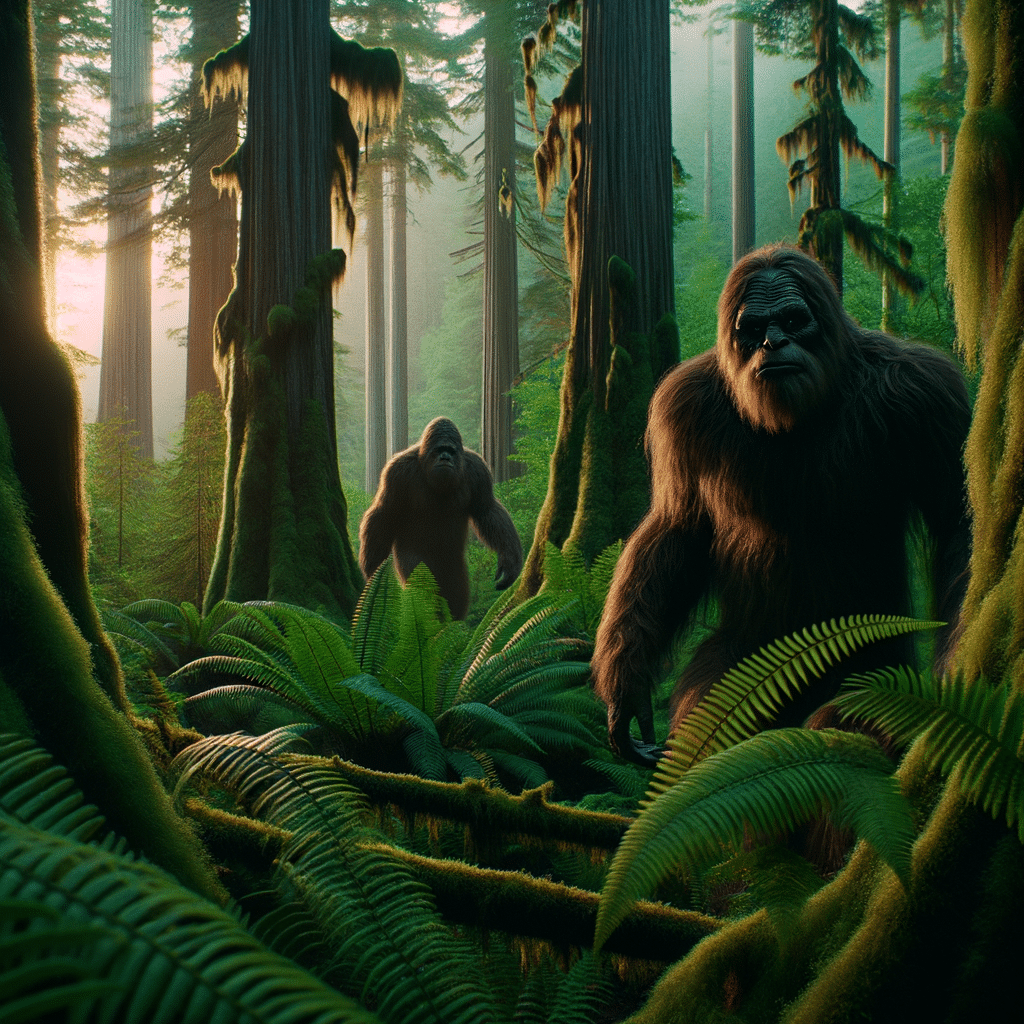
There are places in North America known as bigfoot hotspots where reports of sightings and interactions with the fabled creature, often referred to as the sasquatch, are common. Enthusiasts and researchers seeking evidence of Bigfoot’s existence have gravitated towards these areas, often characterized by thick forests, rough terrain, and secluded wildness. The scientific community, however, views these stories with serious suspicion and careful examination.
Pacific Northwest
Most people believe that the states of Washington, Oregon, and Northern California, in particular, are the core of bigfoot activity in the Pacific Northwest. This area’s great, pristine nature makes it the ideal home for a gigantic, secretive animal. Among the most well-known locations for bigfoot sightings are the isolated regions of the Olympic Peninsula and the thick woods of the Cascade Range. These reports frequently describe large, ape-like animals with human-like features, leaving behind vocalizations and footprints that both believers and skeptics find intriguing.
According to Daegling (2004), skeptics contend that the sightings are frequently the result of hoaxes, misidentifications of well-known animals, or psychological disorders such as pareidolia, which is the propensity to see recognizable patterns where none exist. Furthermore, it is difficult for researchers to get clear photographic or video proof in this area due to the dense forest and frequent severe rainfall. This frequently results in hazy or unclear material that feeds skepticism as well as belief.
In Canada, British Columbia is another important hotspot. Many reports of bigfoot sightings have come from coastal rainforests and hilly areas, such as Vancouver Island and the interior regions close to the Rocky Mountains. Native American legends and mythology from these regions have long mentioned big, hairy creatures that match Bigfoot descriptions in the present day, giving historical context to reports of sightings. According to experts such as Meldrum (2007), although anecdotal stories are fascinating, a crucial obstacle to scientific acceptance is still the absence of tangible data. Skeptics point out that intensive investigations have yielded no verified biological evidence, such as bones or DNA (Nickell, 2011). British Columbia’s rugged and vast terrain provides a likely home for this kind of animal, as well as a formidable obstacle to thorough research.

Appalachia
There is also a reputation for bigfoot activity in the Appalachian Mountains, which run from the southern United States up through the Northeast. Reports from hunters, hikers, and rural inhabitants are common in states like Pennsylvania, Ohio, and West Virginia. These places have huge cave systems and thick forests, which offer enough protection for a creature trying to stay under human radar. Many Appalachian regions are remote and have rough terrain, which adds to the attraction and mystery of these hotspots. However, detractors contend that the same isolation that draws Bigfoot fans to these regions also facilitates the spread of false information and hoaxes (Dennett, 1994). The Appalachian cultural background, rich in storytelling and folklore, may sustain the mythology.
Midwest
Bigfoot sightings have been common in the Midwest, particularly in the forests of Minnesota, Wisconsin, and Missouri’s Mark Twain National Forest. These regions provide a combination of secluded landscapes, wetlands, and deep forests that are typical of other Bigfoot hotspots. These places frequently report large footsteps, odd noises, and brief sightings of a tall, hairy figure. Skeptics frequently attribute these tales to mistaken wildlife or human activity. Schick and Vaughn (2010) explain many bigfoot sightings with known creatures, including bears, encountered in peculiar situations. The diverse terrain of the Midwest, which ranges from dense forests to wide plains, offers both chances for sightings and difficulties for confirmation.

Southwest
The Southwestern United States, particularly the hilly and forested areas of Arizona and New Mexico, have also been the scene of numerous Bigfoot claims. The Mogollon Rim in Arizona stands out as a particularly noteworthy spot, with several documented sightings over the years. The region’s diverse topography, which includes both pine woods and desert vistas, contributes to the fascination surrounding reports of Bigfoot sightings. According to experts, it would be challenging for a sizable, unknown monkey to stay concealed and support a breeding population in these environments (Krantz, 1992). The arid climate and scant vegetation in many areas of the Southwest, which would appear unsuitable for a huge creature, raise further doubts about the veracity of such accounts.
Bigfoot Deserts
Despite the abundance of documented sightings in places like the Pacific Northwest, certain parts of the United States, such as Hawaii and New York City, remain noticeably devoid of these experiences. We appropriately call these places “Bigfoot deserts,” and there could be several reasons for the lack of sightings there.
Bigfoot residence in Hawaii, an island paradise renowned for its tropical temperature and distinctive ecosystem, is difficult. Even though the beautiful volcanic landscapes and deep jungles are remote from the mainland, it seems doubtful that a terrestrial monster like Bigfoot could make it to the islands. Furthermore, because Hawaii’s environment developed independently, there aren’t many huge mammals there as prey or predators. This natural setting does not support the existence of a large, undiscovered species. Hawaii’s cultural narratives and folklore also emphasize other mythological creatures, like the Menehune, which sets them apart from the Bigfoot story on the mainland.
On the other hand, New York City’s urban environment is unsuitable for a creature like Bigfoot. The metropolis provides little in the way of natural habitat or cover due to its dense population, tall towers, and sprawling concrete layout. Given humans’ ongoing expansion and activity, there is very little chance for a massive, secretive species to remain unnoticed. Urban legends and international diversity characterize New York City’s cultural landscape. However, these tales usually center on urban phenomena, such as haunted buildings or notorious gangsters, rather than mythical wood creatures like cryptids.
In addition, there are sociological and cultural factors at play in Hawaii and New York City that contribute to the lack of Bigfoot sightings. Fewer legends about creatures not native to the islands may arise in Hawaii as a result of the emphasis on protecting indigenous culture and natural resources. However, traditional folklore may not be able to grow as it does in more rural areas due to New York City’s fast-paced lifestyle and emphasis on modern challenges.
The dearth of Bigfoot encounters in these regions further emphasizes how influential the local environment has been in creating local folklore. The idea of an elusive species is nevertheless tenable in areas like the deep forests of the Pacific Northwest, where wilderness is vast and largely unexplored. But the myth doesn’t really take off in places where the terrain is either remote or too populated.
Even though many people are still intrigued by Bigfoot, the fact that there haven’t been any sightings in locations like Hawaii or New York City highlights how geography and culture have an impact on how folklore spreads. These so-called “Bigfoot deserts” serve as a reminder that legendary animals are frequently products of their surroundings, with myths flourishing where imagination and the unknown collide.
Conclusion
Rocky and isolated terrain, which offers the privacy and home that could sustain an elusive species, generally distinguish Bigfoot hotspots in North America. These places continue to feed the mystery and curiosity surrounding the Bigfoot phenomenon, whether through eyewitness accounts, footprint discoveries, or vocalization recordings. However, the lack of reliable physical proof and the tenable refutations of scientists and skeptics raise doubts about Bigfoot’s existence. These hotspots attract both researchers and enthusiasts who are looking for conclusive evidence of the creature’s existence and want to learn more about one of North America’s longest-standing mysteries.
References
Buhs, J. B. (2009). Bigfoot: The Life and Times of a Legend. University of Chicago Press.
Coleman, L., & Clark, J. (1999). Cryptozoology A to Z: The Encyclopedia of Loch Monsters, Sasquatch, Chupacabras, and Other Authentic Mysteries of Nature. Simon & Schuster.
Daegling, D. J. (2004). Bigfoot Exposed: An Anthropologist Examines America’s Enduring Legend. Rowman & Littlefield Publishers.
Dennett, M. (1994). Bigfoot evidence: Are these tracks real. Skeptical Inquirer, 18(5), 498-508.
Krantz, G. S. (1992). Big Footprints: A Scientific Inquiry into the Reality of Sasquatch. Johnson Books.
Meldrum, J. (2007). Sasquatch: Legend Meets Science. Forge Books.
Nickell, J. (2011). Tracking the Man-Beasts: Sasquatch, Vampires, Zombies, and More. Prometheus Books.
Schick, T., & Vaughn, L. (2010). How to Think About Weird Things: Critical Thinking for a New Age (6th ed.). McGraw-Hill.


Leave a Reply