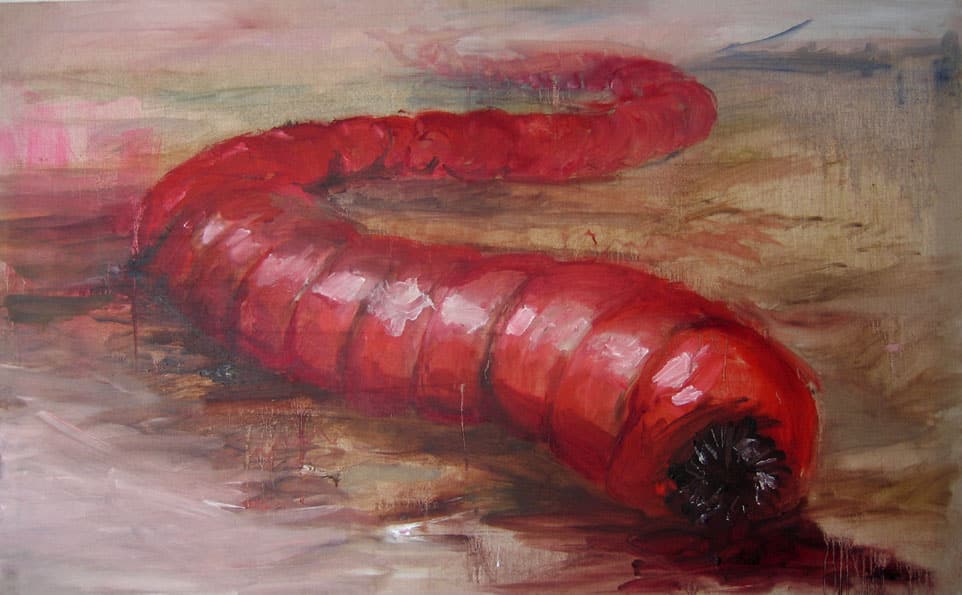
Many claim that there are deadly worms roaming the Gobi Desert in Mongolia. Legend has it that even Genghis Khan faced one of these creatures. This is the story of the Mongolian Death Worm.
The Mongolian Death Worm is a cryptid purported to reside in the harsh and expansive Gobi Desert. It has become one of the most enigmatic and terrifying creatures of Mongolian folklore, with tales of its lethality and mysterious nature circulating among the nomadic tribes and eventually reaching Western audiences. This creature, though feared and revered in equal measure, remains shrouded in mystery due to the lack of empirical evidence of its existence. It represents a perfect blend of natural wonders and supernatural legends, often bridging the gap between reality and mythology.
Description
While the Western world is relatively new to the Death Worm’s legend, it has been a longstanding subject in Mongolian culture, where the sands of the Gobi Desert whisper its name with both respect and dread. The creature is not just a simple animal in these stories but a force of nature, a guardian of the desert’s secrets, and a symbol of the untamed wilderness that defines much of Mongolia’s landscape.
Eyewitness accounts over the years have painted a consistent picture of the Death Worm. It is typically described as a sausage-like creature, with a smooth, blood-red body that reflects its toxic nature. The worm is said to be devoid of any visible eyes or a discernible mouth, its body ending in blunt rounded points. The very sands of the Gobi are believed to house this elusive creature, which purportedly burrows and moves beneath the surface, leaving little to no trace of its existence.
The worm’s alleged abilities are what make it particularly terrifying. It is said to be capable of spitting a corrosive yellow saliva that acts like a powerful acid, capable of instantly killing anything it touches. Furthermore, there are tales of the worm emitting deadly electrical discharges, enough to kill a fully grown person or camel, and strong enough to be felt through the ground. Such features, if real, would make the Mongolian Death Worm one of the most dangerous creatures on the planet.
The roots of the Mongolian Death Worm’s legend are deep and complex, intertwined with the cultural fabric of Mongolia.
History
The first written account of the Mongolian Death Worm dates back to the 13th century, when it was mentioned in the Mongolian epic poem, the Secret History of the Mongols. In the poem, the creature is described as a giant worm that is capable of killing a man with a single bite.
According to historical accounts, Genghis Khan, the renowned Mongolian emperor and founder of the Mongol Empire, is said to have encountered the Mongolian Death Worm.
While details surrounding this reported confrontation remain scarce, it is believed that Genghis Khan’s encounter with the Mongolian Death Worm occurred during his numerous military campaigns across Asia in the 13th century. The legendary ruler’s vast empire stretched from China to Europe, encompassing diverse landscapes ranging from deserts to mountains. It was within these varied terrains that he came face-to-face with this mysterious beast.
The earliest written mention in the West came in the 20th century, but local herders and nomads had been telling tales of the worm long before it piqued the interest of outsiders. These stories were often passed down orally, from generation to generation, serving as a grim warning to those who dared to venture alone into the Gobi.
The 1926 book On the Trail of Ancient Man by Roy Chapman Andrews brought tales of the creature to the attention of Westerners for the first time.
At a meeting of Mongolian officials, the American paleontologist recounted hearing rumors about the monster. “None of those present had ever seen the creature, but they all firmly believed in its existence and described it minutely,” he said.
Andrews wrote, “It is shaped like a sausage about two feet long, has no head nor leg and it is so poisonous that merely to touch it means instant death. It lives in the most desolate parts of the Gobi Desert.”
Modern Cryptid
Cryptozoologist Ivan Mackerle ventured into the Gobi Desert with a few friends in 1990 and 1992 in an attempt to find the worm. Mackerle built a motor-driven thumper and even utilized minor explosions to attempt and locate the huge fictitious sandworms that might be brought to the surface by rhythmic thumping, a concept inspired by Frank Herbert’s novel Dune. It did not find the cryptid.
Journalist Richard Freeman of the Centre for Fortean Zoology conducted an expedition in 2005 with the intention of finding the death worm, however he was unsuccessful. Freeman came to the conclusion that the reports of sightings of a worm with magical powers had to be false and that the worms were probably some kind of amphisbaena, or worm lizard.
The Death Worm was more than just a creature; it was a symbol of the inhospitable and unpredictable nature of the desert. It personified the dangers hidden in the seemingly endless dunes and served as a reminder of the respect one must have for the natural world. Over time, the tales of the Death Worm would evolve, with every encounter adding new layers to its mythology, making it a creature as complex and unpredictable as the Gobi itself.
Despite numerous expeditions and studies, scientific analysis has not been able to confirm the existence of the Mongolian Death Worm. The creature’s characteristics seem to defy biological categorization and its supposed abilities are often considered implausible. Skeptics suggest that the legend may have arisen from misidentified sightings of native wildlife, such as snakes or limbless lizards, which could be mythologized into something far more sinister.
Others suggest that the legend may be a metaphor for the harsh and unforgiving conditions of the Gobi Desert, where temperatures can reach over 120 degrees Fahrenheit during the summer months.
Cryptozoologists, on the other hand, continue to compare the Death Worm to other known creatures in an attempt to rationalize its existence. Some speculate that the worm could be a new species, perhaps related to the caecilians—legless, burrowing amphibians—though this group is not native to the Gobi. The possibility of the worm being a surviving specimen of a prehistoric species has also been entertained, though this too remains purely speculative.
Compared to other cryptids like Bigfoot or the Loch Ness Monster, the Mongolian Death Worm is generally less common in culture, although it is frequently mentioned in writing that critiques, draws inspiration from, or celebrates cryptozoology in general.
The legend of the Mongolian Death Worm has captured the imagination of people around the world and has been featured in numerous books, movies, and television shows. The creature has been the subject of several documentaries, including a 2010 episode of the television show Destination Truth. The Mongolian Death Worm has also made appearances in popular culture, including in the video game series Fallout and the comic book series Hellboy.
Many believe that science fiction author Frank Herbert may have been inspired by the Mongolian Death Worm when he wrote his novel Dune. The book features giant and deadly sand worms set in a desert environment.
The terrifying antagonists created for the Tremors film series, the Graboids, are frequently credited with drawing inspiration from the worm.
A creature known as the Purple Worm appears in official Dungeons and Dragons materials. It burrows underground like its counterpart and kills its prey with a strong poison.
The 2010 television movie Mongolian Death Worm debuted on the Syfy channel on May 8, 2010.
The Mongolian Death Worm is a remarkable example of the interplay between folklore and the natural world. It stands at the crossroads of science and mythology, challenging our understanding of what is possible in nature. The creature’s persistent presence in the collective consciousness—despite the absence of scientific proof—underscores our enduring fascination with the mysteries that remain undiscovered and the allure of the unexplained. It encapsulates the human desire to explore and understand the unknown, representing not just a potential undiscovered species but also the cultural heritage and storytelling traditions of Mongolia.
The Death Worm’s integration into popular culture is a testament to its captivating narrative. While it may never be found in the scientific sense, the Mongolian Death Worm has found a permanent habitat in the human imagination. It serves as a reminder that our planet still holds many secrets and that folklore often has the power to endure longer than the creatures that inspire it. Whether it is a real entity lurking beneath the Gobi sands or a powerful symbol crafted by the human psyche, the legend of the Mongolian Death Worm will likely continue to intrigue and inspire for generations to come.



Leave a Reply