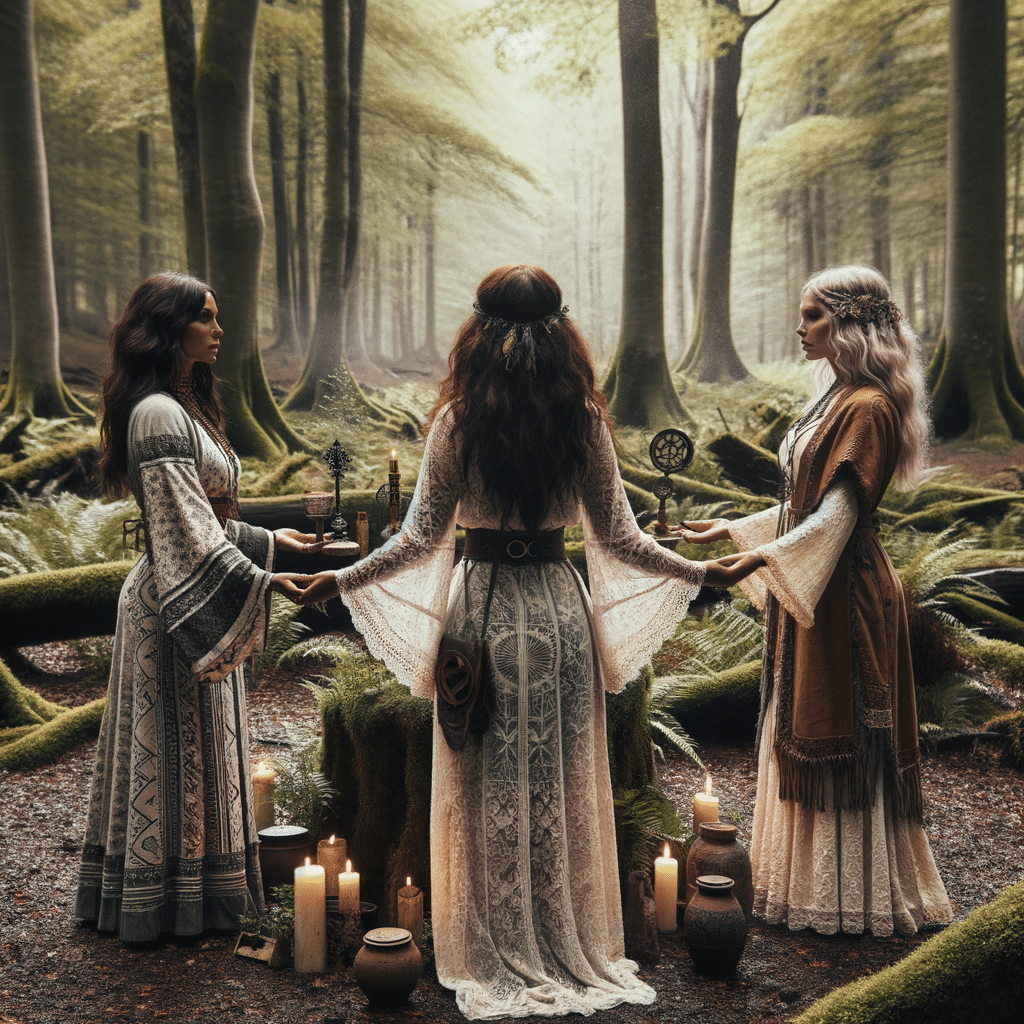
Often referred to as the father of Wicca, Gerald Brousseau Gardner played a key role in the modern resurgence of witchcraft and the formation of Wicca as an official religion. Gardner was born in 1884 into a prosperous family in Lancashire, England, which marked the beginning of his adventure into the world of the mystical. Having grown up in the mild climate of Madeira, Gardner became fascinated with the occult customs of the native people and devoted his free time to researching and recording their magical activities.
The seeds of Wicca were not sown until after Gardner’s retirement at the age of fifty-two, despite his early exposure to magical rituals. Gardner wrote A Goddess Arrives while in Cyprus, but his career took him back to England, where he joined the mysterious Rosicrucian Order Crotona Fellowship, which followed mystic doctrines. Gardner’s admission into the New Forest coven at the age of fifty-five was a turning point in his spiritual development. It was his belief that the coven had preserved pre-Christian magical practices that sparked the synthesis of many esoteric elements with the traditions of the New Forest coven, leading to the creation of Wicca. These elements included Aleister Crowley’s writings, ceremonial magic, and concepts from Freemasonry.
With an intense desire to spread his newly discovered religion, Gardner relocated to London in 1945 after the Witchcraft Act of 1736 was repealed. A growing following was attracted by his active contributions to witchcraft publications and the media’s obsession with his work. Gardner founded the coven in Bricket Wood, which served as a springboard for the initiation of High Priestesses. During the 1950s and 1960s, Wicca’s influence spread throughout Britain and subsequently to the United States and Australia. Gardner’s last major undertaking was his directorship of the Isle of Man’s Museum of Magic and Witchcraft, which he held until his death in 1964 at the age of 79.

The Role of Paganism in Wicca
Often regarded as the forerunner of contemporary Wicca, paganism is an ancient religion based on respect for the natural world, fertility, and harvest cycles. Its roots can be found in the Stone Age, and it can be found across the cultural mosaics of the Nordic countries, the Celtic regions (known as Druidism), Ancient Greece, Rome, and Egypt. Traditionally, pagans worshipped a pantheon of deities or the Earth itself. Many of their beliefs revolved around strong female archetypes, such as the Sacred Feminine, Mother Earth, and the Fertility Goddess. These beliefs were in direct opposition to the Church’s patriarchal teachings, which led to their demonization as heretics.
With the unifying goal of pursuing a spiritual living outside the boundaries of mainstream religion, paganism has served as a source of inspiration for a multitude of religions, spiritual communities, and cultural narratives throughout history. Our beloved books, movies, and folklore all carry on this lineage; stories of King Arthur, Norse mythology, Dungeons & Dragons, and even the epic storytelling of Game of Thrones all derived from prehistoric Pagan myths.
The Wide-Ranging History of Wicca
Wicca has many different roots; it was inspired by a wide range of sources, such as folklore, idealized portrayals of Druid and Pagan practices, and Western esoteric traditions like as Freemasonry, Thelema, Theosophy, and Spiritualism. Gerald Gardner is largely acknowledged for having played a key role in the public introduction of Wicca, yet the religion itself is a patchwork of influences, with a heterodox pedigree. As noted by religious studies expert Ethan Doyle White, Wicca initially came to the notice of the general public in the middle of the 20th century. It resonated especially with the American counterculture movements of the 1960s, providing a spiritual substitute for the dominant Christian religion.
Fundamentally, Wicca, like its Pagan forebears, supports the liberty of personal spiritual practice, unhindered by the inflexible rules of institutionalized religion. Wicca’s increasing popularity can be attributed in large part to its emphasis on individual autonomy and the rediscovery of ancient wisdom, which enable practitioners to create a spiritual path that is consistent with their core values and beliefs. Wicca is a sanctuary for individuals looking for a more personal and intimate relationship with the sacred, and it serves as a monument to the everlasting human longing for connection with the natural world and the divine feminine as it continues to evolve.
Further Reading
Gardner, G. B. (1954). Witchcraft Today. London: Rider and Company.
Gerald Gardner’s Witchcraft Today is a classic within the Wiccan community that provides readers with an insider’s look at the burgeoning practice of Wicca during its formative years. As a foundational text written by the man considered to be the father of modern Wicca, this book offers both historical context and personal insight, making it an invaluable resource for anyone interested in the origins and development of the Craft.
Valiente, D. (1973). An ABC of Witchcraft Past and Present. London: Robert Hale.
Doreen Valiente, known as the ‘mother of modern witchcraft,’ was a close associate of Gerald Gardner and a leading figure in the witchcraft revival. In An ABC of Witchcraft Past and Present, Valiente provides an extensive A-to-Z guide of witchcraft-related topics, from historical folklore to the practices at the time of writing. This book is selected for its comprehensive coverage and as a reflection of the evolution of Wicca through the eyes of one of its most influential practitioners.
Buckland, R. (1986). Buckland’s Complete Book of Witchcraft. St. Paul, MN: Llewellyn Publications.
Raymond Buckland was a protégé of Gerald Gardner and instrumental in bringing Wicca to the United States. Buckland’s Complete Book of Witchcraft is often referred to as Buckland’s Big Blue, and has served as a practical manual for thousands of individuals interested in learning about Wicca. This book is chosen for its practical approach to the Craft, providing exercises, rituals, and the historical background necessary for a well-rounded understanding of Wicca.


Leave a Reply