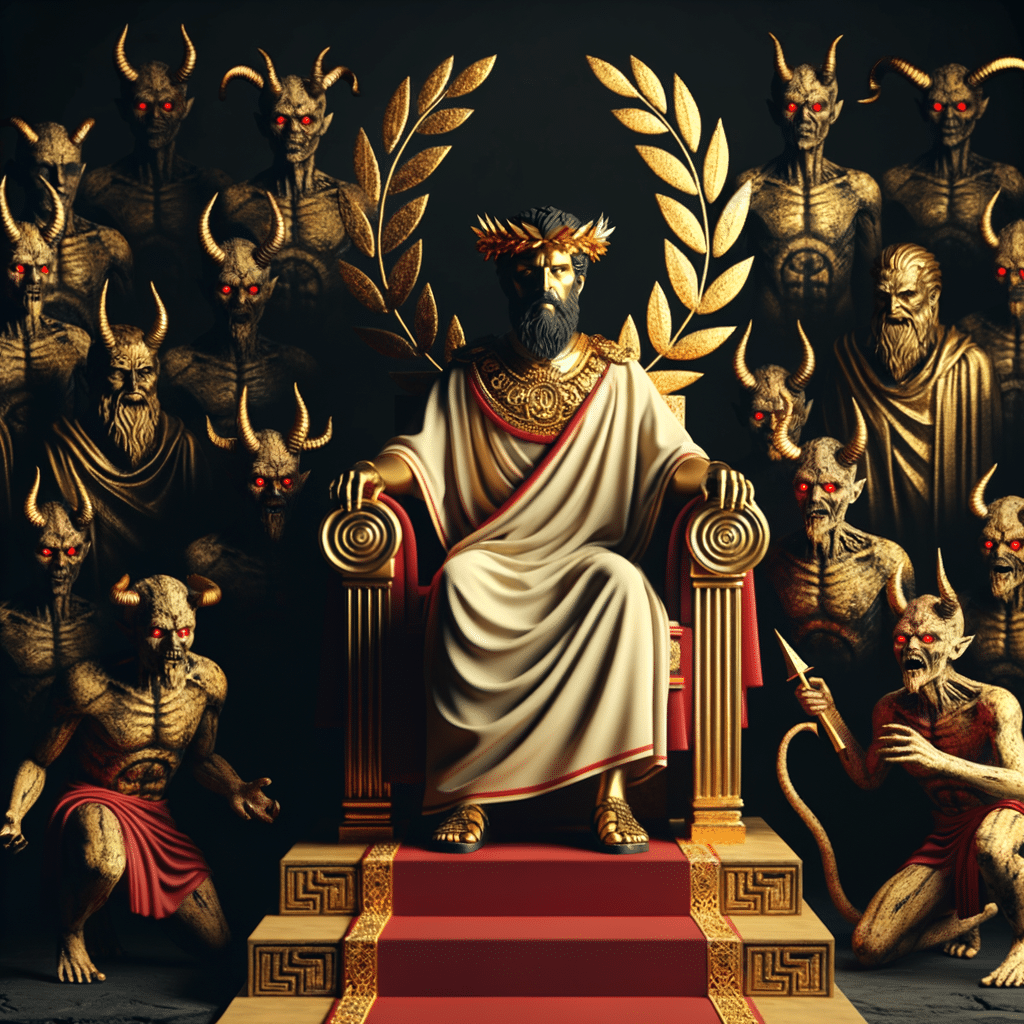
Since the Roman Emperor Nero passed away in 68 AD at the early age of 30, his death has fascinated both historians and conspiracy theorists. The official classification classifies Nero’s death as an assisted suicide. He forced his secretary, Epaphroditus, to kill him after he lost the will to carry out a planned suicide attempt. Nevertheless, rival explanations for his demise have emerged, perpetuating the myth of Nero Redivivus.

The Nero Redivivus Legend
History states that Nero took his own life when he realized his opponents would soon capture and execute him. However, the idea that this story might not be true has spawned a number of conspiracy theories. Brian Blount offers one such argument in his book Revelation: A Commentary, published in 2009. According to Blount, many believed Nero staged his own demise and fled to the east, where he carried on with his plans for a victorious comeback. According to a well-known idea, Nero actually died in 68 AD but would return to power at a later time with the help of Satan. This later theory lies at the heart of Nero Redivivus’ legend.
Early Christians, fearing a recurrence of Christian persecution under Nero’s rule, held many forms of the idea that Nero would rise from the dead. The Sibylline Oracles, a compilation of prophecies attributed to the Sibyls, contains the first documented description of this legend. This narrative claims that following his purported demise, Nero fled to Parthia, which is now northern Iran. There, he gathered an army of Parthian-respected Eastern warriors to aid him in his mission to demolish Rome upon his return. The narratives of other historians, like Tacitus, who brought up stories of Nero’s survival and possible comeback, reinforced this viewpoint.
The Sibylline Oracles portray Nero as a powerful man who will emerge from the east. This story draws on the larger Roman concerns regarding the Parthian Empire, a formidable foe that posed a serious danger to Roman hegemony. The vision of Nero commanding an Eastern army embodied fears of a terrible assault on Roman soil, which would have been especially scary for the Roman public and governing elite.
Augustine of Hippo, a Roman African philosopher whose writings had a major impact on Western Christianity, provides another important version. Augustine declared he would see Nero revealed in his own time and restored to his kingdom. Because of this claim, a large number of early Christians believed that Nero was the Antichrist, a representation of the height of evil who would return to wreak havoc. In her 1996 book The Origin of Satan, Elaine Pagels explores how early Christians equated Nero with the ultimate enemy, a reflection of their concerns about fresh persecution. Augustine’s writings shaped early Christian eschatology by establishing the notion that Nero was a villainous power that would return before the end of time.

Historical Impact
The fear of Nero’s return was more than just theoretical theology. It sparked multiple efforts at insurrection within the Roman Empire. At least three recognized imposters, claiming to be Nero, sparked unrest. During the administrations of Domitian, Titus, and Vitellius, these imposters first surfaced. The latter case demonstrated the significant influence of the Nero Redivivus tale on the political climate of the time, almost resulting in a conflict between the Parthians and the Romans. In The Great Fire of Rome (2010), Stephen Dando-Collins goes into detail about how these imposters took advantage of the general anxiety and unpredictability, causing major upheavals in Roman society. These imposters, who frequently claimed to have survived miraculously or to have received divine favor, were able to gather sizable followings and used the popular belief in Nero’s return as justification for their uprisings.
The legend surrounding Nero Redivivus did not cease with his early years of death. It endured for centuries, impacting both literary and popular culture. Even early Christian writings alluded to the idea of Nero’s return, occasionally portraying him as a figure of apocalyptic significance. For example, some academics interpret passages in the Book of Revelation as references to Nero and the fear of his return.
The Nero Redivivus legend’s enduring impact on subsequent historical and literary works is another indication of its durability. Suetonius emphasizes this belief’s persistence by relating stories of Nero’s possible reappearance in his history, The Lives of the Twelve Caesars. In a similar vein, Cassius Dio notes the persistent reports of Nero’s survival and the havoc they created in his Roman history. These historical documents show that the story of Nero’s return was a deeply ingrained myth that endured for many generations, rather than a passing fad.
Conclusion
This mythology reflects the complexity of Nero’s legacy. Some viewed him as a despot whose return would result in much more suffering. For others, especially those who had reaped the rewards of his patronage, he stood for a bygone era of prosperity. The legend’s enduring popularity underscores the profound rifts and uncertainties that beset the Roman world after Nero’s death, as well as the human predisposition to find solace and purpose in myths and predictions during difficult times.
The legend of Nero Redivivus serves as an example of how dread, prophecy, and political unrest interacted in ancient Rome. Although the official version of Nero’s death points to the tyrant’s ultimate downfall, the conspiracy theories and stories surrounding his purported reappearance capture the intense fear and turbulent atmosphere of the time. The mythology surrounding Nero’s homecoming and his death has always fascinated people, demonstrating the influence of his reign on early Christian theology and Roman history. This legend serves as a reminder of how potent narratives may form communal concerns and impact political landscapes long after the actual events have passed. It does this by combining historical events with apocalyptic visions.
References
Blount, B. K. (2009). Revelation: A Commentary. Westminster John Knox Press.
Dando-Collins, S. (2010). The Great Fire of Rome: The Fall of the Emperor Nero and His City. Hachette UK.
Pagels, E. (1996). The Origin of Satan: How Christians Demonized Jews, Pagans, and Heretics. Vintage.
Suetonius. (2007). The Lives of the Twelve Caesars (R. Graves, Trans.). Penguin Classics. (Original work published c. 121 AD)
Tacitus. (2008). The Annals: The Reigns of Tiberius, Claudius, and Nero (J. C. Yardley, Trans.). Oxford University Press. (Original work published c. 116 AD)



Leave a Reply